Twin strikers at Wigan Athletic — a trip down memory lane

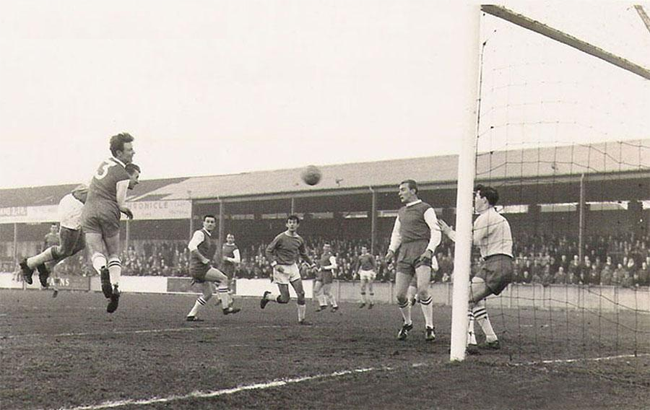
1964-65 : Wigan Athletic 3 Oswestry 0. Harry Lyon gets on to a Walter Stanley cross as Carl Davenport lurks menacingly. Allan Brown looks on from midfield (photo from Wigan World). 

In the late 1970s, my Dad and I would typically go out for a beer on Friday nights. We would rarely discuss things like politics or the weather, preferring to focus our conversations on Wigan Athletic’s progress in the Cheshire League. Among our discussions would be recollections of trips to watch Latics in exotic places like Stalybridge, Mossley and Oswestry. We lived in the south of Wigan, rugby league territory, so the pubs around us were steeped in that kind of nostalgia. One of those was ‘The Waterwheel’, run by ex-Great Britain rugby player, John Stopford. In his heyday in the early 1960s Stopford had been a lightning-fast winger for Swinton. Although he never played for Wigan RLFC, Stopford would draw rugby enthusiasts to his pub. We mostly avoided such places, preferring to walk further afield to pubs that were more salubrious for Wigan Athletic supporters.

One rainy night we succumbed, and tried ‘The Waterwheel’. Upon opening the door and the sight of the scrum surrounding the bar we started to think twice about it. There were some burly men there, faces like boxers, some with arms in slings. We were just about to walk out when my Dad said “Look it’s Harry Lyon over there.” It was indeed my hero from my teenage years. Chatting with Harry was easy. He just made you feel comfortable talking with him. Although he had left the club a decade before you could tell that Wigan Athletic was his first love. He said that it was a wonderful feeling running down the tunnel at the start of a game at Springfield Park, with some 3,000 people urging you on.

Harry Lyon was a great favourite with the fans, Wiganers not only appreciating his incredible goalscoring record, but also loving his commitment on the pitch. I asked him who was the best manager he had worked under – he had 5 during his time at the club from 1962-1968 — his reply was Allan Brown. Brown caused waves in the non-league world in 1964 when he took over at Wigan as player/manager, hiring a swath of full time professionals in a semi-professional league. After training, Brown would sometimes take his players to the town centre restaurant where my mother worked. I would be thrilled when she would bring home players’ autographs, usually written on the backs of serviettes.

Brown’s teams played an attacking 4-2-4 with the manager orchestrating from the centre of midfield. Carl Davenport was Lyon’s striking partner in Brown’s first year. Like Lyon he was an excellent header of the ball. I recall going to the Anchor Ground – aptly named at the time, a real quagmire of a pitch – to watch Latics play Darwen in a cup match. My Dad would recall for many years how Davenport had risen so high that his head was well over the height of the crossbar as he put the ball in the opponents net. Although Davenport was often referred to as an inside forward in those days, he was in reality a twin striker with Lyon. No teams found it easy to cope with the two of them. That season Harry Lyon scored 67 goals!

However, when I asked Harry who was the best striking partner he had played with he immediately retorted: Bert Llewellyn. Unlike Carl Davenport, Bert Llewellyn was only 5 feet 4 inches tall. A headed goal was a rarity, but after joining Latics in the summer of 1965, he scored 49 goals in 39 league appearances over the course of the season. Llewellyn was far from an elegant player, but was a natural goalscorer, sniffing around the penalty box for deflections, toe-poking and scrambling the ball into the back of the net. In his four years at Springfield Park, Llewellyn scored 140 goals in 185 appearances in all competitions. Remarkably, he outscored Lyon in his time at the club. Check out this wonderful article on This Northern Soul on Bert Llewellyn.

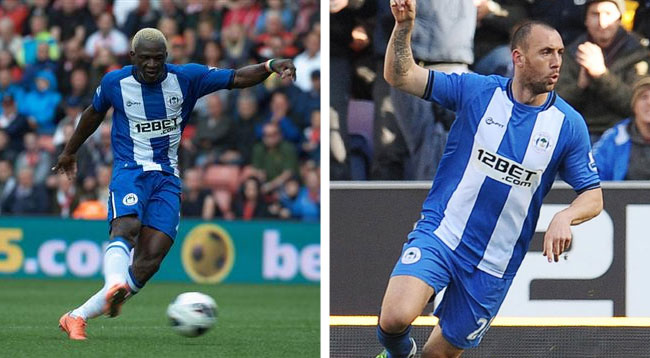
Since that era there have been lots of twin striking partnerships at Wigan Athletic. What a pity that wonderful pairing of Jason Roberts and Nathan Ellington was broken up when Latics reached the Premier League. How refreshing that Robert Martinez has adjusted his tactical system to play with two big strikers this season. The interplay between Arouna Kone and Franco Di Santo is a joy to watch. It is almost like turning back the clock.

We would love to hear from our readers – which has been your favourite striking partnership at Wigan Athletic?

Bradford preview: More for Mauro?

I have often thought that the League Cup is a waste of time. Shadow teams playing each other in empty stadia. What purpose does it really serve? However, in a disappointing season for Wigan Athletic up to this point it has been the League Cup matches that have been the highlight. We have seen two successive 4-1 away wins where the finishing has been lethal, an uncommon experience for Latics fans. Moreover the ties have also shown that the club has considerable strength in depth, with ‘fringe’ players putting in excellent performances.

Will the finishing in the game against Bradford City tonight once again be of that order? Leading the charge, with three goals already in the competition, will be the excellent Mauro Boselli. Boselli is well on the way to proving his doubters wrong. It has been all too easy for the cynics to knock him. All kinds of misleading statistics have been thrown his way. Recently I even heard a football commentator on television say that Boselli had not scored a Premier League goal in three years at Wigan. It is not unusual for such people to put Wigan Athletic down, with their condescending attitudes towards the club. However, this recent comment was palpably unfair. Boselli started only five times in the first part of the 2010-2011 season before going off to Genoa and Estudiantes on loan. He has not started for Wigan in the Premier League since returning in July.

At Estudiantes, prior to joining Wigan, Boselli had scored 22 goals in 29 league starts in 2009-10 and 10 in 23 league starts in 2008-09. Impressive stats when playing for a relatively small club in a league with tight defences. He was the leading goalscorer in whole of the Copa Libertadores competition in 2008-09, helping his team lift the trophy with the match winner in the final against Cruzeiro. Since his return to Wigan he has been carefully nurtured by Roberto Martinez, being limited to three brief  substitute appearances in the Premier League. However, the snippets we have seen of Boselli’s finishing for Latics League Cup and Under 21 teams have shown us how he scored so many goals in tough and competitive competitions in South America. We may well see that tonight.

Prior to cup ties Roberto Martinez typically reiterates that they are an opportunity for the fringe players to break into the first choice lineup. However, he was careful to provide a backbone of experienced first choice players in defence for the wins at Forest and West Ham. Tonight he is likely to play both Roman Golobart and Adrian Lopez in the back three. They come from the opposite sides of Spain and have contrasting styles.

Roman Golobart – a Catalan from Barcelona in the east of Spain – is a big, powerful central defender, nevertheless with good passing ability. Golobart joined the club from Espanyol as a 17 year old in August 2009. Last season he had a successful loan spell at Inverness, being voted fans’ player of the year. Playing under the influence of manager Terry Butcher, ex-England centre half, will surely have helped his game. Still only 20 he is an excellent prospect.

Adrian Lopez –from the province of Coruña in Galicia, north west Spain – signed for Wigan in December 2010 from local team Deportivo La Coruña, as a free agent after a heated dispute over his contractual situation. In the previous three years he had played 26 matches for Deportivo, scoring one goal. In Spain he was known under his nickname ‘Piscu’ to distinguish him from the other Adrian Lopez ,a forward who plays for Atletico Madrid. Now 25 years old, Piscu has had 6 starts since joining Wigan. According to the Wigan Athletic club website, Lopez “ brings cultured development to Latics’ back line”. Clearly a different type of player to the more muscular Golobart. Lopez has struggled with the physicality of the Premier League, but Martinez retains confidence in the player.

Other likely starters for the match are Callum McManaman, Ronnie Stam, Fraser Fyvie, David Jones and Jordi Gomez. There are doubts over the fitness of Ryo Miyaichi. Albert Crusat remains out injured. Martinez may once again opt to put in some of his first choice players, although maybe fewer  than in the previous League Cup games with the away match at Tottenham coming up at the weekend.

Although tonight’s match is at the DW Stadium it might seem more like a home game for Bradford City, who have sold all of their 5,000 ticket allocation. Bradford are currently in 5th place in League Two, but have the highest average attendance in the division at just below 10,000.

Prediction: at least one goal from Mauro Boselli and a win for Wigan Athletic.

Wigan Athletic vs. West Ham: Diame returns with Big Sam’s bruisers

Misfiring Wigan Athletic face newly promoted West Ham at the DW Stadium on Saturday. West Ham have made a good start to the season, currently in 8th place with 14 points. Despite their poor results Wigan are placed just above the bottom three with 5 points from 8 games. However, another adverse result is likely to push them down into that psychologically daunting relegation zone.

The last time the teams met in a Premier League fixture at the DW Stadium was on May 15th of 2011, when a thrilling fight back from the home side condemned West Ham to relegation after six years in the top flight. West Ham had been 2-0 up at half time and relegation looked a certainty for Wigan. The players who scored the goals for Wigan that day – Charles N’Zogbia and Conor Sammon – have since moved on. West Ham’s current XI is unrecognizable from the team that played that day, Sam Allardyce having since brought in a swath of new players. Wigan retain seven of that starting lineup, one notable absentee being Mohamed Diame who now plays for West Ham.

The teams have met six times at the DW Stadium in the Premier League, ending in three wins apiece. Latics beat West Ham 4-1 in a League Cup encounter at the Boleyn Ground a month ago, but Hammers supporters would tell you that their team was largely composed of fringe players. There will be few surprises in their style of play and you can expect long balls to be played forward for Andy Carroll, with the dangerous Kevin Nolan sniffing around the box for rebounds. Nolan has already scored four league goals this season. Once again Wigan will have to be prepared to resist a physical barrage. In their win at QPR, the Hammers committed 22 fouls and received 8 yellow cards.

Given the potential aerial threat from Andy Carroll, Roberto Martinez might be tempted to bring back Antolin Alcaraz in central defence. Ivan Ramis has done well since his unfortunate debut against Chelsea, but Alcaraz’s ability in the air and his understanding with Gary Caldwell make him a strong contender if fit. Another possibility is that Maynor Figueroa will be rested, with Ramis moving across top the left. Figueroa has played non-stop for the past year, having spent the summer playing for Honduras in the Olympics.

Despite the poor results this season Roberto Martinez is once again likely to keep faith in his trusted first team regulars. One of the criticisms leveled at Wigan teams in the Martinez era has been that they pay too much respect to the opposition. The flawed tactic of playing deep in defence against Swansea allowed the opponents to get away with their defensive deficiencies, which Latics only started to expose when they were two goals down. The substitutions came too late and were largely uninspiring. Bringing on Jordi Gomez at a time when urgency was required was unfortunate. The effect was to slow down play and have the ball retreat back into the Wigan half. Mauro Boselli clearly deserved an opportunity, after banging in goals regularly in cup games and for the under 21 team, but bringing him on 7 minutes from the end was not ideal. Franco Di Santo has played some good stuff this season, but was not on top of his game at Swansea. He could have been replaced at least 10 minutes earlier. However, the introduction of Ben Watson into a holding role in front of the defence allowed greater freedom to James McArthur and James McCarthy to play further forward and create opportunities. A definite option for future substitutions.

One could say that Wigan Athletic have been unlucky so far this season. Refereeing decisions have not gone their way and they have not played as badly as their record suggests. Critics would say that you create your own luck and have to go into a match with a positive attitude and really “get at” the opposition. Let’s hope that Martinez resists the temptation of putting Jordi Gomez into a forward role and plays with three upfront. That would likely be his preferred formation of Di Santo, Kone and Maloney. Boselli, Miyaichi or McManaman might enter the fray at some point.

Given an attacking lineup and assertive approach this game is definitely winnable. Prediction: a win for Wigan Athletic.

A history of Scotsmen and the settling in period at Wigan Athletic

As a kid I often used to walk to school with my mother via her place of work in Wigan’s town centre. Typically, as we walked along we would chat and this would result in heads turning. My mother was a southerner and her accent stood out like a sore thumb. “Wur ya from luv?” was not an uncommon question for her to respond to. After being evacuated from the London blitz she had married a Wiganer who would not entertain living anywhere else but his hometown. It was a culture shock for her. She would recount stories of not understanding a word people said to her and how Wiganers could be so uncomfortably direct in conversation. Wigan was a pretty depressed town in those days, heavily polluted and with one of the lowest average household incomes in the country. Times have changed for the better. After the initial shock, my mother grew to love the town and its people, many of whom did not have easy lives. She understood that Wiganers were proud people with warm hearts.

My first experience of culture shock was arriving in Scotland, where I was to go to college. It was difficult enough to understand what people were saying to you, let alone walk around poorly-lit city streets where the English weren’t the most popular. I missed my trips to Springfield Park with my Dad, who would nevertheless do his best to keep me up to date on Latics progress at the time. I would call him up after he had been to watch a match for him to give me his commentary. It was usually fairly brief, laced with his habitual comment that the referee was the worst he had ever seen in his life. Did referees ever like Wigan Athletic one wonders?

Ian McNeill was not only one of my favourite Wigan Athletic managers, but also a Scot. He had been manager of Ross County and clearly retained good connections with his home country. When he first arrived – launching Wigan Athletic into the newly formed Northern Premier League in 1968 — he brought a posse of his countrymen. “Why do we need these Scotsmen? What’s wrong with our local lads” was a common refrain from some fans at the time. I enjoyed Scottish football, regularly watching the two Dundee teams in my time north of the border, and welcomed the acquisition of the Scots. There were the skilful wingers – Davy Breen and Jim Savage – plus the stylish Benny Cairney as a striker. There was also the lanky centre half, Doug Coutts, and that wonderful left back, Billy Sutherland: he of strong tackles and thunderous shots. But my favourite was Jim Fleming, a really skllful and intelligent forward who probably created as many goals as he scored. I often wondered why he would leave Hearts to take up a role as a part-time footballer at an English non-league club, together with a low key job at the Heinz factory. In those days the Scottish League produced more “ball players” than in England, with the ball less in the air and more at the feet. The” Nine in a row” Celtic team that produced the 5 foot 2 inch magician known as Jimmy Johnstone were the prime example.

Culture shock and Scotsmen remain very relevant to Wigan Athletic in modern day. The team that lined up at Swansea last week included four Scots (counting James McCarthy for the sake of argument), two South Americans, one Central American, one Spaniard, one African, one Omani (Oman is actually in Africa, but belongs to the Asian Confederation) and one English-raised player who represents Barbados. In McNeill’s early days the Scots were the minority in the team which was made up mainly of English players. Nowadays the Scots are the mainstay of the current multicultural mish-mash that represents Wigan Athletic. Like Ian McNeill, Roberto Martinez and Graeme Jones retain links with Scotland where they both played.

Not one of the current Wigan Athletic squad has played for any continuous period of time for a top Premier League club, before arriving at the club. Some might say the that Latics squad lack that genuine belief that players acquire after playing at such levels. The current bookmakers odds favour Queens Park Rangers to stay up despite their poor start, factoring in the presence of previously proven top level players in their ranks: Wright-Phillips, Zamora, Park to name but a few. Wigan do have Gary Caldwell and Shaun Maloney, winners of multiple championships in Scotland when with Celtic, but does that give them the kind of belief necessary for the Premier League?

Roberto Martinez’s task is always difficult. Because of the club’s salary cap he has to bring in players from outside England – Scotland, Latin America and Spain mainly. Even the Scots have a culture shock when arriving: probably not so much to the local culture, but more to that of the Premier League with its relentless physical and mental challenges. Gary Caldwell had spent some time at Newcastle before joining Celtic and he stepped right into the first team after his arrival. However, the other three – James McCarthy, James McArthur and Shaun Maloney were given a period of months before being thrust into regular first team action.

The double culture shock for players arriving from overseas can be daunting. Some like Di Santo and Beausejour had already been through that with their previous English clubs, Chelsea and Birmingham. Others came from Europe, where the culture is more similar than other far-flung parts of the world. But imagine Maynor Figueroa coming from Honduras, a developing nation in Central America. He was sensibly given time to settle in, having been signed in January 2008, but making an excellent debut as a starter– against Manchester United and Cristiano Ronaldo — in April of that year. Poor old Mauro Boselli, who had never played for a club outside Argentina, was thrust in immediately in August 2010. The end result was that he failed to make that cultural adjustment that was needed. Fortunately Boselli is back at Wigan, some two years later, biding his time to get into the starting lineup and scoring goals galore in cup and reserve fixtures in the mean time.

It looks like Scottish summer signing Fraser Fyvie is going to be given a significant settling in period before being considered for the first team. This despite the fact that he was a regular in the Aberdeen lineup from a tender age. Looking at other players who have been through the same process it appears the right thing to do. Sometimes the needs of the club force the manager into playing new recruits from the get go. It is not ideal, but some players rise to that challenge. Others unfortunately can’t make the adjustment so easily. The double culture shock is significant and should not be underrated.

Moving up a tier? Wigan and the Premier League financial league table

Over the years, Wigan Athletic have delivered performances ranging from the majestic to the downright nightmarish — none more so than the 2010 season opener against Blackpool. A 4-0 home defeat to anyone would have been bad enough, but to a team who the pundits had already condemned to relegation even before a ball was kicked? It was to prove a difficult season for Latics, only securing safety on the final game of the season. It also went down to the final game for Blackpool, who put up an amazing fight before eventually succumbing to Manchester United.

An old Bob Dylan song reminds us that “Money doesn’t talk, it swears.” The primary reason the pundits had tipped Blackpool for relegation that year was the perception that they did not have enough players of Premier League quality. Their Chairman, Karl Oyston, was not willing to splash money around like confetti and put the club at risk of insolvency. Blackpool’s salary bill that season amounted to just £14 million. Wigan’s was almost £40 million. During that 2010-11 season Blackpool were to do the home and away double over a team with a salary bill almost 10 times that of their own. That was Liverpool, at £135 million.

In the end Blackpool couldn’t quite avoid that relegation trap-door in the jungle of the Premier League, where clubs regularly make huge losses in an effort to keep up with the Joneses. You could say Blackpool got it right. Their salaries amounted to only around 25% of their income – compared with the league average of around 69% – and this helped them gain a positive cashflow for the season. They continue to be run on a sound financial basis in the Championship. Manchester City actually spent more on salaries than the revenues they had coming in, and even Aston Villa were leaking 92% of their revenue on salaries. No wonder Villa have since cut back, putting the emphasis on youth rather than established big-earners. It could be argued, however, that they have gone too far as the lack of quality and experience in this year’s squad makes them candidates for relegation.

Statistics show that the Premier League is financially tiered. In the 2010-2011 season club salary levels published by the Daily Telegraph ranged from £14 million to an absurd £190 million. The top three clubs in the table paid in the £150-£190m range. The teams finishing 4th and 6th paid in the £120-150m range, Tottenham bucking the trend by finishing 5th on a budget of “only” £91m. Fulham and Everton, with budgets around £58m managed to finish ahead of Aston Villa, who spent £84m on salaries. Then followed a clump of clubs paying between £40 and £60m, which included West Ham who were to be relegated despite a wage bill of £56m. Wigan Athletic, Wolves and West Bromwich had salary totals between £37 and £40 million, with only Blackpool below. It would be interesting to see salary levels for the current season, when these become available.

According to the Guardian “ The Premier League’s 20 clubs collectively made a loss of £361m last year, after spending all of their record £2.3bn income. Of the clubs which were in the Premier League in 2010-11, the year of most clubs’ latest published accounts, eight made a profit, of £97.4m in total.”  Dave Whelan wrote off Latics debts for £48m in August 2011. He advocated financial fair play to ensure that debt is maintained at “reasonable and sustainable levels”.

According to Alan Switzer,  of accounting group Deloitte, clubs with salary to revenue ratios of 70% and above are not likely to make a profit. He suggests that levels should go down to the low 60s. In 2010-11, Wigan Athletic were around the 80% level, according to the Daily Telegraph stats, which indicates a negative cashflow of £0.1 m.

The Daily Telegraph statistics show a clear correlation between salary levels and success on the field, although there are some exceptions. So how does a team stay afloat in a tiered Premier League? Do Wigan Athletic have to significantly increase salary levels in order to move up a tier in the league table? Would doing so make them financially less stable?

Last season both Mohamed Diame and Hugo Rodallega left at the ends of their contracts. A rough estimate might suggest that Wigan Athletic lost maybe £10 million in potential transfer money for the two. Whelan rightly insists that Wigan Athletic keep a lid on their salary payments so it is unlikely that either player was given an offer he could not refuse to stay on at the club. This season we have Franco Di Santo and Maynor Figueroa in their final year of contract. Both are key players. Figueroa has developed into an excellent left of centre defender in Martinez’ tactical system. He could prove costly to replace. Di Santo has now added goal poaching to his repertoire and could be worth in the region of £20 million on the open market if he continues to improve at this rate. When Roberto Martinez took over at the club various higher wage earners were sent packing to bring down the wage bill. He is now facing a dilemma in how to keep his top players from leaving at the ends of their contracts, given the total salary cap imposed by his chairman.

Given the factors above, is it possible for Wigan Athletic to consistently reach a mid-table position? Could they defy the stats on an annual basis, keeping a nucleus of good players, allowing a couple of stars to go for premium transfer fees each summer? In this way, the budget could be balanced. The first step would be to already have the replacements for the stars ready and in place. The second would be  to find a way to offer top players longer contracts at competitive rates, whilst maintaining a reasonable total salary cap. Food for thought for Bob and Dave.