Rebuilding on free transfers


Caldwell will be checking out the availability of good players at the ends of their contracts.

Caldwell will be checking out the availability of good players at the ends of their contracts.

On this same day two years ago, Wigan Athletic were suffering from the pain of relegation from the Premier League. Six players from the senior squad had already found other clubs after being freed from their contracts. Speculation was mounting about the futures of others whose contracts had run down and when the big clubs would come in and snatch prized assets still remaining.

Owen Coyle had been appointed manager just ten days before with the brief of getting Latics back into the Premier League. Given the prospect of more players leaving, plus the necessity for a large squad because of Europa league involvement, Coyle clearly had a lot of recruiting to do. However, he was to resist going for big money transfers, instead relying on picking up players at the ends of their contracts or those available at discount prices.

On June 27th he made his first signing, Chris McCann from Burnley. The next day he picked up Stephen Crainey from Blackpool, then three days later Thomas Rogne from Celtic. All were on free transfers. During the month of July he was to pick up two more free transfers in Marc-Antoine Fortune and Juan Carlos Garcia, paying transfer fees for Scott Carson, Grant Holt and James Perch. With the new season approaching he paid transfer fees for Leon Barnett and James McClean. However, the total transfer fees paid by Coyle were modest compared with the incoming funds from the sales of James McCarthy and Arouna Kone.

By the start of the season Coyle had signed ten players, five on free transfers and five more for relatively modest transfer fees. In early September he was to sign Nick Powell and Ryan Shotton on loan.

Gary Caldwell too is currently facing a challenge putting together a squad that can challenge for promotion, albeit from League 1. Following a similar timeline to that of Coyle in his early days, he has  signed three players, all on free transfers. He has also been linked to signing players whose contracts have terminated, but whose clubs will be due some compensation as a consequence of their youth. John McGinn (20) of St Mirren and Max Power (21) of Tranmere Rovers , despite their youth, are experienced midfield players. They could prove to be valuable long term acquisitions, should Caldwell manage to acquire their services.

Caldwell has already managed to bring in probably around £2m in transfer fees through the outgoings of Scott Carson, Rob Kiernan and James McClean. He will gain more in his coffers as soon as James Perch is sold off. Reports suggest that he made bids for Sam Clucas of Chesterfield, but the competition from other clubs has driven the player’s value up beyond that Latics should pay. For the moment he will concentrate on finding clubs for the highest wage earners, meanwhile scouring the market for young, up-and-coming talent.  The likelihood is that he will be stuck with a significant number of players that he would have liked to move on, simply because no other club is willing to offer them the kinds of deals they seek.

Coyle has been criticized for his signings, particularly those of Holt and Fortune, who were both 32 at the time. Although he did not pay a huge transfer fee for Holt, offering him a three year contact became an issue. On the other hand, it was remarkable that given the limited time he had available, he put together a squad good enough to challenge for promotion.

Coyle’s problem was always going to be one of melding together two disparate groups, the ex-Martinez players from the Premier League, together with his mish-mash of ex-top  flight players and proven players from lower divisions.  But more than anything else with Coyle it was the lack of a defined style of play that crippled his teams. Too often the long ball would prevail, anathema to the Martinez disciples. It was to prove his undoing.

Caldwell has already clearly enunciated the style of play he expects. Players may be coming in from other clubs where the long ball has been the norm, but they will be required to play in the style the manager requires. Clubs have already shown that they can get out of League 1 playing good football, even if the majority rely on more traditional methods.

Up to this point one could say that Latics’ signings so far have been somewhat underwhelming, but these are early days. Like Coyle, Caldwell will pay fees for potentially key players, providing he can stay within his budget.

Not only does Caldwell face a challenge in signing a sufficient number of the “right kinds” of players, but he faces a bigger challenge in helping them gel into a functional unit. The training camps over the next month or so are likely to see a changing spectrum of different faces as players come and go. With so many players to move on, and so many to bring in, it is unlikely that the camps will be able to provide the “gelling” that they are primarily aimed to produce. Caldwell will have to deal with players who want to move on, but cannot, and their effect on morale. Not an easy prospect.

Given the sheer number of players that Caldwell is going to need to bring in and his budgetary constraints it is likely that more free transfer men will be brought in. However, one recalls the fine form of Chris McCann until he fractured his kneecap in the FA Cup win at the Etihad. Good players sometimes let their contracts run down in the hope of finding something more lucrative, as did Antolin Alcaraz, Franco Di Santo and Maynor Figueroa a couple of years ago.

It appears that Max Power is now on the verge of signing and Oriol Riera is staying with Deportivo. Press reports from Spain about the Riera transfer saga have been plentiful, but the figure for the fee has varied according to the source. The bottom line is that Latics will take a significant loss in terms of transfer fee originally paid and that to be gained in the coming days. Significantly Andy Delort did not show up for training, suggesting he is heading for new pastures, once again at a major financial deficit.

As July approaches the transfer activity is going to hot up. The sooner he can get all his squad in place, the better it will be for Caldwell. Players coming from other clubs will have to adapt to the style of football the Scot will dictate and the process will take time, as will the process of gelling as a team.

The advantage is that this time around the players will know what is expected of them, as they fit into a well-defined style of play.

One can only reflect on where Latics would be now if that had happened just a couple of years earlier.

Negotiating for Riera


Oriol Riera

Oriol Riera

The ongoing saga over Oriol Riera’s transfer to Deportivo La Coruña continues.

According to the Spanish media, the Deportivo coach Víctor Sánchez del Amo was pleased with Riera’s performances during the loan spell that started in January. The 28 year old Catalan made 21 appearances, scoring four goals as Deportivo managed to avoid relegation from La Liga. They eventually finished in 16th place. Sánchez del Amo is keen to finalise his squad before training resumes on July 2nd.

Reports suggest that Riera and Deportivo have agreed terms, but the clubs have still not agreed the transfer fee for the player whose contract at Wigan runs to 2017. Two other La Liga clubs, Granada CF and Levante, are also reported to be interested in the player, but he has made it clear that Deportivo is his preference.

Latics reportedly paid Osasuna  €3m for Riera last summer and are keen to cut their losses by asking €2.5m. Deportivo have offered €2m.

The heyday of the Galician club has clearly passed. Despite the population of the city being only around 200,000 they were competing with Barcelona and Real Madrid, just over ten years ago. They won La Liga in 1999-00 with a star studded team including Diego Tristan, Djalminha, Roy Makaay and Mauro Silva. In fact from 1992–93 to 2003–04, apart from their title win, they finished in second place four times, and another four times in third place. They competed in the Champions League for five consecutive years, being defeated by Mourinho’s Porto in  the semi-final of 2004.

Their period in the top flight came to an end in 2011, but they went back up the following season only to be relegated again in 2013. However, they once again bounced back to the top flight the following season.

Deportivo are clearly not in a position to splash the cash as they might have done in their heyday. Neither will Latics be keen to take a significant loss on their original outlay. Although some reports suggest that the talks have stalled it is in the interests of both clubs to reach an agreement.

Latics have clearly made a decision not to try to persuade Riera to return to Wigan, where his salary would be out of tune with most of his League 1 teammates. They will probably have to settle to a figure closer to what Deportivo have been offering.

Neither are Granada CF nor Levante likely to want to pay too much for Riera. Levante are the poor relations in the city of Valencia, their last contact with Latics being in Arouna Kone’s transfer in 2012. The Granada franchise is owned by Giampaolo Posso, who also owns Udinese and Watford. His usual mode of operation is in using a superb scouting network across the world to buy young, up and coming players, turning them into stars, then selling sell them for a good profit.

The likelihood is that Riera will be staying in Spain, most probably in Galicia.


Keeping your key asset

Emyr Huws

Emyr Huws

With less than a week to go to the first training session of the new season the summer sell off at Wigan Athletic is starting to gather momentum. Scott Carson has already gone to Derby and it looks like James McClean is off to West Bromwich and Rob Kiernan to Rangers. The latest rumour is that James Perch will be joining McClean and Callum McManaman at West Bromwich.

The demand for ex-Premier League players like Carson, McClean and Perch was always going to be there. They were to be the three most likely to attract transfer income  for the club, as meanwhile it will ease its wage bill by some £20,000 per week or more for each of them. Keeping the three of them would have entailed using up around £3 m of an anticipated wage bill of £8- £10 m.

Behind them in the domestic transfer pecking order come Leon Barnett (29 years old), Don Cowie (32), Chris McCann (27) and Andrew Taylor (28) who have played in the Premier League, but are also experienced Championship division campaigners. Although their potential transfer values may not be high, the club will try to move on most of them, given their Championship-level salaries. Transfer fees will be waived as necessary.

The pairing of Andy Delort and Oriol Riera cost a total of around £5m in transfer fees last year. Sadly Delort was not able to regain his old goalscoring form after rejoining Tours on loan in January. He hit the back of the net only twice in fourteen starts. Reports from the French press suggest that there are Ligue 1 and Ligue 2 clubs interested in him, but it is doubtful whether they would be willing to pay the kind of transfer fee that Latics paid last September. Reports from Spain suggest that Deportivo La Coruna would like to keep Riera, but are unwilling to match the kind of transfer figure that Latics would like.

Latics face a dilemma with the two players. Sell them off for maybe a combined transfer input of  £1m, signifying a £4m loss, or bring them back and have to use up 20% or more of the total wage bill for a squad of around 24 players, on their salaries alone. The option remains of a further loan period for each, relieving wage bill costs, but leaving the door open for the future.

However, media reports suggest that Latics are actively seeking strikers from other English clubs. It therefore looks like they will take the first option and sell the two players off at a significant loss.

All of the players mentioned so far are those for whom salaries are an issue for a club facing a change from a £30m wage bill to one of around a third of that within a year. However, there are also the cases of the younger players such as James Tavernier (23), Martyn Waghorn (25), Aaron Taylor-Sinclair (23), whose salaries will also have to be taken into account, together with the Malky Mackay signings Billy Mckay (26) and Jason Pearce (27), whom one assumes will be staying.

David Sharpe talked some time ago about needing up to fifteen new players. The implication is that the majority of the players signed prior to 2015 will be encouraged to move on.

However, if players are to move on they need a club not only interested in their services, but willing to get close to matching the salaries they have been receiving. In Grant Holt’s case the options seem slim. Ostracised by Uwe Rosler, Holt faded out of the Latics’ scene.  He was sent off on loan to Aston Villa and Huddersfield, where he received an anterior cruciate knee injury that kept him out of action for the second half of last season. Holt is 34 years old and with that ACL injury he is unlikely to attract the interest of clubs who can afford to pay a salary probably well in excess of £20,000 per week.

Critics will say that Owen Coyle should not have been allowed to offer a three year contract with a lucrative salary to a 32 year old. At the time it appeared to be not such a bad bet, getting a player with proven goalscoring pedigree for a relatively low transfer fee. Little did we know that just two years later the club would be in League 1 and the player’s salary would be like a millstone around their necks.

Injuries certainly affect the marketability of a footballer. Holt’s injury while playing on loan at Huddersfield will most likely prove to be the factor that will mean him staying at the club. At 34 and past his best, recovering from injury, but playing in a lower division can he be a key player? Can he win back the fan support that he lost before he was dispatched to Villa Park?  The likely scenario is that Gary Caldwell will have to find ways of motivating a player who has had a difficult time at the club, into being part of a successful set-up.

The injury to Holt did Latics no favours, but the ankle problem that prevented Emyr Huws playing in the second half of last season might well prove to be a blessing in disguise.  The 21 year old Huws was initially signed on loan from Manchester City, but Rosler signed him for a fee in excess of £2m last September. Not long after Huws injured his ankle while playing for Wales and suffered a series of niggles with it that prevented him reaching top form.

However, it was an incident in training in early February that caused Malky Mackay to report that “Emyr’s rolled his ankle badly, we’ve had it looked at and he’s going to need operating on. He’s going to be out for three or four months, and that’s a real disappointment. He came back in for a couple of games, he grabbed his chance and did really well, and it’s a real blow for us and him.”

Mackay clearly rated Huws and the young Welshman was one who avoided the huge January sell-off. Midfield was to prove a problematic area under Mackay and one can only speculate what might have happened had Huws been fit.

Because of his injury Huws might well avoid the cull that will happen in the coming weeks. Big clubs will bide their time and see if he can overcome his injury and realise his full potential. Moreover Caldwell might consider him a key player, well worth paying a salary above the League 1 norm.

Huws showed what a quality player he can be when on loan at Birmingham in 2013-14. He has shown flashes of his quality at Wigan, but niggling injury has held him back. However, he has all the attributes needed to become a top midfield player. He is combative in the tackle, has a cultured left foot, good dribbling skills and the technique to score spectacular goals from distance.

In League 1 Huws is capable of being the kind of imposing midfield player that Latics have lacked since the departures of the Jimmy Macs, McCarthy and McArthur. Moreover in shedding players who have played at higher levels there is a danger of a lack of class in the team. Huws can provide that.

Who knows how many of the players from Coyle and Rosler’s days will be at Wigan come August? So many will be shed because of economic necessity.

But Emyr Huws could prove to be the asset most worth keeping from that 2014 squad.

Only time will tell if Gary Caldwell thinks the same.

Getting the right kind of player

Sharpetweet

English football’s close season lasts too long for me. World Cups, European Championships and Copa Americas can all make entertaining viewing, but there’s nothing like the buzz that you get when your own team is playing. Latics played their last game of the season on May 2nd at Brentford.The League 1 campaign starts more than three months later on August  8th.

These recent weeks have been hard to bear, skimming the internet for transfer gossip, much of which is pure speculation. Does someone actually make up some of those stories? I can’t wait for the new season to start.

The other day a friend asked me what I thought Latics’ chances were of getting promotion this year. I had to reply that I had not the slightest idea. It would have taken too long to explain to him about the implications of the SCMP and parachute payments, together with ditching almost all of the top wage earners on the playing staff. Plus how a rookie chairman and rookie manager were going to turn around a club that had been losing its direction. Given the circumstances was I being an eternal optimist in thinking that Latics could actually reach the lofty goals for the season set by David Sharpe and Gary Caldwell? Up to then they had signed just two players on free transfers. Was my optimism unrealistic?

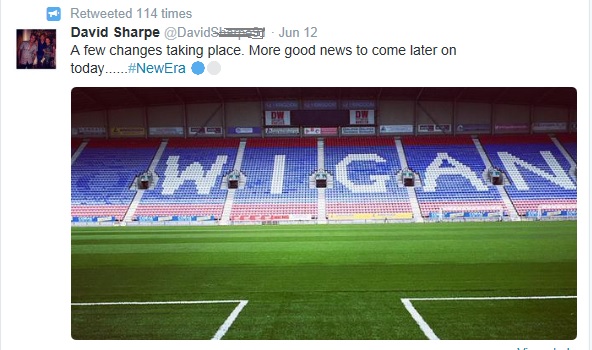
But then on Thursday came that tweet from David Sharpe:  a freshly grassed DW pitch and the promise of more good news later in the day. My mind started to race. Were Latics about to announce the signing of a dynamic up-and-coming young striker who could make all the difference? Or was it that they had signed left sided midfielder Sam Clucas from Chesterfield, a young player who had made a big mark on his club’s season. Moreover he qualified for Sharpe’s professed criterion of being between 23 and 27 years of age.

Then the news came through that Latics had made another free agent signing. The announcement of the procurement of 29 year old Craig Morgan from Rotherham was somewhat underwhelming. Morgan had previously played for four other clubs in the lower divisions prior to joining the Millers.

But his arrival was certainly welcomed by Caldwell:

‘He has great experience, having played internationally, but he also knows the division inside out. He is a quality defender, a real leader on the pitch who has been a captain, with a superb attitude and we are delighted to have him on board.’

Caldwell did not mention that Morgan has played 23 times for Wales.

Moreover the player had chosen to join League 1 Wigan despite receiving a similar financial offer from Rotherham. But he had also turned out an approach from Bolton Wanderers, who seemed far from happy that Morgan had gone to Wigan. One Bolton fan site posted a particularly vitriolic piece. In an open letter to the player the writer says: “We’re glad that your particular brand of mediocrity has found a home. We ourselves have spunked many thousands and millions of pounds on average footballers over the years, and we are all grateful for your decision to join Wigan causing us to avoid falling into the same trap yet again. It’s interesting to us that you chose Wigan. We know that you attended a medical at our Euxton training ground, and we know that you had your Bolton Wanderers contract drawn up and ready to sign on Thursday afternoon.”

Morgan himself commented I had offers from teams in higher leagues, but I chose to come here because of the opportunity and potential here, I didn’t want to just mull around in the Championship. I want to be part of success with this club, I have done previously and I’ve enjoyed it so much that when Wigan came in for me I jumped at the chance because this club is the place I can see myself being successful at once again. The changeover of the Chairman and the manager last season seems to have given the club a fresh start for this new season.”

Sharpe was clearly pleased with the acquisition of Morgan. One wonders if his pleasure was derived as much from depriving the near neighbours of a player they sought, as much as landing an experienced and capable lower division central defender.

The practically simultaneous departure of Scott Carson to Derby County was no surprise, given the signing of Richard O’Donnell and the contract extension for Lee Nicholls. However, it does signify the beginning of the exodus of many of the other eighteen players still under contract from the Championship days.  Caldwell and Sharpe will endeavour to shift on as many of the higher wage earners as they possibly can, replacing them with either experienced players on short term contracts or up-and-coming youngsters. Parachute payments last two more years. David Perkins, 32, has been given a one year contract, Craig Morgan two years, and the 26 year old Richard O’Donnell three years. It looks like Caldwell sees O’Donnell and the 22 year old Lee Nicholls as his goalkeepers for the years to come.

Put simply Latics need to shed a lot of players to make room for others to come in on contracts more in line with those of other League 1 sides. James McClean’s departure also seems imminent, whether it be the New York Red Bulls or a Championship side in England. McClean has been his usual forthright self when asked about his future with Latics. Like several of his colleagues he is unwilling to drop down to League 1, not ideal for the future prospects of an ex-Premier League player. At the same Latics will be happy to get his relatively large salary off the payroll, hoping to recoup some of the transfer fee they originally paid for him. The same will be the case for others such as Andy Delort, James Perch and Oriol Riera .

Latics’ players are due to report back for training on June 25th. It remains to be seen what proportion of those players will be with the club by late August. Although financial considerations are the main driving force for the imminent departure of so many players, the lack of performance by so many last season also comes into consideration. There will be some degree of backing from the fans for the clear-out of players that they felt did not compete as much as they might have while wearing a Wigan Athletic shirt.

Ideally Caldwell would be able to decide which of the players remaining from last year’s squad would be staying. However, the reality of finding other clubs for players on relatively lucrative contracts will tie his hands to some extent. If he is unable to move on players not in his plans he will face financial constraints which will restrict his possibilities for bringing in more dynamic new blood.

In the meantime we will await more signings who will by Sharpe’s preference be  “young, hungry players between the ages of 24-27, ones who have done it before, who know what it’s like to win promotion, who are willing to learn and put in the hours, and buy into Gary’s brand of football”.

Although he does not fit the age criterion Morgan has “done it before”, having played in a Rotherham team that won promotion.

However, although it would seem to be a good bet to sign players who have already been in promotion winning sides it does not necessarily correlate with success. Owen Coyle brought in the likes of Leon Barnett, Grant Holt, Marc-Antoine Fortune, Chris McCann and James Perch, all of whom had played in sides that won promotion out of the Championship. Uwe Rosler was to do the same with Don Cowie and Andrew Taylor.

It is those young, hungry players that Caldwell be primarily focused upon signing, although he will surround them with a core of experienced professionals. But more than anything else he will be looking to sign “the right kind of player”, one that will wear the Wigan Athletic with pride.

Forgetting the past

Alex Cribley (left) with Dr Mike Ashworth.

Alex Cribley (left) with Dr Mike Ashworth.

Last season is still a bit of a mystery for me. Having a poor season is one thing, it happens to a lot of teams. But for us to have got relegated was unthinkable. I’ve got my own opinion on what happened, but that’s all history now. We just need to let it go and be ready for the challenge of bouncing back next season.”

The words of Graham Barrow speaking to the Evening Post.

Many of us would be interested in hearing Barrow’s opinion of what happened last season, but he seems unwilling or unable to make it public. Barrow rightly wants to move on and focus on next season. However, despite saying that last season is all history now, he moves on to talking about his role in Latics’ Freight Rover Trophy win thirty years ago.

The Chorley-born Graham Barrow has had a long association with Wigan Athletic. He was the most rugged and determined of midfield players, sometimes used as a centre forward, signed from Altrincham for £10,000 in August 1981. He was to become a key component in Larry Lloyd’s team that won promotion from the fourth tier and made 179 appearances, scoring 35 goals, in his five seasons at Wigan. He was “Man of the Match” in that 3-1 win over Brentford in that Freight Rover Trophy final.


Barrow moved on to Chester at the age of 32 and suffered five bookings in his first seven games for them. However, he was to make 248 appearances for them, scoring 17 goals. In addition to being captain on the field of play he became assistant manager to Harry McNally, then player/manager from 1992-94. As Latics’ manager in 1994-95 he helped them avoid relegation to the Conference. He was to go on to manage Rochdale, before a short lived return to Chester, subsequently taking the reins at Bury.

Barrow was brought back to Wigan as first team coach by Roberto Martinez in July 2009. On Martinez’ departure in summer 2013 and the arrival of Owen Coyle his future seemed in the balance. New managers tend to bring in their own right hand men, but although Sandy Stewart came in as Coyle’s assistant, Barrow continued as coach. He was to become assistant manager under Uwe Rosler, keeping the position under Malky Mackay and Gary Caldwell who were to follow.

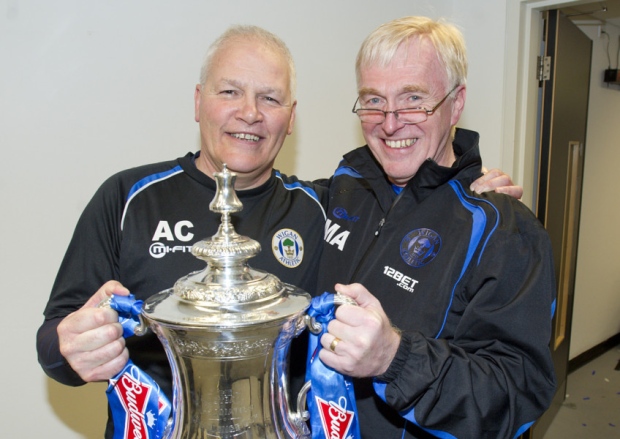
Alex Cribley played in the same Larry Lloyd team and that Wembley final against Brentford. In fact he made 328 appearances for Latics over eight years. Cribley had been signed on a free transfer from Liverpool by Ian McNeill in November 1980 and his versatility made him a key player. His best position was probably in the centre of defence, but he was a solid right back and could lend a hand in a midfield holding role. Cribley went on to become club physiotherapist, being connected with the club for 35 years.

Cribley is perhaps one of the more unsung of Latics icons. However, when Mike Ashworth retired as club doctor in April after 33 years of service he spoke of his colleague:

“One thing I will miss more than anything is Alex Cribley. He was there as a player when I started so he’s been there longer than me, then he became a physio. He’s been a fantastic friend, a fantastic support, a proper professional and Wigan Athletic has been very lucky to have him over the years. I’m going to miss that day to day contact with Alex but I’ll keep in touch, I’ll still go to the games and hopefully get a season ticket now and go back to where I started.”

A couple of weeks ago a rumour went around the social media and message boards that Cribley had left the club. Soon after the kit manager, Dave Mitten, tweeted that he had been made redundant. Ironically Mitten still appears on the Who’s Who on the official club site, but Cribley has disappeared.

Given a drop of two divisions in a space of years and an almost 80% potential dip in revenue compared with the life at the top, Wigan Athletic have to cut their coats according to their cloth. It entails not only a mind shift  in terms of the kinds of players they will look to acquire, but also a fundamental restructuring of the auxiliary and administrative staff  at the club.

Put simply Latics cannot continue with a Premier League infrastructure in League 1. It inevitably suggests a huge cut in the total costs of players’ wages, but also a general downsizing within the organisation.

There are fans who will question the outgoings over the next couple of months, not only players but support staff. The club will look at getting the best possible infrastructure in place, within its new financial situation, for the start of the 2015-16 season. It is going to be a painful time for so many within the club, as redundancies will be announced.

David Sharpe is in an unenviable position in having to oversee the culls. He currently has the support of the majority of fans, despite the poorly handled departure of Emmerson Boyce. There are fans who will question the exit of such as the kit manager, citing that what he was earning was a pittance in comparison with what a player would earn. Those questions will continue as the downsizing continues.

However, past commitments and service to the club should at least be acknowledged, if not celebrated. Boyce spent nine years at Latics in their heyday and deserved more thanks than he got from a club that has not been strong in the human resource management aspect. It is sadly the norm in football clubs across the country, Latics probably being no better or worse than most.

Football clubs need to look forward to the future, but at least recognise people who have put in so much in the past.

We await news from the club on Alex Cribley.