The financial side of a bounce back for Wigan Athletic

Sharpe

David Sharpe offers the club new direction, but he has major challenges ahead of him.


“You will no doubt have heard the news by now that we will be kicking off next season in Sky Bet League One. Everyone associated with Wigan Athletic is suffering this morning but the reality is that this is where we find ourselves and I wanted to write to all of you with a personal pledge that nothing else but an immediate return to the Championship will suffice. We will bounce back.

The words of David Sharpe after Rotherham had put the final nail in Wigan Athletic’s coffin by beating Reading on Tuesday night.

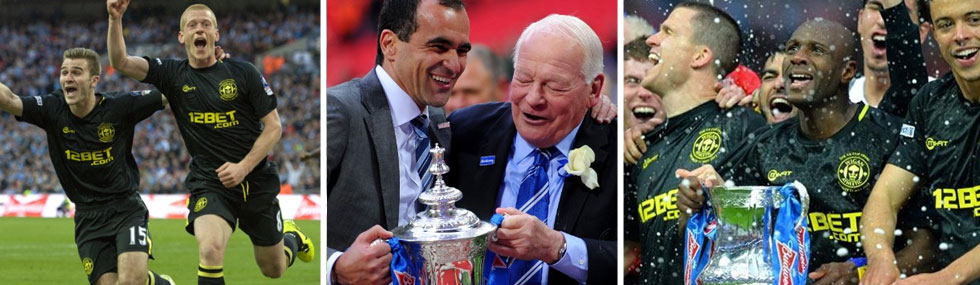
Since taking over as chairman Sharpe has injected a breath of fresh air into the morale of Latics fans. The unthinkable actually happened – from winning the FA Cup to League 1 just two years later. But Sharpe’s enthusiasm for the task of getting the club back into the top echelons is infectious. After the club drifting for months like a rudderless ship Sharpe has come in and provided not only direction, but hope.

He has installed a bright young manager in Gary Caldwell, insisting that it is a long-term appointment. During just four games in charge Caldwell has already turned the style of play from the hoofball prevalent under Malky Mackay to what Sharpe calls “the right brand of football”. Sharpe continues to reiterate the club’s desire to produce a top class academy. He also plans to put in place an effective department of recruitment, something the club was lacking even in the Premier League days.

Sharpe has been impressive in his dealings with the media. Rather than look like a 23 year old novice in the role of club chairman, he has clearly enunciated his vision for the club and looked calm and confident when interviewed. Moreover he is from a generation that is skilled in the use of electronic and social media.

Dave Whelan too started off with a vision when he first took over as chairman some two decades ago. His was to propel Latics out of League 2 into the Premier League in ten years. His achievements are legendary. However, Whelan was already in his late fifties when he took over, with huge business acumen and experience. During those twenty years he was to pump around £100m into the club for them to hold their own in the upper tiers of English football.

DW is a hard act to follow. Does the young chairman not only have the vision, but also the business acumen and sheer determination needed to follow in his grandfather’s footsteps? More importantly is the Whelan family still willing to help support the club financially?

Sharpe is by no means alone in dealing with the financial side of the football club. His grandfather remains the owner and will surely be in regular contact with him. Moreover he has the capable Jonathan Jackson, a Chief Executive with a strong business background, steeped in the tradition of the club since birth.

However, the two of them, together with Head of Football operations, Matt Jackson, have a huge task on their hands over the coming weeks. No less than 13 players left the club in January. A comparable exodus is impending as Latics need to cut their cloth according to the financial realities of League 1 status.

In their last season in the Premier League Wigan Athletic had a staffing budget of around £50 million. Relegation and a huge drop in TV revenues meant that wages had to be drastically reduced, despite a parachute payment of £26 million. To keep a team in mid-table in the Championship typically involves a wage bill in excess of £20 million. Whereas to get into the top six  comes to around £30 million, which is precisely what it cost Latics last season.

With parachute payments dropping to £16m this season that the club once again needed to reduce its wage bill. The departures of ex-Premier League players Jean Beausejour, Jordi Gomez and James McArthur helped. However, manager Uwe Rosler was to bring in nine new players over the summer. Although some were younger players, not on high earning contracts, the competition in the transfer market forced the club to offer more tempting salaries to the rest. The result was a squad that was larger than the club needed with a wage bill close to that £30 million of the previous season.

The January fire sale, in which 13 players left the club, helped to put Latics back on track financially. Apart from the transfer fees received the wage bill was reduced significantly, to probably around £20 million on an annual basis. Sadly the selling of much of the family silver left Latics with a threadbare squad, short on quality. Only two permanent signings were made, coincidentally both being players who had prior experience in League 1. The squad was supplemented by young loanees and players on short term contracts.

For the coming season Latics will receive £8 million in parachute payments, plus around £2.5 million from TV money. The rest will need to come from gate receipts and commercial revenue. The club will have gone from a wage bill of £50 million to £30 million to around £10 million in the space of just three years.

Assuming the current wage bill approximates to around £20 million on an annual basis it means that it will need to be halved over the summer.

Wigan Athletic currently have 19 players under contract until 2016 and beyond. None of those were previously on Premier League contracts. However, having been signed when Latics have been in the Championship division many of them will be on salaries that are way above the norm in League 1.

Excluding loanees there are 8 players out of contract in June. The list includes goalkeeper Lee Nicholls, although rumours suggest that he is being offered a contract extension.

Given the situation Sharpe will look at selling off those contracted players on the highest salaries. Many of the most saleable assets departed in January, but players with prior Premier League backgrounds remain who will be targeted by other clubs. The most likely to attract sizeable transfer fees are Scott Carson, James McClean and James Perch. Moreover Oriol Riera has already shown in his return to Spain that he is a player who will be in demand, likely to bring in a transfer fee.

So many players have been tainted by the low morale and low confidence among the squad this season and their performance levels have dipped. With a fresh start next season and playing in a lower division, many of them are capable of significantly raising those performance levels. However, the financial reality is that around half of them will need to be persuaded to find other clubs, with their contracts terminated by mutual consent.

A few weeks back Sharpe mentioned that Latics were going to need at least ten new players for next season. With around ten retained from the current squad, ten new additions and a handful of players brought up from the development squad it would bring the club close to the squad size of 24 stipulated for League 1 clubs. Up to half of the new additions are likely to be players on loan.

Persuading such a large number of players to move on, helping them to find them new employment, is no easy matter. It will be easier in some cases than others. Some may need to move to clubs offering lower salaries, but in higher divisions than Latics. Players who have been in the Premier League not so long ago will be reluctant to damage their future career prospects by dropping down to League 1.

Caldwell will know which players he wants to retain. However, he might not be able to be so selective. Those returning from long-term injury are unlikely to be sought out by other clubs until they have proved they are fit again. Emyr Huws, Aaron Taylor-Sinclair and Grant Holt fall into that category. Holt is not only recovering from an anterior cruciate ligament knee injury, but will be 34 years of age when the season starts. Moreover he is one of the highest earners. Caldwell’s hands will most likely be tied and he will need to find ways of enabling the big Cumbrian to fit into his style of play.

Caldwell might want to keep at least some of the players whose short term contracts are about to expire. Harry Maguire is on Premier League wages at Hull and the salary expectations of ex-top flight players such as William Kvist, Kim Bo-Kyung and Jermaine Pennant will be high. Caldwell also needs to make a decision on his old teammate Emmerson Boyce. At 35 years of age, Boyce does not have the pace of before. However, Caldwell could choose to use him in a back line of three, where his experience could be useful. But then again, it would also depend on his wage expectations.

Despite Sharpe’s assertions about producing a top class academy the club has not made any recent statements about the development of the Charnock Richard site. There are fans who remain skeptical about whether the project will be brought to its conclusion. We await further news.

The framework governing Financial Fair Play in League 1 differs greatly from that of the Championship. Clubs in Leagues 1 and 2 have to operate under the Salary Cost Management Protocol (SCMP). It limits the wages that a League 1 club can pay out to a maximum of 60% of its turnover. There is no consideration given to clubs coming down from the Championship except that the salaries of players signed before September of the previous season, on contracts of three year or more, are not included in the calculations.

That would be the case of those signed by Owen Coyle prior to the 2013-14 season. However, although the retention of those players would not be contributory to breaking the SCMP protocols, the club will be reluctant to continue to pay salaries of approaching £1 million per year to the higher wage earners. In certain cases, such as that of Holt, its hands may be tied.

Over the coming weeks we will discover which players are moving on. Caldwell faces a tough decision whether to retain a handful of high earners, who would take up around half of the total wage bill, or whether to ditch as many as he can to sign up-and-coming players from the lower divisions or maybe Scotland. It could be argued that if he were to keep some of those high earners they would provide a strong backbone for his team. It could also be said that so many of those players underperformed this season and the club is better off without them.

Sharpe has made it clear that he wants promotion this season. In reality it might be too much to ask of a rookie manager in his first full season with so many new players to bed-in. However, the parachute payments only continue for two more years and after that Latics will compete on an even keel with the other clubs in the division. Promotion in the second year would become a real priority.

Turnover usually includes not only match day revenues, TV money and sponsorship deals. But interestingly the Football League also includes donations from the owners of clubs and the injection of equity. It basically leaves the door open for a rich owner to take over a club and pump money into it in a bid for promotion. Moreover there is no direct restriction on the amount of money the club can spend or receive in transfer fees.

Unlike so many clubs Wigan Athletic have been well managed financially in recent years and made profits in the past three seasons. Whether they make one this year remains to be seen, although the transfer fees received and staffing cuts made in January will help. However, the long term question is whether the Whelan family, through Sharpe, is willing to inject further funds into the club. Funds will be needed for the foundation of a top class academy and if Latics cannot gain promotion in the next couple of years the parachute payments will be gone and they will have no financial advantage over the general morass of clubs in League 1.

Sharpe has made an inspirational start to his tenure as chairman of Wigan Athletic. But the coming weeks are going to test his abilities to remain calm and level-headed, whilst being determined in realizing his vision for the club.

Then there remains the big question about injection of further funds into the club by the Whelan family, which has already given so much.

A visit to Brentford and a look at a disastrous season

With the final game of the season coming up at Brentford on Saturday, Billy Grant  (@billythebee99) of beesotted.co.uk asked us to respond to some topical questions. The article is also posted on the Beesotted site.

This slideshow requires JavaScript.


When we touched base for the first time this season around the time of the Forshaw saga, we had no idea our season would end up like this. We (and the world) thought we would be battling against relegation and you thought we would be battling for promotion with Uwe Rosler making his much awaited return to Griffin Park. Where did it all go topsy turvey?

Things had already started to go awry by the time that Brentford visited in mid-October. Just over a week later, with only three victories in seventeen league games, Rosler was shown the door. It was a sad end to an era in which the German had enjoyed a meteoric rise to fame. The previous season he had taken over a team in 14th place and got them into the playoffs, only to be narrowly beaten by QPR. Moreover the stunning win at the Etihad against the to-be Premier League champions in the FA Cup sixth round would stick in the memory for years to come. So would the semifinal, taking Arsenal to a penalty shootout.

Sadly things had gone pear-shaped for Rosler in the second half of his reign. The rot had set in towards the end of the 2013-14 season. The confidence that had been generated through a long string of good results had started to wane. Then over summer Rosler was to lose class performers in Jean Beausejour and Jordi Gomez, but the biggest blow was the departure of James McArthur on the transfer deadline day.

The new season had seen the team coming back from pre-season training in Germany in poor physical shape, with second half collapses being the order of the day. Moreover Rosler had made nine new signings since the summer, all in need of a settling-in period. But their arrival had swelled the first team squad to over thirty, the end result being Rosler having to deal with disgruntled players not getting a regular game.

Sadly Rosler could not inculcate his vision into his players. As time wore on it appeared that he and the players had become  more and more out of tune in terms of what should be delivered on the pitch. As the new season wore on we were to see less and less of the commitment required for the high tempo, high pressing football he sought.

By November the dream of getting back into the Premier League had become almost unreal. It looked like it was not going to happen this season with Rosler. Dave Whelan stepped in, relieving the German of his job, bringing in Malky Mackay, stating his belief that the Scot was the right man to take the club back to the Premier League.

Little did we know what depths the team would plumage towards under Mackay. His appointment did great damage to the club’s image as portrayed by the national media. Moreover the team did not rise on the bounce effect of a new manager, as is so often the case. In fact they got worse. They did not win a single home game during his tenure and he will go into Wigan Athletic history as their least successful manager.

When Mackay had taken over he had stuck by an “old guard” who had been underperforming under Rosler. Neither did they perform well under him. The result was no less than thirteen players dispatched out of the club in the January window. Given the departure of so many players who had proved themselves in the Premier League it was no surprise that the standard of football was to plummet close to rock bottom. The hoofball that had become evident under Coyle, which Rosler could not eradicate, soon became the order of the day under Mackay.

The conspiracy theorists say that Mackay was brought in as a short-term alternative, with his main task being to cull the dead wood within the playing staff. It could be said that he did that. Perhaps some of the players from the Martinez era had become complacent and were causing divisions within the camp.But the cull, together with a reluctance to provide Mackay with sufficient cash to find adequate replacements, left the club so short of quality players that relegation was always going to be a possibility. Mackay was to replace the departed players with those on short term contracts or young loanees green behind the ears. It was a recipe for disaster.

So many fans are relieved that Mackay will not be at the club next year, even if it is in League 1. But it should not hide the lack of foresight and decisiveness by new chairman, Sharpe, who left it too late in dismissing him.

Give us your thoughts on Brentford’s season

Many of us were shocked by the decision to not continue with Mark Warburton. I wonder if he had come to Wigan with Rosler we might have been promoted by now, rather than relegated.

Warburton deserves commendation for what he has done since he took over as manager. He has stuck to his guns by insisting that the team play good football and their quality has surprised others in the division. To be within reach of a playoff spot on the last day of the season is some achievement.

Whoever follows Warburton is on a hiding to nothing. You have to hope that Benham will make the right appointment. Whelan made a major blunder at Wigan by appointing the “long ball” Coyle following the departure of “tiki taka” Martinez. You need to appoint a manager who will build on what is established, rather than one who will destroy it.

There was an enormous who-ha over Wigan’s poaching of Adam Forshaw at the start of the season. He gave his reason for leaving being he wanted to move to a ‘bigger club’ and to one that was ‘challenging for promotion’. A bit cheeky. Would you admit, looking at how the season has panned out, Forshaw made the wrong move? He was a key player for us and has become a bit player since his move.

Rosler was building for the future by signing a handful of younger players. Andy Delort, Adam Forshaw, Emyr Huws, Aaron Taylor-Sinclair and James Tavernier were brought in. All were stars at their clubs last season and they are still good players. Sadly they were dragged into a situation where even experienced and capable pros, such as Ivan Ramis, Shaun Maloney and Leon Barnett, had been struggling to impose themselves on the field of play. Sadly those young players were mismanaged, first by Rosler then by Mackay.

Forshaw’s transfer had hit the headlines because of the bad feeling it created between the clubs. From the player’s point of view he was rejoining the manager who had nurtured him to the point of becoming League 1 Player of the Year. He was also joining a club that had a squad good enough to challenge for promotion, which would offer him a more lucrative contract.

Like those other young players Forshaw was never able to truly establish himself. He made 13 starts, with three appearances off the bench, scoring one goal.

Talking of Forshaw, his agent played him a big BIG get-out-of-jail card. Out of the blue he got him a move to promotion-chasing Middlesbrough after staring relegation in the face. At one stage, he looked destined for the Premier League with them but now has to settle for the playoffs. Assuming we don’t make the playoffs, do you think Forshaw will be a Premier League player next season?

Ben Watson’s agent did even better. Since leaving for Watford in January he has been a regular in a side that is already promoted. Forshaw has been largely used as a substitute by Middlesbrough, making only five starts.

Forshaw had been part of the January cull, with the club cutting their potential losses for the season by selling players off for whatever transfer money they could get and freeing others on lucrative contracts. So many fans had been disenchanted by the lack of performance by the squad that Mackay did not meet the opposition one would have expected when selling off the family silver. But there were fans who thought the departures of young players with potential was worrying.

Aitor Karanka has done a good job at Middlesbrough. They can play attractive football and will have as much chance as any other team in the playoffs. We learned last year what a lottery the playoffs can be. Should Boro get promoted they are going to have to bring in a lot of new players as their squad is not anywhere near Premier League standard.

Forshaw still has not established as a regular starter in the Championship, but he does have potential and maybe the Premier League environment would suit him?

For a while Latics fans were a bit disenchanted with Brentford over the Forshaw saga, but most of us will wish the Bees well in the quest for promotion. You have an outside chance of getting into the playoff zone, then a one in four chance of winning the playoffs. But the likelihood is that Derby will win at home to Reading on Saturday. If they do then I will fancy their playoff chances. Despite poor recent form their squad is probably the best outside the top two.

The Rotherham result in midweek has consigned you to Division 1. Despite our little ding dong earlier this season, most Brentford fans would actually prefer you stayed up. We had a good day out at Wigan much preferring it to our trips to places like Bolton and Millwall to be quite honest. How do you think you will get on next season???

Wigan is a friendly town and away fans seem to enjoy their visits. I went to Millwall for the first time a couple of weeks ago and can understand why your fans are not keen.

Dave Whelan is now 78 and after 20 years of guiding the club he has stepped back. He made a mistake with the Malky Mackay appointment and his inappropriate comments were gobbled up by the national media. It has sadly tarnished the image of a man who has done more for Wigan Athletic than anyone before.

When all this was going on the club seemed to have no direction and leadership. But now Latics have a new chairman and a new manager, both young and hungry for success. The 23 year old David Sharpe wisely opted for a manager who believes in playing football the “Wigan way”. Moreover his expectation is that Gary Caldwell – only 32 years old – will stay in the position long-term.

Next season is a great unknown for us. There will be another mass exodus over summer as the club sheds its highest wage earners and rebuilds. Sharpe has already stated his goal of promotion next season, but most of us realise that this might not happen so quickly. A large number of new players will be coming in and it is going to take time for them to gel and learn to play football with the style that Caldwell expects.

With the youngest manager and youngest chairman in the four divisions at the helm there is renewed optimism at Wigan. The era of Whelan has gone, but an exciting new one is about to commence.

Do you think you players will turn up at the weekend?

More than half of the players who made the starting lineup against Wolves last weekend are on short-term contracts which finish next month. Many of the remainder are likely to be leaving in summer. Will this motley crew give their commitment on Saturday?

Nevertheless Caldwell will expect them to give their all and many might want to impress possible future employers. Moreover there is no pressure on them to get a result.

Given such a scenario who knows what will happen? It could be a surprise victory for Latics or a hammering.

My guess is that it will be a 1-1 draw.


Almost gone but there’s hope

Will Caldwell play 3-4-3 next season?

Will Caldwell play 3-4-3 next season?

At the start of the season there were rumours in the media that Wigan Athletic were looking to sign Benik Afobe on loan from Arsenal. Little did we know at the time that it would be Afobe who would put what could be the final nail in the coffin that represents Latics’ season.

Afobe has scored 23 goals this season. Wigan’s leading goalscorer is James McClean with 6. Would Afobe have been able to score like that if he had joined Latics, rather than MK Dons, at the start of the season? Or has Wigan become a strikers’ graveyard, a place where past performance counts for nothing?

Gary Caldwell must have found it hard in his first three matches to resist moving towards the 3-4-3 that became the hallmark of his days under Roberto Martinez. Yesterday he employed something approaching it, with the players he had at his disposal. Given Wolves’ penchant for thrusting players forward it had looked like the right decision to play with three central defenders. It seemed to be working until Afobe scored that “soft” goal, which sapped away Wigan’s brittle confidence. Caldwell would have hoped that a back line of three, becoming five with the wing backs dropping back, would cut out possibilities for a headed goal of that type.

With Latics a goal down and not looking like pulling one back, Caldwell felt it necessary to move to a conventional back four, so that he could accommodate changes in midfield and up front. William Kvist was pulled off after 56 minutes, with James Perch coming out of the back three to a holding midfield position. The goal-shy MAF came on at centre forward with the enigmatic James McClean moving to the left wing. Twelve minutes later Caldwell took off Jerome Pennant for Billy Mckay. But unlike what happened in the previous match with Brighton, the changes did not work this time around. Indeed the departure of Kvist probably did not help, given his ability to drop deep to receive passes and build up from the back.

Latics are surely heading for League 1. The direction had been set in January with the selling off of so much of the family silver. The departure of thirteen players would have been unimaginable at the start of a season that promised so much. Uwe Rosler had made a fatal mistake by signing nine new players over summer, despite having a squad good enough to reach the FA Cup semi final and the Championship playoffs. The result was a fractured squad where new players found it difficult to settle in and the morale of the existing players sank. But just as Rosler had erred in bringing in so many players, Malky Mackay was to do the same. He brought in eleven over a period of three months.

The disruptive pattern caused by managerial changes continues to be problematic in English football. The classic case is typified by a new manager bringing in his assistants, coaches and backroom men from his previous clubs. He then wants to bring in his own players, those who are more likely to be loyal towards him than those recruited by his predecessor. The new manager will say that he wants to bring in players who can play the kind of football he believes in. The result is inevitably disruption and turnover.

However, clubs are slowly adjusting to this scenario. A new model is emerging where a Director of Football has the overview at the club. The ability of a manager to bring in hordes of new coaches, backroom staff and players is diminished under this model. The Director of Football and those above him at the club will take the lead at identifying the kind of football they want at the club. The manager they appoint would need to fit into that philosophy rather than imposing his own.

With the appointment of Matt Jackson as ‘Head of Football Operations’ Wigan Athletic have moved towards the alternative model. Moreover Gary Caldwell has been appointed largely because he is the right fit for the club, given the statements of young chairman, David Sharpe. Sharpe has already stated the need to bring in at least ten new players over summer. His action of creating a new department for the recruitment of players is another indication of a change in model.

Moreover both Sharpe and grandfather Dave Whelan have insisted that the coaching staff largely remain intact, despite the changes in manager. When Rosler was appointed many of us expected him to bring in his assistant manager and first team coach from Brentford. In the event he was allowed to bring in Chris Haslam as Head of Performance, but the long-serving Graham Barrow was to continue as first team coach. Barrow was to be moved into the assistant manager position following the acquisition of Eric Black as first team coach in July. The rumours were that Black was Whelan’s appointment, not Rosler’s.

Malky Mackay’s appointment saw the arrival of David Kerslake as first team coach, despite already having Black in place. Black remains although, in the absence of information from the club, we can assume that Kerslake departed with Mackay.

The role of the coaches over the course of a terrible season has been questioned by many fans. The managers, Rosler and Mackay, have carried the can for poor performances, but Barrow, Black and goalkeeping coach Mike Pollitt remain in place.

Probably the biggest failure this season was the failure of the new players signed by Rosler to reach the performance levels they showed at their previous clubs. It was compounded by the lack of motivation of players who had played under Martinez and Rosler.

Seemingly bright young talents such as Adam Forshaw and James Tavernier were dispatched in January, with Emyr Huws and Aaron Taylor-Sinclair disappearing through injury. The mishandling of strikers Andy Delort and Oriol Riera was sad to see. Yesterday’s starting lineup saw just one of Rosler’s signing make the starting lineup, in William Kvist. Another two, Don Cowie and Andrew Taylor were on the bench.

The events of the first half of the season clearly had a negative effect on the players released in January. Tavernier’s loan spell at Bristol City has not seen him become a regular first choice, with 8 starts and 3 appearances off the bench. Likewise Forshaw’s stay at Middlesbrough has seen him used largely as a substitute, with only 5 starts. Delort scored two goals in his first three games on returning to Tours, but has not scored in his last seven, with the club just three points above the relegation zone. Riera has been more successful having made 13 starts at Deportivo La Coruna, with four goals. Rob Kiernan too has been a success in a loan spell, having started 11 matches at Birmingham to date.

One wonders if there is any possibility of those loan players returning. Delort, Kiernan and Tavernier are young and would surely improve if capably nurtured. Riera is an experienced central striker and goalscorer who was poorly treated by Rosler, then written off by Mackay.  If Caldwell is to adopt a 3-4-3 system next season he could clearly do much worse than put in Delort and Riera as two of his front men. Moreover Tavernier is naturally suited to the position of wing back and will score goals if given the chance. Kiernan had a difficult time this season, but he is still only 24 years old. At his best he is a cultured central defender who can pass the ball. He can also play in central midfield.

Whether the loan players will return is going to largely depend on the departure of the bigger wage earners. Latics will hope to get reasonable transfer fees for the likes of Scott Carson, James McClean and James Perch. Ali Al-Habsi will become a free agent, as will Marc-Antoine Fortune. Disaffected players like Leon Barnett and Chris McCann will most likely be encouraged to move on. The futures of the much maligned Don Cowie and Andrew Taylor might lie elsewhere.

Had Afobe joined Wigan Athletic at the start of the season, could he have scored the goals to help them stay afloat? The question is academic, but given the way that strikers with good credentials have failed to make it at the club, one doubts it.

The latest sad example is Billy Mckay, who must have been full of confidence after scoring a potful of goals in Scotland. Four months after signing from Inverness he still has not made a start for the club. A sad indictment on the recruiting/coaching functions at Wigan Athletic.

Mckay is merely the latest in the long line of strikers who have arrived with promise, but have not been sufficiently nurtured. The coaching staff must surely take some responsibility for what has happened.

Latics already have one foot in League 1. Even a draw for Rotherham in their midweek home game with Reading will be enough to finish them off.

But Gary Caldwell has been like a breath of fresh air since being appointed manager.

With the backing of the coaches he might well lead Latics back to the Promised Land.

A trip to Netherfield – Part 1


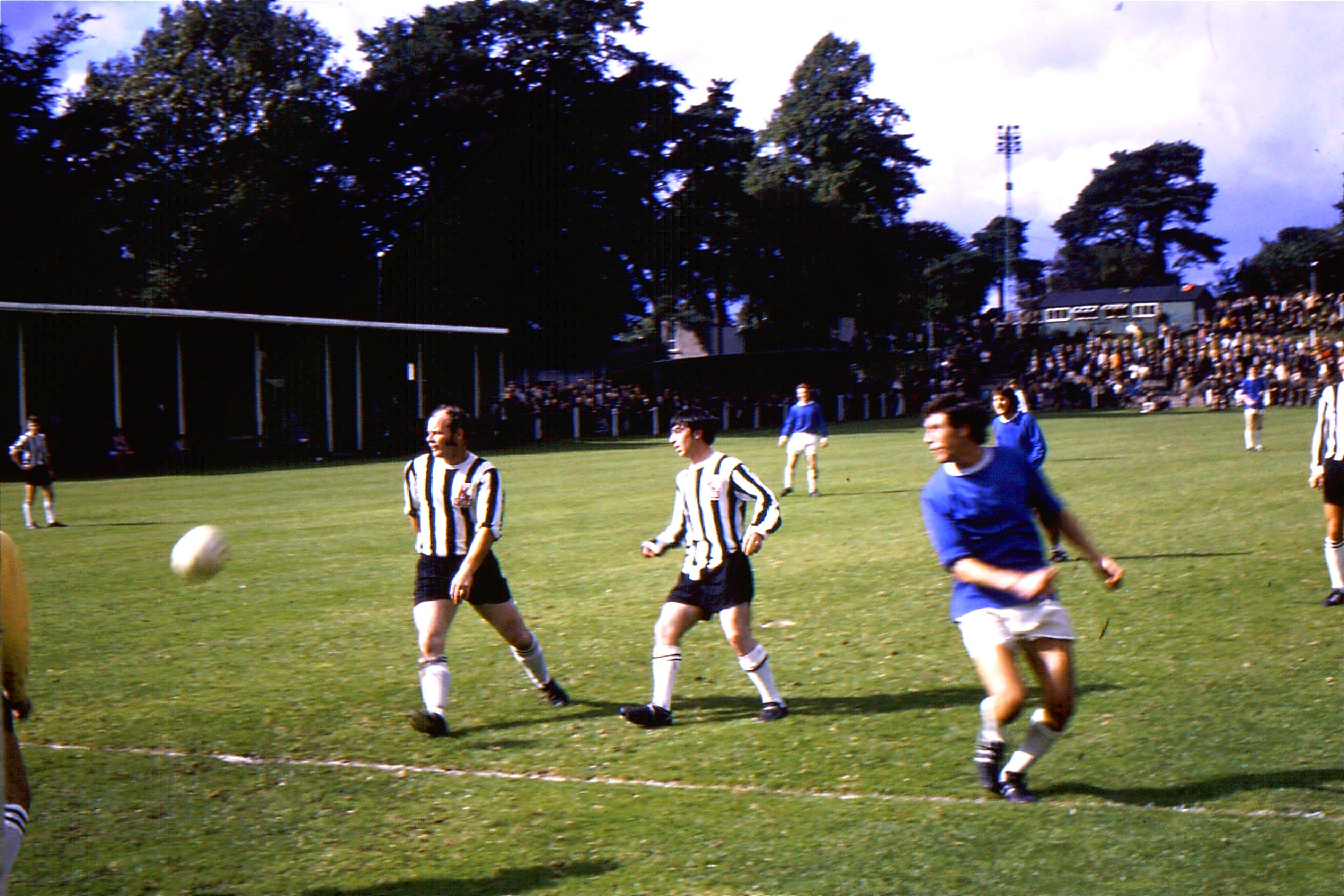
Geoff Davies attacks as ex-Latics player Alf Craig (left) looks on. Kenny Morris and Doug Coutts watch from defence and Bobby Todd from midfield.

Geoff Davies attacks as ex-Latics player Alf Craig (left of centre) looks on. Kenny Morris and Doug Coutts watch from defence and Bobby Todd from midfield.

On a bright sunny day, with a hint of autumn in the air, my father and I walked through the town centre towards the Gas Showrooms, opposite the market square. I had bought the coach tickets the day before, going to our usual source, Barnes Travel Agents in Market Street.

As we waited for the coach to arrive my father started to reel off one of his favourite old stories about traveling to watch Latics play. This time it was at Bacup, the ground being on top of a steep hill. The coach’s engine had stalled and the driver could not get it moving again, so the passengers had to push it up the hill. A story of his that must have been at least nine years old, when Latics would meet Bacup Borough in the Lancashire Combination.

The coach had no problems getting up hills in this journey. The advent of the M6 motorway had made traveling north much easier, although we had to come off a little before Kendal, the difficult stretch leading over Shap being close to completion, but not ready yet. We arrived an hour early and decided to go through the turnstiles and soak up some sun on the terraces. Just like at Springfield Park there was a supporters club building inside the ground where we could get drinks and a bite to eat.

As we walked in we saw a sight that I had never seen before at a football ground. There were three or four cows grazing on the pitch. It provided a classic rural scenario and made one wonder if this was the reason that the Netherfield pitch was one of the better ones in the league.

It was September 5th 1970, an exciting time for Wigan Athletic fans. The advent of the Northern Premier League had brought new hope for the club, which had been thus far been thwarted in its ambition to be elected to the Football League. Moreover Latics had appointed a dynamic young player-manager who had started to meld the talented squad assembled by his predecessor into probably the best side the club had ever had.

Playing away at Netherfield was never an easy prospect. The team from Kendal, set up by employees of the K Shoes company, were old adversaries from the days in the Combination. Like Wigan they had joined the fledgling Northern Premier League (NPL) as founder members in 1968. They had finished in midtable the previous season.

The arrival of Gordon Milne to Wigan Athletic in the summer of 1970 suggested that the club had serious ambitions. Milne had been one of Bill Shankly’s first signings for Liverpool, paying Preston a £16,000 transfer fee. He went on to make 236 appearances for the Reds in the next seven years, during which he was capped 14 times for England under Alf Ramsey. Milne had joined Latics from Blackpool at the age of 33. Although nearing the end of his playing career he was still a force in the midfield. Curiously his father, Jimmy Milne, had been manager of Latics in the 1946-47season.

The NPL offered hope to Wigan Athletic in their quest for a place in the Football League. The archaic system had remained in place by which the bottom clubs in Division 4 would apply for reelection, together with non-league aspirants. Critics would complain that the Football League was a closed shop and that the clubs would play the “old pals act” by voting for those bottom four clubs.

It was hard for a go-ahead non-league club to get into the Football League and only two had got elected in the past eighteen years, Peterborough in 1960 and Oxford United in 1962. An added complication was that the non-league vote was repeatedly split.

In 1968 Latics had been one of 15 non-leaguers making an application. They received two votes, one less than Cheltenham Town, but woefully short of the 38 votes that got the least favoured Football League club, Workington, reelected. Wigan Athletic did not make an application the following season.

In those days Latics could only dream that automatic promotion to the Football League might become a possibility for non-league clubs. However, the creation of a northern super league, composed of the top clubs from the various regional competitions, was a real step forward. Winning such a league would certainly give more kudos than the Cheshire County League, even if it had been  the best of the northern regional competitions. Moreover the prospect of only the winners of the NPL and the Southern League applying for election would make sense, if it could ever become a reality.

The NPL started in the summer of 1968. It comprised 7 clubs from the Cheshire County League, 5 from the Lancashire Combination, 4 from the Midland Counties League, 3 from the Northern Regional League and one from the West Midlands League. Interest in Wigan was high and Latics’ first game at Springfield Park against Ashington was to draw a crowd of 6,721 – the highest home league attendance for 13 years.

The legendary Ian McNeill had been recruited to manage Latics in that first NPL season. He had been managing Ross County, following a successful playing career with Leicester City and Chelsea. His contacts in Scotland were to prove valuable and in his two year stay he brought in the likes of David Breen, Benny Cairney ,Doug Coutts , Jim Fleming, Jimmy Lynn, Jim Savage and Billy Sutherland. The left full back Sutherland had been signed from Rangers to begin that first NPL season. He was to go on to make 228 appearances over a seven year period at the club.

But the most notable of all in McNeill’s squad that year was not a Scot, but an ex-youth player from Arsenal, who had played just three games in the Cheshire League the previous season, after being signed by Allan Saunders. Just 19 years old at the time, Ian Gillibrand soon established himself as a regular in the team. Although he lacked height for a central defender, Gillibrand had an impressive leap and his reading of the game made him look like the non-league version of Bobby Moore. He was to play a further ten seasons at the club, breaking the record for his number of appearances and, most famously leading Latics out to their first ever Football League match at Hereford.

McNeill was keen to win the NPL in its inaugural season, but so too were the previous season’s Cheshire League champions, Macclesfield Town, led by their inspirational player-manager Frank Beaumont. McNeill paid Runcorn £3000 for Alan Ryan, who had scored a remarkable 66 goals in the previous season. But despite having an excellent record of record of W18 D12 L8, Latics were to finish in second place, 12 points behind the Silkmen. Attendances had almost doubled from an average of 1,801 the previous season in the Cheshire League to 3,393.

The following season was an even better one for Latics, with a record of W20 D12 L6, but they were to once again to finish behind Macclesfield, this time on goal difference. Despite doing a great in those two initial NPL seasons McNeill was to leave the club following a disagreement with the chairman.

Ken Cowap replaced McNeill with Gordon Milne, who soon splashed out £4000 for the 32 year old ex-Everton winger Derek Temple from Preston. It was a sign that Latics were very serious about winning the title.

However, Milne’s key signing at the time was to prove to be the 23 year old centre forward Geoff Davies for a much more modest fee from Northwich Victoria.

Mauled by the crowd at the Den


It was my first visit to the district of South Bermondsey, the home of Millwall FC since 1993. I had expected to meet a partisan crowd keen to cheer their team to victory in a relegation dogfight. But following Latics’ draw at Fulham I was optimistic that they could do even better against a side with much less quality than the Cottagers. Gary Caldwell would have his team play neat and compact in the first half, frustrating the home crowd, stifling their passionate support.

In fact the home crowd was to voice its frustration on several occasions in the first 15 minutes as their team could not string their passes together. Millwall looked a poor side, ready for the taking. But Latics were playing cautiously with Marc-Antoine Fortune a solitary figure up front. Nevertheless their possession football was frustrating both the Millwall team and their supporters.

However, the home crowd was to rouse their team into knocking Latics off their game. For once we had bought tickets in the central stand near the half way line. I had hoped that not only would we get a good view of the game, but be surrounded by some of the more moderate home supporters.

My illusions were soon shattered. As Kim Bo Kyung ran with the ball the crowd around me chanted racist words at him, akin to the politically incorrect term that Dave Whelan had used when referring to  Asian restaurants he used to visit as a kid. One fan behind me shouted “stop him”, another took it a stage further with his rallying call of “flatten him”.

Millwall responded to the crowd’s promptings with a series of professional fouls, in an effort to knock Latics off their game. However, Latics stayed relatively calm, retaining possession. Neither side was to produce much goal threat in the first half. Scott Carson had saved Latics after Gaetan Bong ‘s error put them in trouble. The much maligned Fortune should have opened the scoring for Wigan after 27 minutes from a lovely Bong cross but his tame header made it easy for Forde to turn the ball over the bar. It clearly was not much fun for Fortune playing that role as the lone striker, but his lack of running off the ball and inability to stay on side hampered promising moves developing.

Going in at half time with the scores level was a solid base to build upon. Up to that point the referee had resisted much of the baying of the crowd. The atmosphere had almost resembled that of a bull fight rather than a football match. Spectators who had previously looked contemplative would suddenly stand up and shout expletives at the referee and the Latics players. One wondered how long the referee could resist their demands.

But if Latics could continue to frustrate Millwall and their hostile crowd and pose more of an attacking threat, it looked like they could go on and win the match. One wondered if Caldwell would put in Martyn Waghorn for Fortune immediately after the interval in an effort to win the game.

The crowd continued to be loud and vocal, aiming their abuse at the “northerners “, but James McClean in particular. Caldwell was to wait a further 8 minutes before making the obvious change to the applause of the away contingent. Sadly with the crowd baying for blood Waghorn was to stay on the pitch for only 9 minutes, being given a red card after supposedly retaliating following a scuffle. His departure seemed to have provided the death knell for Wigan’s chances, but they could have got on top soon after when a neat move saw Kim pass the ball to Bong who blasted the ball over the top from eight yards.

The referee continued to be swayed by the crowd, allowing the home team to continue their professional fouling. Millwall were to take the lead after 74 minutes when Abdou ran to head in a left wing cross from Harding. Six minutes later the referee made a ludicrous decision in sending off Jason Pearce after he had taken the ball in what looked like a hard, but fair, tackle. He evened things up by sending off Millwall’s Upson with Pearce.

Nine man Wigan continued to attack, but looked vulnerable with only two at the back. Substitute Gueye capitalized on the lack of defensive cover by running through and beating Carson with an angled shot in the last minute.

In the end the partisan home crowd had won the day. They had lifted their mediocre team to a crucial victory that gives them hope of avoiding relegation. However, three of their final four games remaining are away from home. Their home game is against Derby County.

Wigan had by no means played badly. The defenders had clearly been working on their distribution and it was a rare sight to see Carson resist so many chances to hoof the ball upfield. Instead he looked for a teammate nearby with a throw. Rarely can one remember a Wigan Athletic goalkeeper so reluctant to use the throw as a means of launching attacks. He looked almost peeved to have to the throw the ball in this match.

It was pleasing to see Tim Chow being brought on for the final 10 minutes. The young player should really have been in contention for a place back in August, after a fine close season. Caldwell has done what Rosler feared to do in blooding the St Helens-based player.

With just three games remaining, Caldwell will have the opportunity to blood more young players, who will become senior squad members next season as the club downsizes its wage bill.

Summer is likely to see another fire sale as Latics will almost certainly head down a division. The likes of ex-Premier League players such as Carson, McClean and Perch will be sold off to the highest bidder. None of the players currently on loan or short term contracts are likely to be offered renewals, given either their potential salary demands or their performances up to this point. Old favourites like Al-Habsi and Boyce will surely be on their way.

Once again it will be a time of change for Wigan Athletic.