Finances, FFP and the long term future for Wigan Athletic

2012-moneyball

Leicester City were once again champions of the second tier of English football this year. No club has done that more than the Foxes, this being their seventh title.

Leicester were deserving winners of the 2013-2014 Skybet Championship. Manager Nigel Pearson had built up a squad that in terms of quality and depth was far superior to those of the majority of the other clubs in the division. His success was reflected in their tally of 102 points for the season, the joint highest since 2005-06 when Reading amassed an impressive 106 points.

But did Leicester buy their success?

Leicester lost £34 million in the 2012-13 season, beating what had been a record deficit of £29.7 million the previous year. However, the Financial Fair Play (FFP) rules came into play at the start of the 2013-14 season. FFP was to allow Championship clubs to lose no more than £8 million this season or they would face a fine or a ban on player transfers. Leicester’s Thai owners had lent £75 million, but facing FFP they drastically reduced the club’s debt by conversion into equity, as Dave Whelan did at Wigan. The Leicester Mercury  reports that the club can “effectively make a £13 million loss and still comply with these rules. This is because the rules do not include costs relating to the youth academy and various one-off losses.”

The FFP rules clearly have some loopholes and Leicester’s accounting team, like those at many other clubs, will be keen to manipulate them and not pay the penalties. Leicester still expect to meet that £13 million loss target.

In contrast with Leicester’s total losses of almost £64 million over the two seasons from 2011-13, Wigan Athletic actually made a profit in each. Reversing a spiral of losses spanning decades, Latics made total net profits of £4.3 million in 2011-12 and £822,000 in 2012-13. That was accomplished while they were in the Premier League.  Can they continue to make a profit – or at least break even – in the totally different environment of the Skybet Championship?

When Wigan Athletic were relegated from the Premier League last season it was clear that both revenues and attendances were going to drop. The question was going to be – by how much?

Latics’ gate money in the Premier League days was always dwarfed by the TV revenues they were receiving and from a purely financial viewpoint attendances were not much of an issue. Last year match day revenues covered no more than 10% of total revenue of £56.4m. Without the television revenues, the club could never have seriously competed in the Premier League.

However, relegation entailed a huge loss in TV revenue – an average Premier League club now receives around £60 million, while the average Championship club receives around £2.5 million. It was clear that the club would need to look at maximizing its other sources of revenue. However, parachute payments (£59 million over four years, including £23 million in the first) would help cover the shortfall  and give Latics a competitive advantage over the majority of the clubs who receive only the £2.2 million Premier League Solidarity payment.

Financial accounts for the season just finished are not yet available, but the likelihood is that the majority of the clubs in the Championship once again lost money. In 2012-13 only five clubs made a profit: Blackpool, Crystal Palace, Huddersfield, Peterborough and Watford. Most of those clubs did so through their business in the transfer market.

The Championship clearly has a long way to go in terms of marketing itself. Its television revenues are paltry in comparison with the Premier League. This despite the fact that  average attendances for the Championship division place it in eighth place of leagues in the whole of Europe.

With an average of 43,497 the Bundesliga once again tops the attendance charts in Europe ahead of the top flight leagues in England, Spain, Italy, France and the Netherlands. The second division of the Bundesliga had an average attendance of 17,888, with England’s second tier following with 16,605.

Wigan Athletic’s average league attendance of 15,177 this season was some 8% below the division  average. Brighton topped the attendance table with an average of 27,283. However, Latics ranked third in attendances away from home drawing an average crowd of 17,370, bettered only by Leeds and Burnley.

In the two years they had spent in the Championship division prior to promotion, Latics averaged 9,531 in 2003-04 and 11,563 in 2004-05 when they finished second. Latics now have a much bigger and younger fan base than they did then. That core of younger supporters will help attendances remain at least where they currently are at the moment unless the club is relegated.

On a local level their attendances remain above those of Wigan Warriors who averaged less than 14,000 in 2013.  Since Latics entered the Premier League in 2005 their attendances have been constantly superior. The challenge will be to hold them there whilst remaining in the Championship. Latics highest league attendance at home this year was 19,226 against Leeds United. The lowest was 12,970 when hosting Yeovil.

Latics’ Lancashire rivals in the Championship are old clubs with fan bases built up over more than a century. Wigan Athletic were formed in 1932, got into the Football League in 1978 and the Premier League in 2005. Their average attendance in the 1993-94 season just twenty years ago – not a long time span compared with the age of those clubs – was 1,897, which is an eighth of what they had in this 2013-14 season.

This season their average attendance was higher than those of Burnley (13,719 – founded in 1882), Blackpool (14,216 – founded in 1877) and Blackburn (14,961 – founded in 1875), being bettered only by Bolton (16,140 – founded in 1874).

During their stay in the Premier League Wigan Athletic wisely kept their ticket prices well below those of most other clubs. The ticket prices  remain competitive in the Championship. In the 2013-14 season the lowest price for a ticket at the DW Stadium was £15, equal to costs at Blackburn, Leicester and Nottingham Forest. Such tickets were cheaper only at  Derby and Huddersfield at £10. Moreover Latics’ cheapest season ticket price of £280 was below average, being bettered only by Yeovil £273, Bournemouth £250, Derby £230, Blackburn £225, Blackpool £195 and Huddersfield £199.

Through playing successes in recent years, keeping admission prices low and an increasing involvement in the local community the club has built up a fan base that now rivals those of their venerable neighbours and competitors. Through Whelan’s actions of converting debt into equity, Wigan Athletic are currently close to being debt free. They are being run along sound financial lines and are not living beyond their means, as is the norm with most Championship clubs.

However, the Championship is a difficult environment in which to operate. It is the parachute payments that are currently keeping Latics afloat. In order to hold a mid table position a club typically carries a wage bill in excess of £20 million. But the total of match day receipts, television revenue and commercial revenue is unlikely to reach £10 million next season and they will be without the financial benefits of the Europa League.

The long-term future for Latics in this division appears bleak. Parachute payments will decrease by £5 million next season, when Latics really need to put in a concerted effort to get back to the Premier League where they would have the huge financial buffer of media revenues. They will face stiff financial competition from the relegated clubs – Cardiff, Fulham and Norwich – with their first year parachute money and Premier League squads. Moreover  there are other clubs, not long departed from the top tier, receiving such subsidies. What will happen if Latics do not get promotion within the next three years?

Over recent years there have been a lot of clubs who have maintained high wage bills, without the playing success to match it. However, the clubs near the bottom of the table have almost invariably tended to be those with the lowest wage bills.

In an interesting study of Championship club finances made by Kevin Messere he quotes that: “Typically to finish in the top six a cost base of £30M is required.” Given the figures we have already looked at, Latics are unlikely to be able to reach such a figure without making a loss, unless they use financial reserves or make a healthy profit in the transfer market. However, given the significant outlay to be made at Charnock Richard they are unlikely to have much in reserve. The inference is that Uwe Rosler will have to sell off some of his prized assets or to cut his squad size drastically.

Given the inability of the Football League to attract big money from the media there will continue to be a large imbalance in income in the Championship division for years to come. Parachute payments give a huge financial advantage to clubs coming down from the Premier League, although many have been weighed down by the salaries of players remaining on long-term contracts. In 2012-13 relegated clubs Bolton and Blackburn had costs amounting to around £50M, leading to big financial losses over the season, despite the first year parachute payments they received.

Given the precarious financial future ahead of the club, Dave Whelan has made a bold move in purchasing what promises to be an excellent venue for a youth academy. Put simply, Wigan Athletic needs to be a “selling club”. Selling one prized asset each year might well be enough to keep the club afloat over the long term, no matter which division they are in.

It is going to take some years for the club to be able to develop its academy sufficiently to provide potential first team players. In the meantime it will be a matter of making astute signings, of young players in particular, who can be nurtured and eventually sold on.

We can expect a lot of changes over the summer. Rosler will have to look at offloading players with high salaries and will have to reduce his squad size significantly. Changes might also be made within the coaching and backroom staff, with him bringing in people who have worked with him previously who know his philosophy and the style of play he seeks. Ex-Brentford assistant manager Alan Kernahan and coach Peter Farrell will surely be under consideration.

Next season promises to be a fascinating one for Wigan Athletic. Rosler will lose a number of quality players over the summer. The question will be whether he will be able to find quality replacements, given the financial resources at his disposal.

In the meantime Latics will strive towards long-term sustainability as a higher echelon team in English football.

Like us on Facebook, or follow us on twitter here.

QPR 2 Wigan Athletic 1 – a spirited end of an era


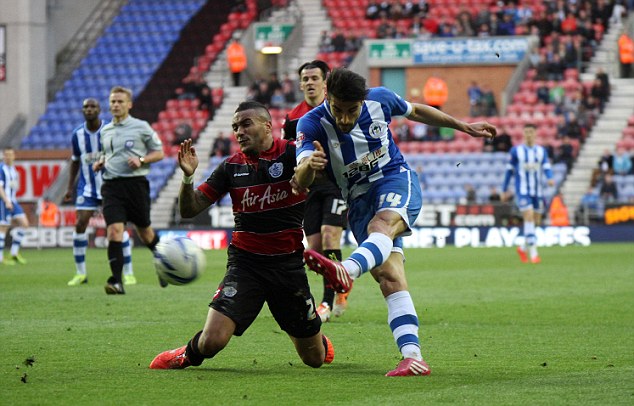
Hoilett goes down under Caldwell's challenge for a penalty.

Hoilett goes down under Caldwell’s challenge for a penalty.

Charlie Austin’s extra time goal heralded not only the end of the season, but the end of an era for Wigan Athletic.

The failure to beat the Londoners over two legs means another year in the Championship for Latics and a likely exodus of many of their most skilful players. This was a brave performance, full of spirit, against a strong QPR side.

Uwe Rosler kept the same lineup that played in the first leg except bringing in James McClean for Marc-Antoine Fortune. He was to use a tactic that had worked before in producing some of Latics’ best results of the season away from home – high pressing to disrupt the opponents’ play, followed by dogged defence. But defending a 9th minute goal for the remaining 81 minutes was always going to be a mountain to climb, let alone a team was playing its 62nd game of the season having to play extra time.

James Perch typifies the Rosler approach. He has been one of the mainstays of Wigan’s revival under the German, with his willingness to run himself into the ground for the cause. Just as he did at the Etihad, Perch got himself into the six yard box to convert an excellent 9th minute cross from the lively James McClean. QPR had been bamboozled by Rosler’s tactic of using McClean and Callum McManaman to high press their centre of defence. The result was the QPR defenders hoofing long balls, gobbled up by the Wigan defence.

McClean could have added a second as he ran on to O’Neil’s backpass, but instead of trying to round goalkeeper Rob Green he chose to make a theatrical dive. A good chance went begging and the Irishman got a yellow card from Mark Clattenberg for his actions. Not long after Shaun Maloney had a shot blocked by Green, but then QPR gradually got themselves back into the game. The high pressing had gradually disappeared from Wigan’s game and Harry Redknapp moved Kevin Doyle from right midfield to support Charlie Austin up front. Moreover James McArthur, who had been excellent in the midfield pressing, had to go off with an injury after 36 minutes, Roger Espinoza replacing him. It was a different contest now.

A shell-shocked QPR were gradually getting back into the game. Carson made a fine save from a fierce drive from Niko Kranjcar and McClean cleared Austin’s header off the line. But Latics went into the dressing room at half time with their lead intact.

McClean had another fine chance after the break, going through one on one with Green, but he did not have the control to convert it. Green blocked his first effort and McClean’s effort from the rebound hit the post and went wide. Although the home team’s attacks lacked coherence, Wigan became besieged. They could not hold on to the ball, the defenders hoofing it over the midfield to forwards who had little chance of retrieving it. Wigan’s three central defenders – Emmerson Boyce, Gary Caldwell and Rob Kiernan – had been superb in defence, repelling Rangers’ attacks.

Redknapp had brought on Korean left back Suk Yun-Young after 50 minutes for the combative Clint Hill, who had been lucky to survive the first leg after his deliberate elbowing of Kiernan. The pattern of play continued, with Latics unable to hold the ball and QPR applying pressure, but not convincingly. However, Redknapp’s substitution of big target man Bobby Zamora after 65 minutes for Doyle was to change the course of the game. Zamora’s striking rate is comparable with that of Fortune, but his physical presence and experience was to make the difference.

McManaman was replaced by Martyn Waghorn in the 71st minute. A couple of minutes later Zamora interchanged passes with Junior Hoilett who was brought down by a reckless challenge by Caldwell just inside the penalty box. Austin converted the penalty with ease. Moreover Caldwell had been injured in the challenge and had to be substituted by Leon Barnett. Zamora continued to cause problems and almost sealed it for QPR near the end of normal time, but his lob passed over Carson’s crossbar.

The game went into extra time with Latics playing with spirit, but the hoofing continued. The decisive goal came in the 96th minute when Zamora helped the ball through to Austin who got to it much quicker than Barnett to beat Carson. The final minutes of extra time saw Barnett pushed forward as Latics pumped in high balls. In the final minute a deflected shot from Kiernan passed narrowly wide of Green’s goal. It was not to be Wigan’s day.

The Good

The energy and passion shown by a Latics team playing its 62nd game of the season was truly exceptional. It was cruel that the game went into extra time, but those tired legs kept running to the bitter end.

The backline of Boyce, Caldwell and Kiernan had been immense in repelling the waves of QPR attacks until the penalty. It looked like Rosler’s gamble of starting Caldwell, who had played less than a handful of games in a year, was going to pay off until that fateful moment in the 73rd minute.

Rosler’s tactic of blitzing QPR from the start worked well. High pressing and a high level of physical fitness are key elements of the German’s approach to football and the players responded well, at least for the first quarter of the game. Starting without a centre forward was a brave ploy that almost came off.

It was sad to see Caldwell so visibly distraught on the sidelines after giving away the penalty and having to be substituted. It looks like his Wigan Athletic playing career is over. Up until that 73rd minute he had looked like the great defender and leader that he was in the closing part of the 2011-12 season when Latics ensured Premier League survival through beating the elite. He has also had some calamitous moments for Latics over the years, making rash tackles such as the one that turned this game. For some fans he has been a hero, for others a scapegoat.

Uwe Rosler deserves immense credit for the way he has lifted the club since the dark days of Owen Coyle. Reaching the semi-finals of both the FA Cup and the Championship playoffs has been a great achievement.

The Bad

Roberto Martinez would have scratched his eyes out if he had seen his team throw away possession as Latics have done, not only in this match, but in many others over these past months. Rosler has cut out the excessive sideways and backwards passing that could be so frustrating during the Martinez era. He has also tightened up the centre of defence. But he has not cut out the hoofing that started to rear its ugly head under Owen Coyle.

When a team “parks its bus”, as Latics did after scoring, it is important to hold on to the ball as much as possible. QPR did it fairly effectively at the DW last week.

In this match the Wigan defenders were once again prone to the big hoof, none more so than the goalkeeper. Carson is a fine ‘keeper, with a very powerful kick. But during Coyle’s reign he was making those long, speculative clearances and under Rosler he continues to do so.

The hoof is a part of Wigan’s play that needs to be cut out if Rosler is to maintain the continued support of Latics fans who have an expectation of good football.

Player Ratings

Scott Carson: 8 – a terrific defensive display. He made some fine saves and inspired confidence in his defence. Distribution poor.

James Perch: 8 – an excellent display. Took his goal well.

Emmerson Boyce: 9 –superb in his reading of the game. The best player on the pitch.

Gary Caldwell: 8 – excellent until the rush of blood for the penalty.

Rob Kiernan: 8 – excellent in defence.

Jean Beausejour: 6 – has not been at his best in recent weeks. Has a long summer ahead with the World Cup.

James McArthur: – led the high pressing with expertise. Badly missed when he went off after 36 minutes.

Jordi Gomez: 7 – not at his best, but got through a lot of work.

Shaun Maloney: 6 – still not at his sharpest.

Callum McManaman: 7 – worked hard closing the opposition down, but never received the service to make him more of a threat. When he was taken off after 71 minutes it dulled the Latics attack.

James McClean: 7.5 – an enigma once again. Worked so hard closing down the opposition and his powerful running was a constant threat to the QPR defence. His fine cross led to Latics’ goal. With better finishing he could have won the game for Wigan. What a pity.

Substitutes

Roger Espinoza: 7 – came on after 36 minutes. He was his usual energetic self, always involved, playing at high tempo.

Leon Barnett: – came on after 73 minutes. Has not been able to regain his previously good form since his injury at Ipswich.

Martyn Waghorn: – came after 71 minutes. Retrieving high balls is not his forte.


Like us on Facebook, or follow us on twitter here.


Have the loan players let Latics down?


Last night’s bore draw against Queens Park Rangers leaves Latics with a mountain to climb in the return game on Monday. After 61 matches this season can Uwe Rosler motivate his players to find sufficient energy and motivation to give it a real go at Loftus Road?

Significantly there were no loan players in the starting eleven to face QPR. Nick Powell and Josh McEachran were not even named in the squad. Jack Collison and Nicky Maynard were on the bench and the latter was called into play with less than 20 minutes to go.

The situation last night was calling for someone to come off the bench and do something special, as the game drifted towards a goalless draw. Maybe Powell could have chipped in with one his spectacular goals and McEachran’s passing might have unlocked QPR’s dogged defence? It was not to be.

When Uwe Rosler took over in December he inherited a squad with an average age of around 28. There were ten players who had been signed over summer by Owen Coyle, together with those brought in during the Martinez era. Two of Coyle’s initial signings had been loan players, Nick Powell and Ryan Shotton. Both made favourable impressions during Coyle’s tenure. The Scot also brought in Marc Albrighton and Will Keane on short term loans. The former looked useful, but the latter could not establish him. Ironically Keane is now on loan at QPR.

Once the January transfer window opened, Rosler too, was busy in the loan market.

His first acquisition was young defender Tyias Browning from Everton on a one month loan. Browning had a good debut after coming on after half time in a 3-0 home win over Bournemouth. However, he gave away a penalty in the 3-0 defeat at Doncaster and never appeared again.

Nicky Maynard, aged 26, was signed on-loan from Cardiff in mid-January. The striker had been dogged by injury and was in need of playing time. He made his debut in the 3-0 home win against Doncaster. Since then Maynard has started in 13 games, coming on as substitute 5 times. He has scored 4 goals and made one assist. Maynard has struggled with the physical demands of the lone centre forward role and is probably better suited to a twin striker system.

The 21 year old Josh McEachran was then signed from Chelsea, on loan until the end of the season. He made a fine start coming on in the 57th minute against Charlton. His exquisite pass in the 88th minute led to Marc-Antoine Fortune getting an equalizer, which was later converted into a victory through a Jordi Gomez free kick. McEachran had successful prior experience in the Championship division, having played 38 games on loan at Middlesbrough last season. At the time he looked a very good loan signing. Since then he has made 8 starts for Latics, with four appearances off the bench. In 6 of his 8 starts he was substituted on or before the 68th minute.

The 24 year old Martyn Waghorn made an immediate impact on joining on loan from Leicester City. He made his debut in the 1-0 defeat at Huddersfield on February 8th. Waghorn was soon to become a key player in Rosler’s set up with his versatility and his ability to take set pieces. Waghorn has made 15 starts, with just one appearance off the bench in last night’s match. He has scored 5 goals and has 5 assists. He has now been given a long term contract.

Ryan Tunnicliffe, aged 22, was signed on loan from Fulham at the end of February. He had a successful loan spell at Ipswich in the first half of the season. He made his debut as a substitute in the 4-1 win at Nottingham Forest on March 1st. He made his last appearance against Bolton at the end of March. Tunnicliffe struggled to adapt to Rosler’s system. He started in three games and came off the bench in two.

The 26 year old Jack Collison was signed in mid-March on loan from West Ham. His debut was off the bench after 61 minutes in the 2-1 home win over Watford. Collison came with a lot of Premier League experience with the Londoners. After initially looking like he could slot into Rosler’s style of play, his performances have been disappointing. He has made 5 starts, with 6 appearances off the bench.

In the 61 matches that Wigan Athletic have played this season they have used 35 players, out of which 10 were signed on loan. Only Powell has been on a season long loan, the remainder being half season or less.

The most successful of the loan players have been Powell, Shotton and Waghorn. But it would be fair to say that Albrighton impressed in his brief stay.

Uwe Rosler had a successful track record in using loan players at Brentford. In fact they had four players in the squad that recently won promotion to the Championship, who the German signed on loan. Forward Marcello Trotta, on loan from Fulham, made 37 league appearances for them this season. George Saville, midfielder from Chelsea, made 40 appearances. Blackburn’s Alan Judge made 22.

When Rosler first started bringing in loan players at Wigan it added an extra dimension to the squad, let alone lowering its average age. However, as the season progressed and games came in thick and fast, so many of the loan players disappointed. That led to Rosler having to be over-reliant on his key players, who have struggled to maintain their high performance standards after being overloaded with playing time.

That was evident yesterday as a starting lineup without loan players looked jaded and unable to raise their tempo.

There has been criticism of Latics’ current crop of loan players from fans who say they do not have their hearts in the club and think they are above it. They cite the perceived lack of effort from talented individuals like Powell and McEachran who will go back to their elite clubs, Manchester United and Chelsea. However, Collison is unlikely to survive the end of contract cull at West Ham and Maynard faces another season in the Championship with relegated Cardiff.

Why those loan players have not played up to potential is hard to determine. Maybe some of the criticism is valid, but injuries and physical fitness might also be factors. The bottom line is that, Waghorn excepted, they have not performed up to expectations.

Ideally Powell and McEachran in particular will come back on Monday and show us all what they are capable of. They are both talented individuals who could make a difference in the pressure cauldron of Loftus Road on Monday.

The likelihood is that they have played their last games for Wigan.

Like us on Facebook, or follow us on twitter here.

Wigan Athletic 0 QPR 0 – a damp squib

Skybet championship play off semi final, Wigan Athletic v QPR

Gomez latches on to Caldwell’s long pass after 42 minutes.

Seldom will one see a game as sterile as this, with so few chances created. It was a damp squib. A Latics team looking low on confidence had 58% of the possession, but never committed enough men forward to pose problems for the visitors’ packed defence.

Uwe Rosler surprised us by leaving Martyn Waghorn on the bench, playing Marc-Antoine Fortune up front with Callum McManaman and Shaun Maloney. Rosler preferred Rob Kiernan to Leon Barnett and he was joined by Emmerson Boyce and Gary Caldwell in a central backline of three. James Perch and Jean Beausejour were the wing backs, with James McArthur and Jordi Gomez in central midfield. Scott Carson continued in goal. Nick Powell did not make the squad.

Harry Redknapp put out a lineup with lots of creative players, but from the onset it was clear that his tactic would be to pack his defence and frustrate Latics. It was a measure of strength of the QPR defence that Wigan’s first decent shot on goal came after 42 minutes when Gomez pulled down a long pass from Caldwell and forced a good save from Rob Green. Carson had been virtually unemployed at the other end. It had been a scrappy, physical affair with McArthur, McManaman and Caldwell joining Richard Dunne in receiving a yellow card.

QPR came out more positively early in the second half with Junior Hoilett looking lively and having a shot go wide. Carson did well to punch away a cross from Hill, and then made a good save from a low shot from Traore.

Latics got back on top of possession and had the chance of the match when Kiernan found Fortune eight yards from goal, but the French Guinean spooned it wide. One was expecting Rosler to make his habitual substitutions around the 60 minute mark, but they were not forthcoming. The game continued to be scrappy, with Latics mainly relying on long balls which were gobbled up by the visiting defence.

The substitutes came after 76 minutes as Martyn Waghorn and Nicky Maynard replaced McManaman and Fortune, but it had little effect. The game reached its predictable conclusion in a dull goalless draw.

The Good

QPR came in to the match in better form than a Latics team that had lost 4 out of their last 6 games. It showed.

Wigan looked solid defensively.

Looking on the bright side Latics are still in with a chance in the return match on Monday.

The Bad

It was more like watching a game of chess rather than a football match. QPR stymied Latics, who had little to offer in the final third of the field. Apart from that first half shot from Gomez, Wigan’s flair players could not provide that telling pass or shot that would make the difference.

What was missing from Latics was tempo. Roger Espinoza is a player who can not only put energy into a game, but has a catalytic effect on his team mates. However, he sat on the bench the whole match. James McClean could also have come on and injected some life into Wigan’s play. He too was shunned.

We did not see Latics playing the Rosler way with high pressing and fast counterattacks. They were insipid and cautious, the wing backs holding back and not enough players getting in the box.

Fortune started the match after not having scored in his last 17 games. It was no surprise when he missed Latics’ best opportunity in the second half. However, that was the only opportunity he had, given the woeful service into the box. Rosler could be criticized for starting Fortune rather than Maynard who had scored two goals in the previous game. However, had Maynard started he would have been on the receiving end of too many long balls, which is not his forte. Fortune once again plugged away, given poor service.

Latics have played QPR three times this season and still not scored a goal.

However, all is not lost. An early goal for Wigan on Monday would provide a big boost for their flagged self-confidence and could see them go through. Stranger things have happened.

Player Ratings

Scott Carson: 6.5 – did all that was required of him.

James Perch: 6 – solid.

Emmerson Boyce: 6 – solid.

Gary Caldwell: 6.5 – solid in defence and put some decent long balls forward.

Rob Kiernan: 6 – looked comfortable in defence. Injured by Clint Hill’s elbow in the first half, unseen by the officials.

Jean Beausejour: 6 – solid in defence, seemed afraid to go too far forward.

James McArthur: 6 – worked hard to maintain possession.

Jordi Gomez: 6 – worked hard but could not put his stamp on the game.

Callum McManaman: 6 – could not find a way through a massed defence.

Marc-Antoine Fortune: 5.5 – spurned his only opportunity of the game.

Shaun Maloney: 6 – not at his best yet after a long time out injured.

Substitutes

Martyn Waghorn, Nicky Maynard: – came on after 76 minutes, but could not make the difference.

Like us on Facebook, or follow us on twitter here.

Will Powell be back for the playoffs?

nick-powell-wigan

Wigan Athletic have a paltry goalscoring record this season, notching just 81 goals in 60 matches. But among the goals they have scored there have been some absolute crackers. Jean Beausejour’s rocket shot at Derby, Jordi Gomez’s free kicks, Roger Espinoza’s 35 yard blinder against MK Dons.

But in terms of sheer self-confidence and artistry Nick Powell’s second goal in the Europa League home game against Maribor stands out. It is the kind of thing that one might expect to happen at places like the Nou Camp or the Bernabeu, but it was certainly a joy to see it at the DW.

Powell was the hero for Latics that night. His first goal had come after 22 minutes from a simple header into an empty net after the Slovenian goalkeeper had made a hash of a punch. Ben Watson scored with a header from Jean Beausejour’s cross some 12 minutes later. But Maribor clawed their way back into the game as Latics went flat, scoring after 61 minutes. Powell’s deciding goal came in the 91st minute when he somehow found the energy that most of his teammates did not have to slalom through the visitor’s defence and score with aplomb.

That was in early October and Powell’s stock was high. His name was being touted around the media as the one who could go back to Old Trafford and lift his parent club out of their lethargy.

Owen Coyle was clearly delighted to sign Powell on loan last August, saying “I said to David (Whelan) when I was bringing him in, for me it was a win-win-win situation.We would win out of it because we got a terrific player, Nick Powell would win because I’ve given him a platform to showcase his talents and Manchester United will get back a more-developed player with more experience and a player who can challenge; as we’ve done before with the Sturridges and the Wilsheres.There’s no doubt from me he can have a huge career.”

During the time Coyle was at Wigan it looked like his assessment of Powell’s potential might be right. The 19 year old was to get rich experience in Europe, starting in five of the six Europa League games and coming on for the last half hour in the other in Kazan. His first appearance for Latics was coming on as a substitute in the 2-0 defeat at Leicester on September 14th. Five days later he started in the unfamiliar centre forward position in the 0-0 draw with Zulte Waregem in Bruges. With experienced central strikers Grant Holt and Marc-Antoine Fortune struggling with injuries, Powell soon established himself in that position.

Alex Ferguson had signed him from Crewe in July 2012. Powell had been a boy wonder with the Railwaymen, making his debut at the age of 16. He was to get lots of media attention scoring a spectacular goal for Crewe in the 2012 League 2 playoff final, but he had already agreed on a move to Old Trafford before then.

The iconic Dario Gradi, Director of Football at Crewe, explained what Ferguson saw in Powell: “He is athletic, he’s a good size, he’s good physically and he’s bright, he knows where people are around him. His clever with his play, he’s not just twinkle toes. Nick’s got a brain and a desire and Alex spotted it on the strength of one outing.”

Powell had become a key player in Coyle’s squad. Given the number of games Latics were facing Coyle was operating a rotation policy but Powell seemed to be the one Latics forward who could go the full 90 minutes on a regular basis. It prompted fans to wonder about the fitness levels of his team mates. At the time of the Scot leaving the club in December, Powell had made 14 starts, 3 appearances as a substitute and scored 6 goals.

In both of Graham Barrow’s games in charge, Powell started, but was substituted early in the second half. He was pulled off after 65 minutes in Uwe Rosler’s first game, the 2-1 defeat at Maribor. However, in the next match he came back to play the full ninety against Bolton, scoring with a bicycle kick in Latics’ 3-2 win.

He scored a goal in the 2-1 win at Reading in the next match, but was taken off at half time. Around that time in late December media speculation over Powell’s future was going haywire. The main theme was that Manchester United were going to recall him from his loan spell. Another version was that he was either going to go on loan to another Premier League club for the rest of the season or another club was to sign him. The names of Everton and Swansea were often quoted.

In the event, Powell was to stay at Wigan until the end of the season. His next goals came after coming on in the 60th minute in the FA Cup tie at MK Dons when Latics were in trouble. His two well- taken goals helped them reach the fourth round.

Injury caused Powell to miss the month of February and he returned to the field on March 12th coming on in the 54th minute in the 1-0 home win over Sheffield Wednesday. Since then Powell has only completed two games, including a goal in the 3-3 home draw with Yeovil. His other goal was an 88th minute equalizer at Bolton, after coming on at the 70 minute mark. The last game he completed was the 1-0 defeat at QPR on March 25th.

Since Uwe Rosler’s arrival, Powell has made 12 starts, 10 appearances off the bench and scored 6 goals. The stats paint a different story than in the first half of the season under Coyle.

Nick Powell had an impressive start to his loan spell under Owen Coyle. Although Ferguson and Manchester United signed him as a midfield player,  Coyle thrust him into a central striking role. During Coyle’s tenure he looked the part.

The young player exudes a certain kind of arrogance in his body language on the field of play. Some have compared him to Berbatov, but under Coyle, Powell was willing to graft and defend in a way that would not typify the Bulgarian. Powell won the hearts of many Latics fans through not only his excellent technique and confident play, but also through the physical effort he put out for his team.

Somewhere along the line, Powell lost his way. He just has not been the same kind of player in the second part of the season. Have injuries and illness played a part? Has the extreme media attention got too much for him, above all not knowing where he will be next year? Or is it just that he is a young player, not long turned 20, who lacks consistency? The conspiracy theorists will say that there is a rift between Powell and Rosler.

What fans have seen over the past weeks is a Powell who has not shown the same kind of physical commitment that we saw earlier in the season. Moreover the swagger that the young player was showing in his body language earlier in the season was seen as a sign of self-belief, but  is now being interpreted by some as a “couldn’t care less” attitude. However, some would say that Powell has not been well used by Rosler, too often pushed out to the wings where he is less effective. At times under Coyle, he enjoyed a free role.

Nick Powell is a fine young player, who has represented his country at all youth levels 16-21. He has recently been nominated Crewe’s best player of all time. He is a class act and will almost certainly represent his country at senior level.

If Powell can make the playoffs – in a positive frame of mind and a good state of health and fitness – it might conceivably make the difference between another year in the Championship division or a return to the Premier League for Wigan Athletic.

Like us on Facebook, or follow us on twitter here.