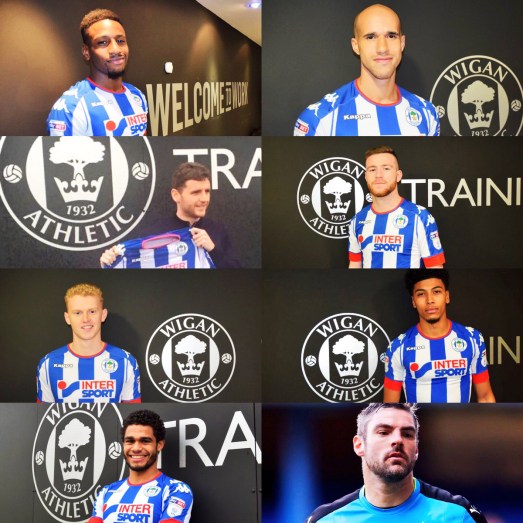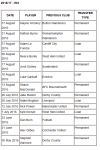
A murky future for Latics – a Chinese buyout or Mike Phelan?

A murky time for Wigan Athletic.


These are unsettled times at Wigan Athletic. A team that has relegation staring in its face unable or unwilling to show the urgency needed to stave it off. The departure of the Head of Football Operations with barely a murmur from the fans. A new contract for a player who has hardly made an impact this season. The Sun newspaper telling us that another of Alex Ferguson’s men could be taking over as manager. Then the blockbuster rumour that Dave Whelan is looking to sell up, with a Chinese consortium visiting the facilities at Christopher Park, Euxton and the DW Stadium.

The players are surely caught up in this too. It has been an awful season with so many of last year’s squad finding the step up to the Championship division tough.

Some will say that the squad just has not had enough quality to compete in the higher division, but there were players of flair and high technical quality there at the start of the season. Nick Powell was always going to be a risky signing, given his horrendous problems with injury in recent years, and so it has proved. Saturday’s cameo appearance shows what a difference he could have made if he could have stayed fit. Jordi Gomez was another flair player and he had a great record in the Championship division with Latics and Swansea.  Gary Caldwell used him sparingly, Warren Joyce too, being seemingly content to shunt him off to Spain in January. Joyce also lost Latics’ most dynamic player and potential match winner, Yanic Wildschut, to Norwich City’s over-generous offer in January. Alex Gilbey too had shown flair early in the season before receiving a serious injury from which it took him months to recover.

Having had to make the massive shift from the possession football of Gary Caldwell to the hoofball of Warren Joyce the players have lost much of their ability to pass and receive the ball. Moreover with the end of the season approaching and League 1 beckoning, so many will be unsettled. Until the last couple of games a willingness to fight for the cause has rarely been lacking in the players, who have suffered so many heart-breaking defeats by fine margins. The seeming lack of urgency is surely a manifestation of a feeling of insecurity for so many of them. They know that the last time Latics were relegated there was a huge exodus of players, with 22 new players coming in.  Indeed some may have already been told to start looking for another club.

Matt Jackson’s departure was labelled as “the end of a consultancy period” on the club web site. After rejoining Latics in 2011 the ex-team captain had taken over as Head of Football Operations. Interestingly the club communique tells us that Jackson had not been involved in player recruitment for the past 18 months, although he was part of the newly formed Player Recruitment Department from the summer of 2015. Jackson was heavily involved in the Latics Academy and the switch to Euxton.

The announcement of a new two year contract for another ex-captain came as a surprise to many of us. Craig Morgan was a rock upon which League 1 was won last season, but has not had an easy time this year. Injuries and an infection have limited his availability and the 31 year old has made just 12 starts and 5 substitute appearances this season.  The contracts of Jussi Jaaskelainen, David Perkins and Stephen Warnock are also due to expire in June.

Given the results it is appears more and more unlikely that Graham Barrow will continue as manager next season. Indeed there are even rumours that a new manager may be brought in before the season finishes. Doing so would give a new incumbent the opportunity to decide on contracts and the players he would like to keep.

For weeks now we have heard rumours that ex-Hibernian and Rotherham manager and Bolton and Everton player, Alan Stubbs was a frontrunner. The rumours may have been fuelled by the fact that John Doolan, who was Stubbs’ first team coach at Hibs, has already rejoined Wigan. Moreover Stubbs will have been visible watching his son, Sam, play for Latics’ youth team and development squad. However, the assertion that ex-Manchester United assistant manager, Mike Phelan, might be taking the reins has already been met with concern by fans.  It also appears that a return for Gary Caldwell is a possibility.

To add to all of this uncertainty the alleged visit of a Chinese consortium is of even more import. The visit might well be tentative, but is this an indication that the 22 year Whelan dynasty will soon come to an end?

Much has been said and written about DW’s incredible success at the club. If he had not taken over in February 1995 what would have happened? Would another buyer have come in and made the investments that Whelan made? Not likely. The club was not an attractive proposition at the time, languishing in the fourth tier with attendances so often below 2,000. Its only real asset was Springfield Park. Whelan invested  with a mission to propel his home town club into the Premier League. Estimates vary as to how much he put into Wigan Athletic, but the figure appears to be somewhere between £90 m and £100m.

The club is surely more sellable in 2017 than it was in 1995. It has a more tangible “brand” after its successes in recent years – winning the FA Cup, reaching the final of the League Cup, eight years in the Premier League. But other than its players what assets does it have? Both the DW Stadium and the Euxton facility are owned by companies linked with the Whelan family, not the club itself.

Should the Whelan legacy continue we can expect continued financial backing for the near future at least. The club will be expected to be as financially self-sufficient as possible, although achieving that whilst maintaining success on the field of play will be a challenge. Wigan Athletic’s fan base has grown to maybe five times what it was in 1995, but still does not match those of the majority of clubs in the Championship. It is more akin to those of clubs in League 1. Moreover to maintain attendance levels the club has had to resort to cut-price season tickets. Put simply, the club will not have the revenue to seriously compete, even in League 1, unless there is backing from the ownership.

However, although Dave Whelan will surely provide a buffer for the club in the near future there appears to be no way that he will be making the scale of investment he has in the past. Given the club’s current predicament it is highly unlikely that it will reach the top tier of English football again in the foreseeable future.

Eleven of the twenty four clubs in the Championship are now owned by overseas investors. Aston Villa, Birmingham City and Wolves are Chinese owned.

In the long term it is unlikely that the Whelan family will continue to inject funds into Wigan Athletic. There will surely come a point where they will say “enough is enough”, but would anyone be tempted to buy a club that does not own its own stadium or training ground?

It is a time of uncertainty at all levels within the club. Ownership and management issues further cloud a murky near future.


Like us on Facebook, or follow us on twitter here.

Fighting for points through set pieces?

buxton

Jake Buxton’s header at QPR brought a great save from Alex Smithies

It almost happened again. A good corner kick from Jamie Hanson and a bullet header from Jake Buxton. It would have put Latics 2-1 up at QPR, but a fine save by Alex Smithies prevented it.

Another header from Buxton from a Max Power corner had given Wigan Athletic an invaluable three points at Wolves a week before. A week earlier and Omar Bogle had headed home a goal against Norwich from corner kick launched by Michael Jacobs. Jacobs had also provided the delivery from the corner for Callum Connolly’s second goal at Burton in mid-January. Has Warren Joyce been placing more focus on set pieces during training?

Barnsley, Cardiff City and Newcastle United have the best record in the Championship division on set pieces in the season so far, each with 17 goals. Leeds United come next with 16 goals, 10 of which came from corners. Wigan only have 8, second worst to Aston Villa with 3. In fact, one of the most frustrating aspects of Latics’ play this season has been their performance on corners and free kicks. Too often the delivery from corners has failed to reach the centre of the goalmouth and the players waiting in and around the box have been too passive in their approach.

Latics have an average of 11.4 shots per game, only Blackburn Rovers having a lower average count. The stats show that Latics average a respectable 13.3 shots per game at home, but away from home only 9.6 shots per game, the lowest in the division. Wigan are clearly more disciplined when playing at home, where they have collected 28 yellow cards. They have received 42 away from home, the highest in the division.

West Bromwich Albion lead the Premier League in terms of goals from set pieces. They have 15, 11 of which have come from corners. Under Tony Pulis they have become a compact unit, with a tough defence and a high work rate. They have the lowest average possession rate at 40.7%.

There are arguments to the effect that football teams should not be obsessed with possession. But Roberto Martinez was certainly a believer and by maintaining possession his teams were more able to withstand the physical demands of the Premier League, more often than not playing against teams with technically superior players. In fact the top six teams in the Premier League table also have the top six possession statistics.

Wigan Athletic’s current average possession rate of 49.3% is the 13th highest in the division, but has been on a strong downward trend since the departure of Gary Caldwell. The emphasis on passing has been superseded by what is euphemistically called a more “direct approach” under Warren Joyce. Given Joyce’s previous reputation as coach of a Manchester United reserve team that played entertaining, flowing football it is difficult to fathom why he has resorted to such methods. Is Joyce trying to stave off relegation by transitioning to a Pulis-type approach?

However, 45% of West Bromwich’s goals have come from set pieces, compared with 27% for Wigan. Given the lack of flowing football from Joyce’s teams, making goals from open play relatively scarce, it is essential that they improve their conversion rate on set pieces.

In the 2014-15 season when they were to be relegated Wigan Athletic’s average possession was 51.6 %. They had an average of 13.7 shots per game. They scored 15 goals from set pieces, 8 of which were from corners. The previous season when they reached the Championship playoffs they had 52.3% possession and 14.7 shots per game, with 17 goals from set pieces.

Although results are the primary concern for Wigan Athletic fans at this moment in time there are many who would like to see Joyce’s team playing in what David Sharpe once named “The Wigan Way”. What that actually means is open to conjecture. The best quality football that Wigan Athletic have probably ever consistently played was from March to May 2012 under Roberto Martinez, while among the most exciting was the attacking play of the Paul Jewell era.

The football played by the current team is far removed from those halcyon times, closer to that of the days of Malky Mackay. But the very minimum most fans want is for Joyce to send his team out to win, rather than not to lose.

In the meantime, with the shortage of goals from open play and a lack of willingness to throw players forward, it is the set pieces that can prove crucial for Latics’ survival in the Championship division.

What are the chances of a set piece goal against Nottingham Forest tomorrow?

 
Like us on Facebook, or follow us on twitter here.

High turnover but what’s changed? A perspective on Wigan’s latest window

c3kuvlmwiaqxpzs

Management hates it, the media loves it, fans have little choice but to be glued to it in hope and trepidation. Transfer deadline day is bigger business every year that goes by. It’s one of the ways – the lack of a winter break being the other obvious one – in which the British game likes to make things that bit more complicated (and profitable) than the rest of the world.

For clubs that swapped managers during the first half of the season, the January transfer window has become an opportunity for the new regime to stamp its authority on the squad. Ship out players that don’t fit the tactical model; replace them with players that do; balance the books by shedding big earners and reinvesting in problem positions. It’s a pattern that has become all too familiar at Wigan, with last year’s success in League 1 the notable exception.

There are a couple problems with this approach. First, you have less time in January than in the summer, not only to recruit good players and find a home for high-earning misfits, but just as importantly to provide incomings the tactical and personal adaptation period they need to succeed. On top of that, you have to navigate an inflated market to negotiate fair prices for players, which can be particularly challenging if you appear desperate, as one does in a relegation fight, for example.

Another unpleasant feature of the January transfer window well known to Latics, particularly in the Premier League days, is the risk of losing your most successful players. It tends to be instigated by agents or players themselves, and to materialize in the dying hours of the window, preventing the club from finding an adequate replacement. Sometimes, these decisions become of huge financial importance to the club, and their approval is beyond the manager’s control.

Add to this Wigan’s very limited spending power compared to its Championship competitors – and you realize what a big ask we as fans are making of the manager. It’s worth pausing to put oneself in Warren Joyce’s shoes. There are plenty of arguments claiming the manager should only be judged after a window. I’d take them a step further to suggest that’s still nowhere near enough time. The new players haven’t had a pre-season with him; many will need to adjust to playing at a higher level; all will have to adapt to new surroundings and teammates; and Joyce himself will need to adapt his tactics, having lost his most valuable player.

The counter argument, of course, is that Joyce brought some of these challenges upon himself. Too much turnover is bad for any organization, specially in a short period of time, and the high number of ins and outs will breed instability. Was it really necessary to bring in so many people, so many loanees in particular? Right when the team was gaining some consistency and producing results on the pitch? Plenty to debate. In the meantime, here are some ups and down on another busy window:

Good News: The whopping fee received for Yanic Wildschut (£7.5 million according to Sky,£7 million elsewhere.) It’s hard to take, given his status as Latics’ best attacking threat, with pace and strength to burn, and room to improve. But his finishing was often frustrating, he was inconsistent, and very much rough around the edges. If he had to go, credit is due the club for gaining such a huge profit on their investment.

Bad News: Yanic again. Being gone so late in the window. It’s hard to ignore that Wigan have scored three goals fewer than Rotherham, and yet just sold their most effective attacker.

Good News: In Gabriel Obertan, the club have found as close to a direct replacement as could be expected. We’ll be left to imagine what Joyce’s team might have looked like with two pacey wingers on the pitch. But at least Obertan’s defining attributes are similar to Wildschut’s: pace and strength, some trickery, abundant potential yet inconsistent finishing. He should be entering his peak years, has something to prove, and lots of experience at a higher level. Joyce knows him, he’s apparently a good professional, and they have said encouraging things about each other. The term of contract is short, therefore financial risk is too. All in all, a gamble worth taking.

Bad news: The squad feels unbalanced and bloated. There are a lot of midfielders, but few wingers or attacking playmakers given Nick Powell’s absence. With Obertan almost certain to start, it’s likely Michael Jacobs (in desperate need of a goal) on the other wing, with Colclough, Weir and Browne all unproven backups. Meanwhile, in the centre of midfield, Joyce has Power, Morsy, Perkins, MacDonald, Gilbey, Tunnicliffe, Hanson, Byrne, and Laurent to keep happy. Perhaps some of these players will be used in different positions (Hanson as defensive cover, etc.), but it’s a bloated, uneven squad that Joyce may have a hard time keeping happy.

Good News: Welcome Omar Bogle! He may need time to adapt. But the club beat out competitors to get him, and on paper, he has everything he needs to succeed at Championship level. A lot of hope is resting on his inexperienced shoulders, but if his teammates can provide him service, there is reason to believe. The option of a little-and-large Grigg and Bogle parternship is also intriguing. He’s left-footed, too.

Bad News: Banking on lower division signings is playing with fire. If Grigg is to become injured, Latics are left with Bogle, and Mikael Mandron to lead the line. Both have potential, but their success has come in League 2 and the Conference, respectively. They are completely unproven at this level, and playing with new teammates.

Good News: Alex Bruce appears an astute short-term signing, with potential for a longer stay. Dan Burn and Jake Buxton have developed a useful partnership in recent games, but Bruce is a dependable and experienced head to provide backup, who should also be good to have around the place.

Bad News: He hasn’t played all season due to an Achilles injury.

Good News: Keeping Sam Morsy and Max Power. Much of the attention has been on keeping Morsy, who has performed very well since his return. Power may not have started strongly, but has been steadily improving and remains a player of undoubted potential. Had rumours of his departure materialised, Latics would have lost an opportunity to reap the rewards of blooding him at this level. Good things should come of establishing Power and Morsy as a partnership.

Bad News: Too many loanees. In order to secure loan signings, managers often have to pledge a certain number of game time to the players’ parent clubs. Given the maximum of five loan signings per match-day squad, it looks an impossibility Latics’ recent loan signings will all get their wish to show what they can do. Jakob Haugaard may find himself sacrificed given the arrival of Matt Gilks. Callum Connolly is certain to play. That leaves Jamie Hanson, Marcus Browne, James Weir, Ryan Tunnicliffe, Bruce and Haugaard to vie for the other berths. Presumably, borrowing players and not giving them a game reduces the chances of players being borrowed from the same clubs in the future. Given many of these players are expected to be fringe players anyway, might Latics have been better off without a few of them?

Good News: Joyce appears to have both a short-term, and long-term plan. Signings like Gilks, Bruce and Obertan point to survival needs, while the signings of Jack Byrne, Mandron, and Josh Laurent show a continued desire to invest in youth and capitalize on Joyce’s wealth of experience in the area of player development. Byrne, in particular, was highly rated at City and appears a good long-term signing.

Verdict

Despite the high turnover, it doesn’t appear likely there will be immediate, dramatic changes to the starting lineup – Obertan in for Wildschut, perhaps the goalkeeper, and a new striking option in Bogle off the bench. This should prove a blessing, given the progress made in recent weeks. But it also calls into question the need for such a high number of incomings and outgoings. Joyce would do well to resist the urge of upsetting the players who have recently given him good commitment and results.

As supporters, patience is going to be important. Demanding instant impact from players adapting to a higher level is unfair, as is demanding instant adjustment from a team that became dependent on Wildschut to create for it. But if the new signings can add to the promising form shown of late and provide cover for injuries, we can be cautiously optimistic that, with a new crew of Joyce-loyal players and relative stability in the starting XI, we’re better off than before the window.

Full squad can be seen here

Is it Caldwell’s fault?

blame

There are various views on why Wigan Athletic are in their current predicament. Some say that Gary Caldwell should have been given more time to get things right in the Championship. Others point to a woeful start by his replacement, Warren Joyce, with puzzling team selections and tactics.

But a view that has been gaining more and more ground on the social media is that it was the recruitment over the summer that is the principal reason. Put simply, some people say that the players just are not good enough.

In May 2015 Wigan Athletic chairman, David Sharpe, announced a change in the club’s player recruitment structure. He considered it “crucial for long-term benefit of Wigan Athletic”. We were told that the new recruitment team was to be led by the Head of Football Operations, Matt Jackson, who together with Chief Executive, Jonathan Jackson, and Academy Head, Gregor Rioch, had been involved in reshaping the club’s Academy.

As stated in an article we published last week “A mental amount of movement”, in the  2015-16 season, Latics had 31 incomings and 44 outgoings of players, loans being included. The figures for the first half of the 2016-17 season were 14 coming in and 20 leaving. Since the article was published there have been two more outgoings, with Craig Davies having joined Scunthorpe and Nathan Byrne sent off on loan to Charlton. There has been one coming in, goalkeeper Jakob Haugaard.

The figures alone provide food for thought and debate. Is the huge turnover in players over the past couple of seasons an indicator of recruitment strategies that just have not worked or is it an indication of a chasm between recruitment and coaching? More crucially, why is the club that won the League 1 title struggling in a position below the other two clubs that were promoted? Is the recruitment team capable of making the right kinds of decisions? But crucially, how does the manager fit into the scheme of things?

It has been said that at Arsenal, Arsene Wenger’s influence is total. According to an article in the Guardian, Wenger “… is the lord of the kingdom he has built over the past 19 years. His influence extends into every pore of the club and where transfers are concerned, the manager’s authority is total. Wenger always has the final say. The board have attempted to put support systems in place around him, such as their purchase of StatDNA, the football data analytics company, which can help to identify potential signings. But Wenger continues to rely on his own eyes, together with those of his scouts.”

A comparison of Liverpool in the Brendan Rodgers era makes interesting reading. The Guardian tells us that Rodgers, the head of recruitment Dave Fallows, the chief scout Barry Hunter, the head of performance and analysis Michael Edwards, the chief executive Ian Eyre and FSG’s president Mike Gordon comprised the group that decided Liverpool’s entire transfer strategy.

There is clearly no blueprint for successful recruitment at any club. The top clubs in England have recruitment teams, whose composition tends to vary, using an increasingly data-driven approach. Some managers have more autonomy than others in determining the players they want, although the chairman tends to have the final word on the financial side.

At the end of May 2016, Gary Caldwell told us Latics were looking at bringing in four or five new players. That did not happen. By the end of the transfer window 14 new players had been brought in. However, 20 had gone.  The inference is that Caldwell had realised between May and the end of August that many of the players he had were not up to Championship standard. But was this solely Caldwell’s call? What say did the recruitment team have in that higher than expected turnover of players in summer?

Caldwell surely had a say in the players who left. His decisions to break up the successful central defensive partnership of Craig Morgan and Jason Pearce and send midfielder Sam Morsy off on loan were certainly controversial. But the overriding criticism has been that the players who were brought in were no better than those the club already had. Whether that is down to Caldwell, the recruitment team or financial matters is something that as onlookers we cannot say. However, we can take a look at the players who were brought in over summer to make assessments.

Nathan Byrne was signed from Wolves near the end of the summer transfer window for a fee reputed to be around £400,000. Caldwell signed Byrne essentially a right wing back, although he can play on the wing. Although he has only been at the club for around 4 months he has been sent off on loan to Charlton. Byrne made 6 starts with 8 substitute appearances. Joyce has not yet shown any inclination to use a back three with wing backs.

Goalkeeper, Adam Bogdan, was brought in on a one year loan from Liverpool, after a tough time at the Merseyside club. Being an ex-Bolton player hardly endeared him to the Wigan public. Neither did taking the place of fan favourite Jussi Jaaskelainen, as he had done before at the Macron. Bogdan had been a fine keeper at Bolton, but despite often making excellent saves and keeping his side in games when the defence was under pressure, his high profile error at Brighton and a hesitancy to leave his area  were problematic. When injury curtailed his season many fans were not unhappy to see him go. Jaaskelainen regained his place after Bogdan’s injury but he too made an error which led to a home defeat by Huddersfield. The Finn was replaced by Jakob Haugaard last Saturday. In the meantime rumours suggest that Joyce is also trying to sign Rangers keeper, Matt Gilks.

Luke Garbutt was signed on a half season loan to provide cover for the left back position, with Reece James being unavailable due to long term injury. Garbutt had had a reputation as a player for the future at Everton, but had come to Wigan after an indifferent spell on loan at Fulham in 2015-16. Playing as a wing back, Garbutt started against Nottingham Forest and QPR in late August. However, he was substituted after 59 minutes against Sheffield Wednesday on September 10 and did not appear again until Joyce took over as manager. Garbutt was used in midfield or at right back before returning to Everton at the end of his loan period in early January. Although he showed considerable expertise in taking set pieces, Garbutt’s all round play often failed to convince.

Reece Burke was signed on a season-long loan from West Ham, following an outstanding stint at Bradford City last season. Given the departure of Jason Pearce and the marginalisation of Craig Morgan by Caldwell, it appeared that Burke would be a strong contender for a position in the centre of defence. However, Burke was used in the right back position and made 8 appearances before returning to his parent club due to a hip injury in December. We surely did not see the best of the 20 year old playing out of his best position.

Dan Burn and Jake Buxton were signed from Fulham and Derby County respectively. They have become the regular central defensive partnership. Burn had a difficult start riddled with hesitancy and occasional major errors, but has shown much more consistency in recent games. Buxton’s start to the season was punctuated by a suspension following a red card in the League Cup tie at Oldham. But since then he has shown himself to be a consistent, reliable performer. Neither Burn not Buxton is at his best passing the ball out of defence, a key aspect of play under Caldwell. However, under Joyce it is not so crucial.

Whether their partnership is better than that of Morgan/Pearce is open to conjecture. The question that remains is why the latter partnership was not given a chance at Championship level, allowing a more gradual transition as needed. But the way that Pearce was hastily dispatched to Charlton and Morgan stripped of the captaincy suggests that there were more than footballing issues involved.

Sam Morsy’s recent return to Wigan has opened up the debate as to why he was sent off on loan. Under Caldwell, Morsy played the holding midfield role in front of the back four, but on Saturday he was pushed further forward with Shaun MacDonald behind. MacDonald arrived without  a big fanfare. He had been instrumental in Bournemouth’s rise up the divisions, but his career had been stifled by limited first team appearances in the Premier League. Moreover he was taking over the Morsy role, inevitably inviting comparisons.

Like Morsy, MacDonald is strong in the tackle, and although he does not reveal the range of passing that Morsy possesses, he rarely wastes the ball. However, at 6 ft 1 in, MacDonald is strong in the air and has the ability to step back and become a third central defender. Like Buxton, MacDonald has become the kind of unsung hero whose name will be among the first on any team list. Should Joyce be able to persuade Morsy to stay, the two together would provide a ring of steel in midfield.

The 22 year old Alex Gilbey was signed after impressing for Colchester United and has shown himself to be a technically skilled player, willing to work hard. Gilbey was making a successful transition between League 1 and the Championship until an injury against Fulham in mid-September. A recent tweet from the player suggests he could be back in action by the end of this month.

When Jordi Gomez was signed on loan from Sunderland, hopes were high that he could repeat the kind of form that made him Latics’ Player of the Season in 2013-14. Although we have seen flashes of the true Gomez on occasions we have not seen him play with the same kind of consistency that we saw in his time under Uwe Rosler. Joyce will be hoping that the play-maker’s form will improve, his ability to keep hold of the ball in midfield being so important when the defence is under pressure. Moreover the Catalan has the ability to drift in from midfield to score goals.

Caldwell’s biggest gamble over summer was in signing the injury-riddled Nick Powell on a three year contract. It is a gamble that has not yet paid off. Powell has been unable to get any consistency to his game, being constantly niggled by injury. The hamstring tear received on Saturday looks set to keep him out for the rest of the season. Powell’s career continues to hang over the abyss, a sad situation for such a talented player.

Rumours suggest that Cardiff are to cut short Adam Le Fondre’s loan period at Wigan in order to sell him. Given that Bolton are one of the clubs who apparently want “ALF” it seems unlikely that Cardiff will gain much in transfer revenue. But Le Fondre has been given few opportunities during his time at Wigan and the player himself might well want to move on. The 30 year old has made just 3 starts, with 8 appearances off the bench, scoring 1 goal.

20 year old right back Kyle Knoyle was signed on loan from West Ham but suffered an injury in pre-season that kept him out for months. His only appearance so far has been as an 89th minute substitute at Cardiff at the end of October.

Kaiyne Woolery, 22, was signed from Bolton Wanderers for a small fee. His sole appearance has been as an 87th substitute at home to Derby in early December.

The summer signings involved a relatively small financial outlay. Five players were brought in on loan, four on free transfers (Burn, Gomez, Powell, Warnock), Byrne for around £400,000, MacDonald for reputedly £125,000, Gilbey for a compensation fee, Buxton and Woolery for small fees.

Wigan Athletic may have even made a profit on their summer transfer dealings, having recouped around £1m for the sale of Emyr Huws to Cardiff plus small fees for Tim Chow and Jason Pearce.

In hindsight should David Sharpe have given Caldwell more financial support in the summer market? Were Caldwell’s hands tied, to some degree, in making the kinds of quality signings he would need to strengthen his team to compete in a higher division?

The well-publicised signing that did not come off over summer was that of Hearts right back, Calum Patterson. Wigan’s bids fell well below the Scottish club’s evaluation. Latics went on to pay a significant amount to sign Nathan Byrne, but the player did not have the defensive qualities to play as an orthodox full back. In retrospect, would the extra money that would have been needed to secure Patterson have been well spent, given that the right back position has been so problematic this season?

However, another factor facing the club was the prospect of the parachute payments running out at the end of the season. An immediate return to the Premier League would be ideal, but to mount a promotion push would have involved a major financial outlay in terms of transfer fees. Moreover should the bid not be successful Latics would be left with players on big contracts without the financial support of parachute payments.

In fact the summer transfer activity suggested that Latics were looking for consolidation, both in terms of league position and in finances. In order to compete for players, free agents included, the club has had to offer salaries commensurate to the division. However, other than the case of Nick Powell, the highest earners are largely on loans or contracts that expire at the end of the season. They include Adam Bogdan, Jordi Gomez, Adam Le Fondre and Stephen Warnock. Should the unspeakable occur once again – relegation – the club would sell off its prime assets and drastically reduce its wage bill.

So, is it Caldwell’s fault that Wigan Athletic are in relegation mire?

Many would fault Caldwell for the premature departures of Morsy and Pearce at the beginning of the season. Some would say he should have preferred Jaaskelainen to Bogdan, although the Finn is now 42 years old and well past his best. Perhaps he should have kept the backbone of his League 1 title winning team in place, phasing in the newcomers. Momentum was probably lost as a result.

However, in terms of recruitment Caldwell was at the mercy of both his chairman and the recruitment team. Burn, Buxton, Gilbey and MacDonald are by no means bad signings. Gomez has struggled to impose himself, but he has enough quality to do so in the second half of the season. Whether Woolery will ever achieve his potential remains to be seen. The management will be praying that Powell can rid himself of the hamstring problems that have dogged his career in recent years. At his best he is one of the top players in the division.

Caldwell used the loan market to good effect last season, but the rules governing loan signings changed, stays of less than half a season not now possible. Summer’s loan signings have been largely disappointing.

Latics are in relegation dog-fight partly because of mistakes made by both managers, Caldwell and Joyce, but the incomings and outgoings of summer transfer market may have had a more major effect.

If anyone or anything is primarily to blame for Wigan’s current position it has been a lack of ambition on the part of the club. Let’s hope Sharpe will back his latest manager in the January transfer window. That means not selling off his most saleable assets and bringing in more quality.


Like us on Facebook, or follow us on twitter here.
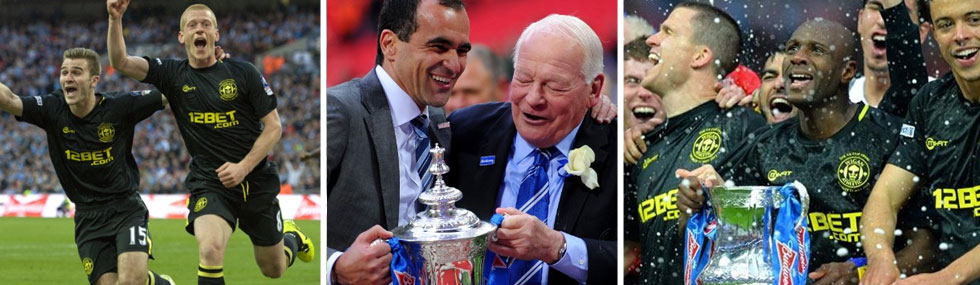
A mental amount of movement

nixon

Alan Nixon is not every Wigan Athletic supporter’s favourite journalist. But he is very active on Twitter and seems to get hold of inside information on what is going on at the club. Sometimes his prophesies come to fruition, but not always. Since tweeting the above message he has let us know that Bolton are interested in Adam Le Fondre and that Nathan Byrne and Craig Davies are on their way out to League 1.

Nixon’s phrase a “Mental amount of Movement around Wigan” seemed to strike a chord. There has been an extraordinary turnover of staff over recent years. Since the summer of 2015 we have had six managers – Roberto Martinez, Owen Coyle, Uwe Rosler, Malky Mackay, Gary Caldwell and Warren Joyce. Coaching staff have come and gone, with the exception of Graham Barrow who is in his eighth year since re-joining the club in July 2009.

When Warren Joyce was first appointed there were rumours of him being joined by ex-Manchester United stalwarts, Paul McGuinness and Jim Ryan. Since then there have been no announcements from the club, but yesterday a photo of McGuinness involved in Latics’ training appeared on Twitter.

mcguinnessRavel Morrison appears with Nick Powell, with another ex-United player, Cameron Stewart partially hidden behind Dan Burn.

So, the turnover at Wigan continues. McGuinness looks set to come in, but whether that would mean a departure for Barrow remains to be seen. Nixon could well be right about the possible ins and outs over the January window. The numbers might be well short of those of fire sale of January 2015, but could match those of last January.

The club itself has published details of the ins and outs of players at the club since May 2015. There has been a huge influx and outgoing of players since then. The stats cause one to question the club’s recruitment policies. Why has there been so much turmoil and when will it stop?

According to the figures released for 2015-16, there were 31 incomings and 44 outgoings, loans being included.

The stats for 2016-17 up until the summer transfer window show 14 coming in and 20 leaving.

The critics will say that the huge turnovers have been caused by poor recruitment, players being brought in but released within months. Indeed, if the rumours of the impending departures of Nathan Byrne and Adam Le Fondre prove to be the case then a couple of players acquired at the end of August 2016 will be gone in January 2017.

In some cases, such players have been recruited as free agents or for nominal transfer fees, although in others the quantities will have been more substantial. So many players have been given away at knockdown prices in efforts to bring down the wage bill and clear the way for new ones coming in.

Changes of manager have exacerbated the situation, with the newcomer typically wanting to bring in his own men, supposedly to fit into the style of football he prefers, although one remains to be convinced that has always been the case.

People have expected an influx of ex-Manchester United personnel since Joyce arrived. It could well be that Ravel Morrison and Cameron Stewart will be the first contingent to join Reece James, Andy Kellett and Nick Powell who worked with Joyce in Manchester.

Wigan Athletic’s recruitment policy continues to be a cause for concern, both in terms of causing instability and coming with a heavy financial burden that the club can ill-afford. The agents’ fees alone for all those incomings and outgoings would make interesting reading.

It has indeed been a “mental” amount of movement.

Like us on Facebook, or follow us on twitter here.