A Portsmouth fan’s view of Paul Cook


 Paul Cook – the right man for the job

As expected, the announcement came yesterday of the appointment of Paul Cook as manager of Wigan Athletic. He joins the list of ex-Latics players who have managed the club in recent years along with Gary Caldwell, Paul Jewell and Roberto Martinez, together with Graham Barrow in short term stints.

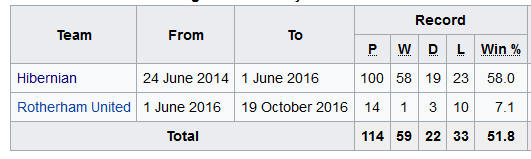
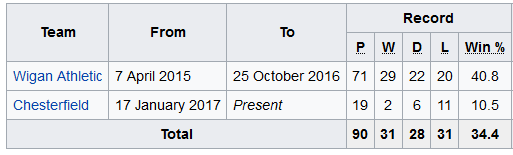
Cook’s  impressive track record as a manager is reflected in his stats:

Courtesy of Wikipedia

Following Cook’s appointment, chairman David Sharpe commented on the club’s official site that:

“Paul was the man that I felt was best to take this club forwards after looking at the jobs he has done at Chesterfield and Portsmouth in the last four seasons.He has won two promotions, has never been outside of the top six, has a 50% win ratio and also plays the brand of football that I think is the best for this football club. Moving forwards, I’ll be delighted to see Paul’s work in progress and I have a good feeling about it.”

Adding that:

“The man I met, in terms of his character and how lively and energetic he is, makes me believe he will be a lift for the whole place and I think we need that sort of character.He’s very bubbly, will have the boys playing with a smile on their faces and I am looking forward to what he will bring it.”

The social media and message boards have been awash with comments from Pompey fans regarding Cook’s departure with one year still remaining on his contract. The Portsmouth FC official site stated that:

“Paul Cook has stepped down as Pompey boss to take up the vacant managerial position at Wigan Athletic. A financial compensation agreement was reached with Wigan over the weekend, resulting in permission being granted for the Latics to speak to Paul. Assistant manager Leam Richardson has also left Fratton Park. Cook arrived at Pompey in May 2015 and led the club to the League Two play-offs in his first season in charge. There was even more success at the end of last term, with the Blues earning automatic promotion and securing the title on a dramatic final day. Portsmouth Football Club would like to thank Cook and Richardson for their service to the club. “

The likelihood is therefore that Richardson will be joining Cook at Wigan as his assistant.

The 37 year old Richardson, born in Leeds, began his playing career at Blackburn Rovers as a right back. He signed for Bolton Wanderers in July 2000 for a fee of £50,000. Loan spells followed at Notts County and Blackpool before the Tangerines signed him on a permanent contract. Richardson went on to make 71 appearances for Blackpool before joining Accrington Stanley in August 2005. He was to stay there for 8 years making 133 appearances. He took over as caretaker manager in January 2012 until Paul Cook took over a month later. When Cook left Accrington in October 2012, Richardson took over as manager. However, he was to join Chesterfield in May 2013 as Cook’s assistant manager, subsequently moving on to Portsmouth with him.

In order to get an overview of Paul Cook’s time at Portsmouth we contacted Jim Bonner  (@FrattonFaithful) of the Fratton Faithful fan site.

Here’s over to Jim:

There can be no disputing that Paul Cook is a good manager. After all, he won Portsmouth the League Two title by sticking to his principles and winning games in the right manner. However, it should be remembered that he delivered this league title when Pompey were favourites to win the division on goal difference from Plymouth and including an inexplicable collapse by Doncaster who lost all four of their final matches when they required just one.

Cook will have your team playing attractive, possession football and his preferred 4-2-3-1 formation means that the back four are well protected whilst the attacking midfield trio are free to attack and create chances for the lone striker. He is also an excellent motivator as rarely did Pompey lose more than a single consecutive game under his management and any bad performance was usually followed by a good one.

 His record in the transfer market was mixed. He has the eye for a quality player as proved in his first season with the Blues as he virtually rebuilt a poor squad and moulded it into a good one with signings like Christian Burgess, Enda Stevens and Gareth Evans proving to be shrewd. However, his second season saw him sign many players who either couldn’t get into the team or had their stays abruptly ended by either having their contracts terminated or being shipped out on loan. Milan Lalkovic must be secretly delighted that Cook has gone.

The negatives of Cook’s management is that whilst Plan A can work extremely well, he doesn’t have a Plan B. His stubborn attitude meant he would rarely stray from his 4-2-3-1 formation and when he did, the results and performances were worse! He also struggles to work out how to break down teams that will “park the bus” and play for a draw on home turf. Thus, you should prepare yourselves for grating post-match interview soundbytes such as “All credit to Shrewsbury, they’re an excellent team and had a gameplan which stopped us scoring. We go again next week.”

Whilst he may be good enough to get a squad of Wigan’s quality back up to the Championship, there is a feeling amongst people that he isn’t tactically smart enough or indeed professional enough to succeed at a higher level.

Cook also seems to struggle under pressure as he felt the heat with 16,000 expectant Pompey fans constantly scrutinising him as he occasionally lashed out at the media whilst having indirect digs at them. The crowds at the DW Stadium may be half the size of what he was used to at Fratton Park, but the expectation will be exactly he same and he may well feel the heat if the Latics fans aren’t happy with performances next season.

In a nutshell, it should speak volumes that the reaction of Pompey fans is anger at the manner he left rather than any kind of sorrow that the event even took place. He’s a good manager but there are arguably even better bosses that Portsmouth can attract to replace him with Kenny Jackett rumoured to take his place.


Like us on Facebook, or follow us on twitter here.

Paul Cook – the right man for the job

Football took a nose dive at Wigan Athletic last season. What we saw in its place was a kind of “fightball” with players allowed to hoof the ball upfield, the end result being players ultimately unable to pass the ball with any consistent degree of accuracy. The end result was another seemingly inevitable relegation.

It had happened before, in the 2014-15 season, when William Kvist’s long throw-ins into the penalty box had become Malky Mackay’s principal attacking ploy. Who could have guessed that Warren Joyce and Mackay would create such a blot on the landscape of football when they were first appointed?

Owen Coyle’s long ball tactics and lack of tactical expertise had been no surprise to those of us who had seen his teams play prior to his arrival at Wigan. The surprise was more that Dave Whelan had appointed a manager whose style of football was diametrically opposed to that of his predecessor.  The end result in Coyle’s case was a team that should have been challenging for promotion instead languishing in the bottom half of the table. In the cases of Mackay and Joyce the rot was to prove terminal.

Watching Paul Cook’s Chesterfield in the League 1 playoffs a couple of years ago immediately had me reflecting on his days at Wigan. Cook was the kind of player who probably would not have got a place in the teams of managers such as Mackay and Joyce. Harry McNally brought him in as an 18 year old from modest Marine, a club from Crosby who had been regular adversaries for Latics in their days in the Lancashire Combination. But despite his humble footballing origins Cook was a class act, an intelligent footballer with excellent control and a superb left foot. He was a member of Bryan Hamilton’s exciting Latics side of 1985-86, who were desperately unlucky not to be promoted to the second tier, a late run from Derby County pipping them by a single point. Cook continued to be an important player under Ray Mathias, who like Hamilton, encouraged his teams to play good football. But it was no surprise when he was snapped up by Norwich City in 1988, the next step in a career that was to see him go on to amass 642 Football League appearances, scoring 56 goals in the process.

Cook was a cultured player and he expects his teams to play in a similar fashion. He started his managerial career in the lower leagues, spending some six years at Southport, Sligo Rovers and Accrington Stanley before joining Chesterfield in October 2012. His first season saw the Spireites come within two points of the League 2 playoffs, but they were to win the division the following year. They went on to firmly establish themselves in League 1 in 2014-15, reaching 6th place, losing out to Preston North End in the playoffs.

In May 2015 Cook was appointed manager of Portsmouth. Pompey had fallen from the Premier League to 16th place in League 2 within a period of just five years. In 2015-16 Cook lifted them to sixth place and the playoffs, narrowly going down to Plymouth Argyle in the playoffs. They went on to win the division last season under his guidance.

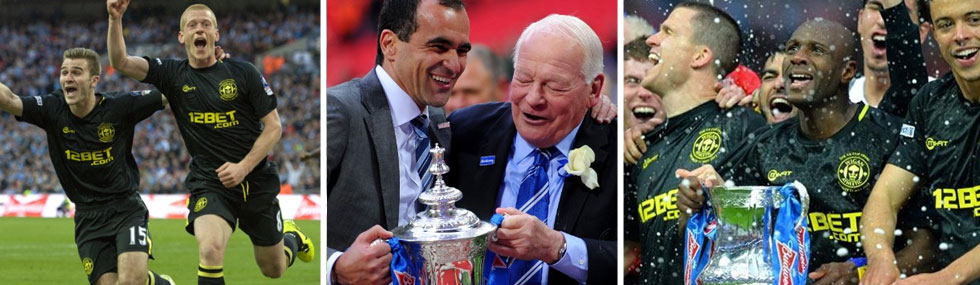
Paul Cook has an impressive 44% win ratio as a manager. Moreover he has done that by insisting that his teams play a version of football akin to that which led Wigan Athletic to the most successful results in their history. Roberto Martinez had led Latics to wins over giants – Arsenal, Chelsea, Liverpool, Manchester United – plus an FA Cup Final victory over Manchester City, by playing possession-based football.

As a young player at Wigan Cook was not universally appreciated by the home crowd. There were those who urged him to “get stuck in” and release the ball quicker. Fortunately in Hamilton and Mathias he had managers who appreciated his style of play and who wanted their teams to play good football.  If there was one thing that Cook lacked it was pace. It meant that he was not to play at the highest levels of English football, despite his technical expertise.

It looks like Paul Cook will be signed up as Wigan Athletic’s manager in the next 24 hours.  Once again he will not be popular with all of the fans. Those who prefer a more direct style of play will be left frustrated. It will signal a reversion to the kind of football most recently employed at Wigan by Gary Caldwell, prematurely dismissed in October. The cynics had said that Caldwell could not get promotion out of League 1 playing possession-based football. They were proven wrong as his team went on to win the division.

On Cook’s seemingly impending arrival at Wigan, his ex-boss Mathias remarked to Wigan Today that:

“He has proved he can do it. I know his upbringing and how he’s lived his life. He can be very strong for Wigan and he can be a strong talker when he has to be.”

 Paul Cook is an experienced manager with an excellent track record in the EPL’s lower divisions. He is the right qualities for the job at Wigan Athletic in this moment of time.

Like us on Facebook, or follow us on twitter here.

Garry Cook and the next chapter for Wigan Athletic

“I was both honoured and delighted to be asked to be part of the team developing the next chapter for Wigan Athletic. Returning to the UK and football was a careful decision and had to include supporting a chairman with a high level of ambition and enthusiasm to build the club for future success.”

Garry Cook’s arrival at Wigan was a bolt out of the blue. From 2008-2011 he was CEO of Manchester City, helping transform them into a major power in European football. He may have left City under controversial circumstances, but his prior accomplishments at the club were impressive.  On his departure the chairman Khaldoon Al Mubarak stated that:

On every level, the club is unrecognisable from the organisation which he inherited and our staff and supporter services, community outreach and commercial activity have seen unparalleled growth under his direction with yet more projects to be realised on the horizon.”

Cook had worked for Nike in the USA from 1996-2008, becoming head of the “Brand Jordan” project alongside basketball mega-star Michael Jordan. On joining Manchester City in May 2008 he was given an annual salary in the region of £1.5 m. In September 2012 Cook was appointed Executive Vice President and Managing Director of Europe, Middle East and Africa for the mixed martial arts organisation, UFC. He rose to the position of Chief Global Brand Officer. He left UFC in October 2016 following a series of staffing cuts.

Cook is a highly experienced executive, used to working on a large scale, with equally large budgets. Put simply, why would he get involved with Latics?

According to the club site Cook is to be a non-executive director, assisting part-time, “helping the Board of Directors with strategic planning and long term objectives”. But what does that really mean? When Cook refers to “developing the next chapter for Wigan Athletic”, what is he referring to?

Even to the impartial observer, Cook’s appointment would appear to be a win-win for Wigan Athletic. Given a seeming reluctance to pay top whack to people involved in the running of the club, it is unlikely that Cook will receive the level of remuneration to which he has been accustomed, even allowing for the fact that it is a part-time position. However, following a six year absence from English football Cook might well want to get his foot back in the door, foresaking his normal monetary expectations. But what can we expect from Cook?

If Cook is given a fair crack of the whip – “if” being the operative word – we can expect some changes in the strategic direction of a club that has had too many ups and downs since that eventful day in May 2013. The turnover of managers in the past four years has been disturbing. That of players even more so.

Last season Wigan Athletic had the biggest turnover of players of any club in English football’s four divisions, mirroring what has happened too often in  recent years. Over those years the choice of managers has been haphazard, the more successful ones being sacked so little time after doing so well. Others have been appointed that the discerning fan could see were ill-suited from Day 1. Player recruitment has been an area of great concern. Too much money has been spent on players who have not made the grade, sometimes not entirely their fault. Long term contracts have been offered to players past their best, seemingly up-and-coming signings have so often disappeared from view. In a business sense the dealings in the transfer market, including money paid to agents, have left much to be desired.

Given this backdrop, Cook’s input would surely be valuable. Cook was heavily involved in player recruitment at City, albeit on an elevated plane, but he also had a major input on infrastructure and the commercial side. Even when Latics were in the Premier League commercial revenues  were low compared with other clubs in the division. They remain so. In terms of infrastructure, the development of an academy, potentially capable of providing players for the senior squad, remains a work in progress. The club’s purchase of the Charnock Richard golf course was upstaged by the Whelan family’s  acquisition of the ex-Bolton Wanderers training facility at Euxton. The club owns neither its main training ground nor it stadium.

When Dave Whelan took over the club in 1995 his vision of Wigan Athletic being in the Premier League was to provide direction for the club in the years that followed. Following the FA Cup win and relegation there has been no overriding direction. Put simply, the club needs to come to terms as to what it is and what it could be. A clearly defined, well -articulated vision for the future could provide the driving force for improvement in the operations of the club.

Garry Cook clearly has a lot of nous to bring to the table of the Wigan Athletic Board of Directors. However, it should be noted that Cook was appointed  at City by Thaksin Shinawatra and was instrumental in bringing in Sheikh Mansour’s money to buy the club, in poor financial shape at the time, for a figure around £150 m.

Latics supporters continue to speculate on the influence that Cook will have on the club. Is he there to provide the kinds of ideas that can move the club forward, developing  a strategic plan? Or is he there to make the club more marketable, then find suitable future investors? Is it a signal that the Whelan dynasty is nearing its end?

In the meantime we can but ponder on what the next chapter for Wigan Athletic enabled by Cook might be.

Like us on Facebook, or follow us on twitter here.

A look at the stats for Wigan Athletic manager candidates

Odds according to skybet.com

“Our immediate priority is to identify and appoint a first-team manager or head coach. That recruitment process is already well underway, and we will focus on ensuring that we appoint a manager who fulfils the criteria we have set in terms of the type of person we wish to employ and someone who has the ambition, drive and intelligence to enhance and help develop the structure we have created over the last few years. It’s important to appoint someone who will create a culture for success, which is something we have failed to do this season.”

The words of David Sharpe published in Wigan Today this Monday.

Sharpe is clearly following a different route than he or his grandfather, Dave Whelan, have taken over recent years. He has been looking at a host of potential employees, hoping that he will make the right decision. The stats show that Wigan Athletic have had seven managers in the last five seasons. Too many rash decisions have rocked the club back on its heels. The end result has been turmoil, with a massive turnover in players as new managers have come and gone.

But the process of selecting the “right” manager is a slow, deliberate process. In the meantime the club is without someone at the helm as players contracts come to an end. It seems inevitable in football that when a new manager comes in he wants to bring in his own backroom and coaching staff and his own new players.

However, according to Sharpe’s recent comments we will not be seeing the kind of turnover of players that we have seen in recent summers:

Unlike in 2015, when we had to significantly rebuild the squad, the basis of a very strong group of players is already in place. We may see some movement in the transfer market, and we want players who are prepared to achieve success in League One next season. But compared to previous transfer windows, we will not have the same level of movement. Stability is important, and we will stress that to any new manager.”

Names of potential managers for Latics have been constantly bandied around the social media and message boards. Moreover supporters have claimed that some of those candidates have been spotted at the DW Stadium. But Sharpe is holding his cards close to his chest, possibly waiting for the playoffs to be completed before coming to any decision.

The bookmakers’ odds change rapidly. Previous favourites disappear down the list and new names appear. Moreover it depends on which bookmaker you choose to consult.

For the purposes of this article we will take a statistical look at the top seven candidates according to the current odds offered by SkyBet.

It was the American writer, Mark Twain, who attributed that famous comment on statistics to ex-British prime minister, Benjamin Disraeli: “There are lies, damned lies and statistics”.

However, in this modern football age stats are enjoying an increasing use. Here, for better or worse,  are the WDL stats for the candidates (supplied by Wikipedia):

Paul Cook

Odds: 5/4

Age:  50

Born: Kirkby

Current club: Portsmouth

Managerial statistics:


Nathan Jones

Odds: 2/1

Age: 43

Born: Rhondda

Current club:  Luton Town

Managerial statistics:


Alan Stubbs

Odds: 7/1

Age: 45

Born: Kirkby

Previous club: Rotherham United

Managerial statistics:


Michael Appleton

 Odds: 8/1

Age: 41

Born: Salford

Current club: Oxford United

Managerial statistics:


Darrell Clarke

 Odds: 10/1

Age: 39

Born: Mansfield

Current club: Bristol Rovers

Managerial statistics:


Uwe Rosler

 Odds: 12/1

Age: 48

Born: Altenburg, East Germany

Current club: Fleetwood

Managerial statistics:


Gary Caldwell

 Odds: 14/1

Age: 35

Born: Stirling

Current club: Chesterfield

Managerial statistics:


Like us on Facebook, or follow us on twitter here.

The financial side of keeping a nucleus for League 1

“Que sera sera…..whatever will be will be….we’re going to Shrewsbury….que sera sera

So sang a group of Wigan Athletic supporters. It certainly took the wind out of the sails of the “going down” taunts of home fans at the Madejski Stadium last Saturday.

Shrewsbury is certainly a pleasant place to visit. Its football team has competed in each of the three EFL divisions. Their New Meadow stadium holds 9,375. Shrewsbury Town met Manchester United in the FA Cup in February 2016. They lost 3-0, which is not surprising given the fact that the Shrews had a wage bill of £2.5 m compared with £210 m of United.

In fact the Shrewsbury wage bill is typical of many clubs in League 1. According to an interesting article on the Daily Mail site, the average salary of a League 1 footballer in 2014-15 was £69,500. It compared with £324,200 in the Championship. The ratio of the average salaries is 1 to 4.7.

There are strong arguments to suggest that the league positions of clubs in the Championship division correlate to their wage bills. In their first season back in the Championship Wigan Athletic finished in a playoff place. The wage bill was around £30 m. Clubs in mid-table would typically have wage bills averaging £20 m.

Latics’ reputed wage bill for the current season is around £17 m. Assuming they were to trim next year’s wage bill according to, say, that previous ratio of average salaries between the two divisions, it would give a figure of around £3.6 m. In 2015-16, still buoyed by parachute payments, Latics had a wage bill of around £6 m in League 1, reportedly second highest after that of Sheffield United.

So at what level will David Sharpe pitch the wage bill for the coming season? As in the Championship there is some degree of correlation between wage bills and success on the playing field in League 1. If the club is to break even financially next season what kind of wage bill would be realistic? Moreover will the club be able to slash its wage bill as successfully as it did in the summer of 2015, when faced with a drop down to the third tier?

In 2015-16 Latics finished top of League 1 with an average attendance of 9,467. Shrewsbury Town finished in 14th place with an average of 5,407. The average attendance for the division was 7,163. Wigan’s cheapest adult season ticket cost  £250 while Shrewsbury’s was £285.

David Sharpe took a bold step in reducing season ticket prices for the club’s return to the Championship. Renewals were pitched at £179, with a price of £199 for new purchasers. The levels were uneconomic compared with those of competitor clubs, but Sharpe was clearly hoping to not only hold on to the core support, but to attract others. With just one match to go in the Championship season Wigan’s average home attendance is 11,560 up by more than 2,000 from the previous season in League 1. However, the bigger clubs in the Championship have brought sizeably larger away support than had those in League 1.

Rumour suggests that the club will maintain the levels of season tickets prices for the coming season. If this is so the £179 price would be almost 40% less than the figure of £295 to be offered by Shrewsbury Town for the coming  season. Moreover should Latics not be as successful as they were last time in League 1 attendances will surely fall. The match day revenue differentials between Wigan and Shrewsbury could merge closer.

Put simply potential match revenues for Wigan Athletic will in no way suffice to give them a competitive advantage over most of their rivals. Some would say that under Gary Caldwell Latics had bought their way out of League 1, having a wage bill twice that of most of their rivals. That was made possible by the parachute payments they were receiving at the time. However, now that the parachute era has come to an end, how can Latics get a financial advantage over most of their competitors in League 1?

One solution is to sell off assets. The second is for the ownership to provide the necessary funding.

The saleable assets Latics have are their players. The club’s main asset, Yanic Wildschut, was sold in January for a hefty premium. Early in the season Will Grigg would have been another major asset: he was scoring goals and looking comfortable in the higher division. It was sad to see how the player later found himself either warming the bench, playing as a lone centre forward with a derisory lack of support, or being played out of position. A player who could have probably drawn a transfer fee in excess of £5 m is now not such an attraction on the transfer market. Better to keep Grigg who has a superb record of goalscoring in League 1.

Nick Powell will surely be on his way. After months out through injury he roared back with spectacular performances as a super sub. In doing so, Powell put himself in the shop window. Dan Burn is another player who has caught the eye and will surely be of interest to Championship clubs. Burn was already an experienced Championship level player when arriving on a free transfer from Fulham. He has since developed a level of self-confidence  previously lacking. Between the two, Latics could possibly raise around £5 m on the market.

Omar Bogle was the most exciting of the January signings. Having scored a lot of goals for Grimsby he arrived brimming with confidence and style. But after a promising start Bogle was to wilt under  a horrible burden put on him by Joyce: that of being the lone striker in a 4-5-1 formation. Injury too was to hold him back. Like Grigg, his potential transfer value has plummeted. But the likelihood is that either Grigg or Bogle will be sold, albeit at a discounted price.

Max Power was almost sold to Birmingham City in January. Although he did not have the season he would have liked, Power remains one of the more saleable assets. Sam Morsy too is a player who could be sought by Championship clubs.

Last weekend Jonathan Jackson stated that “There will be some changes in the squad, but we want to keep the core there.”

Goalkeeper Matt Gilks and ex-captain Craig Morgan will be two of those core members who continue. Gilks was only signed in January on an 18 month contract and Morgan recently signed a two year extension to his contract. The long-term injured players – Donervon Daniels, Reece James, Andy Kellett and Shaun MacDonald – will also be staying. Alex Gilbey is another who has not been able to play in recent games after coming back from long-term injury. Latics will be hoping at least some of those players will be available for the beginning of next season.

It is difficult to predict who else will stay to provide a core for the coming season. The club is going to have to slash its wage bill some 60-70% to be financially viable. Put simply more than half of the players currently under contract are likely to depart over summer, many on free transfers. Others will be sent off on loan.

The players currently under contract for the coming season are:

Goalkeepers: Matt Gilks, Dan Lavercombe

Full Backs – Luke Burke, Reece James.

Centre backs: Dan Burn, Jake Buxton, Donervon Daniels, Jack Hendry, Craig Morgan.

Midfielders: Jack Byrne, Alex Gilbey, Andy Kellett, Josh Laurent, Shaun MacDonald, Sam Morsy, Max Power, Danny Whitehead.

Forwards: Nathan Byrne, Omar Bogle, Ryan Colclough, Will Grigg, Michael Jacobs, Mikael Mandron, Sanmi Odelusi, Nick Powell, Kaiyne Woolery.

The amount of turnover at the end of the 2015 season was remarkable, with 31 incomings and 44 outgoings, including loan players.

Latics currently have seven whose contracts are due to expire – Jordan Flores, Jussi Jaaskelainen, Billy Mckay, Gabriel Obertan, David Perkins, Andrew Taylor and Stephen Warnock. There are another eight players whose loans are coming to an end.

In 2015 Gary Caldwell had already been installed as manager to oversee the massive turnover that took place over the summer.

At this stage we do not know who the next manager is going to be and there have been mutterings about taking the time to choose the right man for the job.

But given a mountain of a task ahead we might well see an appointment made sooner rather than later.
Like us on Facebook, or follow us on twitter here.