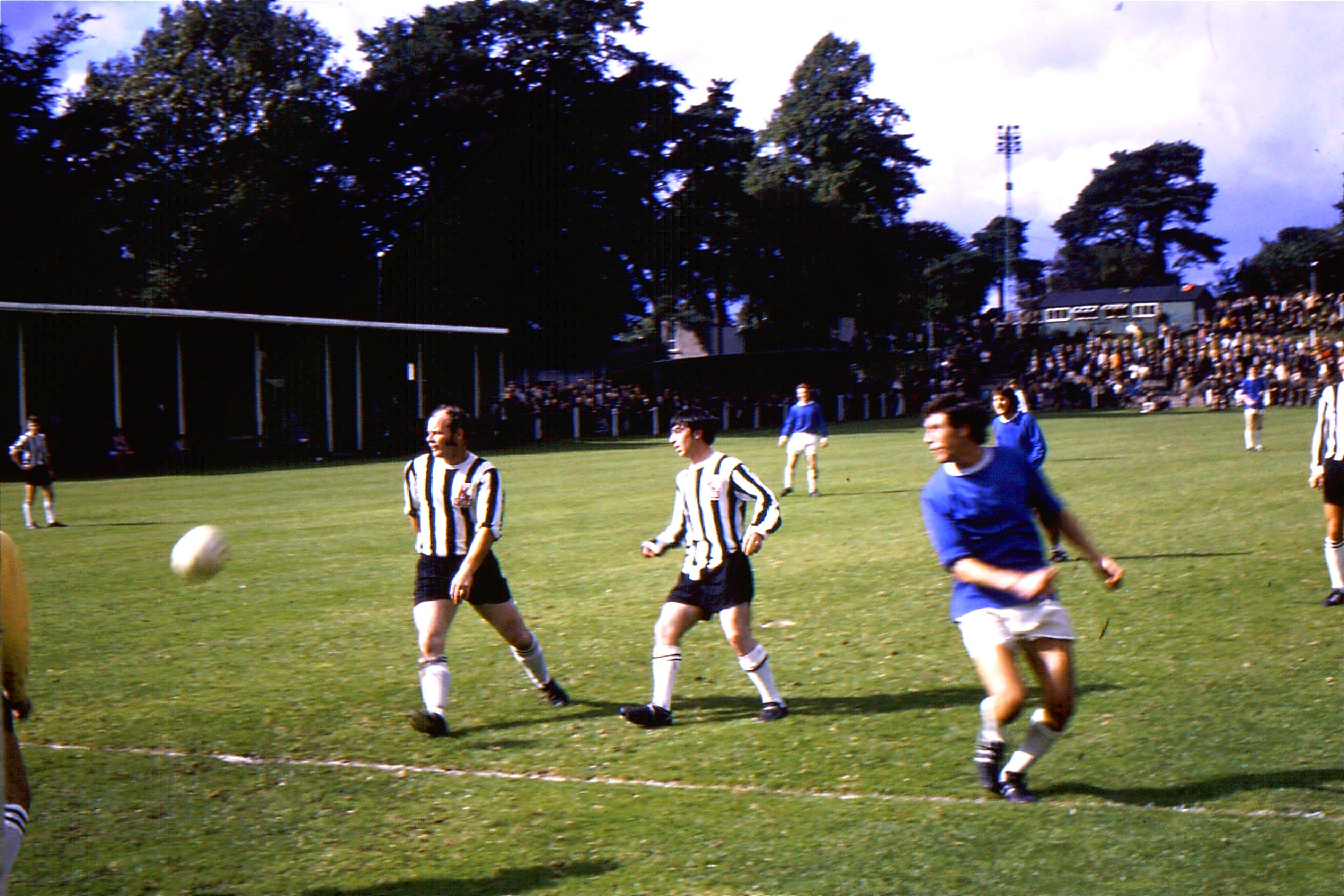
Geoff Davies attacks as ex-Latics player Alf Craig (left of centre) looks on. Kenny Morris and Doug Coutts watch from defence and Bobby Todd from midfield.
On a bright sunny day, with a hint of autumn in the air, my father and I walked through the town centre towards the Gas Showrooms, opposite the market square. I had bought the coach tickets the day before, going to our usual source, Barnes Travel Agents in Market Street.
As we waited for the coach to arrive my father started to reel off one of his favourite old stories about traveling to watch Latics play. This time it was at Bacup, the ground being on top of a steep hill. The coach’s engine had stalled and the driver could not get it moving again, so the passengers had to push it up the hill. A story of his that must have been at least nine years old, when Latics would meet Bacup Borough in the Lancashire Combination.
The coach had no problems getting up hills in this journey. The advent of the M6 motorway had made traveling north much easier, although we had to come off a little before Kendal, the difficult stretch leading over Shap being close to completion, but not ready yet. We arrived an hour early and decided to go through the turnstiles and soak up some sun on the terraces. Just like at Springfield Park there was a supporters club building inside the ground where we could get drinks and a bite to eat.
As we walked in we saw a sight that I had never seen before at a football ground. There were three or four cows grazing on the pitch. It provided a classic rural scenario and made one wonder if this was the reason that the Netherfield pitch was one of the better ones in the league.
It was September 5th 1970, an exciting time for Wigan Athletic fans. The advent of the Northern Premier League had brought new hope for the club, which had been thus far been thwarted in its ambition to be elected to the Football League. Moreover Latics had appointed a dynamic young player-manager who had started to meld the talented squad assembled by his predecessor into probably the best side the club had ever had.
Playing away at Netherfield was never an easy prospect. The team from Kendal, set up by employees of the K Shoes company, were old adversaries from the days in the Combination. Like Wigan they had joined the fledgling Northern Premier League (NPL) as founder members in 1968. They had finished in midtable the previous season.
The arrival of Gordon Milne to Wigan Athletic in the summer of 1970 suggested that the club had serious ambitions. Milne had been one of Bill Shankly’s first signings for Liverpool, paying Preston a £16,000 transfer fee. He went on to make 236 appearances for the Reds in the next seven years, during which he was capped 14 times for England under Alf Ramsey. Milne had joined Latics from Blackpool at the age of 33. Although nearing the end of his playing career he was still a force in the midfield. Curiously his father, Jimmy Milne, had been manager of Latics in the 1946-47season.
The NPL offered hope to Wigan Athletic in their quest for a place in the Football League. The archaic system had remained in place by which the bottom clubs in Division 4 would apply for reelection, together with non-league aspirants. Critics would complain that the Football League was a closed shop and that the clubs would play the “old pals act” by voting for those bottom four clubs.
It was hard for a go-ahead non-league club to get into the Football League and only two had got elected in the past eighteen years, Peterborough in 1960 and Oxford United in 1962. An added complication was that the non-league vote was repeatedly split.
In 1968 Latics had been one of 15 non-leaguers making an application. They received two votes, one less than Cheltenham Town, but woefully short of the 38 votes that got the least favoured Football League club, Workington, reelected. Wigan Athletic did not make an application the following season.
In those days Latics could only dream that automatic promotion to the Football League might become a possibility for non-league clubs. However, the creation of a northern super league, composed of the top clubs from the various regional competitions, was a real step forward. Winning such a league would certainly give more kudos than the Cheshire County League, even if it had been the best of the northern regional competitions. Moreover the prospect of only the winners of the NPL and the Southern League applying for election would make sense, if it could ever become a reality.
The NPL started in the summer of 1968. It comprised 7 clubs from the Cheshire County League, 5 from the Lancashire Combination, 4 from the Midland Counties League, 3 from the Northern Regional League and one from the West Midlands League. Interest in Wigan was high and Latics’ first game at Springfield Park against Ashington was to draw a crowd of 6,721 – the highest home league attendance for 13 years.
The legendary Ian McNeill had been recruited to manage Latics in that first NPL season. He had been managing Ross County, following a successful playing career with Leicester City and Chelsea. His contacts in Scotland were to prove valuable and in his two year stay he brought in the likes of David Breen, Benny Cairney ,Doug Coutts , Jim Fleming, Jimmy Lynn, Jim Savage and Billy Sutherland. The left full back Sutherland had been signed from Rangers to begin that first NPL season. He was to go on to make 228 appearances over a seven year period at the club.
But the most notable of all in McNeill’s squad that year was not a Scot, but an ex-youth player from Arsenal, who had played just three games in the Cheshire League the previous season, after being signed by Allan Saunders. Just 19 years old at the time, Ian Gillibrand soon established himself as a regular in the team. Although he lacked height for a central defender, Gillibrand had an impressive leap and his reading of the game made him look like the non-league version of Bobby Moore. He was to play a further ten seasons at the club, breaking the record for his number of appearances and, most famously leading Latics out to their first ever Football League match at Hereford.
McNeill was keen to win the NPL in its inaugural season, but so too were the previous season’s Cheshire League champions, Macclesfield Town, led by their inspirational player-manager Frank Beaumont. McNeill paid Runcorn £3000 for Alan Ryan, who had scored a remarkable 66 goals in the previous season. But despite having an excellent record of record of W18 D12 L8, Latics were to finish in second place, 12 points behind the Silkmen. Attendances had almost doubled from an average of 1,801 the previous season in the Cheshire League to 3,393.
The following season was an even better one for Latics, with a record of W20 D12 L6, but they were to once again to finish behind Macclesfield, this time on goal difference. Despite doing a great in those two initial NPL seasons McNeill was to leave the club following a disagreement with the chairman.
Ken Cowap replaced McNeill with Gordon Milne, who soon splashed out £4000 for the 32 year old ex-Everton winger Derek Temple from Preston. It was a sign that Latics were very serious about winning the title.
However, Milne’s key signing at the time was to prove to be the 23 year old centre forward Geoff Davies for a much more modest fee from Northwich Victoria.
 LOS THREE AMIGOS