Di Santo comes into his own

A bit unusual at first, Roberto Martinez’s strategy in the transfer market has become quite familiar. He likes to shop in Scotland and Spain — markets he knows well and can compete with financially. He’s not afraid to dip into lower divisions, and values a season-long loan from a top club to boost competition for places in the squad. He is astute in his timing, snapping up players like Victor Moses and Nouha Dicko at cut rate prices when their clubs were in financial need. His buys normally fall in one of three brackets: young, upcoming but unproven; players who have fallen to the fringes and want to re-establish their careers; or foreign players seeking a stage on which to earn a move to a bigger club.

The policy has yielded strong results. Signing two young central midfielders from Hamilton Academicals and moulding them into a Premier League partnership that out-tackled and out-passed the midfields of Manchester United, Arsenal, Chelsea and Liverpool last season borders on genius. Ali Al-Habsi, a reserve at neighboring Bolton, has been nothing short of outstanding. And Shaun Maloney, rescued from a hiccuping career for Celtic, has been revitalised in blue and white stripes after a slow start. But of all his success stories in the market — and there are plenty more — one signing stands out as an exception to his regular policy.

Franco Di Santo arrived from Chelsea for 2 million pounds on deadline day at the beginning of the 2010-2011 campaign. The Argentine had been plucked from Chilean outfit Audax Italiano in 2008 after a decent scoring record in the Chilean League, the South American Copa Libertadores (Champions League equivalent), and the Copa Sudamericana (Europa League equivalent). Having failed to break into the first team, Di Santo spent time on loan at Sam Allardyce’s Blackburn, but finished it with a desperate strike rate of 1 in 23 appearances, having been stuck out on the wing in a kick and rush system that clearly would not have suited him.

The move was surprising because Latics had never before shopped directly from a top four club. Scott Sinclair had come in on loan the year before and it was largely assumed that Franco would follow the same path. The fact that Wigan bought him outright, at a bargain 2 million price, was taken by many to mean that Chelsea simply didn’t rate him. The consensus around the league, and in the media, was that he didn’t have the finishing to cut it in the Premier League.

His transformation has been a joy to watch, but didn’t happen over night. Indeed, the goals took a long time to come. In his first season with the club, Franco was largely starved of service. In hindsight, it is not surprising that he, along with Mauro Boselli and Jason Scotland before him, struggled to score when flanked by Charles N’Zogbia and Hugo Rodallega — players who more often than not wanted to finish the move themselves.

But there have been several turning points in the past year for young Franco. He started last season with a couple spectacular — if slightly fortunate deflected — strikes, which did his confidence a world of good. Then, in December, Roberto switched to the current tactical system employing wing-backs rather than wing-ers. The switch did more than change the shape of the team. It transformed the way the team attacked. Instead of the right-footed winger on the left, cutting in to shoot, we started seeing the wing-backs, left-footer on left and right-footer on right, bomb forward and launch crosses into the box. The higher number of crosses resulted in higher number of chances for the centre-forward, and Franco has benefited — as have Arouna Koné and Mauro Boselli in their appearances this season. The strike rate per minute on pitch of all three strikers if you include league and cup matches this season, is higher than any Latics striker in the Roberto Martinez era. They are the top three.

The third and most recent catalyst, was the most recent tactical switch following Victor Moses departure and Arouna Koné’s arrival. Di Santo now has a strike partner, whose threat has freed up space for his clever running, and two of Di Santo’s three strikes this season have been assisted by the Ivorian. Di Santo now has service, confidence, and space — and his finishing has been been top class.

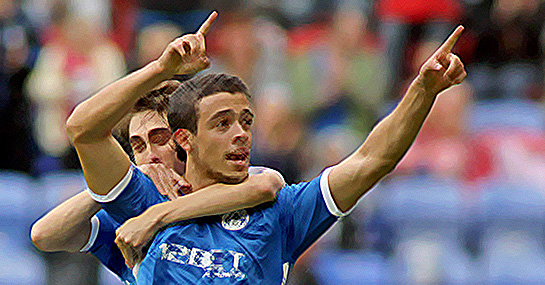
If he can keep up this level of finishing, there is nothing to stop Di Santo’s progress. His technique is excellent, he has pace and strength, excellent work rate, fantastic hold up play and is an intelligent passer of the ball. But it is more than his attributes on the pitch that catch the eye. Sometimes, when players take the step down from a larger club, their egos get in the way. When you watch Di Santo play, his enthusiasm is clear, and his body language is that of a man proud to play for the club. His enthusiasm is infectious, and no doubt an important element in the dressing room. Martinez likes to speak about bringing in not only the right talent, but the right personalities. In Franco, he has a winner who also seems a genuinely nice guy happy to be there.

As with many young prospects before him, this has not happened overnight. The club is only now starting to reap the benefits of the striker’s steep learning curve. But it has been a joy to watch his come into his own — long may it continue. At Wigan Athletic.

Moving up a tier? Wigan and the Premier League financial league table

Over the years, Wigan Athletic have delivered performances ranging from the majestic to the downright nightmarish — none more so than the 2010 season opener against Blackpool. A 4-0 home defeat to anyone would have been bad enough, but to a team who the pundits had already condemned to relegation even before a ball was kicked? It was to prove a difficult season for Latics, only securing safety on the final game of the season. It also went down to the final game for Blackpool, who put up an amazing fight before eventually succumbing to Manchester United.

An old Bob Dylan song reminds us that “Money doesn’t talk, it swears.” The primary reason the pundits had tipped Blackpool for relegation that year was the perception that they did not have enough players of Premier League quality. Their Chairman, Karl Oyston, was not willing to splash money around like confetti and put the club at risk of insolvency. Blackpool’s salary bill that season amounted to just £14 million. Wigan’s was almost £40 million. During that 2010-11 season Blackpool were to do the home and away double over a team with a salary bill almost 10 times that of their own. That was Liverpool, at £135 million.

In the end Blackpool couldn’t quite avoid that relegation trap-door in the jungle of the Premier League, where clubs regularly make huge losses in an effort to keep up with the Joneses. You could say Blackpool got it right. Their salaries amounted to only around 25% of their income – compared with the league average of around 69% – and this helped them gain a positive cashflow for the season. They continue to be run on a sound financial basis in the Championship. Manchester City actually spent more on salaries than the revenues they had coming in, and even Aston Villa were leaking 92% of their revenue on salaries. No wonder Villa have since cut back, putting the emphasis on youth rather than established big-earners. It could be argued, however, that they have gone too far as the lack of quality and experience in this year’s squad makes them candidates for relegation.

Statistics show that the Premier League is financially tiered. In the 2010-2011 season club salary levels published by the Daily Telegraph ranged from £14 million to an absurd £190 million. The top three clubs in the table paid in the £150-£190m range. The teams finishing 4th and 6th paid in the £120-150m range, Tottenham bucking the trend by finishing 5th on a budget of “only” £91m. Fulham and Everton, with budgets around £58m managed to finish ahead of Aston Villa, who spent £84m on salaries. Then followed a clump of clubs paying between £40 and £60m, which included West Ham who were to be relegated despite a wage bill of £56m. Wigan Athletic, Wolves and West Bromwich had salary totals between £37 and £40 million, with only Blackpool below. It would be interesting to see salary levels for the current season, when these become available.

According to the Guardian “ The Premier League’s 20 clubs collectively made a loss of £361m last year, after spending all of their record £2.3bn income. Of the clubs which were in the Premier League in 2010-11, the year of most clubs’ latest published accounts, eight made a profit, of £97.4m in total.”  Dave Whelan wrote off Latics debts for £48m in August 2011. He advocated financial fair play to ensure that debt is maintained at “reasonable and sustainable levels”.

According to Alan Switzer,  of accounting group Deloitte, clubs with salary to revenue ratios of 70% and above are not likely to make a profit. He suggests that levels should go down to the low 60s. In 2010-11, Wigan Athletic were around the 80% level, according to the Daily Telegraph stats, which indicates a negative cashflow of £0.1 m.

The Daily Telegraph statistics show a clear correlation between salary levels and success on the field, although there are some exceptions. So how does a team stay afloat in a tiered Premier League? Do Wigan Athletic have to significantly increase salary levels in order to move up a tier in the league table? Would doing so make them financially less stable?

Last season both Mohamed Diame and Hugo Rodallega left at the ends of their contracts. A rough estimate might suggest that Wigan Athletic lost maybe £10 million in potential transfer money for the two. Whelan rightly insists that Wigan Athletic keep a lid on their salary payments so it is unlikely that either player was given an offer he could not refuse to stay on at the club. This season we have Franco Di Santo and Maynor Figueroa in their final year of contract. Both are key players. Figueroa has developed into an excellent left of centre defender in Martinez’ tactical system. He could prove costly to replace. Di Santo has now added goal poaching to his repertoire and could be worth in the region of £20 million on the open market if he continues to improve at this rate. When Roberto Martinez took over at the club various higher wage earners were sent packing to bring down the wage bill. He is now facing a dilemma in how to keep his top players from leaving at the ends of their contracts, given the total salary cap imposed by his chairman.

Given the factors above, is it possible for Wigan Athletic to consistently reach a mid-table position? Could they defy the stats on an annual basis, keeping a nucleus of good players, allowing a couple of stars to go for premium transfer fees each summer? In this way, the budget could be balanced. The first step would be to already have the replacements for the stars ready and in place. The second would be  to find a way to offer top players longer contracts at competitive rates, whilst maintaining a reasonable total salary cap. Food for thought for Bob and Dave.

Bend it like Beausejour

Some say he looks a little pudgy. Others complain he doesn’t have the speed to take on defenders. That Birmingham would not have let him go if he were that good. Something of an international journeyman, he has played for ten clubs in a space of ten years, spanning six different countries. Why then did Roberto Martinez continue to pursue Jean Beausejour, following the 2010 World Cup, until finally signing him in January 2012?

After just 15 minutes had gone at Sunderland last Saturday, a sublime cross came over from the left wing that Arouna Kone should have buried to put Latics 1-0 in front. It was the kind of precision pass that David Beckham might have provided in his heyday, curling away from the goalkeeper with pinpoint accuracy. Pure artistry. Neither player is the type to run down the wing and beat a defender for speed. But both somehow are able to get in pinpoint crosses from the tightest of situations, an ability that few players possess. Although Beausejour only joined Latics in January, he led the squad for assists last season.

Let’s not forget his defensive qualities either. Forming a strong partnership with Maynor Figueroa on the left hand side of the defence he provides key defensive cover. Ask Theo Walcott what it is like having Beausejour trail you – the Chilean rendered him totally ineffective in the memorable 2-1 win at the Emirates Stadium in April. Beausejour is not elegant, but is a complete player, the classic wing back – able to defend and create goals.

Jean André Emanuel Beausejour Coliqueo was born in Santiago in June 1984, of a Haitian father and mother from the indigenous Mapuche ethnic group. Beausejour remains a hero with the downtrodden Mapuche people. He started his professional career playing for leading Chilean club, Universidad Católica in 2002 before moving to provincial Concepción where he played for a year. Within the following three years he’d serve stints at Servette of Geneva, Grêmio of Porto Alegre, Brazil, and Gent of Belgium. After returning to Chile for a couple of years he spent the 2009-2010 year playing for Club America, Mexico City’s biggest club.

Beausejour has made 40 plus appearances for Chile, playing under flamboyant Argentinian coach Marcelo Bielsa for almost three years. Not only did he score the winning goal against Honduras that helped Chile to qualify for the knockout stages of the 2010 World Cup, but he was to play in a classic Bielsa system that had three central defenders and two wing backs. In November 2011, he and four other players were suspended by Chile FA for 10 matches after arriving in “poor physical” condition, allegedly drunk, before a World Cup qualifying match against Uruguay.

Given Beausejour’s career record of lack of continuity at any one particular club and his suspension from the Chilean national team it was therefore a calculated gamble taken by Roberto Martinez to bring him to Wigan from Birmingham City. However, Beausejour has become a key player in the tactical system adopted by Roberto Martinez. His start to the current season has been marred by a niggling injury but he remains one of the players whose name would be penciled in first on the team sheet. He is 5 ft 11 inches tall and physically strong, not easily deterred.

Jean Beausejour has certainly settled into the Wigan Athletic lineup. A team player, he is solid in defence. When Latics have the ball he is always available, hugging the touchline, stretching the opposition defence. He rarely loses the ball and has a few tricks up his sleeve with quick footwork. His crosses can create havoc in even the best of defences, whether from open play or set pieces. Given his technique one might expect him to more often take direct shots on goal, especially from free kicks. He has proved an excellent signing up to this point and one hopes that his years of wanderlust are over. At 28 years old he is nearing the peak of his career. The best is yet to come, especially if he is encouraged to go for goal from free kicks.

Much to appreciate despite late equalizer

An outstanding afternoon of Premier League football at the DW saw former hero and youth system product Leighton Baines cap a man of the match performance with the most emphatic penalty finish in recent memory. He has always been a tremendously skilled player, but the fact that Everton have built their team around him — a left back — is mightier praise than any words could offer. A slightly more muted celebration might have been welcome at the DW, but he remains a source of pride for those who witnessed his beginnings in Wigan.

Before the equaliser, Latics had enjoyed a very good first half, filled with the kind of crisp passing, pace and attacking incision Roberto has been working toward for some time now. Everton were always dangerous — little surprise with the amount of quality on display — but had fallen 2-1 behind and were a bit lucky to remain on even footing after Marouane Fellaini appeared to elbow Figueroa in the face. He’d been growingly frustrated throughout the half as Latics clearly sought to reduce his aerial threat on set pieces with a gentle shove here and there. The decision not to send him off was probably influenced by an earlier talking point. Latics’ first goal, an Arouna Kone header from a Sean Maloney cross, was marginally offside.

In the end, pressure told and Latics’ rearguard were undone by panic and good attacking pressure by their opponents, giving away a penalty with three minutes of regulation time to play. Baines stepped up, and despite a late flourish from the Latics including a glorious spurned opportunity by Sean Maloney, the result stood.

The Good:

The front three were in devastating form. Franco Di Santo showed no signs of rust after missing a game and a half through injury. His was a performance of pace, quality and intelligent passing and movement. His goal was well-taken, and he has now scored 3 for the season, despite missing the aforementioned game and a half. Arouna Kone put in his best performance in a Latics shirt and was a constant threat. He looks to have developed a good understanding with his attacking teammates and in this form, will never be far from the scoresheet. Sean Maloney was bright and dangerous all match, free to roam the pitch as lone playmaker, and might have sealed the win for Latics on a couple occasions with better finishing.

Particularly in the first half, the Jimmy Macs were showing the kind of energy and ferocity that led to Latics’ big results last season. First to every 50-50%, competitive but generally clean, they were a joy to watch. McArthur gave the ball away a couple times, McCarthy once — but in general their passing too, was of a high standard.

The Bad:

The lack of defensive composure to hold on to the result as pressure mounted. The McManaman-for-Di Santo substitution made sense but didn’t amount to much. The bigger question was why an extra ball-playing midfielder wasn’t introduced to try and regain possession when Everton were turning the screw. Still — Everton have the air of a team on the ascendancy. While always appreciative of David Moyes results on a tighter budget that their direct competitors in the upper part of the table, I’ve never been convinced of the type of football his teams display. But this is a side with real balance, understanding, and attacking flair. Credit where it’s due.

Conclusions:

We said in our preview that three points were needed. I’m personally satisfied with the result and performance, despite the disappointment of being unable to hold onto the three points. The way our attacking players linked up together in the first half in particular, but also in that late flourish, shows real promise. Sure, we are light on points, but there is quality in this side.

Kone has bedded in. It was bound to take a few matches, but his link-up play with Di Santo and Maloney was outstanding. His passing was intelligent and pace a threat.

Maloney is much more effective as the lone playmaker, as Jakarta Jack previously wrote about on this blog. He is a versatile attacker, full of invention, flicks and an eye for the killer through-ball. But it was his dribbling that left Seamus Coleman on his bum for the first goal. The freedom to move from one side to the other, identify and then run at the weaker defenders, brought out the best in him despite the missed opportunity at the end of the match.

On the surface, Emmerson Boyce’s season has been below the high standard he set last season. His attacking contribution has been small. But even on a tough day like this one, the advantage of having him in the side was evidenced in the number of clearances made with his head from set pieces. When you are only playing with three at the back, having him act as a fourth centre back on set pieces is crucial.

Player Ratings:

Ali Al-Habsi: 8 – Made some very good saves; one first half dipper in particular, was world class.

Ivan Ramis: 7.5 – My pick of the centre-backs, this might have been his best match so far in blue and white despite facing the outstanding pair of Steven Pienaar and Leighton Baines.

Gary Caldwell: 6 – Flustered towards the end.

Maynor Figueroa: 6 – Did okay despite the threat of the lively Kevin Mirallas, but might’ve ended up the villain if Kevin Friend had awarded a penalty aginst him in a 50-50 challenge with Jelavic.

Emmerson Boyce: 6 – No attacking contribution, which is entirely understandable when you have Leighton Baines and Steven Pienaar running at you. Defended well on set pieces.

Jean Beausejour: 6 – Some nice touches, passes and deliveries in the first half, but faded with the rest of the team in the second.

James McCarthy: 7 – There was a moment in the second half when he misplaced a pass and the whole stadium seemed to gasp and groan at the same time. You just don’t expect it. His pass completion rate is outstanding. He was immense in the first half but found it harder in the second.

James McArthur: 6.5 – Also fantastic in the first half, fading in the second.

Sean Maloney: 7.5 – Energetic, inventive 95 minutes from the little magician. Loses marks for uncharacteristically opting to shoot instead of squaring for an easy tap-in in the dying minutes of the match. Set up the first goal with a good piece of skill.

Franco Di Santo: 8.5 – Rarely loses the ball, and his use of it just keeps getting better. Developing into an elegant and mobile centre forward, with a vastly improved goals-per-game ratio.

Arouna Kone: 9 – Thoroughly impressive. On his own up front for large stretches for the match, but did a lot more than hold the ball up and knock it back — he seeks to create chances with his passing and running. A dynamic and highly promising performance.

Subs:

Callum McManaman: Must be personally pleased to be chosen to enter the fray at such a crucial time in the match. Has leapfrogged quite a few players in the pecking order in the last few months. More to come, hopefully…

Wigan vs. Everton: Three points needed

Never has a Premier League table so early in the season so closely resembled the way most of us expect it to finish in May. Yes, Liverpool will climb and West Ham will slip, and Arsenal have had a difficult fixture list. The mid-table teams will shuffle around according to form. But by and large, the top and bottom five include four of those you would expect to be in there. There is no Hull (or Norwich, or Wigan for that matter) flying in 2nd place on enthusiasm and adrenalin — in fact, this year’s candidates for such a feat, Southampton and Reading, are already languishing in the relegation zone.

The team that does occupy 2nd place is Everton. Are they the Newcastle of last season? You certainly don’t get the sense that they’re just keeping the spot warm for a bigger club.

It was clear they meant business in the opening fixture against Manchester United. Players and fans alike were fired up with energy levels high and atmosphere both electric and intimidating at Goodison. After that win, they deflated Michael Laudrup’s high flying (at the time) Swans with a 3-0 away victory, were extremely unfortunate not to beat Newcastle, and took all three points from Villa. They disposed of Southampton quite easily last weekend, and only stumbled away at West Brom. It is fair to say they are a team in form.

Latics meanwhile, have had a topsy turvy start to the season. The thumping 4-1 League Cup wins over Nottingham Forest and West Ham have cushioned the disappointment of missed opportunities in the Premier League. If the kind of finishing we saw in the confident and stylish win at Southampton had been on show against Stoke, Fulham and Sunderland, Latics may well have picked up 9 points and be in that top five. Instead, poor finishing from Wigan has left the side in the bottom five.

Jakarta Jack called for a shake-up in his article earlier this week. Not necessarily wholesale, but a few fresh faces to liven things up. I suspect we might see one or two. For one, I think Mauro Boselli will be involved. His form and finishing in the League Cup and reserves has been sensational. Arouna Koné has been unlucky but really should have scored one or two more than he has, while Di Santo’s form interrupted by injury.

Jordi Gomez’s suspension has been repealed, but Di Santo’s return to fitness should in turn signal a return to the bench for the Spaniard. Ryo Miyaichi and Callum McManaman have been used as impact subs in the last two matches but must be in contention. Antolin Alcaraz can’t return soon enough in defence.

Everton are looking scary. Leighton Baines is practically a playmaker at left back, and an excellent one at that. His partnership with Steven Pienaar down the left is extremely dangerous and Emmerson Boyce and Ivan Ramis will have to be alert. Kevin Mirallas looks a quality player. Nikica Jelavic has continued last season’s form with three goals in five league matches. Marouane Fellaini is attracting interest from bigger clubs. Their defence is one of the most established in the league having played together for a number of seasons. And with Victor Anichebe, Seamus Coleman and Steven Naismith on the bench, they have depth.

But Latics need three points to arrest this slump of late — I suspect there will be a real urgency around the DW tomorrow. If they take their chances, they can get them.