Latics need a Wildschut for promotion


It is midway through the League 1 season. The “New Era” duo of Gary Caldwell and David Sharpe has breathed new life into a club that was down on its knees. After a prolonged period of gloom and despondency there is light at the end of the tunnel.

With 23 games played, Wigan Athletic stand in 5th place with a record of W11 D7 L5. They are in the playoff zone, just 8 points away from an automatic promotion place. They have a good defensive record, with just 21 goals conceded, bettered only by the top two teams.

Caldwell has shown himself to be a dynamic young manager, excellent in recruitment, tactically aware. His is articulate and sets a dignified tone for the club when dealing with the media. Sharpe too has made a strong impression, his sheer enthusiasm for the club shining through. He too is articulate, adept in his dealings with the national and social media. Together the two have forged a positive new identity for a club that had lost its way, but is now firmly back on track under their leadership.

Caldwell has built up a strong squad, the envy of other managers in the division. It was by no means easy to put together a revamped squad containing more than twenty new faces. Caldwell and his coaches faced a huge task on the training ground, helping the players gel as a unit that can play a style of football that Sharpe labels “The Wigan Way”. Moreover Caldwell has instilled a never-say-die spirit that means his teams have shown the ability to claw their way back into games they would seemingly have lost.

The foundations are certainly in place. The immediate goal is promotion back to the Championship. In order to achieve automatic promotion a total of at least 90 points will be needed. That will require a points average in excess of two per game for the rest of the season.

A long unbeaten run is what Caldwell will seek. Latics achieved an unbeaten run of 11 matches, stretching from mid-September to late November until a blip led to league defeats by Burton and Blackpool, together with an exit from the Football League Trophy at the hands of Barnsley.

However, a couple of hard-fought away victories at Barnsley and Fleetwood have put them back on track. After disappointing away performances early in the season they are now unbeaten in their last eight league games on the road, as the players have shown the ability to grit their teeth and grind out results.

Caldwell and his recruitment team did so well in the last transfer window. But can they achieve such good results in the January window that is almost upon us? What adjustments can we expect to be made to the squad? Will the two remaining short-term loanees – Donald Love and Yanic Wildschut – be staying?

Since the beginning of the season four loanees have already returned to their clubs. Caldwell was disappointed when Jonjoe Kenny was called back to Everton in late September, then Shaq Coulthirst went back to Tottenham just over a month later. Over the past couple of weeks  Sean Murray has returned to Watford and Alex Revell to Cardiff City. Sadly the talented Francisco Junior has gone back to Everton to receive treatment on a troublesome groin injury that has hampered him during his time at Wigan. Caldwell will hope that the player can overcome the injury and that he can return before his loan period ends in mid-January. However, rumours suggesting Latics are close to signing midfielder Liam Kelly from Oldham suggest that Caldwell might be covering his bases in case the African does not make it.

The right back position has been a problem all season, with the serious injury to Kevin McNaughton early on and the departure of Kenny. Donervon Daniels has shown his versatility by playing there when needed. Tim Chow has also been tried there. Donald Love was signed on loan from Manchester United in early October. Injuries and call ups to the Scotland under-21 squad have limited Love to five starts and three substitute appearances. However, Caldwell clearly rates the 21 year old Rochdale lad and may well seek a permanent transfer.

Few players have made such a strong and immediate impression on Latics fans as Yanic Wildschut. His impact has rivalled that of Amr Zaki in 2008-09. Wildschut has started in ten games, coming on off the bench in six. He has scored four goals. In full flow Wildschut is a sight to behold, a winger with searing pace and a blistering shot when he cuts in from the left and shoots with his right.

Some would say Wildschut is a throwback to the past when the winger’s job was primarily to attack, although even in the days of 4-2-4 they were still expected to do some defensive duties. Defending is not Wildschut’s strong point, as noted by Middlesbrough manager Aitor Karanka. However, given the physical exertion he needs to put into his electrifying runs, can Caldwell really expect him to make a significant defensive contribution?

When Wildschut first arrived at Wigan he immediately caused panic in opposition defences. However, after a while other teams learned how to deal with him, if sometimes by foul means rather than fair. His recent performances in the starting lineup have been frustrating at times. However, bringing him on in the closing stages, when the opposition defenders legs are tiring, can have an explosive effect.

Although Caldwell has certainly bolstered his defence his team’s attacking can be slow and predictable. He needs a player with Wildschut’s explosive abilities who can upset the equilibrium of the opposition.

It is rumoured that negotiations with Middlesbrough over a permanent signing of the Dutchman have been going on for some time. Boro will surely want to recoup at least the £300,000 they paid Heerenveen for him in September 2014. Moreover other clubs might be in competition for his signing. At this stage it seems unlikely that Karanka will want him permanently back at Middlesbrough, given the “modern” type of footballer the Spaniard prefers. The question is whether Sharpe is willing to pay the kind of fee that Boro will demand for a player who is not a regular starter.

Caldwell will be hoping that a deal can be struck to keep Wildschut at Wigan. If that does not happen he is going to look elsewhere for the kind of player who can add such an extra dimension to Latics’ attack. Without such a player Wigan Athletic’s hopes for automatic promotion might well fall on the rocks.

Losing money to win promotion

benefactor

Figures can help provide startling comparisons, causing us to question underlying trends. Recent information and figures  from Wigan and Horwich have  once more caused questions to be raised.

Wigan Athletic lost £3.9m last season. Having to pay agents a total of £1,461,088 was a contributory factor towards the loss, which had come after three consecutive years of making a profit.

The last time Bolton Wanderers announced a profit was in 2006. Referring to their loss in 2014 the club stated that ”Net loss improved by £41.6million, down to £9.1million year on year.” A couple of weeks ago Wanderers were issued a winding-up petition by the HMRC, which goes to court on January 18th. Owner Eddie Davies has loaned the club £185m over recent years, but is not prepared to continue to pump money in. In the meantime they are looking for ways to pay their players and staff.

The scale of Latics’ loss for 2014-15 came as a surprise to most of us, although it is small compared with those suffered by other Championship clubs last season, not just Bolton.

In the summer of 2014 Dave Whelan made a calculated gamble in a bid to get Latics back into the Premier League. Is David Sharpe about to follow in his footsteps?

“The continued financial support of the Whelan family has allowed the club to continue pursuing long-term strategic goals and although the financial results for the year ended 31 May 2015 mirrored the disappointments on the field, the owners remain committed to developing and improving Wigan Athletic to enable the club to return to the highest level of English football.”

The words of Jonathan Jackson to Wigan Today after announcing last season’s financial loss.

It is certainly reassuring to hear that the owners – the Whelan family – remain committed towards getting the club back into the Premier League. The question is how they will be able to develop and improve things at the club to make it a possibility. Will the Whelan family remain the benefactors to Wigan Athletic that they have been in the past?

Last season Dave Whelan had given major backing in the transfer market to Uwe Rosler, who had taken Latics to the FA Cup semi-final and the Championship playoffs.  £7.3m was brought in through the sales of James McArthur and Callum McManaman. But £10m was spent on transfers into the club, the majority on Andy Delort, Adam Forshaw, Emyr Huws and Oriel Riera. Other signings were made at lesser prices, with some being free agents.  But not only was it the shelling out of money on transfer fees that was to cost the club, but Rosler had brought in eleven new players. The large squad that resulted was to eat away at the budget week by week.

Sadly things went pear-shaped for Rosler, who was sacked in November. Seeing his financial gamble starting to look less viable, Whelan was to embark on a huge cost cutting exercise in January. The hapless Malky Mackay was to be the manager who oversaw a fire sale that resulted in swathes of players leaving in the January transfer window.

But that too turned into a gamble that turned sour on Whelan as Latics’ severely pruned squad just did not have the quality to hold their own in the Championship under a manager who could not deliver.

With hindsight one could say that Whelan’s appointment of Malky Mackay caused more damage to the club on and off the field than anything previous in the club’s history. The January sales certainly helped rebalance the finances. If those players had stayed the budget would have been propelled much further into the red, anathema for a club that had prided itself on balancing its books. It could be argued that those players had lost the will to fight for the club and were happy to sit pretty on their inflated salaries at a time when the going was tough.

But it was the scale of the January clear out that was staggering. More than anything else it was a cost-cutting exercise, which helped reduce a potentially large budget loss for the season.

Did the January sales leave Latics in better shape for the future? The reality is that they were a major factor in the club losing its place in the Championship division.  Getting back there is not going to be easy and if Latics cannot gain promotion from League 1 this season or the next they will be in trouble. Parachute payments help provide a huge competitive advantage over other clubs but they will be at an end in the summer of 2016.

For the moment the hope is that the purge within the club and the advent of a young duo at the helm will bring forward a shining new era. But even if the dynamic duo of Gary Caldwell and David Sharpe can get Latics back into the Championship division, what would be the chances of them going further?

At the end of last season Championship clubs were over £1.1bn in debt, an average of £48.5m per club. The desire to reach the riches of the Premier League continues to drive so many clubs severely into the red. Having a benefactor owner is the key to getting out of the division. But there are clubs in the division who make every effort to live within their means, not an easy matter with the profligacy around. If Latics were to get back there, in which category would they stand?

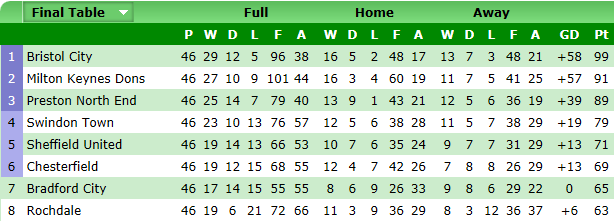
Benefactor owners have made their mark even in League 1, where clubs live within their means much better than in the division above. Last year’s champions, Bristol City, have been bouyed by the funding of Steve Lansdown. Second place Milton Keynes Dons are owned by Pete Winkleman, who moved Wimbledon FC to Milton Keynes in 2001. Playoff winners Preston North End are supported by Trevor Hemmings, who has reduced their debt by more than £50m since 2010. During the 2013-14 financial year, he waived £18.7m of debt and £15m through a share issue.

Wigan Athletic will look towards breaking even financially on the current season. They are likely to continue to shed higher wage earners this January, as they did just over a year ago and in summer. Players on Championship-level salaries will be encouraged to leave. Squad size could also diminish.

A few miles away in Horwich, Bolton Wanderers will surely do something similar but on a larger scale. They have to drastically cut their costs and a fire sale like that one in Wigan just over a year ago is on the cards. They will surely be heading towards League 1 next season, but will they meet their local rivals there?

Whether Gary Caldwell can achieve promotion this season remains to be seen. Perhaps it will be next season, or perhaps Latics will be marooned in a division where they will no longer have a financial advantage over the rest.

But in the current climate of English football the level of elevation will depend on the funding of a benefactor. But Dave Whelan’s role in Wigan Athletic’s rise was not solely as a benefactor. He was a visionary who made it possible through his hard work, knowledge and dedication.

David Sharpe has a hard act to live up to. But he has already revealed a vision that can take the club forward, impressive for such a young man.

But is Sharpe capable of being the chairman who can not only run a balanced budget this season, but provide the benefactory backing for the club to eventually get back into the Premier League?

The Whelan family have done so much for Wigan Athletic over the past two decades. How much more can we expect from them?

Where will Latics finish?

TableDec

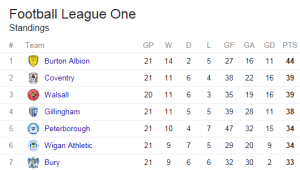
After playing 21 games Wigan Athletic lie in 6th place in League 1 with a record of W9 D7 L5.

They have the 3rd best defensive record in the division, together with Bradford City, having conceded 20 goals.

But there are 9 clubs who have scored more than Wigan’s 29 goals up to this point.

Gary Caldwell is a young and inexperienced manager who has had a mountain of a task to deal with. His first managerial appointment was at a Wigan Athletic in free fall, where the team had acquired a losing mentality with morale close to rock-bottom.

His brief was to move on as many of the ex-Championship and Premier League players on his staff as he could, in order for the club to be able to balance its books month-to-month. He was also to make sure the club did not go into the red on the transfer market  through outgoing fees exceeding the incoming ones. Moreover his chairman made clear his hopes that Caldwell’s new team might smash the division with 100 points. The chairman also wanted the new team to play football in “The Wigan Way”, signifying a major transformation from the “direct” style that predominated in the reign of his predecessor.

Caldwell has taken all this on his shoulders with dignity. He is bright and eloquent and may well have a glittering career ahead of him in football management. Up to this point he has brought in 21 new players, with economic necessities indicating that there will be more turnover in January. His team has not played consistently well so far, but results have been good enough to reach the playoff zone.

Caldwell, like his chairman David Sharpe, is aware that Latics have a tight timeline for getting back into the Championship division. This is their penultimate season for the receipt of parachute payments. Should promotion not happen this season or next the club will find itself in the same financial boat as others in League 1. Moreover in the case of it happening next season rather than this, it would mean Latics going into a Championship division without parachute payments, competing against clubs that have that huge advantage over them.

It is not surprising therefore that Caldwell has stated his aim of achieving automatic promotion this season, rather than next. What are the chances of Caldwell’s team achieving his aim? Is League 1 the kind of division where a team can make a rapid ascent of the table in the second half of the season? Is it realistic to expect Latics to overhaul Burton Albion and/or Coventry in those top two positions?

At this stage last season (2014-15) Bristol City and MK Dons led the division:

tabledec202014

They were to hold those 1st and 2nd positions at the end of the season.  Moreover Preston, Swindon and Sheffield United were to hold their playoff places:

Table2013(2)

In 2013-14 Leyton Orient had been top in December:

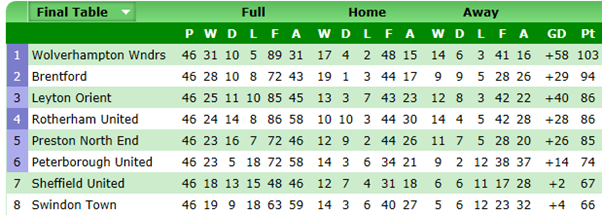
TableDec2013But the London club eventually finished 3rd, losing out to 4th place Rotherham in the playoffs. Wolves, loaded with big parachute money and ex-Premier League players, ran away with the division in the second half of the season:

Table2014

Notably the top six clubs remained the same from December, even if some positions had changed.

In three of the past five seasons the top two teams at this time of year achieved automatic promotion at the end of the season. Leyton Orient had been overtaken in the top two by Brentford in 2013-14, but the gap between the two teams in December had only been one point. No team below 3rd place at the 21 game mark in December had achieved automatic promotion in those four seasons.

The exception was that of Bournemouth in 2012-13. In December they were lying in 9th place, with 32 points from 21 games. They were to finish in 2nd place, just a point behind Doncaster Rovers who had been in 2nd place after 21 games in December. The December leaders, Tranmere Rovers, had dropped to 11th place by the end of the season.

But how about promotion through the playoffs?

Last season it was 3rd placed Preston who won the playoff place. But interestingly for the previous four seasons it had been the team in 4th place that had won the playoffs.

Following an 11 game unbeaten run Caldwell’s team has not won for the last four. The expectations of the chairman and the fans weigh heavily on the manager. His squad is by far the most expensive in the division and they are expected to perform better. For a hard core of fans a failure to reach promotion this season would be a disaster. Others are more patient and will say that Caldwell needs more time to build a solid base that will not only serve Latics in the here and now, but in the long term.

The statistics over the past five seasons suggest that Latics are unlikely to achieve automatic promotion this year. Moreover there is statistically at best a one in four chance of them winning the playoffs.

However, Caldwell has a large and very able squad at his disposal, which is capable of defying the odds. He has repeatedly experimented, changing his lineups in efforts to try to get the best out of his players. What he rarely changes is the style of football.

Having been employed by his chairman to adapt the style of play from the ugliness of the Malky Mackay era, he has had to change the mindsets of so many players brought up on a more direct style. That remains a work in progress. The frustrations of constant backwards and sideways passing are frustrating to fans who crave for a faster tempo. In the days of Mackay a player under pressure would more often than not hoof the ball away, giving possession back to the opposition. In the Caldwell era they are more likely to retain possession, but too often to little effect.

The 32 year old Caldwell seeks to follow the example of Roberto Martinez who was appointed to his first managerial position at Swansea at the age of 33 in February 2007. Within 15 months Martinez had transformed the Swans style of play and they were League 1 champions by May 2008. He showed that it is possible to play skilful possession football in League 1 and be successful.

The task ahead of Caldwell is to have the whole at least equal the sum of its parts for his team. He will be aware that there are supporters who were never fans of the kind of football that Martinez’s teams played at Wigan. Moreover even the neutrals among the fans have been frustrated by then sterility of Latics’ play in recent matches. The running off the ball that is essential in possession football has been less evident and players on the ball have been unwilling to take risks, taking the easy way out with lateral or backwards passing.

Caldwell has lifted the gloom of the Mackay days and there are rays of hope for the future. His teams have shown a fierce determination to fight back when things have not been going well, something that last year’s outfits were unable to do. Although Caldwell’s teams can be criticised for failing to adjust their play in the bad weather conditions they have nevertheless shown their ability to grind out results. The draws at Bradford and Southend may not have been pretty to watch, but the determination was certainly evident.  However, the combined play of the team has not yet reached the heights one would expect given the talents of the squad as a whole.

But after 26 matches in all competitions up to this point, involving 31 players, the gelling process is not complete and players are still adjusting to Caldwell’s preferred style of play. Having a large squad can be seen as a significant advantage over other League 1 clubs, particularly as injuries come into play. However, the other side of the coin has been rotations of the starting lineup.

Doom and gloom continues to be bandied about on the message boards and social media. Some pundits are even suggesting Caldwell be dismissed,  despite his considerable achievements up to this point with Latics having a good squad of players, being only five points away from an automatic promotion place. Expecting instant results from Caldwell given the tasks that he has had to deal with is surely unrealistic.

If Caldwell can get his squad down to a size that will continue to give him a competitive advantage but alleviate the need for constant squad rotation, the gelling process will surely hasten. Given the range of players he has at his disposal he is unlikely to have a regular starting eleven. But certain players will form the backbone of the team, even if small adjustments are made from game to game.

But more than anything, Caldwell needs time. The question is how much time does he need for his team to gel into a promotion winning side.


Don’t panic, but find the right blend

TableDec

Another awful performance and the doom and gloom is back in full force on the message boards. No wonder – within the space of a week Latics have lost at home to two sides in the relegation zone of League 1, albeit one defeat being on penalty kicks. With a budget more than four times higher than most clubs in the division can we not expect better performances from Gary Caldwell’s team? How much longer can we say that the team is still in the gelling process?

Is it time to press the panic button? Max Power does not think so.

“I don’t think it is time to panic; every team goes through a sticky patch and if this is ours then I fully believe we’ll come through it on the other side,” Power explained on the official WAFC site. “Saturday was only our second league defeat since September and that says a lot about us as a team but we know the last couple of weeks haven’t been good enough and it is up to us to put it right.”

This time a year ago Malky Mackay had been in charge for almost a month. Sadly Latics had not won any of their first four matches since his arrival, which had sparked mayhem from the media. But the optimists among us hoped that Mackay would get rid of the dead wood that was chewing away at the fabric of the club. Those were the players who just did not seem to care. They needed clearing out, with new players coming in who would give their all when wearing a Wigan Athletic shirt.

The disastrous regime of Mackay will be etched in our memories for years to come. But there are lessons to be learned from it that should be borne in mind in the present. Fans had been peeved with what appeared to be a lack of effort from the players that Mackay had inherited from Uwe Rosler. It seemed to give Mackay carte blanche to jettison no less than sixteen of them in the January transfer window. Household names were dispatched for minimal transfer fees with hardly a murmur. Sadly the net result was that Mackay was left with a threadbare squad of dubious quality, with the numbers being made up by young rookies from Premier League and other Championship  clubs. Relegation was the sad consequence.

As always when a team goes through a rocky patch there is criticism of the manager through the social media. Caldwell’s tactics and team selections are certainly under attack at the moment. Some point to him being a rookie manager, making mistakes along the way. Some of the comments can be off-the-wall, but others can be thought-provoking, like this one from Yon Mon on the Vital Wigan forum

“We play the same way no matter which players play. No matter what formation we play. Bring the ball halfway into the opposition’s half, pass sideways, pass backwards, pass forwards to the same point give it to Wildschut he then attempts to beat the 2 or 3 players on him. Sometimes he does sometimes he doesn’t. If he’s successful he then either shoots or plays across a crowded goalmouth. Trouble is our 1 or 2 players there are crowded out. It’s predictable and other teams have sussed us out. Where’s the variation? Where’s the movement upfront? Where’s the support when we attack? It’s too slow and it gives other teams time to get back and crowd us out. About 7 or so games into the season GC said he’d stopped having other teams watched because when they came here they played completely different. Has it not occurred to him it’s because we’re easy to play against and all they have to do is crowd us out to stop us being effective?”

Donnys Page  on the Cockney Latic forum echoes similar sentiments after the Blackpool game, although the writer acknowledges the need to give Caldwell more time :

“It wasn’t pretty. Slow, monotonous, boring. A continuation from last week. Not good enough. One pass to foot in the box to Grigg. Nothing in midfield but sideways and backwards movement and slow build ups. Again a job done by Pool and an easy job at that. We never stretched them at all. Got to give Caldwell a bit more time though. A month ago things were going quite well but at the moment clubs have us sussed unless he changes something.”

Horc responded to Donny on that same thread by making strong suggestions:

“Its time for a total clear out of everyone involved with the footballing side of Wigan Athletic who worked with and under Martinez and start again as it is just a continuation of the boring, negative, sideways and backwards, predictable crap we suffered under him for four years but with worse players.”

Sammy Salt 1968 on the forum of This Northern Soul opines that:

“We are pedestrian and predictable . So easy to play against . Every club has worked us out now . They let us have our possession , save their energy and then press us and counter our cart horse defence . We suffer from delusions of grandeur that we can a play a patient continental game and pass teams into submission . You would think we were on a dry pitch in August the way we set up with no plan to beat the elements as well . I am sure there is a role for both long and short corners but we seem to always take wrong option . There is total absence of a leader….”

Caldwell is under pressure at the moment, but as Max Power said, it is not time to panic. Despite gaining only one point from their last three league games, Latics remain in the playoff zone, in sixth place, just five points away from an automatic promotion spot. At the start of the season, given the almost complete turnover of the playing staff, I for one would have been satisfied with a mid-table position by Christmas.

Nor every Wigan Athletic fan was a lover of Roberto Martinez and his style of football.  Many see Caldwell as an acolyte of Martinez. They see the frustrations of the Martinez era returning under Caldwell. Patient possession football is not the order of the day for those who yearn for the days of Paul Jewell’s 4-4-2.

However, like Martinez, Caldwell will stick with his beliefs although he will surely be pragmatic enough to recognise when things are not working. Under managers such as Coyle and Mackay the hoof was the order of the day for defenders who did not know what to do with the ball. They were both poor appointments and set the club back on its heels. In the Caldwell era, as it was in that of Martinez, the hoof is frowned upon and players who do not have the self-confidence to do something imaginative merely pass the ball sideways or backwards.

Martinez always had a creative player capable of unlocking a visiting defence. Shaun Maloney, Victor Moses and Charles N’Zogbia were totally different in their styles, but were capable of doing something special.

Caldwell seemed to have that to some degree in Michael Jacobs earlier in the season, when he was playing in the hole between the holding midfield and the central striker. Jacobs was to be superseded by the arrival of Yanic Wildschut, who was devastating in his role of cutting in from the left wing, with blistering speed, not only unleashing powerful shots but providing superb assists.

The advent of Wildschut, combined with a knee injury sustained against Shrewsbury, has impacted upon Jacobs’form. He has been too often pushed away from his best position towards the right wing where he is much less effective. Moreover Wildschut is now not only heavily marked by the opposition, but defenders have started to figure out how to play him. He is not having the same impact that he was a few weeks earlier.

During the unbeaten run of eleven matches, Latics rarely looked like world beaters. So often good results were hiding unimpressive performances.  But they had an attacking threat. The more forward players were running into space, looking to receive the ball. Midfield was coming up in support.

In recent games these things have not been happening to the same degree. Too often a player can receive the ball in the middle of the field and have no other option but to pass the buck. Such a habit is contagious. Players who are fighting for their places in a very competitive squad are reluctant to make mistakes which can ultimately lead them to lose their place in the starting lineup.

On Saturday Caldwell chose a starting lineup that must have been pretty close to his eleven best available players, based on their form over the course of the season. On paper it looked a positive team selection.

However, choosing your best available players is not always the way to choose your potentially most viable lineup. Sometimes combinations of certain players just don’t work. You need the water-carriers and the flair players. It is the blend that is the key.

Question marks remain about the viability of playing the two best central strikers – Davies and Grigg – with Wildschut on the left wing. Moreover none of the three are likely to perform the levels of defensive duties necessary to keep things compact.  That, in turn, puts added pressure on the midfielders, who are expected to both support the attack and repel counterattacks.

Wildschut is an exciting player to watch and has made a huge impression since his arrival. His permanence at the club could prove crucial to Latics’ promotion chances. However, Caldwell needs to consider how best to use him. In the Martinez days of 3-4-3 Victor Moses was essentially a winger with freedom to roam. He was not strong on his defensive duties. However, he linked up well with his wing backs. Both Emmerson Boyce and Jean Beausejour were excellent in those functions. One did not feel that Moses cramped their style.

However, if Caldwell’s team plays 3-4-3, with the Dutchman in his preferred position on the left wing, one wonders about the difficulties the young left wing back, Reece James, must face. James is expected to attack, but his space is limited by having a left winger in front of him.

The lack of recent form of Michael Jacobs is a concern for Caldwell. Jacobs is the main creative force at his disposal. To get the best out of the player he needs to be played in that central advanced midfield role. He also needs a good share of the ball. Haris Vuckic is an obvious candidate for a similar role, but has not even appeared on the bench in recent games.

The lack of creativity in midfield has been a worry for Latics over the past weeks.  Max Power and David Perkins are largely involved in physical battles for the dominance in the middle of the park. Caldwell faces the choice of playing two holding midfielders with two wing backs in the 3-4-3 system, or three parallel midfielders in a 4-3-3 formation.

There are fans calling for wholesale changes in the January window. However, Caldwell must be cautious in his transfer dealings. Having endured problems in the gelling in of so many new players, he will be cautious about bringing in too many more. He simply cannot afford to have too much turnover, as happened in the Mackay era last January.

Caldwell’s dilemma is that he may need to leave out  some of his best players to provide a balanced and functioning unit. It is going to take some bravery on his part to do that.


Concentrating on the League

Davies2

“I was thinking to myself: last minute, against my old club, this is going to drop for me, I’m going to put them out. It was just one of those things. The ball’s ended up going a couple of yards behind me. It wasn’t meant to be, and we just have to get on with it.”

So said Craig Davies to Wigan Today.

There is an old saying in football that it is results that count. If that pass had reached Davies and he had put the ball in the back of the net then Wigan Athletic would almost certainly have reached the northern final of the Football League Trophy. The result would have overshadowed the poor performance.

In fact results have overshadowed poor performances on various occasions this season, as Gary Caldwell’s sides have battled back in the closing minutes to put things right. Last gasp winning goals from Jordy Hiwula at Chesterfield and Francisco Junior at home to Swindon, together with Will Grigg’s late equaliser at home to Millwall, added an extra five points to Latics ’tally. Without them Wigan Athletic would not be in the playoff zone now.

It had looked like another last gasp winner was coming against Barnsley, but sadly this time it did not.

Gary Caldwell was said to be “hugely disappointed” with his team’s exit from the competition.  A home game against League 1’s bottom club had looked like the passport to the Northern Final of the competition.  We had been looking forward to visiting Wembley once again. But hopes were dashed after the manager had struggled to muster five players to take the spot kicks. Barnsley had won a League Cup match against Scunthorpe through a penalty shootout, 7-6 in their favour. They were to go on to show enough confidence to do it again.

The disappointment of the defeat, of which even Caldwell himself admitted that Barnsley had merited their win, has been hard for fans to take. As always, the blame for such a poor performance falls on the manager’s shoulders. The social media and message boards are once more bristling with criticisms of Caldwell’s style of play and team selections. But one or two brave souls continue to sticks their necks out by suggesting that it is the players who are to blame for displays like that. Caldwell himself even went as far as to say that “If I was a player that played today, I’d be very worried about my place.”

As with the previous performances against Shrewsbury, Burton Albion and Southend United so many of Caldwell’s key players had not played up to expectations. The lack of form of Michael Jacobs and David Perkins has been particularly worrying, although it was always going to be hard for the two of them to keep up the high standards of performance they had maintained prior to the arrival of seasonably bad weather.

Recent matches have been played in particularly difficult conditions, which are hardly conducive to the style of football that Caldwell seeks. In such conditions against League 1 opposition, Latics will need to play with a more direct approach, as they did at Southend. There was no lack of effort or fight from the players on that occasion and they were able to grind out a 0-0 draw that could easily have turned into a victory if one of Leon Barnett’s three fine efforts had gone in. But the first half ploy of launching long balls to the twin strikers, Grigg and Revell, just did not work. It was only when Craig Davies had come on in the final quarter that the long balls started to work more effectively.

Sometimes a player’s arrival in a team can correspond to a change in fortunes. This has certainly been the case for Caldwell’s team.

Both Yanic Wildschut and Jussi Jaaskelainen made their debuts against Walsall in early October. Many fans would say that their arrival in the lineup was instrumental in Latics extending an unbeaten run of three into eleven.

Wildschut had come on as a substitute in the 46th minute. He followed up with a man of the match performance at Crewe, scoring a spectacular goal. The Dutchman went on to terrorise opposition defences for the next month. He still retains that capacity, although the opposing teams are now wise to his threat and are finding ways to deal with him, sometimes legally, sometimes not.

Given the player’s explosive style, Caldwell has used Wildschut carefully, often taking him off around the two thirds mark. The manager had talked during the week about the physical demands on Wildschut’s body, arising from his style of play. He chose to leave the big winger on the bench on Saturday, bringing him on after half time. Wildschut’s loan period from Middlesbrough ends on January 2nd. The player has added so much more of a goal threat to the attack that Caldwell will be desperate to fix up a deal with the north eastern club come January.

Boro manager Aitor Karanka apparently does not include Wildschut in his future plans. Wildschut does not meet his tactical plans, not least by his unwillingness to track back and help out his full back. It is not only Wildschut’s lack of defensive awareness that has impeded his career in the past, but an inability to lift his head and be aware of the situation around him. Wildschut continues to frustrate, but has not only scored three good goals, but also made a similar number of excellent assists. He is invaluable to the Wigan Athletic attack.

Jaaskelainen has impressed in his ability to dominate his box and to marshal his defence. He adds calmness to the defence through his experience and knowledge of the game. The other goalkeeper, Richard O’Donnell lost his place primarily because of his lack of forcefulness in his own box. He will clearly need to work on improving this aspect of his game. In early season O’Donnell was too often faced with dealing with awful back passes from defenders passing the buck to him and putting him under pressure. Following an uncharacteristically bad mistake at Bury, O’Donnell’s confidence is probably at a low. But he had an excellent record at this level with Walsall and was rated as one of the division’s top keepers.

Jaaskelainen exudes confidence through his pedigree as a top Premier League goalkeeper over many seasons. However, at 40, his reactions are not as quick as they were. At least some of the goals he has allowed would most likely have been saved by O’Donnell.

Alex Revell’s arrival met with instant success in his first two games, but less than that in his next three. Revell started on the right of an advanced midfield in the 4-2-3-1 system that Caldwell used at the start of the 2-0 away win at Rochdale. Then Revell scored a well-taken goal in a target man role with a header in the 1-0 win over Shrewsbury. But he was unable to impress in the confrontations with Burton, Southend and Barnsley. At 6 ft 3 in Revell is comfortable in the target man role, but his career record shows he has never been a consistent goal scorer. Fans continue to be puzzled why Revell gets the nod ahead of Davies in the starting lineup.

But perhaps Caldwell’s ploy of playing Will Grigg and Revell together was not such a bad one. The bright spot of the Barnsley game was seeing Grigg put away two goals in the manner of a true goal poacher. After the game the player admitted that he had not played particularly well, but it is goals that win matches and Grigg is the most likely to score them for Wigan Athletic. Although he scored a bagful of goals playing as a lone striker for MK Dons last season, Grigg would surely thrive playing alongside a big target man whose physical presence can draw away defenders and create space for him. The question is whether it should be Revell or Davies in the target man role.

Caldwell took a gamble on playing the left footed Andy Kellett at right wing back against Barnsley, which probably did not come off as much as he would have liked. The absence of both Donervon Daniels and Donald Love had forced his hand to some degree, although he could have called on Tom Chow. The renewal of Love’s loan period for another month will help Caldwell provide cover for that right back position, provided the young player can stay fit. Bringing in a raw young player on loan to a side seeking promotion is always going to draw criticism from fans, but Caldwell clearly rates the Rochdale-born lad highly.

In fact Love’s current loan spell will come to a conclusion four days after the transfer window opens on January 3rd. By then Caldwell will have decided whether he wants to negotiate with Manchester United on making Love a permanent signing or to seek another extension of the loan period. He will have to make similar decisions for Junior and Shaun Murray, both talented midfield players, but who have not shown enough to merit a regular place in the side up to this point. Revell’s permanence at Wigan will to a large degree depend on whether Grant Holt will be returning from his loan spell at Wolves, which ends on January 2nd. Caldwell has already voiced his enthusiasm to keep Wildschut, whose loan period also runs out on January. Wildschut might not be the finished product, but appears indispensable to Wigan’s promotion push.

Securing Wildschut on a permanent contract is going to depend largely on David Sharpe’s willingness to pay Middlesbrough the fee they will seek. This in turn might well depend on possible outgoings from Wigan. Economics could well dictate the departures of players on Championship level salaries, whose contracts expire at the end of the season. Latics might well seek small transfer fees in some cases, but the main concern is that of reducing the monthly wage bill. Leon Barnett, Don Cowie and Chris McCann are in that position.

Getting knocked out of three cup competitions has hardly been pleasing for the fans. The awful FA Cup exit at Bury was followed by dreams of Wembley being quashed by League 1’s bottom club. But for Caldwell, in his quest for promotion back to the Championship, it could turn out to be a blessing in disguise.  His players will be focused on one thing only – the league.

Latics currently lie 5th in the table, five points behind an automatic promotion place. This is despite the team rarely clicking on all cylinders. But, cup competitions apart, results have been remarkably good for a squad with 21 new players.  The home tie with Sheffield United on Boxing Day will be the 23rd league game, the half way point of the season.  If the team can overcome its recent jitters there is a strong possibility that Latics will be within close striking distance of an automatic promotion place by New Year.

As the season has progressed Caldwell’s players have gradually started to gel as a working unit. However, up to this moment in time the whole has not equaled the sum of its parts. A major concern for Caldwell will be the possibility of further turnover of playing staff in January. Will the economic side of things at the club be in his favour or against him?

Caldwell needs continuity in terms of his playing staff, not more wholesale changes which will further slowdown the gelling process. It could be argued that he would be wise to stick with what he already has, although quite a bit of that is beyond his control.

It remains early days in the “new era” at Wigan Athletic. The January transfer window is another hurdle to be crossed.

Caldwell, Sharpe and their recruitment team did so well in the last transfer window. The question is whether they can make the right decisions in January.

Promotion will largely depend on what happens.