A Cardiff fan’s view of Kevin McNaughton

Soccer - Pre Season Friendly - Cardiff CIty v Celtic - Cardiff City Stadium

It has been announced that  32 year old Kevin McNaughton has signed for Wigan Athletic on a one year contract, following a trial period at the club.

Given the youthful nature of his squad Gary Caldwell will be looking for some more experience and McNaughton can certainly provide it, having played more than 450 games in his career. McNaughton made his debut for Latics in the pre-season match at Southport and subsequently played against Dundee and Blackburn Rovers.

The 5 ft 10 in McNaughton was born in Dundee, but came up through the Aberdeen youth system. He made his debut for the Dons as an 18 year old and was to make 175 appearances over 5 seasons.

McNaughton signed for Cardiff City in summer 2006 and manager Dave Jones used him regularly as a left back in the 2006-07 season. The following season saw him switched to right back and he played in all six matches in Cardiff’s run to the 2008 FA Cup final. His following season was dogged by injury but he reclaimed his place in the 2010-11 season when he was voted Player of the Year.

In September 2013 McNaughton went on loan to Bolton Wanderers, making 13 appearances during a three month stay. He went back to Cardiff in January and played in a handful of Premier League games by the end of the season.  Last season saw McNaughton return to Bolton on loan, where he made 8 appearances. He had made 254 appearances for Cardiff before being released this summer.

In order to learn more about McNaughton’s time at Cardiff we reached out to Benjamin James of the View from the Ninian fan site.

Here’s over to Ben:

What to say about Kevin McNaughton?

A player who most, if not all Cardiff fans, would have gladly kept. A player who came in unheralded and went on to become one of the most revered players of recent times. The very definition of a club legend.

The image of him on the pitch after our promotion to the Premier League is iconic – he, out of all those players in the squad, deserved it more than most. Near misses and play-off disappointments were felt most by him.

It looked as if for all the years he had given us, he was going to miss out on some Premier League action; a loan to Bolton looked to signal the end of his career at Cardiff City. But he returned and I was so happy that he got to play in the Prem for us.

Wigan have signed a player who will build an incredible rapport with the fans. You’ve signed a player who will leave it all on the pitch. You’ve signed a player who will be invaluable to the dressing room – if you want someone to dress up as Dangermouse, he will be the first to do it.

I’ve seen him knock himself out in consecutive games, take out lino’s in his quest to get to the ball and outpace the quickest of players.

I can’t think of a bad word to say about him and I know I’m not alone in this. In an ideal world, Kev would have seen out his career with us. He became a true fan favourite in his nine years with the club and he will be missed.

He’s played all across the back four and even in midfield at points. He’s seen the best of times and some of the worst yet he’s stayed as consistent as ever. I really hope he succeeds at Wigan and Wigan succeed with him – he deserves nothing less.  

Getting the right kind of player

Sharpetweet

English football’s close season lasts too long for me. World Cups, European Championships and Copa Americas can all make entertaining viewing, but there’s nothing like the buzz that you get when your own team is playing. Latics played their last game of the season on May 2nd at Brentford.The League 1 campaign starts more than three months later on August  8th.

These recent weeks have been hard to bear, skimming the internet for transfer gossip, much of which is pure speculation. Does someone actually make up some of those stories? I can’t wait for the new season to start.

The other day a friend asked me what I thought Latics’ chances were of getting promotion this year. I had to reply that I had not the slightest idea. It would have taken too long to explain to him about the implications of the SCMP and parachute payments, together with ditching almost all of the top wage earners on the playing staff. Plus how a rookie chairman and rookie manager were going to turn around a club that had been losing its direction. Given the circumstances was I being an eternal optimist in thinking that Latics could actually reach the lofty goals for the season set by David Sharpe and Gary Caldwell? Up to then they had signed just two players on free transfers. Was my optimism unrealistic?

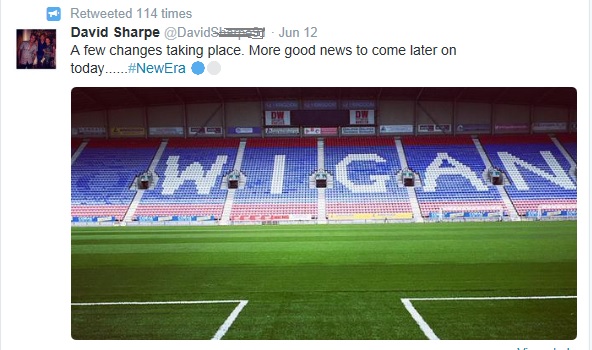
But then on Thursday came that tweet from David Sharpe:  a freshly grassed DW pitch and the promise of more good news later in the day. My mind started to race. Were Latics about to announce the signing of a dynamic up-and-coming young striker who could make all the difference? Or was it that they had signed left sided midfielder Sam Clucas from Chesterfield, a young player who had made a big mark on his club’s season. Moreover he qualified for Sharpe’s professed criterion of being between 23 and 27 years of age.

Then the news came through that Latics had made another free agent signing. The announcement of the procurement of 29 year old Craig Morgan from Rotherham was somewhat underwhelming. Morgan had previously played for four other clubs in the lower divisions prior to joining the Millers.

But his arrival was certainly welcomed by Caldwell:

‘He has great experience, having played internationally, but he also knows the division inside out. He is a quality defender, a real leader on the pitch who has been a captain, with a superb attitude and we are delighted to have him on board.’

Caldwell did not mention that Morgan has played 23 times for Wales.

Moreover the player had chosen to join League 1 Wigan despite receiving a similar financial offer from Rotherham. But he had also turned out an approach from Bolton Wanderers, who seemed far from happy that Morgan had gone to Wigan. One Bolton fan site posted a particularly vitriolic piece. In an open letter to the player the writer says: “We’re glad that your particular brand of mediocrity has found a home. We ourselves have spunked many thousands and millions of pounds on average footballers over the years, and we are all grateful for your decision to join Wigan causing us to avoid falling into the same trap yet again. It’s interesting to us that you chose Wigan. We know that you attended a medical at our Euxton training ground, and we know that you had your Bolton Wanderers contract drawn up and ready to sign on Thursday afternoon.”

Morgan himself commented I had offers from teams in higher leagues, but I chose to come here because of the opportunity and potential here, I didn’t want to just mull around in the Championship. I want to be part of success with this club, I have done previously and I’ve enjoyed it so much that when Wigan came in for me I jumped at the chance because this club is the place I can see myself being successful at once again. The changeover of the Chairman and the manager last season seems to have given the club a fresh start for this new season.”

Sharpe was clearly pleased with the acquisition of Morgan. One wonders if his pleasure was derived as much from depriving the near neighbours of a player they sought, as much as landing an experienced and capable lower division central defender.

The practically simultaneous departure of Scott Carson to Derby County was no surprise, given the signing of Richard O’Donnell and the contract extension for Lee Nicholls. However, it does signify the beginning of the exodus of many of the other eighteen players still under contract from the Championship days.  Caldwell and Sharpe will endeavour to shift on as many of the higher wage earners as they possibly can, replacing them with either experienced players on short term contracts or up-and-coming youngsters. Parachute payments last two more years. David Perkins, 32, has been given a one year contract, Craig Morgan two years, and the 26 year old Richard O’Donnell three years. It looks like Caldwell sees O’Donnell and the 22 year old Lee Nicholls as his goalkeepers for the years to come.

Put simply Latics need to shed a lot of players to make room for others to come in on contracts more in line with those of other League 1 sides. James McClean’s departure also seems imminent, whether it be the New York Red Bulls or a Championship side in England. McClean has been his usual forthright self when asked about his future with Latics. Like several of his colleagues he is unwilling to drop down to League 1, not ideal for the future prospects of an ex-Premier League player. At the same Latics will be happy to get his relatively large salary off the payroll, hoping to recoup some of the transfer fee they originally paid for him. The same will be the case for others such as Andy Delort, James Perch and Oriol Riera .

Latics’ players are due to report back for training on June 25th. It remains to be seen what proportion of those players will be with the club by late August. Although financial considerations are the main driving force for the imminent departure of so many players, the lack of performance by so many last season also comes into consideration. There will be some degree of backing from the fans for the clear-out of players that they felt did not compete as much as they might have while wearing a Wigan Athletic shirt.

Ideally Caldwell would be able to decide which of the players remaining from last year’s squad would be staying. However, the reality of finding other clubs for players on relatively lucrative contracts will tie his hands to some extent. If he is unable to move on players not in his plans he will face financial constraints which will restrict his possibilities for bringing in more dynamic new blood.

In the meantime we will await more signings who will by Sharpe’s preference be  “young, hungry players between the ages of 24-27, ones who have done it before, who know what it’s like to win promotion, who are willing to learn and put in the hours, and buy into Gary’s brand of football”.

Although he does not fit the age criterion Morgan has “done it before”, having played in a Rotherham team that won promotion.

However, although it would seem to be a good bet to sign players who have already been in promotion winning sides it does not necessarily correlate with success. Owen Coyle brought in the likes of Leon Barnett, Grant Holt, Marc-Antoine Fortune, Chris McCann and James Perch, all of whom had played in sides that won promotion out of the Championship. Uwe Rosler was to do the same with Don Cowie and Andrew Taylor.

It is those young, hungry players that Caldwell be primarily focused upon signing, although he will surround them with a core of experienced professionals. But more than anything else he will be looking to sign “the right kind of player”, one that will wear the Wigan Athletic with pride.
Forgetting the past

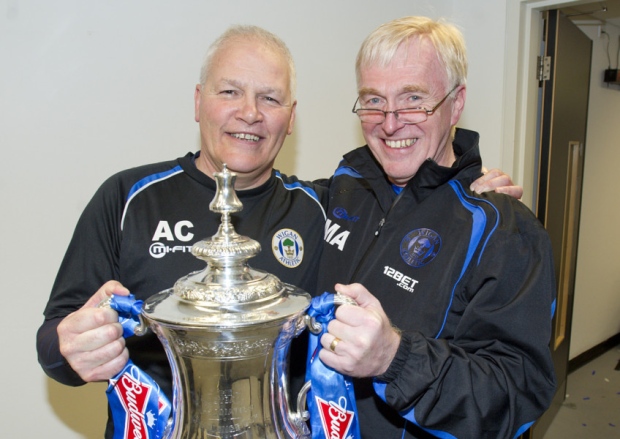
Alex Cribley (left) with Dr Mike Ashworth.

Alex Cribley (left) with Dr Mike Ashworth.

Last season is still a bit of a mystery for me. Having a poor season is one thing, it happens to a lot of teams. But for us to have got relegated was unthinkable. I’ve got my own opinion on what happened, but that’s all history now. We just need to let it go and be ready for the challenge of bouncing back next season.”

The words of Graham Barrow speaking to the Evening Post.

Many of us would be interested in hearing Barrow’s opinion of what happened last season, but he seems unwilling or unable to make it public. Barrow rightly wants to move on and focus on next season. However, despite saying that last season is all history now, he moves on to talking about his role in Latics’ Freight Rover Trophy win thirty years ago.

The Chorley-born Graham Barrow has had a long association with Wigan Athletic. He was the most rugged and determined of midfield players, sometimes used as a centre forward, signed from Altrincham for £10,000 in August 1981. He was to become a key component in Larry Lloyd’s team that won promotion from the fourth tier and made 179 appearances, scoring 35 goals, in his five seasons at Wigan. He was “Man of the Match” in that 3-1 win over Brentford in that Freight Rover Trophy final.


Barrow moved on to Chester at the age of 32 and suffered five bookings in his first seven games for them. However, he was to make 248 appearances for them, scoring 17 goals. In addition to being captain on the field of play he became assistant manager to Harry McNally, then player/manager from 1992-94. As Latics’ manager in 1994-95 he helped them avoid relegation to the Conference. He was to go on to manage Rochdale, before a short lived return to Chester, subsequently taking the reins at Bury.

Barrow was brought back to Wigan as first team coach by Roberto Martinez in July 2009. On Martinez’ departure in summer 2013 and the arrival of Owen Coyle his future seemed in the balance. New managers tend to bring in their own right hand men, but although Sandy Stewart came in as Coyle’s assistant, Barrow continued as coach. He was to become assistant manager under Uwe Rosler, keeping the position under Malky Mackay and Gary Caldwell who were to follow.

Alex Cribley played in the same Larry Lloyd team and that Wembley final against Brentford. In fact he made 328 appearances for Latics over eight years. Cribley had been signed on a free transfer from Liverpool by Ian McNeill in November 1980 and his versatility made him a key player. His best position was probably in the centre of defence, but he was a solid right back and could lend a hand in a midfield holding role. Cribley went on to become club physiotherapist, being connected with the club for 35 years.

Cribley is perhaps one of the more unsung of Latics icons. However, when Mike Ashworth retired as club doctor in April after 33 years of service he spoke of his colleague:

“One thing I will miss more than anything is Alex Cribley. He was there as a player when I started so he’s been there longer than me, then he became a physio. He’s been a fantastic friend, a fantastic support, a proper professional and Wigan Athletic has been very lucky to have him over the years. I’m going to miss that day to day contact with Alex but I’ll keep in touch, I’ll still go to the games and hopefully get a season ticket now and go back to where I started.”

A couple of weeks ago a rumour went around the social media and message boards that Cribley had left the club. Soon after the kit manager, Dave Mitten, tweeted that he had been made redundant. Ironically Mitten still appears on the Who’s Who on the official club site, but Cribley has disappeared.

Given a drop of two divisions in a space of years and an almost 80% potential dip in revenue compared with the life at the top, Wigan Athletic have to cut their coats according to their cloth. It entails not only a mind shift  in terms of the kinds of players they will look to acquire, but also a fundamental restructuring of the auxiliary and administrative staff  at the club.

Put simply Latics cannot continue with a Premier League infrastructure in League 1. It inevitably suggests a huge cut in the total costs of players’ wages, but also a general downsizing within the organisation.

There are fans who will question the outgoings over the next couple of months, not only players but support staff. The club will look at getting the best possible infrastructure in place, within its new financial situation, for the start of the 2015-16 season. It is going to be a painful time for so many within the club, as redundancies will be announced.

David Sharpe is in an unenviable position in having to oversee the culls. He currently has the support of the majority of fans, despite the poorly handled departure of Emmerson Boyce. There are fans who will question the exit of such as the kit manager, citing that what he was earning was a pittance in comparison with what a player would earn. Those questions will continue as the downsizing continues.

However, past commitments and service to the club should at least be acknowledged, if not celebrated. Boyce spent nine years at Latics in their heyday and deserved more thanks than he got from a club that has not been strong in the human resource management aspect. It is sadly the norm in football clubs across the country, Latics probably being no better or worse than most.

Football clubs need to look forward to the future, but at least recognise people who have put in so much in the past.

We await news from the club on Alex Cribley.

Looking back at MAF’s time at Wigan

 Fortunemiss

“The centre-forward is often a tall player, typically known as a target man, whose main function is to score the majority of goals on behalf of the team. The player may also be used to win long balls or receive passes and “hold up” the ball as team-mates advance, to help teammates score by providing a pass (‘through ball’ into the box); the latter variation usually requiring quicker pace. Most modern centre-forwards operate in front of the second strikers or central attacking midfielders, and do the majority of the ball handling outside the box.

I had been looking for a description of the role of the centre forward and after a bit of searching I found the above on Wikipedia. It sums up more or less what I thought the role involved. But why didn’t I trust my own judgment in the first place? After decades of watching football surely I knew what a centre forward should do. But events over the past year or so had clouded my judgment.

My boyhood hero as a centre forward was Harry Lyon. Lyon was by no means a giant, but he had the jumping technique to out-do defenders on high crosses. He certainly scored the majority of the goals for Latics in his heyday. In fact he netted a remarkable 67 times in the 1964-65 season. But the following season saw his goalscoring tally drop, when he scored less than his strike partner Bert Llewellyn who got 49.

Lyon was a scapper, lacking elegance in his tussles against opposition defenders, but he would always chase the long ball and fight hammer and nail to hold possession. Memory fades, but I don’t recall Harry as the kind of player to provide through balls into the box, but his strike partner would be there sniffing for the rebound of one of his ferocious shots. Llewellyn and his predecessor at Wigan, Carl Davenport, were good at putting those loose balls in the net.

But football has changed since Lyon’s day. Defenders are much fitter and most teams have a couple of large guys in the centre of defence who are very good at clearing the ball, especially if it is in the air.  For decades after Alf Ramsey brought in 4-4-2, teams used that system. The twin strikers would tussle with the twin central defenders of the opposition, but after a while the fashion changed.

Perhaps it had become too easy for those central defenders. Marking for them had been straightforward – you take one and I take the other being the order of the day. They were later to be faced with just one central striker, with support coming from the flanks and the midfield. Their roles became more complicated, sometimes confusing.

In the higher levels of English football not so many teams now play 4-4-2. The job of the centre forward has become an almost thankless task, extremely physically challenging in having to chase balls and hold up against often two big defenders. Then he has to have the energy and enthusiasm to mount attacks on goal. Not surprisingly good centre forwards are hard to come by in this day and age. Some are good at scoring goals, but not so efficient in chasing lost causes and holding up the ball. Others are the reverse. The average goal tally for a centre forward has not surprisingly dropped, given his onerous other duties.

However, this does not mean that modern day systems don’t work. The top teams have midfield players moving into the “hole” behind or to the side of the centre forward, notching opportunist goals. Those typically towering central defenders have a hard time coping with their runs.

Uwe Rosler was clearly a disciple of the “modern” approach. In his first season he often used MAF – Marc-Antoine Fortune – in that lone centre forward role, with two players wide of him. Fortune did a good job in holding up the ball and worked hard. MAF had been used sparingly by Owen Coyle, with Nick Powell being on the scene, but Rosler often used him as the target man following Powell’s loss of form and Grant Holt’s fall from grace. Over the course of the 2013-14 season,  MAF was to make 17 league starts, with 20 appearances off the bench. He scored four goals.

Rosler had clearly decided that MAF would not be his first choice centre forward when he signed Oriol Riera before the beginning of last season. This was underlined when Andy Delort was signed just before the close of the summer transfer window. But neither of the two overseas players could settle in their roles. MAF was brought back in.

In Malky Mackay’s first game in charge in late November, Latics were home to Middlesbrough. MAF was given the lone centre forward role, with Callum McManaman and Shaun Maloney playing wide. MAF was to become a regular fixture in Mackay’s teams, even when he switched to 4-4-2. Fans had been hopeful that more goals would come with a switch to the system that had done Latics proud in their heyday. However, Mackay was to pair up MAF with James McClean, a winger playing as a central striker, or Leon Clarke, a journeyman who rarely delivered. Mackay had scorned the idea of linking him up with Billy Mckay or Martyn Waghorn. By the end of the season, MAF had made 27 league starts, with 8 appearances off the bench and scored one goal.

MAF had become a feature in the Mackay era through his ability to chase those lost causes and hold up the ball. Although he offered a minimal goal threat the team often suffered when he was not on the field. MAF had become an important cog in Mackay’s long ball tactics.

MAF was like Marmite to Wigan Athletic fans. You either loved him or you hated him. Despite his whole-hearted play and willingness to sacrifice for the team, few loved him. MAF had become synonymous with the most disappointing season in living memory for most fans.

At Wigan MAF had become the target man, not always his role at previous clubs. Indeed at West Bromwich he had often been played wide. Perhaps Latics would have got more out of the player if they had done that. MAF’s career record as a goalscorer was weak when he arrived at Wigan as a 32 year old, but playing as a lone centre forward helped make it even worse. Moreover his concentration could lapse and he could too often be caught offside.

We might well ponder what might have happened if Latics had persevered longer with the overseas strikers, Delort and Riera. Had they been written off by the coaches or was it an economy measure to send them off on loan in January? On top of that, the reluctance of Mackay to give Waghorn and Mckay a genuine chance was hard to fathom, given the impotent strike force he was regularly fielding. There are fans who even suggest that Latics have avoided relegation if Mackay had not so often fielded MAF.

MAF sadly became the scapegoat of an awful season. Unlike Harry Lyon he could not score goals. Neither could he make assists.

MAF is by no means a bad footballer, neither does he shirk in his duties. But he is not a goalscorer.

We wish him well in his next move.

Holt injury opens door for Riera

Previous articles on Oriol Riera:

It’s time for Riera

An Osasuna fan’s view of Oriol Riera

It looked distinctly possible that Oriol Riera might go back to Spain within the month of January. His ex-manager from his time at Cordoba, Lucas Alvarez, is in charge at Levante and reportedly wants Riera on loan. Levante are currently in 15th place in La Liga, having scored just 12 goals in their 16 matches.

The Valencia club have done business with Latics before, Arouna Kone arriving at Wigan in August 2012 for a fee of €3.5m. Allowing Riera to go on loan would reduce Latics’ wage bill, with the possibility of a permanent deal to follow.

However, the cruciate knee ligament injury suffered by Grant Holt could force Malky Mackay’s hand into retaining Riera.

Mackay’s credibility as Latics manager continues to plummet. His record in seven games in charge reads W1 D1 L5. The arrival of a new manager so often coincides with an immediate upturn in results, but it has not been the case for Mackay at Wigan. Uwe Rosler was dismissed because of a run of bad results, but in his last seven games in charge he had a record of W1 D4 L2.

Mackay’s credibility has been undermined in the eyes of fans by his team selections. Marc-Antoine Fortune has many attributes, not least his ability to salvage something out of long punts from the defence. However, he has scored only 5 goals in 53 appearances for the club. James McClean too has attributes – his enthusiasm is important in a struggling team and his direct running can trouble opposition defences. But McClean is essentially a winger, not a lone centre forward in a 4-3-3 formation or a twin striker in 3-5-2.

Fortune and McClean make a hardworking front two, but both lack the instinct to make the incisive runs needed to split opposing defences. Neither are they the type to be in the right place to put away the tap-ins.

Mackay went some way to appeasing fan pressure by switching to a 3-5-2 formation with twin strikers.

Would he even consider using Riera and Andy Delort as an upfront partnership? Or could it be that one or both will have departed the club by the end of the month?

Of the two, Riera is the more experienced and has proved himself in the Primera Division of Spain. Delort is a raw diamond from Ligue 2 of France.

Has Mackay already passed judgement on the two? Are they still in his plans?