From scapegoat to hero – A look at Jordi’s five years at Wigan

“My time in Wigan was unforgettable.”


So said Jordi Gómez after he had cut his five year tie with Wigan Athletic by agreeing to join Sunderland.

The myriad of Latics fans that for months had been campaigning for him to stay through the social media were to be disappointed, although in their heart of hearts they probably knew it was not going to happen. The player who was transformed from scapegoat to hero is packing his bags for the north east. Emotion apart, a return to the Premier League and a lucrative three year contract makes sound sense to a player who is 29 years old.

It is ironic that Gómez should be leaving Wigan with his popularity ratings being at their highest point during his five year stay. His final season proved to be easily his best. The Spaniard had started to win over fans through playing a key role in the FA Cup run of the previous season. Moreover he had shown before what a force he could be playing in the Championship division. However, it took the departure of the hapless Owen Coyle to allow Gómez the chance to show what he was capable of. He was to shine under Uwe Rösler.

After suffering continual verbal abuse from sections of the crowd for so many years, Gómez had won over so many of them through his performances over these past months. Ice cool penalties dispatched in the cup run against Manchester City and Arsenal thrust him once again into the eye of the media. Spectacular goals from long range in open play and from free kicks, matched with a high work rate added to the impression of the Spaniard being a changed man under the management of Uwe Rösler.

In the end his displays managed to convince the majority of Latics fans that he was a player the club should keep if they were to keep pressing for promotion. The inability of the club to keep him leads supporters to worry about who next will jump ship.

But was it more than just financial security that helped the Spaniard decide to leave Wigan after five years?

If it had not been for an end of season rally,  Sunderland would have been joining Latics in the Championship next season. Gus Poyet must have known it would be an uphill task to turn things around when he replaced Paolo Di Canio at Sunderland in October last year. Poyet had come in with a reputation for good football from his time at Brighton and the Mackems are a much more attractive side to watch now. It is a playing style that Gomez should find relatively easy to fit into.

Although the majority of Latics fans will be sad to see Gómez go, there will be others who won’t.

Jordi Gómez was a player who divided Latics fans. He was derided by those who preferred the more traditional English approach of “up and at ‘em” . His admirers would say he was a skilful player who could bring order to a game through his cultured technique, keeping the ball while under pressure, drawing fouls. It was sometimes said that we would never see how good Gomez could be until Latics were playing the level of skilful football that Roberto Martinez sought.

The anti-Gomez lobby was strong during Martinez’ reign at Wigan. Jordi Gómez was identified as a player in whom the manager had faith beyond the norm. When the crowd lost their patience with the tiki-taka style of Martinez’ teams it was so often Gomez who suffered the brunt of their frustration .

I retain a vivid memory of the first match of what proved to be the last season for Martinez at Wigan. Latics had lost 2-0 at home to Chelsea. At the end of the match I was sheltering from the pouring rain outside, when I overheard a conversation where a group of Latics supporters came to the consensus that having Gomez in the team was like playing with ten men. These fans were  infuriated  by the team’s apparent unwillingness to go at Chelsea after falling behind. Jordi had come on in the second half for crowd favourite Shaun Maloney. Once again Jordi Gómez had become the scapegoat of a section of fans, who were above all frustrated by the manager’s tactical approach.

In those days, when Wigan fell behind there would be little increase in tempo, contrary to what one would expect in English football. In this particular game Latics had so often seemed languid after giving away a soft opening goal. In such circumstances the Englishman in me would get frustrated, even if I  knew that Martinez’s teams would not follow the usual English pattern. Watch Barcelona fall behind and you would see no change in their brand of football: they would eventually grind you down and beat you. The Barcelona style was clearly an inspiration for Martinez, but he was savvy enough to know that Latics did not have the wherewithal to go with it fully.

Jordi had come through the youth ranks at La Masia, with the likes of Messi and Pique. The Barca style of play was in his blood and it was probably for that very reason that Martinez first signed him. Martinez espoused possession football and for Gómez had grown up playing that brand of tiki taka.

It was anathema  for Gómez to waste the ball with a speculative pass. He would infuriate fans by passing the ball backwards or sideways, rather than risk losing possession. His detractors would label him as lazy, too slow and unwilling to go into 50/50 challenges.

If one looked at the stats for ground covered during his time on the pitch the ‘lazy’ tag would he hard to justify. When Latics’ defence or midfield was under pressure Gómez was invariably there to receive the ball, so often drawing free kicks which gave his side a breather. But too often Martinez would play Gómez in a role wide on the right where he did not have the pace to get past the full back on the outside. Inevitably he would have to cut the ball back inside, once again testing the patience of the fans. The manager was doing the player no favours using him in that position.

Over four years in the Premier League Gómez had mixed success. In the minds of many Wigan Athletic supporters Jordi Gómez never quite proved that he could handle the transition from the Championship to the Premier League. Too often he would get himself into great scoring positions, but not have the composure to put the ball in the net. However, Martinez continued to have faith in Gómez and the player persevered with the support of his manager, despite hostility from elements of the crowd, but never establishing himself as a regular starter.

In the 2012-13, his last season in the Premier League, Gómez scored three goals in 32 appearances However, those goals were memorable as they came in the same game, a thrilling  3-2 home win over Reading in November.

In that very game Gómez was booed early on following misplaced passes and poor finishing. A few minutes later he slipped an incisive short pass through to Kone who should have scored. But Gómez was back to showing his frustrating side just before half time, maneuvering past defenders with considerable skill in before shooting wide. Who would have thought that he would come to the rescue, winning this game for the Latics with a brilliant hat trick of second half goals? Even the most fair and open-minded of Latics supporters had been getting to the point where they would wince to see his name on the team sheet.

The game would be remembered as the day that Gómez showed the Wigan fans that his manager’s faith in his abilities might be justified after all. In the second half of this match he had looked a class act, threading through good passes and taking his chances with great aplomb. Sadly Gomez was unable to add to his goal tally in the league after that.

That hat trick against Reading really was something special, but Gómez’ outstanding contribution in the 2012-13 season was in the FA Cup. Gomez was pivotal in that cup run, scoring three goals and making four assists. His assist for Callum McManaman’s goal in the semi-final against Millwall will stick in the minds of Wigan supporters for years to come. In the FA Cup Final Gomez had played remarkably well in a midfield holding role, but as fate would decree, he was the one to go off after 81 minutes to allow Watson to come on.

Given his previous success in the Championship with Swansea, Gómez appeared to be a key player for Owen Coyle on his arrival at Wigan. However, the Scot did not get the best out of the player, sometimes following Martinez’s habit of playing him wide on the right.

The low point for the player under Coyle was in the Europa League home game against Zulte Waregem in early December. Coyle had put out a well-balanced starting lineup, omitting his two out-of-form central strikers and playing Nick Powell upfront. Callum McMananan and James McClean were on the wings and this time Gómez was played in his natural advanced midfield role.The four were to link up very well at times in the first half, showing the kind of movement and mutual understanding that had been sadly lacking for big chunks of the previous game against Brighton. Although he made mistakes at times, Gómez was a key link player in the first half.

Gómez had a bad start to the second half, with poor deliveries from set pieces followed by the crowd voicing their frustration with him after being caught unawares as an opponent robbed him of the ball.  He was to be substituted soon after. Taking him off after the crowd got on his case was not going to help the player’s confidence. He needed a better level of support from a manager who had put him in the starting lineup.

However, the arrival of Rösler was to enable Gómez to play the football he was always capable of at Championship level, resulting in him being voted ‘Player of the Year’. But if fans would have voted for the  award in December, Gómez would have been nowhere near the top of the charts.

Ironically Gómez only became a regular starter under Rösler in March. Prior to that he was in and out of the lineup, only once completing a full 90 minutes. However, following serious injuries to Ben Watson and Chris McCann,  Gómez’s  name was to become one of the first to be written on the teamsheet. Spectacular and crucial goals, great assists and a willingness to cover every blade of grass of the pitch were to help Gómez win that ‘Player of the Year’ award. In doing so he leapfrogged over stalwarts like Emmerson Boyce and James McArthur who had played far more games and provided a real backbone for the team. However, given the abuse that Gómez had taken over the years, few would begrudge him the award.

In the minds of many Wigan Athletic supporters Jordi Gómez never quite proved that he could handle the transition from the Championship to the Premier League. He had a rare ability to drift in, seemingly unnoticed by a defence, but too often he would get himself into great scoring positions, but not have the composure to put the ball in the net. There had been so many times over the those years when Gómez had done everything right until his final touch has let him down, whether it will be a header, a shot or a defence-splitting pass. He just did not seem to have had the self-belief to deliver in the Premier League.

The stats show that in four years playing in the Premier League Gómez scored 7 goals in in 46 starts and 25 appearances as a substitute. He made no assists.

As Swansea’s ‘Player of the Year’ in the 2008-09 season he scored 12 goals in 38 starts and 6 substitute appearances, making 5 assists. As Wigan Athletic’s  ‘Player of the Year’ he scored 12 goals and made 10 assists in 37 starts and 13 substitute appearances, in all competitions. The stats reveal the gulf between the player’s performances in the Premier League and the Championship.

However, whatever shortcomings he might have had at Premier League level, there could be no doubting his determination and commitment to the club. Gómez has learned to hassle and harry the opposition, and to cover a large number of yards of the pitch in each game he plays. At Swansea he played in a newly promoted team that was on the up. His role was to orchestrate the midfield and to score goals. When he arrived at Wigan he moved into a struggling team that was too often unable to get the lion’s share of the possession.

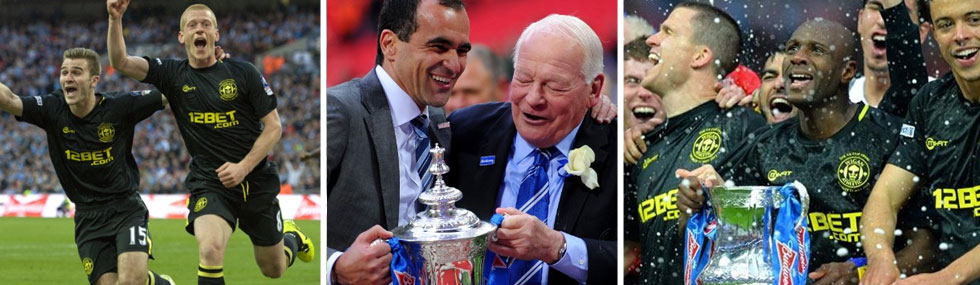
Latics fans will surely wish Jordi Gómez well at Sunderland. Despite constant abuse from some sections of the crowd he has maintained a positive and professional attitude. He will be long remembered for his role in helping Wigan Athletic win the FA Cup.

Jordi’s next challenge will be to prove, once and for all, that he is a true Premier League player. Sunderland might not be the best side in the elite division, but with Gus Poyet at the helm the Spaniard  should be able to slot seamlessly into the style of play.


Like us on Facebook, or follow us on twitter here.

Callum for Wembley

Manchester City v Wigan Athletic - FA Cup Final

Being ‘Man of the Match’ in an FA Cup Final can be hard to live up to. Callum McManaman knows that all too well.

Just eleven months ago McManaman was the toast of the town as he led Gael Clichy and the Manchester City defence a merry dance at Wembley. He had not only been the star of the Final, but also of the whole FA Cup tournament. He had started in all of Latics’ seven matches in that cup run, scoring three goals and making two assists. His free running in the final trapped Pablo Zabaleta into a red card, turning the momentum of the game. His superbly taken goal from Jordi Gomez’s exquisite pass had sealed the semi-final win over Millwall.

Who could have known that just three days later he would get an ankle injury that would not only put him on crutches, but seriously knock back his career prospects in the process. A burgeoning young talent had been coming through, with managers of the rich and famous clubs casting an eye in his direction. The injury put everything on hold.

Many Latics supporters had viewed McManaman’s injury as a kind of blessing in disguise. If it had not happened the young player would most likely have been whisked away to a big club rather than helping Latics get back to the Premier League. Moreover the excellent Shaun Maloney remained at the club following the large turnover of players in the summer. Latics had a new manager in Owen Coyle and he would have at his disposal two players who could tear the hearts out of the defences of Championship sides.

Those hopes were soon quashed as Maloney’s injury In September put him out of action long term. Moreover McManaman was dealing with illness and niggling injuries that hampered his return to full fitness. When Coyle left in December, McManaman had made hardly any impact up to that point. Fans were hoping that new manager Uwe Rosler could get the best out of the exciting young forward.

At this point of the season McManaman has started in only 14 of the 41 league matches played, scoring one goal and making one assist. Moreover he has rarely played the full ninety minutes. However, he has started in four of the five FA Cup matches Latics have played, scoring in the home tie with MK Dons.

It has been a disappointing season so far for Callum McManaman, but there is still time for him to make a major impact. He has clearly enjoyed playing at Wembley, judging by his performances against Millwall and Manchester City, maybe less so than in his appearance as a 60th minute substitute in the Community Shield.

Rosler will surely take McManaman into strong consideration for lining up in the semi-final against Arsenal at the weekend. Coincidentally it was against the Gunners that his career took that set-back last season. Saturday’s game will be one in which he will be keen to impress, showing a big audience that he still has that talent that has been hiding under the surface for so long this season.

If he is given the chance McManaman can get his career back on fast-track with a star performance against the Gunners. At his best there are few more exciting players to watch in English football.

Like us on Facebook, or follow us on twitter here.

Auld Mac getting better and better – a look at James McArthur


The Jimmy Macs - McArthur left with McCarthy.  Photo courtesy of the Daily Record

The Jimmy Macs – McArthur (left) with McCarthy.
Photo courtesy of the Daily Record

They were the two Jimmy Macs – James McArthur and James McCarthy – in the engine room of Roberto Martinez’s midfield. It could be difficult guessing Bob’s starting lineups, but the Jimmy Macs always seemed to be there. Together with Shaun Maloney they could compete on an even keel with the likes of  Gerrard, Lampard and Scholes. They were the ones who underpinned Wigan Athletic’s famous victories against giants like Arsenal, Chelsea, Liverpool, Manchester City and Manchester United.

Both had started at Hamilton Academicals in the second tier of Scottish football. Both Glaswegians and both part of the Accies side that won the Scottish First Division in 2007-08. The younger Jimmy Mac – McCarthy – was first to join Latics in summer of 2009, to be followed by ‘Auld Mac’ a year later. James McCarthy made 120 appearances for Latics before he moved to Everton early this season. James McArthur has made 116 up to this point.

Given his wealth of Premier League experience McArthur was expected to be a major force in the Championship division. His early performances under new manager Owen Coyle were disappointing, his partner McCarthy’s departure not helping. Some even suggested McArthur would never be the same without the younger Mac. But then again not many players reached optimum levels under Coyle’s slack regime. However, Coyle clearly recognized McArthur’s talent and leadership qualities, giving him brief captaincy duties for the first time in the absence of Emmerson Boyce.

The arrival of new manager Uwe Rosler signaled a change in tactical approach. Coyle’s long ball tactics had not suited the skilful McArthur and he soon made an impact upon his new manager. He formed a formidable midfield trio with Chris McCann and Ben Watson that was to prove crucial in Latics’ revival. Sadly both McCann and Watson were to pick up long term injuries and since then McArthur has had a variety of players accompanying him in midfield. Nevertheless he has kept up his excellent form.

However, Auld Mac has become more and more influential in that midfield engine room. He has become the fulcrum around whom things happen, a complete midfield player. Despite already having played 45 games this season he was full of energy and drive in an outstanding display in the draw with champions-elect Leicester City on Wednesday.

McArthur was once described as a tough tackler with creative spark. But he has become much more than that. He has become the midfield general who sets the example to his teammates in terms of his commitment and dedication to the Wigan Athletic cause. He will always be remembered as being part of the team that beat Manchester City to win the FA Cup last May. He had a wonderful game as a makeshift wing back.

If there is one area in which McArthur needs to improve it is in scoring more goals. However, when he does get them they tend to be good ones. That rocket shot at Huddersfield last season and the amazing chip over the Northern Ireland goalkeeper are as good as you will see.

Auld Mac is not so old. In fact he is only 26 and still has not reached his peak. He has taken his game to a higher level and many would view the underrated Scot as Latics’ player of the season at this point. It is ironic that when he is showing  possibly the best form of his career he is not making the first choice line-up for his country. Granted he has dropped down a division, but are the current starters for the Scotland team really better than him?

James McArthur is a quality footballer with a great attitude. He can help take Wigan Athletic into the play-offs and beyond.

At 26 he has still not reached his peak. Latics supporters will hope he will stay at the club for years to come.

Like us on Facebook, or follow us on twitter here.

A look at Jack Collison

Colison

Once again Uwe Rosler has made a shrewd move in the loan transfer market with the signing of Jack Collison from West Ham. The midfielder joins Josh McEachran, Nicky Maynard, Nick Powell, Ryan Tunnicliffe and Martyn Waghorn as loan players at the club.

Collison is only 25 years old, but has made over 100 appearances for the Hammers since his debut on January 1st, 2008. He can play in either centre or wide midfield. During his time at West Ham he made 49 Premier League starts, with 25 appearances off the bench, scoring 7 goals with 4 assists. If it had not been for injuries Collison would surely have made more appearances at Premier League level.

Although born and raised  in England, Collison qualified to play for Wales through his Welsh maternal grandfather. He has made 17 appearances for Wales. Earlier this season he spent the month of October out on loan at Bournemouth, where he made four appearances.

Given the loss of midfielders Ben Watson, Chris McCann and Roger Espinoza through injury the signing of Collison is well-timed. He will immediately compete for a place in the starting line-up. Collison has already played in the Championship for West Ham in 2011-12 when he made 28 starts, with 5 appearances as a substitute, scoring 6 goals with 3 assists.

West Ham have a dozen players whose contracts or loans expire in June 2014. The fan site West Ham Till I Die  suggests that only three of those players – who include not only Collison, but the likes of Joe Cole and Jussi Jaaskelain – will be offered further contracts, as the London club aims to cut £9 million off its wage bill.

As such as Ryan Tunnicliffe and Josh McEachran have discovered it can take loan players some time to get used to the style of play preferred by Rosler. However, providing Collison can maintain a good level of fitness he will be an important member of the squad. Should he impress there will surely be a strong possibility of him continuing at Wigan next season.

Like us on Facebook, or follow us on twitter here.

Watson’s best is yet to come

Ben-Watson

He wrote his name into history with a brilliant last-minute header that won the FA Cup. If you were in a room full of football fans from all over the world and asked them to name a Wigan Athletic player, you can guess whose name would be most likely to come up.  That would be Ben Watson.

At his best he can look as classy as any midfield player in England. He is a strong tackler capable of making key interceptions. He has genuine football vision and can make forty yard passes with Beckham-like precision. He can certainly score goals and is not afraid to take penalties. One recalls the away game at Stoke last season when Tony Pulis was far from happy to see the Londoner brought off the bench to take a penalty, which he duly dispatched.

Watson’s peak time at Wigan was during the late rally in the 2010-11 season, when Latics produced a series of results that shocked the English football world and silenced even the most vile of their critics in the gutter press. Roberto Martinez had moved to a system with three central defenders, with Watson playing just in front of them, making up the extra man in the centre of defence when needed and playing a deep-lying midfield creator role.

You could say Martinez made the most inspired substitution of his career when he brought on Watson for a tiring Jordi Gomez after 81 minutes in the FA Cup Final. The end result was that a player who had never consistently commanded a first team place at the club became its most famous-ever player.

Ben Watson has his critics among Latics fans. They would say he is prone to lapses of concentration in defence, too one-paced in his play and inconsistent in his taking of set pieces. Far too often his shots on goal from free kicks have endangered supporters sitting in the back rows of the stands behind the goal.

However, the 28 year old has already started in 24 league games this season beating his previous best of 23 league starts in 2010-11.

Steve Bruce signed Watson from Crystal Palace in January 2009 for a fee of around £2m. He was to make 6 league starts with 2 goals under Bruce’s management.

Watson could not  establish himself under new manager Martinez in 2009-10, being sent off on loan to Queens Park Rangers for the first half of the season.  Coming back he could still not get into the Wigan team and was loaned to West Bromwich Albion in February 2010, but was recalled early in April. By the end of the season he was to make 5 appearances, getting a goal in the 3-2 home win against Arsenal on April 19.

The 2010-11 season was a mixed one for Watson, not being a regular starter until after Christmas, when he was to become a key player in that deep-lying midfield role.

After signing a new three year contract in August 2011, Watson could not settle into a rhythm in the 2011-12 season and started in only 14 Premier League matches.

Last season saw the Londoner make only 7 league starts, mainly down to the broken leg he received at  Liverpool in the November. Watson was not to reappear until May when he played in the 3-2 away win at West Bromwich. He was soon to go on to score that all-important goal at Wembley.

Watson got off to a good start in Owen Coyle’s first league match in charge. His superb shot from 30 yards opened the scoring at Barnsley on the opening day of the season, leading to a 4-0 rout. He also scored a superb goal in the Europa League match at home to Maribor, running through from his own half to connect with Jean Beausejour’s cross. Coyle played him in that deep-lying midfield creator role but also further forward in midfield. In Shaun Maloney’s absence he became the main taker of set pieces.

Watson survived the ‘Coyle Revolution’ better than some of his teammates who had also been with the club in the Martinez era. Coyle certainly rated him and his set-piece deliveries were crucial to an attacking approach where Latics were looking for headers from their big men.

Many of us wondered how the new manager Uwe Rosler was going to use Watson in a high tempo game plan. But from the start the German was positive about Watson and he has publicly stated his hope that the player will sign a new contract.

Watson scored another good goal against Crystal Palace recently. Once again he ran in from a deep position to score an opportunist strike from James McClean’s low cross. Together with James McArthur and Chris McCann he makes up a formidable midfield trio, which has a high work rate and no mean level of skill. Roger Espinoza, Jordi Gomez and Josh McEachran will continue to challenge that trio for a place.

At 28 a midfield player is often around his peak. However, with Watson one has the feeling he can get better still.  Rosler clearly has plans for the player and believes he can fit into his high-tempo style. Moreover if Watson can cut out the errors he can be prone to make through lack of concentration he will be a much better player. Rosler is keen to increase fitness levels of the squad and this will help Watson both physically and mentally.

Ben Watson has certainly had his ups and downs at Wigan, but has shown both patience and determination to get where he is now. He has the ability to be a top class footballer.

However, given the financial constraints that Latics are now facing it is unlikely that they will be able to offer Watson the kind of contract he seeks.

In the meantime Watson will continue to be a pivotal player in Wigan Athletic’s climb up the table.

Like us on Facebook, or follow us on twitter here.