The demise of good football at Wigan Athletic

This slideshow requires JavaScript.

Malky Mackay’s team of scrappers was once again caught short on their home ground. Watford are by no means Barcelona, but they try to play good football and deserve to be challenging for promotion. A 2-0 win for the Hornets was never a surprise to the realists among the Latics support.

It is almost exactly a year ago since Wigan Athletic beat Watford at the DW Stadium, their ninth win in ten matches. Uwe Rosler had built a side that was hard to beat, with a solid defence and flair players who could make the difference. It was not always pretty to watch, but fans were happy with the results and “In Rosler We Trust” was the order of the day.

It was results that were of paramount importance when Owen Coyle had taken over the reins in the summer of 2013. His brief was to get the club back into the Premier League by the end of the season. The Scot brought in ten new faces, a necessary thing to do after the exodus of players following relegation. His challenge was to meld together a dressing room of players who had played under Roberto Martinez and his new signings.

Coyle was never going to be an adherent to the ’tiki taka’ style of football preferred by his predecessor. However, more than half of his squad had been weaned on that approach. It was in their blood. But what was Coyle’s preferred playing style? How would the ex-Premier League players adapt to it?

Coyle was quick to revert to a traditional back four, immediately scrapping the 3-4-3 that had been the hallmark of success in the Martinez era. In his first league game in charge at Barnsley he brought in five of his new signings. There was only one player from outside the British Isles in the starting lineup – in contrast to the ‘League of Nations’ lineups that Martinez had fielded.

However, that promising start was not to be continued and Latics stuttered through the next few games. The long ball – anathema in the days of Martinez – was soon to become a feature of Wigan’s play, led by the powerful kicking of new goalkeeper Scott Carson. Players who were used to the possession game under Martinez were now expected to adapt to the more direct and physical approach of Coyle. At times the players simply appeared that they did not know what to do in the absence of a clearly-articulated footballing philosophy from the manager.

The same could not be said of Coyle’s successor, Uwe Rosler. The German talked enthusiastically about high tempo, high pressing football. It gave us visions of Latics playing the exhilarating type of football demonstrated by the likes of Borussia Dortmund. Not surprisingly the players struggled to adapt to the style of football eschewed by their new manager. They could press high up the pitch for the first twenty to thirty minutes, but invariably ran out of steam.

In the early days of Rosler’s reign it was put down to the lack of fitness of the players under Coyle. However, that high pressing early in the game was to upset many opposing teams, providing a solid platform for obtaining improved results, even if the second halves of too many matches saw Latics massed in defence.

Despite considerable success in his first season – 5th place in the league, reaching an FA Cup semifinal – Rosler could not inculcate his vision into his players. As time wore on it appeared that he and the players became more and more out of tune in terms of what should be delivered on the pitch. As the new season wore on we were to see less and less of the commitment required for the high tempo, high pressing football he sought.

By November the dream of getting back into the Premier League had become almost unreal. It looked like it was not going to happen this season with Rosler. Dave Whelan stepped in, relieving the German of his job, bringing in Malky Mackay, stating his belief that the Scot was the right man to take the club back to the Premier League.

The harsh reality is that Mackay is taking Latics to League 1, rather than the Premier League.

During his tenure results have been awful, but the style of play has been even worse. Jettisoning thirteen players in a January fire-sale was clearly a collective decision, not taken by Mackay alone. David Sharpe must shoulder responsibility for this action, as too should Jonathan Jackson. The end result is a squad desperately short on quality compared with that of a year ago. Moreover the style of play is more akin to that of the club’s time in the Cheshire League than what we have been accustomed to over the past decade.

That the majority of fans are not demonstrating for the removal of Mackay is a reflection of the numbness that so many feel. His supporters – few as they may be – will say that he has got the players playing with the kind of passion that was lacking this season under Rosler. The fire sale and the threat of League 1 left him with little option but to sign loanees and players on short term contracts. He has been left to mop up the mess left behind by Rosler. Even the anti-Mackay brigade will grudgingly accept that there is some substance to such assertions.

However, how many fans have the confidence that Mackay can turn things around, given time? His management experience is at Championship level, together with a brief sojourn in the Premier League. The high probability is that Wigan Athletic are going to be in League 1 next year. Is he the right man to get them back out?

Mackay’s appointment was ill-fated to say the least. It has caused seemingly irreparable damage to the club. However, despite the media fracas it looked like Latics had appointed someone who could steady a sinking ship on the filed of play. He had successfully worked under pressure of relegation at Watford and taken Cardiff to the Championship title. On paper he looked the right kind of person to get the results to put the team back on track.

However, during Mackay’s reign we have seen the standard of football plummet to close to rock-bottom. The passing style of football that we have seen over the years has disappeared, with “hoof ball” coming to the fore. It could be said that teams in the relegation zone so often need to sacrifice good football to grind out results. The recent run of four consecutive away wins has been attained by following such a pattern. However, when the team plays at home it does not have the wherewithal to break down the opponent’s defence. The skliful approach is sadly lacking.

Mackay’s teams at Watford and Cardiff were not noted for their good football. The sad conclusion is that as long as Mackay continues at Wigan we are not going to see the type of dynamic football we saw from Paul Jewell’s teams or the skilful possession football under Roberto Martinez.

Mackay will almost certainly be in charge until the end of the season. It remains to be seen how much longer he will be at the club.

The brand of football that Watford are playing at the moment is close to what last season’s Wigan Athletic team were capable of at their best. With Mackay at the helm we are not going to see that from the home team at the DW Stadium.

Through the effects of relegation from the Premier League and some poor managerial appointments  we have witnessed the demise of good football at our beloved club.

Let’s hope the young chairman, David Sharpe, will have the foresight to make the kinds of decisions to bring it back.

Getting the best out of the strike force

Will Billy Mckay go the same way as his predecessors, Delort and Riera?  Photo courtesy of BBC Sport.,

Will Billy Mckay go the same way as his predecessors, Delort and Riera?
Photo courtesy of BBC Sport.,

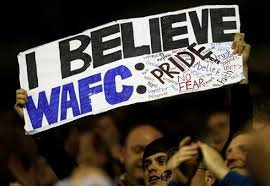
When the lineup was announced prior to the Leeds match on Saturday it was a sadly depressing moment. The mood had been positive and people had started to “Believe” again. But a look at the team sheet was enough to send many of us into despair. How can you keep faith in a manager who just does not seem to realize that some things just do not work?

The dampener on the proceedings was the selection of a strike force of Marc-Antoine Fortune and James McClean.

This is not to suggest that the two players do not have their merits.

Despite scoring only one league goal in 24 appearances the controversial MAF continues to get his place in the team. His holding up of the ball, commitment and willingness to sacrifice for the team make him a good team player. He has played under three managers at Wigan, all of whom have appreciated his attributes. In fact since signing in summer 2013 he has made 35 league starts and 25 appearances off the bench, scoring 5 goals.

McClean is on his way to be being voted “Player of the Season”. Fans have been impressed by his willingness to run himself into the ground for the cause, in a season when so many of his teammates have not shown that level of desire and commitment. Malky Mackay clearly believes he can become a bona fide central striker, through his speed, physicality, a powerful left foot and willingness to run at defences. As a left winger he has always been a committed team player, so often running back to help out his left full back. He is the club’s top scorer with six goals.

However, McClean has always had his critics. They will say he lacks the “trickery skills” that the best wingers possess, that he runs around like a headless chicken, not lifting his head, not providing the level of assists to be expected of an experienced Premier League practitioner. As a central striker he is too often caught offside and does not make the kind kinds of runs off the ball that are needed.

The Derry-raised forward deserves commendation for his commitment and enthusiasm to help the cause. He is the leading scorer with 6 goals this season, but as a central striker he has a lot to learn.On Saturday he was to be switched to the left flank during the course of the game.

Neither Fortune nor McClean are what might be called “natural strikers”. Those are the kinds of players who are in the right place at the right time to get the tap-ins to those balls fizzing across the box. Moreover their combined goalscoring records do not suggest they are going to do so.

The likelihood is that neither will be at the club at the end of the season. Fortune is now 33 and it would be a surprise if he were given a further contract. According to reports, McClean is one of the highest wage earners at the club (some suggest he is on £30k per week) and is likely to be released whether or not Latics stay in the Championship.

However, Latics do have other strikers. The big centre forward Leon Clarke – who has played for 14 clubs – is very much a “journeyman”. Nevertheless his physical presence has added to the forward line and his commitment has been excellent. Add to that a debut goal against Bournemouth.

Billy Mckay and Martyn Waghorn continue to be marginalized by Mackay.

Waghorn was Uwe Rosler’s first permanent signing and made a positive impact in the latter half of last season. Often played wide he nevertheless scored 5 goals in 15 appearances. Moreover he was a consummate team player, strong defensively, so often dropping back to defence to help his full back. During that period Waghorn was never a spectacular player, but one who fitted into the framework of the team, a very useful asset. Many of us expected Waghorn to continue to be one of Rosler’s mainstay players, but injury combined with the signing of new strikers pushed him out of contention. He has made just 6 starts this season, with 12 appearances as a substitute, scoring 2 goals.

Like Oriol Riera and Andy Delort who preceded him, Mckay is a proven goalscorer. He had scored 10 goals in 23 appearances for Inverness Caledonian Thistle this season, prior to joining Latics. In his two previous seasons in the SPL he scored 18 and 22 goals respectively.

Sadly it looks like Mckay is going the same way as his predecessors. The woeful treatment of Delort and Riera has continued with Mckay, albeit under a different manager. Is there a disconnect between recruiting and coaching at the club? Under Rosler good performance in training was paramount to his process of team selection. It continues with Mackay. Is Mckay not fit enough for the demands of the Championship or does he just not impress the coaching staff on the training field?

Mckay will have arrived with confidence, after banging in the goals in Scotland. But being given no starts and six appearances off the bench, his confidence will surely have already dissipated. Granted, he has failed to impress so far, but players need a run of games in the starting lineup to show their worth. Surely he must soon be given that opportunity?

Since Malky Mackay’s arrival Latics have not won a single home game, drawing two and losing eight. They have only scored 5 goals in those 10 matches at the DW Stadium.

Given his woeful record, it is a wonder that Mackay continues to be employed by the club. But it looks like he will continue at least until the end of the season.

In the meantime his coaching staff need to take a long hard look at themselves to explain how so many players with genuine talent have fallen by the wayside this season. It is their role to help players adjust, to make them into effective performers at the appropriate level.

Let’s hope that Mckay does not get consigned to the same level of mismanagement as Delort and Riera.

Believing again with Malky and Sharpy

Photo courtesy of fansonline.net

e Photo courtesy of fansonline.net

Situations can change quickly in the football world.

Three weeks ago I published an article “Can we believe under Mackay?” Latics had lost badly at Nottingham Forest and Malky Mackay’s record at Wigan was W1 D3 L10. Moreover the club seemed to be drifting with its talismanic leader, Dave Whelan, nowhere in sight. It was a club where leadership appeared noticeably absent. “Believing” was not easy.

The weekend later Latics did inspire some momentary confidence with a 1-0 win at Reading. There were two home games coming up, so the more optimistic of supporters raised their hopes that it could be the start of a revival, although the battle-hardened contingent warned us to beware of a false dawn. The darksiders proved to be right as Latics lost to both Charlton and Cardiff. A failure to get three points in the next match at Blackpool would nail the relegation coffin for Latics, psychologically of not mathematically.

The 3-1 win at Bloomfield Road was certainly a tonic, but unsettling rumours were starting to spread about the club being sold to Thai buyers. Still no word from Whelan. Moreover the next match was away at Norwich, who had won their last six games and were challenging for promotion.

Within the space of a few days the future suddenly seems much brighter. DW stepped down as chairman, but made it clear that the Whelan family and Chief Executive Jonathan Jackson would continue to run the club. There would be no sell-off. Fans were debating the idea of Whelan’s 23 year old grandson, David Sharpe, taking over as chairman although the more savvy pointed out that Jackson was the pillar upon which the near future of the club would largely rest.

The 1-0 win at Norwich, gained with just 32% possession, was precisely the kind of performance that many of us expected when Mackay was appointed. A gritty, backs to the wall display, based on strong defence and a moment’s inspiration from the excellent Kim Bo Kyung. Sharpe will surely have enjoyed overseeing a hard fought victory on receiving the reins from his grandfather.

The mood is much more positive among the fans now. The team has won two consecutive games for the first time this season and people are seriously thinking whether they can once more “Believe”. The manager remains unpopular and Sharpe has a hard act to follow as future chairman, but there is at least something to look forward to now.

The pundits tell us that Mackay’s current record of W4 D3 L12 – a winning percentage of 21% – lifts him above the level of being statistically the club’s least successful manager. He has certainly transformed things since his arrival. Not one of Uwe Rosler’s ten signings started the game at Norwich and only four of the eleven have contracts at Wigan beyond summer. At last he has succeeded into motivating the players to wear the Wigan Athletic jersey with pride, willing to give their all on the pitch.

But there is a hard road ahead for both Mackay and Sharpe.

After those consecutive wins the manager has regained some degree of credibility. However, he has incredibly still not won a match at the DW Stadium. He will be anxious to notch up his first against Leeds tomorrow. Can he lift his players to the same levels of energy and passion that they showed at Blackpool and Norwich? It will be a challenge to do so for the third time in a week.

David Sharpe has been active at the club for over a year now. He worked with Mackay on the January clear-out and is likely continue to support the manager at least until the end of the season. Questions remain whether relegation can be avoided and if Mackay is the right manager for Latics in the long term.

However, there suddenly seems much more purpose at the club, following Dave Whelan’s announcements and a couple of good results.

Let’s hope we can “Believe” in the Malky-Sharpy partnership.


Bowing out gracefully


“Dave Whelan: Racism row forced me to quit.”

So said the Daily Express headline yesterday. Sadly another example of gutter journalism, of which we have seen far too much over recent months in the national press.

That newspaper, along with others, was once more ready to condemn a man who has done so much for English football over the years.

They neglected to mention his record as a chairman over the past two decades:

  • Bought the club in February 1995. Finished in 14th place in Division 3. Average attendance for 1994-95 season was 1,748.
  • Summer 1995 – arrival of The Three Amigos – Diaz, Martinez and Seba.
  • Division 3 champions in 1996-97.
  • Plans for new stadium announced in 1997.
  • Beat Millwall 1-0 at Wembley to win Auto Windscreens Shield in 1999.
  • JJB stadium inaugurated in August 1999 with a friendly against Manchester United.
  • Division 2 champions 2002-03.
  • Won promotion to the Premier League in 2004-05.
  • Reached League Cup final in 2005-06, finishing 10th in Premier League, average attendance 20,609.
  • Eight seasons in the Premier League from 2005-2013. .
  • Second half of 2011-12 season rally with first win against Manchester United and away victories at Liverpool and Arsenal –all won on merit.
  • FA Cup Semi-Finals  in consecutive seasons 2012-2014.
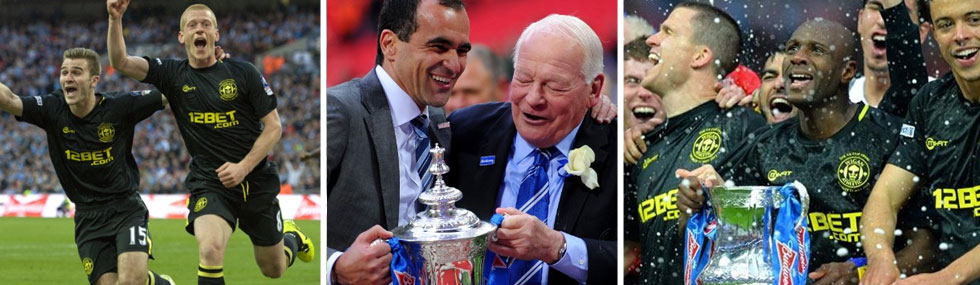
  • FA Cup winners in May 2013.
  • Community Shield appearance in August 2013.
  • Group stages of the Europa League with trips to Belgium, Russia and Slovenia in 2013-14 – also reaching FA Cup semi final and championship playoffs.

Listening to Whelan’s interview by the club brought tears to the eyes. He even brought up the matter of the broken leg a couple of times. It contrasts with that on Sky Sports where the interviewer was clearly intent on treading the beaten path of the racism saga.

However, during that Sky interview Whelan was able to blow away much of the recent uncertainty about the club’s future by saying:

“Contrary to some suggestions, there are no plans to sell the club, which will remain in family hands and I have every confidence that (grandson) David (Sharpe), along with chief executive Jonathan Jackson, will lead us forwards with wisdom.”

Following in the steps of a Wigan icon like Dave Whelan would be hard for anyone, let alone a 23 year old like Sharpe. However, the young man got himself off to a good start by handling his interview with Sky with considerable aplomb.

It is the end of an era.

Dave Whelan has gone out as gracefully as he could, given the pressure from the national media.

He leaves behind a remarkable legacy, the like of which was unimaginable two decades ago.

Whelan’s final fling

Whelan

Sometimes we lose sight of things that happened not so long ago.

“He is the man to lead us back into the Premier League.”

Looking at Dave Whelan’s comment when Malky Mackay was appointed brings perspective. The chairman was looking at salvaging a season that had gone awry under the leadership of Uwe Rosler. He had acted in a timely manner to keep the promotion dream alive. How could he have expected that fourteen games later Latics would stand second from bottom nine points from safety?

Whelan has spent almost £100 million on Wigan Athletic over the past two decades. Only the naïve could argue that Latics could have achieved what they did without his funding.

But Whelan did much more than that. His vision and leadership turned a struggling lower division club into an entity to be respected at national level. It was the driving force that is not so apparent now as it was before.

Wigan Athletic’s success has brought it a larger fan base than could have been imagined twenty years ago. Wigan was a rugby town – at least in terms of attendances – when he first took over, but he turned it around. The football club’s attendances over the past decade have consistently bettered those of their rugby counterparts.

Moreover support has not just grown inside the town, but the club has become known on a global basis. Eight years in the Premier League and reaching the League Cup Final helped, but winning the FA Cup was the icing on the cake.

However, through those successes, expectations heightened. Latics wisely courted the young supporters who would provide the backbone when their more senior equivalents would no longer be around. But the younger support was brought on Premier League football. They were not there when Latics visited the likes of Prescot Cables and Earlestown. They don’t expect the club to be struggling to stay in the Championship division.

Whelan pumped so much money into the club for so long. In recent years he has insisted on the club balancing its books and his Chief Executive Jonathan Jackson has played a major role in making that happen. Old timers will know of his father Stan, ex club President, who did so much for Latics in his time. It could be said that Stan Jackson’s greatest achievement was persuading Whelan to buy the club those years ago.

The traditionalists will say that a football club belongs to the fans. But the reality is that, at the highest level of English football, the fans take the back seat. There are no clubs who can challenge in elite circles without massive financial backing. Some clubs have become supporters’ trusts, but they too have face financial reality. The concept of fans owning a club is appealing in many ways, but the reality is that those clubs continue to struggle.

There is a large degree of uncertainly this moment in time at Wigan Athletic. People are waiting for leadership from Whelan. Where is the club heading now? Will he be selling up or handing the reins to his grandson?

Above all, what is his vision for the club’s future?

At 78 years of age, and after achieving more than could have possibly been imagined, does he have the energy for one final fling? The “racism saga” with the FA must surely have taken a lot of out him.

In the coming week he might well make the decision to relieve Malky Mackay of his duties. But what would follow if he did?

Maybe Whelan has had enough and is ready to pass on to someone else. That would be perfectly understandable.

However, if that is to be the case, can he please set some direction beforehand?

The direction would identify what kind of club Wigan Athletic should be in the future. Without big financial backing it would surely need to be a club that can be self-sufficient, holding its own but surviving economically on selling off its top talent.

Where is the club heading? Not only for League 1 but the non-fulfillment of the Academy scheme at Charnock Richard?

Dave Whelan has enabled amazing things to happen at Wigan Athletic, but it could well be that the time has come to pass the reins to someone else.

However, let’s hope that it will not be the immediate case.

Whelan’s final fling could well involve the dismissal of Mackay and the appointment of someone who could motivate and organize the players into saving this sad season for the club.

Anything more than that would be a bonus.