A trip to Moss Rose

maurobosellibournemouthwigangoal_576x324
Mauro Boselli’s rocket shot at Bournemouth on Tuesday was eventful in more ways than one. Once more he showed the kind of clinical finishing that Latics have desperately lacked in the Premier League this season. The big question is whether he will ever be able to show such finishing in the Premier League. Roberto Martinez has been reluctant to put him in there, but has the time come for a change of heart? In any event, Boselli’s goal was enough to beat Bournemouth and set up a fascinating match at Macclesfield.

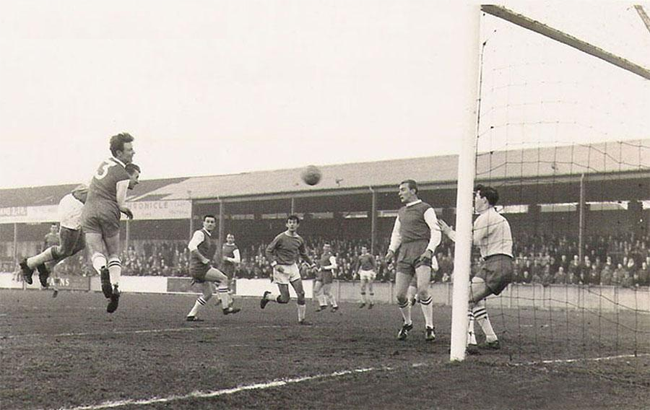
Macclesfield Town is a special name for those Wigan Athletic supporters who remember the club’s non-league era. My first sight of the ‘Silkmen’ was at Springfield Park in autumn of 1961, when the reigning Cheshire County League champions were visiting. Latics had only just got back into the league, at the expense of Wigan Rovers, after being relegated in 1947. However, they had finished in second place in the Lancashire Combination and were holding their own in the Cheshire League.This match proved to be a rude awakening for Wigan. Macc’s silver-haired player-manager, Frank Bowyer, led his team to a 4-1 rout. Macclesfield were to finish second and Wigan fifth at the end of the season.

Macclesfield proved to be formidable opponents for Wigan over the next couple of decades. A visit to their Moss Rose ground was to be feared and Latics often came unstuck there. One exception was a Boxing Day fixture on a snow-bound pitch in 1964 when Carl Davenport’s volley was the difference between the two sides. That was the season when Harry Lyon scored his 66 goals and Latics won the league, Macc finishing second. Both Wigan and Macclesfield joined the newly created Northern Premier League in 1968, each club winning the championship twice before Wigan got elected into the Football League 10 years later.

The fortunes of the clubs have differed greatly since those days. Wigan are in their eighth season in the Premier League and Macclesfield back in the Conference after 15 years in the Football League. There are people who knock Wigan Athletic’s success, but the reality is that Latics are four divisions above their old rivals. A remarkable achievement.

Like us on Facebook, or follow us on twitter here.

Twin strikers at Wigan Athletic — a trip down memory lane

1964-65 : Wigan Athletic 3 Oswestry 0. Harry Lyon gets on to a Walter Stanley cross as Carl Davenport lurks menacingly. Allan Brown looks on from midfield (photo from Wigan World). 

In the late 1970s, my Dad and I would typically go out for a beer on Friday nights. We would rarely discuss things like politics or the weather, preferring to focus our conversations on Wigan Athletic’s progress in the Cheshire League. Among our discussions would be recollections of trips to watch Latics in exotic places like Stalybridge, Mossley and Oswestry. We lived in the south of Wigan, rugby league territory, so the pubs around us were steeped in that kind of nostalgia. One of those was ‘The Waterwheel’, run by ex-Great Britain rugby player, John Stopford. In his heyday in the early 1960s Stopford had been a lightning-fast winger for Swinton. Although he never played for Wigan RLFC, Stopford would draw rugby enthusiasts to his pub. We mostly avoided such places, preferring to walk further afield to pubs that were more salubrious for Wigan Athletic supporters.

One rainy night we succumbed, and tried ‘The Waterwheel’. Upon opening the door and the sight of the scrum surrounding the bar we started to think twice about it. There were some burly men there, faces like boxers, some with arms in slings. We were just about to walk out when my Dad said “Look it’s Harry Lyon over there.” It was indeed my hero from my teenage years. Chatting with Harry was easy. He just made you feel comfortable talking with him. Although he had left the club a decade before you could tell that Wigan Athletic was his first love. He said that it was a wonderful feeling running down the tunnel at the start of a game at Springfield Park, with some 3,000 people urging you on.

Harry Lyon was a great favourite with the fans, Wiganers not only appreciating his incredible goalscoring record, but also loving his commitment on the pitch. I asked him who was the best manager he had worked under – he had 5 during his time at the club from 1962-1968 — his reply was Allan Brown. Brown caused waves in the non-league world in 1964 when he took over at Wigan as player/manager, hiring a swath of full time professionals in a semi-professional league. After training, Brown would sometimes take his players to the town centre restaurant where my mother worked. I would be thrilled when she would bring home players’ autographs, usually written on the backs of serviettes.

Brown’s teams played an attacking 4-2-4 with the manager orchestrating from the centre of midfield. Carl Davenport was Lyon’s striking partner in Brown’s first year. Like Lyon he was an excellent header of the ball. I recall going to the Anchor Ground – aptly named at the time, a real quagmire of a pitch – to watch Latics play Darwen in a cup match. My Dad would recall for many years how Davenport had risen so high that his head was well over the height of the crossbar as he put the ball in the opponents net. Although Davenport was often referred to as an inside forward in those days, he was in reality a twin striker with Lyon. No teams found it easy to cope with the two of them. That season Harry Lyon scored 67 goals!

However, when I asked Harry who was the best striking partner he had played with he immediately retorted: Bert Llewellyn. Unlike Carl Davenport, Bert Llewellyn was only 5 feet 4 inches tall. A headed goal was a rarity, but after joining Latics in the summer of 1965, he scored 49 goals in 39 league appearances over the course of the season. Llewellyn was far from an elegant player, but was a natural goalscorer, sniffing around the penalty box for deflections, toe-poking and scrambling the ball into the back of the net. In his four years at Springfield Park, Llewellyn scored 140 goals in 185 appearances in all competitions. Remarkably, he outscored Lyon in his time at the club. Check out this wonderful article on This Northern Soul on Bert Llewellyn.

Since that era there have been lots of twin striking partnerships at Wigan Athletic. What a pity that wonderful pairing of Jason Roberts and Nathan Ellington was broken up when Latics reached the Premier League. How refreshing that Robert Martinez has adjusted his tactical system to play with two big strikers this season. The interplay between Arouna Kone and Franco Di Santo is a joy to watch. It is almost like turning back the clock.

We would love to hear from our readers – which has been your favourite striking partnership at Wigan Athletic?

Moving up a tier? Wigan and the Premier League financial league table

Over the years, Wigan Athletic have delivered performances ranging from the majestic to the downright nightmarish — none more so than the 2010 season opener against Blackpool. A 4-0 home defeat to anyone would have been bad enough, but to a team who the pundits had already condemned to relegation even before a ball was kicked? It was to prove a difficult season for Latics, only securing safety on the final game of the season. It also went down to the final game for Blackpool, who put up an amazing fight before eventually succumbing to Manchester United.

An old Bob Dylan song reminds us that “Money doesn’t talk, it swears.” The primary reason the pundits had tipped Blackpool for relegation that year was the perception that they did not have enough players of Premier League quality. Their Chairman, Karl Oyston, was not willing to splash money around like confetti and put the club at risk of insolvency. Blackpool’s salary bill that season amounted to just £14 million. Wigan’s was almost £40 million. During that 2010-11 season Blackpool were to do the home and away double over a team with a salary bill almost 10 times that of their own. That was Liverpool, at £135 million.

In the end Blackpool couldn’t quite avoid that relegation trap-door in the jungle of the Premier League, where clubs regularly make huge losses in an effort to keep up with the Joneses. You could say Blackpool got it right. Their salaries amounted to only around 25% of their income – compared with the league average of around 69% – and this helped them gain a positive cashflow for the season. They continue to be run on a sound financial basis in the Championship. Manchester City actually spent more on salaries than the revenues they had coming in, and even Aston Villa were leaking 92% of their revenue on salaries. No wonder Villa have since cut back, putting the emphasis on youth rather than established big-earners. It could be argued, however, that they have gone too far as the lack of quality and experience in this year’s squad makes them candidates for relegation.

Statistics show that the Premier League is financially tiered. In the 2010-2011 season club salary levels published by the Daily Telegraph ranged from £14 million to an absurd £190 million. The top three clubs in the table paid in the £150-£190m range. The teams finishing 4th and 6th paid in the £120-150m range, Tottenham bucking the trend by finishing 5th on a budget of “only” £91m. Fulham and Everton, with budgets around £58m managed to finish ahead of Aston Villa, who spent £84m on salaries. Then followed a clump of clubs paying between £40 and £60m, which included West Ham who were to be relegated despite a wage bill of £56m. Wigan Athletic, Wolves and West Bromwich had salary totals between £37 and £40 million, with only Blackpool below. It would be interesting to see salary levels for the current season, when these become available.

According to the Guardian “ The Premier League’s 20 clubs collectively made a loss of £361m last year, after spending all of their record £2.3bn income. Of the clubs which were in the Premier League in 2010-11, the year of most clubs’ latest published accounts, eight made a profit, of £97.4m in total.”  Dave Whelan wrote off Latics debts for £48m in August 2011. He advocated financial fair play to ensure that debt is maintained at “reasonable and sustainable levels”.

According to Alan Switzer,  of accounting group Deloitte, clubs with salary to revenue ratios of 70% and above are not likely to make a profit. He suggests that levels should go down to the low 60s. In 2010-11, Wigan Athletic were around the 80% level, according to the Daily Telegraph stats, which indicates a negative cashflow of £0.1 m.

The Daily Telegraph statistics show a clear correlation between salary levels and success on the field, although there are some exceptions. So how does a team stay afloat in a tiered Premier League? Do Wigan Athletic have to significantly increase salary levels in order to move up a tier in the league table? Would doing so make them financially less stable?

Last season both Mohamed Diame and Hugo Rodallega left at the ends of their contracts. A rough estimate might suggest that Wigan Athletic lost maybe £10 million in potential transfer money for the two. Whelan rightly insists that Wigan Athletic keep a lid on their salary payments so it is unlikely that either player was given an offer he could not refuse to stay on at the club. This season we have Franco Di Santo and Maynor Figueroa in their final year of contract. Both are key players. Figueroa has developed into an excellent left of centre defender in Martinez’ tactical system. He could prove costly to replace. Di Santo has now added goal poaching to his repertoire and could be worth in the region of £20 million on the open market if he continues to improve at this rate. When Roberto Martinez took over at the club various higher wage earners were sent packing to bring down the wage bill. He is now facing a dilemma in how to keep his top players from leaving at the ends of their contracts, given the total salary cap imposed by his chairman.

Given the factors above, is it possible for Wigan Athletic to consistently reach a mid-table position? Could they defy the stats on an annual basis, keeping a nucleus of good players, allowing a couple of stars to go for premium transfer fees each summer? In this way, the budget could be balanced. The first step would be to already have the replacements for the stars ready and in place. The second would be  to find a way to offer top players longer contracts at competitive rates, whilst maintaining a reasonable total salary cap. Food for thought for Bob and Dave.
Is it time to break up a winning team?

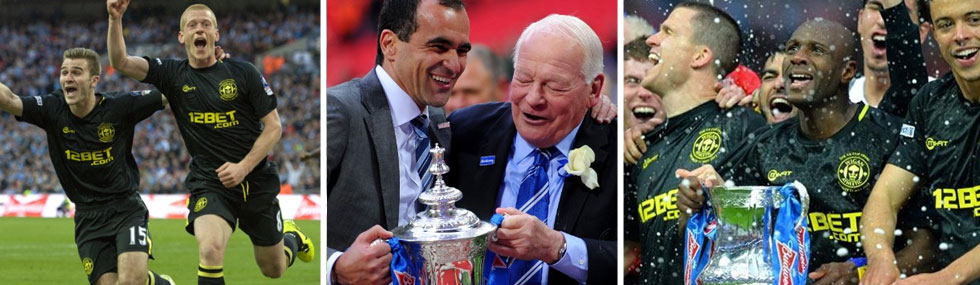
With just four points from the opening six matches, this is Wigan Athletic’s worst start to a Premier League season. There was a win at Southampton, a home draw with Stoke, losses at home to Chelsea and Fulham and losses away at Manchester United and Sunderland. Despite our pre-season optimism, Latics are back in the dog fight zone, needing to scrap it out yet again. Where do we go from here? Is it time for the team that beat Arsenal, Liverpool and Manchester United within the space of a few weeks to be dismantled and rebuilt?

We started the season with optimism largely because of the fantastic achievements of the “great escape team”, but also because it looked like we had more strength in depth than ever before. Two excellent performances in the League Cup attest to that, with the “fringe” players staking their claims, although they have not yet come into fruition. Interesting to note how Liverpool have been bold enough to bring in exciting, if unproven, youngsters to arrest the lack of performance by too many of their senior professionals. Their 5-2 win at Norwich this weekend attests to the virtue of trying something new if the formula  is not working.

So is it time for fresh blood to be brought in or should Martinez stick with those players who performed miracles in keeping us up last season? So far Martinez has shown loyalty to those players, following the maxim of “Don’t break up a winning team”.

Callum McManaman first made an appearance in the Premier League under Steve Bruce in May 2009, as a substitute against Portsmouth. Since then he has been started in cup ties but has been limited to a handful of substitute appearances in the Premier League. Throughout his time at Wigan he has been the outstanding performer for the reserve team and did well on loan at Blackpool in first part of last season. He has been capped four times for England at under 20 level. He showed us his excellent technique with a beautifully taken goal in the recent League Cup game at Nottingham Forest. It was the kind of finishing rarely seen from a Wigan Athletic player in recent years. Mauro Boselli has scored three opportunist goals in the League Cup, his second against West Ham showing a touch of class and arrogance. Eager to keep himself sharp he asked the manager to give him a couple games for the under 21 team, first scoring a late equalizer and then a winner. Ryo Miyaichi is an exciting young player, with electrifying pace. All three have been limited to substitute appearances so far. Ronnie Stam is an excellent attacking wing back, if not as strong defensively as Emmerson Boyce. He has not even been appearing on the bench. All these players merit strong consideration for a place in the starting lineup.

So is it time for a real shake-up – to bring in fresh blood who can energise the team? Martinez’ approach over these years has tended to be cautious, packing the midfield when the team is not doing well. On Saturday Wigan Athletic played with a lone centre forward: a conservative line-up. Jordi Gomez was once again chosen to play in the nominal right wing position. Far too often Gomez is played in a wide role that does not suit his game. He usually ends up either turning inside or passing the ball backwards. More on that here. To be frank, I think it is unfair on Gomez to have him play wide on the right. A couple of years ago we would regularly see Hugo Rodallega being played wide on the left, a position for which he was unsuited. Rodallega was a central striker, never a winger. The end result was a loss of form by the player.

To be fair on Martinez there have been injury problems that have disrupted the rhythm of his first choice lineup. Antolin Alcaraz has only played twice, while Jean Beausejour and James McArthur have struggled to reach full fitness. Alcaraz’s absence was crucial in last season’s poor start as well. The Paraguayan is not only a good defender, but his understanding with the other centre backs is not to be under estimated. Add to that the absence of Franco Di Santo, a bright light at the beginning of the season, missing the Fulham and West Ham matches, coming on as a substitute on Saturday. Moreover there has been a dip in form by senior professionals, Gary Caldwell and Emmerson Boyce. Neither has performed anywhere near the levels they displayed near the end of last season. Arouna Kone has come in and showed his willingness to make a success of that difficult lone centre forward position. He has scored two goals so far and got into good positions on other occasions, if some of his finishing has been disappointing. Ivan Ramis is gradually settling in to the centre of defence after a nightmare start in the opening game against Chelsea. His terrific goal at West Ham last week will surely boost his confidence.

Martinez has a dilemma. He has players knocking on the door who merit an opportunity. On the other hand he does not want to tamper with what had been a winning formula. Having Alcaraz, Beausejour and McArthur fully fit again would certainly help matters. However, underperforming players need to get the message that they are not automatically selected. A shake-up, even if it is a little one, might benefit the team.

Gomez and Maloney: wingers or playmakers?

How did Wigan Athletic stay up last season? Was that incredible late run due to a tactical transformation? Or was it due to new players coming in and changing things? The acquisition of a specialist left wing back – Jean Beausejour in January – certainly helped the system flow more effectively. However, if you were to ask a room full of Latics supporters which player made the biggest difference the answer would surely be Shaun Maloney.

Maloney’s season had not really started until he came on as a substitute against Norwich in March 2012. He put through a fantastic pass to Victor Moses to get the goal that earned an invaluable point at Carrow Road. Following that match, his ex-Celtic colleague , Gary Caldwell, dubbed Maloney as “Our Secret Weapon” quoting that “He picks up the ball in the final third and he can either beat his man and he can pick out that killer ball – like you saw with the goal.” Caldwell was proved to be right.

Maloney was later to score the Latics’ goal of the season to defeat Manchester United. His ice cool penalty in the victory over Liverpool at Anfield sticks in the memory, as does his cutting in from the left and putting a brilliant narrow angled finish in the 4-0 drubbing of Newcastle. But more than the goals he scored it was that role as a “playmaker”, linking between defence and attack that helped transform the quality of football Latics were able to play.

Maloney had come to Wigan following  a difficult final period at Celtic. His career had been blighted with injury. Moreover he had been struck by homesickness during his previous spell in the Premier League — at Aston Villa in 2007-2008. These factors made it unlikely that a Premier League team would come for him, until Roberto Martinez knocked on his door. During his two spells at Parkhead he had won five SPL Championships, Scottish Cups and three Scottish League Cups. His acquisition by Wigan Athletic is summer of 2011 was therefore a calculated gamble. For the first half of the season, he made four appearances as a substitute and played in two awful team performances in the FA and League Cups. Fitness remained the issue. It was through sheer hard work and dedication that Maloney got back to a level of fitness that would help him be able to showpiece his skills in the Premier League.

Wigan Athletic’s starting lineup last Saturday included both Jordi Gomez and Shaun Maloney. Normally, only one of them makes the starting lineup, with the other coming on as a substitute. Both are playmakers, who need to receive a lot of the ball to be effective. However, each has learned during his time at the club that defensive duties are also required. Neither is a natural tackler but they both do their share in trying to win the ball back. Both cover huge amounts of ground during a match. Both are cool penalty takers. Both score goals which are not from the penalty spot.

Jordi Gomez is a player who divides Latics fans. He is derided by those “Darksiders” who prefer more the more traditional English approach of “up and at ‘em” . The fans who appreciate him will say he is a skilful player who can bring order to a game through his cultured technique, keeping the ball while under pressure and drawing fouls. I have heard it said that we will never see how good Gomez can be until Latics are playing the level of skilful football that Roberto Martinez seeks. We have seen some really magic moments from Gomez during his time at Wigan. At Arsenal in April he put through the pass that sent Di Santo through to score then got an opportunist goal himself. He has been unlucky so many times with fine efforts that have hit the woodwork – last Saturday against Fulham was another example.

How do the playmakers – Gomez and Maloney – fit into the current tactical system? Are they wingers or central midfielders? Can they play together?

Maloney still finds it difficult to complete 90 minutes. Gomez is the natural replacement. Their styles differ greatly. Maloney will dribble with the ball more than Gomez who will seek the wall pass more frequently. Gomez does not have the pace or dribbling capacity to be a winger. When played wide on the right he inevitably turns towards the middle where he is going to be more comfortable and effective. However, he is not afraid to shoot – he has a good technique and can hit the target. Maloney was used mainly as a left winger by Aston Villa. Although right-footed he can cross the ball with his left foot. He can dribble past defenders and cause danger. However, it is when they move into the “hole” in midfield – behind the central striker- that both Gomez and Maloney are most effective.

Playing Gomez and Maloney together is unlikely to be effective because their basic function is too similar. They are players who make themselves available to receive the ball, providing the link between defence and attack. Both are good players. Let’s not forget that David Jones can also play in that position and is a capable and creative player. He added the incision in the Capital One victory at West Ham last night.

Let’s play the playmakers in their natural position in central midfield, ahead of the holding midfielders, but behind the forwards. Martinez has done well to adjust the tactical system following the loss of Victor Moses. The presence of two big central and pacy strikers is a real plus. There remains the possibility of playing without the central playmaker and having two wide players supporting the central striker. Well done, Roberto, in being open-minded towards further tactical innovation. But please – let’s not see Gomez and Maloney playing wide, flanking a single centre forward.