Does size matter? A look at Premier League pitches


Wembley Stadium

I paid my first visit to Wembley Stadium in 1967 when I went to watch Skelmersdale United – locally known as “Skem” – play Enfield in the FA Amateur Cup final. I had harboured visions of it being a wonderful stadium – it wasn’t –but the pitch really impressed me. It was like a bowling green, a great achievement by the ground staff in those days before the advent of pitch technology. I recalled watching FA Cup finals at Wembley when teams would visibly tire as the match progressed, players suffering severe leg cramps. The same happened in that Wembley final, particularly with the match going to extra time. The underdogs of Skem were to put up a wonderful performance, drawing 0-0, after Alan Bermingham could not put away a penalty. Exhaustion probably played a part in his miss. After playing on the biggest and most energy-sapping pitch in English professional football, Skem were to go on and lose the replay at Maine Road, 3-0. They were to win the same cup four years later.

My father used to say that Springfield Park’s pitch was as big as Wembley’s. He was close to the truth. In fact it was around 107 meters long and 66 meters wide, longer but narrower than Wembley’s. Latics’ non-league opponents at the time were clubs whose home pitches were typically around the regulatory minimum size of 100 by 64 meters. They faced a physical challenge when playing at Wigan on the big Springfield Park pitch. In those days pitch sizes also varied significantly in the First Division — West Ham and Tottenham typically had the smallest.

Premier League pitches are standardized  for the first time this season. Rather than go by the previous broad parameters (between 100-110 meters long and 64-75 meters wide) clubs are now required to have a pitch meeting the UEFA standard of 105 by 68 meters. However, there is a get-out clause in that clubs may be allowed to have pitches of differing sizes if the nature of construction of their ground prevents them meeting the new criteria. West Ham and Tottenham will once again have the smallest pitches, measuring just less than 101 meters long and 67 meters wide. Given the style of football his teams play, Sam Allardyce will not be unhappy that Upton Park cannot accommodate a regulation size pitch.

As one might guess, Stoke City have had the biggest adjustment to make, having previously reduced their pitch size to the previous minimum parameter of 100 by 64. Stoke are now going to play in a playing area which is now almost 12% bigger (7,140 square meters compared with 6,400). Other clubs had consistently complained to the Premier League about Stoke’s choice to play to minimum pitch size parameters. It will be interesting to see if this affects their style of play. Several other clubs have had to follow suit, being unable to cite the get-out clause.

When Latics moved from Springfield Park to the JJB Stadium in 1999 they were to find a pitch that was shorter but wider. It was quality, not size, that was to become the issue. The poor state of the pitch- which would churn up so frequently – began to give the club some degree of notoriety. In February 2011, Latics had the pitch dug up and relaid following a cup tie against Bolton. It was the second successive year that they had needed to do this. Some clubs might have left the pitch in a churned up condition until the end of the season, actually using it to their advantage. However, Roberto Martinez’s insistence that his team play good football made it paramount that they have a smooth playing surface. Dave Whelan clearly backed him up, commenting that “You don’t want to go into a game where the players cannot express themselves and cannot play the game they want to play or we want to play.” Whether the damage had been caused by geological or rugby-driven issues, Latics took advantage of the type of technology that allows for rapid repairs.

Since then the pitch has been much better. Hotels-n-Europe.com is a site that helps you find accomodation close to football stadia. In their information about the DW Stadium they tell us: “The pitch is a state of the art design and construction utilising a sand based matrix which contains an irrigation and under soil heating system. The pitch itself is a natural grass pitch with a 2% synthetic fibre infusion which helps to stabilise the pitch profiles.” Let’s hope that the reinforced grass pitch continues to hold up to the pressures put on it.

Wigan Athletic’s style of football is well suited to a larger pitch, with the wing backs able to hug the touchlines, stretching opposing defences. However, there is no evidence to prove that a larger pitch contributes to a better standard of football. Let’s wait and see if the new ruling has any effect on the quality of play from long ball sides such as Stoke and West Ham.

In Wigan Athletic’s case it has been pitch quality – rather than pitch size – that has mattered.

A view from the dark side — don’t show opponents too much respect

It must be my upbringing in a staunch Wigan Athletic household- I still have a problem with the naming of the East Stand of the DW Stadium. The Boston Stand. My son could pretend that the name is derived from the city where he lives, but the reality is it is a rugby thing. I never had anything against Billy Boston – he was a fantastic rugby league player and a fine host in his pub in Standishgate – but it still rankles.

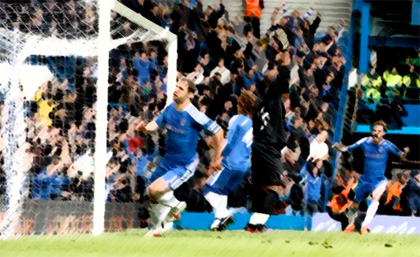
So here was I packed in like a sardine in the central section of the Boston Stand. Great view though. Wigan Athletic were losing 2-0 to Chelsea after 7 minutes. Both mistakes down to a new defender, in his first game for the club. Hats off to the crowd – nobody got on Ivan Ramis’ back and jeered him. There were comments about the referee, giving the penalty, since Mike Jones was the same arbiter who let Chelsea get two offside goals to beat Latics last year. To be honest, from where we were sat it was hard to see if Ramis deserved the penalty award given against him.

We were a bit numbed by those opening goals, so early in the game. In previous years our teams would have collapsed. Not this team though. They got back into the game playing controlled football, having more possession than their more illustrious and disproportionately more expensive opponents, giving as good as they got. However, as half time approached the dark side reared its ugly head. In this case the dark side was represented by two very friendly, warm Wiganers who complained that Latics weren’t really going at Chelsea. There was some truth in their argument. When Latics were attacking the midfield players were not getting into the box sufficiently. One or two forwards against six or seven defenders makes it unlikely that you will score. But then again Chelsea had players with lightning pace who could break away and kill the game completely if you totally committed yourself forward.

In the second half the Darksiders got more and more frustrated. I had one of two intellectually stimulating verbal exchanges with them, until it came to the point where the more eloquent of the two made a thought- provoking comment: “We show these teams too much respect”. Given the counter-attacking threat of the opponents I thought Latics were using the right approach and I told him that. But, on reflection, I have to agree with him that in some matches in the past Martinez’s teams have been over cautious and let the other team take the initiative. Let’s not talk up the other team and say how capable they are. There is a lot of psychology in Premier League football and we need to get this right. We need to shed the little, humble Wigan tag and get a bit of swagger. However, at the same time let’s have the tactical nous not to shoot ourselves in the foot and not commit ten men forward against a team likely to destroy us if we do.

All football clubs live with darkside supporters – those who don’t like the manager and victimize certain players. However, I thought the Latics’ fans were generally very supportive on Sunday. So many fans have now become appreciative of the good football that Roberto Martinez demands of his team. At one stage the more plain spoken, if less eloquent, of the two Darksiders said that he wanted Martinez gone. I replied that it was not the opinion of the majority of Wigan Athletic supporters. He then suggested I was a rugby man. That ultimate insult made my blood boil, but I managed to keep my head and reply politely that I was not.

Last season we saw something very special – Wigan Athletic beating the elite, not through luck but on merit. Which previous manager prior to Martinez could have had a team playing such great football with such aplomb?

Let’s hang in there with Bob and Dave. Latics are way ahead of where they were. Their plan to take the club forward is unraveling, but it will take time and patience. Apart from the opening minutes it was a fine performance against Chelsea. Let’s look forward to a good performance at Southampton. Believe and keep the faith!

Blind optimism and Latics’ new season

One of the lads in my class at school was called Brian. He claimed to be an Horwich RMI supporter.  I thought I was remarkable enough at the time, being a Latics fan, in a town dominated by the cherry and white. There were few of us Latic fanatics at school and if we dared to utter words of blind optimism about our club, our classmates were quick to shoot us down.  The message was – how can you support a measly little non-league football club? Don’t even dream of reaching the heights of our wonderful local rugby team or the football giants in neighbouring cities. However, I considered myself an optimist as far as Wigan Athletic were concerned. It was in my blood – and still is. I trust that those classmates are eating their words now.

To be honest, Brian was even more of an optimist than me. Horwich Railway Mechanics  Institute was in fact a much older football club than Wigan Athletic, having been formed in 1896. Their only major  success over those years was in winning the Lancashire Combination championship in 1957-58.  Coming up on Saturday afternoon at Springfield Park was a Lancashire Junior Cup tie between our two teams. It was akin to David and Goliath. Brian saw it differently — an epic tussle between two of Lancashire’s outstanding non-league clubs. He reeled off the names of RMI’s starting eleven, declaring each player a “good-un”, although it was clear from the intonations of his voice that some were more good than others. He had faith – I thought foolishly so – that RMI would get a good result.

Brian was right that day, the match ended in a draw. My Dad was so furious he said he wouldn’t go and watch the replay in the coming week. Their ground was a freezing, a God-forsaken place on the top if a big hill where the wind ruled the roost, he said. Their pitch was going to be rutted and would make good football impossible.

Fortunately, he relented and we took the short bus ride, and walked up to RMI’s ground at Grundy Hill.  Latics won 5-0, and Brian avoided me at school the next week, although I did quietly admire the genuine faith and optimism he seemed to have in his little club. Later, I became disillusioned to find out that he went to see Bolton more than Horwich.  But then again —  why would he announce himself a  fan of Horwich RMI rather than First Division Bolton? Strange how it turned out that Bolton now play home games  in Horwich, whereas the latest incarnation of RMI plays in Leigh.

So what would an optimist make of Wigan Athletic’s chances this season? That Bob and Dave are still here and therefore the club is continuing to move forward.  The appointment of the admirable Matt Jackson to spearhead the much needed youth system upgrade is to be commended. Boselli  is back and so far has averaged a goal a game in pre-season, having only played a half in each. He remains our potentially most clinical finisher, if not the silky skilled player that Di Santo has become. Both Fyvie and Ramis look like excellent signings. Roberto has also brought in two 19 year olds from elite Spanish clubs, each with good credentials. Assuming no major injuries or loss of form, a place in the top half of the table is a distinct possibility.

So what of Victor Moses? Why are Chelsea putting in such derisory bids for him? The odds are that he will go. He is far from the finished article, mainly with his decision-making in goal-scoring opportunities. He wasted a lot of chances last season. However,  there is a need for  a flair player like Moses, or N’Zogbia before him, to do the unpredictable and unsettle defences. Providing he can avoid injuries I expect Albert Crusat will make more of an impact this year. He is pacy, intelligent and David Silva has shown that slightly built players can flourish in the physical Premier League. It would be a mistake, however, to view Crusat as the replacement for Moses  — they are different types of player – and Dicko and McManaman will also compete for that spot.

Latics’ superb end of season performances, however, were built from the back. The three central defenders — Alcaraz, Caldwell and Figueroa – were outstanding, but one lived in fear of any injury to any of them. There was always the possibility of slotting Boyce into the centre but he was playing possibly the best football of his career at wing back. The signing of the experienced and highly capable Ivan Ramis is therefore welcomed. In fact, Figueroa might miss the first part of the season after being on Olympic duty for Honduras. Expect Ramis to slot in for him – if not it will be Lopez or Golobart.

In goal we have the outstanding Ali Al Habsi. The promising  young goalkeeper, Lee Nicholls, is clearly one for the future, but needs to get more experience before stepping in for the Omani. The 40 year old stalwart, Mike Pollitt, will be the first choice backup ‘keeper. There is newspaper talk about a promising young Australian coming on trial.

Latics are well served for wing backs. Ronnie Stam was in excellent form last season before being left out for Emmerson Boyce, who did spectacularly well. Jean Beausejour was the piece in the jigsaw puzzle that made a big difference in the latter part of last season. Wing back is not a position most clubs use, but Beausejour played in that position for Chile under Marcelo Bielsa. Both he and Stam are specialist wing backs. Ramis’ arrival allows Figueroa to serve as emergency wing-back in the event of injury to Beausejour.

Despite losing Diame and Thomas the midfield looks strong. The classy Ben Watson will fight to get his place back from James MacArthur, although he will face competition from Fraser Fyvie. The excellent James McCarthy is potentially as good as most midfield players in the Premier League and is likely to be our sought after by the big clubs before the end of the season. It may be that Fyvie is seen as his long-term replacement. He is a complete player and the goals that have been missing over the past season are likely to return. All he lacks is a little self belief.  David Jones remains a useful squad player able to play in a variety of positions. He has a great left foot and is an intelligent footballer. Hopefully he will steer clear of injuries this year.

Shaun Maloney was a revelation in the latter games of the season as the playmaker.  He has that kind of quality that can make a difference. His experience in a Celtic team that dominated the SPL has given him the level of self-confidence that most of his teammates lack. His career has been blighted by injury and one doubts his ability to make it through a full season unscathed. Jordi Gomez, the butt of some fans, remains a good footballer, able to play that role. Jordi has learned that he has to work hard off the ball and now covers a lot of ground. He is not a natural tackler, but does a lot of harassing of opponents to complement his considerable skills on the ball. Both Maloney and Gomez are likely to score goals, be it from open play or the penalty spot.

There has been talk of Conor Sammon going out on loan, although he does not seem to know anything about it. Sammon needs regular first team football if he is going to develop further. He is not likely to get it with Di Santo and Boselli ahead of him in the pecking order for the centre forward position. Speaking of loans, Lee Nicholls is already fixed up for a spell at Northampton.  One wonders how many more of last season’s loanees –  Golobart, Kiernan, Mustoe and Redmond – will be sent off again for more first team experience.

Perhaps I am being a blind optimist like my friend Brian, but with Bob and Dave still at the helm this club is going to be steered towards a bright future.  They are a great double act and deserve to succeed at the club. Whether Wigan Athletic have a good season in 2012-13 depends on the players. Shaun Maloney summed things up at the end of the season by suggesting that the great revival was brought about by hard work. We have a pretty good squad this year and with the full commitment of the players a mid-table position is a distinct possibility. Forget about the friendly loss to Real Mallorca. We are in for  a good season. Believe and keep the faith!!

Bring back Boselli

* this article was written by Jakarta Jack but somehow listed under my name. I agree 100% with his views however!

A sleepy Sunday afternoon in May 2011. I turn the television on and inadvertently come across an Italian league game.  The atmosphere in the Genoa-Sampdoria derby I am watching  is frenetic. It is 1-1.  In the 97th minute, the on-loan striker Mauro Boselli receives the ball to his right just inside the box, pirouettes and hits a cracker into the far left hand corner of the Sampdoria keeper’s net. The Genovese home crowd goes crazy.


Looking back to November 2010 at West Ham  – Latics are  losing 2-1 and get a penalty. Not long off the bench, Boselli steps up but fluffs it. It turned out to be the key moment for Boselli and Latics, his homesickness exacerbating the issue. Here we are a year and half later, and Boselli remains a Latics player. This columnist advocates his return.

Mauro Boselli started his career at Boca Juniors in Buenos Aires, a big club in a country that produces great players. He made 42 appearances between 2003-2008, scoring 10 goals. That he did not make more appearances for them was largely due to the form of World Cup forwards, Martin Palermo and Rodrigo Palacio. So he moved to Estudiantes de la Plata in 2008 — a small club with a ground capacity at the time of 23,000, where he was key to their Copa Libertadores success in 2009. He scored the winning goal in the final. His 9 goals made him the tournament’s leading goalscorer. During his time at Estudiantes he scored 32 goals in 57 appearances in a league where goals are hard to get. He is an Argentine international..

The Argentine came to Wigan at a time when they desperately needed goals. He did well in pre-season, but found the role of lone centre forward difficult, as had Jason Scotland before that. At Estudiantes he had played with a twin striker, Argentine international, Mariano Pavone. To find himself alone and up against the giant, physical defenders of the Premier League must have been demoralizing. At the time, service from Latics midfielders was scant, in a time when Roberto was concerned about committing men forward after some notably heavy defeats. Despite scoring a well-taken cup goal, Boselli had failed to score in the Premier League and his time was a miserable one.

His next stop was a loan move to Genoa, where he got few opportunities. His goal in the derby was the exception. He played 7 matches, netting 2 goals. He clearly missed his native Argentina and returned to Estudiantes on loan for the 2011-2012 season, where he has scored 11 goals in 29 appearances.

Mauro Boselli is a fine centre forward who never had much of a chance before at Wigan. He is a much more natural goalscorer than anyone we have. Given the improved support from the midfield and number of quality crosses now being provided from the wings, conditions suit him. Let’s hope that those who have criticized him – like those who have criticized Roberto Martinez in the past – will give him a chance. We’d love to have you back, Mauro. You can do a great job!

Chelsea 2 Wigan Athletic 1: False result as Latics once again fall victim to unfair refereeing decisions

Twice this season, a match official has made a footballing decision so horribly incorrect that they were suspended from duty in the ensuing fixture. The first was Andre Marriner, the referee who allowed Morten Gamst Pedersen to simply run the ball in from the corner flag, producing a goal that denied Wigan Athletic a crucial three points against Blackburn Rovers. The second was linesman Dave Bryan, who on Saturday gifted Chelsea three points by allowing two offside goals to stand. Again, the victim was Wigan Athletic, who would have escaped the relegation zone with one point from this match, let alone the three they deserved.

Back in December, Wigan Athletic suffered from another blatantly incorrect decision when Conor Sammon was sent off against Manchester United for very minimal contact with Michael Carrick. When the club appealed the suspension, the FA acknowledged its mistake and rescinded the suspension, something they do not make a habit of doing. A token gesture, I suppose, but once again, Wigan emerged with no points.

Two of these incidents were so bad the Premier League decided to suspend the officials. It’s no surprise they both happened to Wigan. We are, after all, the only team in the history of hte league to have to face 1) the newly promoted teams in back-to-back fixtures on the first three gameweeks, when they are typically at their strongest 2) the traditional top four in a five match stretch.

If these refereeing “blunders” had happened — not that they would — to a wealthier, more influential team, there would surely be talk of re-playing the matches. While there was plenty of media coverage about the Pedersen incident and Chelsea’s victory on the weekend, nothing has been done about either situation to recompense Wigan the lost points they so desperately need.

While any conspiracy about the Premier League wanting rid of little Wigan and its relatively small crowds and TV market is hard to prove, the evidence available certainly points in that direction.

But lets face it — there’s probably more to it than that. First of all, there’s human error. Bigger clubs have bigger stadiums, officials are human and react to noise, abuse and threats. It’s also certainly not outside the realm of possibility that Chelsea’s billionaire owner Roman Abramovich — so keen on winning the Champions League — played some part in linesman Bryan’s decision-making on Saturday as his team desperately needed those three points to remain in the race for fourth place. After all, Chelsea also got a very soft penalty against Fulham last night, although it wasn’t enough to get them three points.

The tragedy is that Wigan is playing the best football it has ever played, and at the highest level. The team was outstanding against Chelsea from back to front, full of culture and quality, solidity and belief. The performance, as have many of the last 7-8, merited three points or at the very least a valuable away point against a Champions League semi-finalist.

Next up, Manchester United. If any good comes of Saturday’s disgrace, it’ll be a fair match on Wednesday. We may have conceded three illegal goals in our last two visits to Stamford Bridge, but it’s even worse against United. In addition to Conor Sammon’s bizarre sending off this season, Wayne Rooney was allowed to continue on the pitch after elbowing James McCarthy in the face last year, and Antolin Alcaraz and Hugo Rodallega were harshly sent off in the fixture before that.

It will be interesting to see how Roberto Martinez — by some distance the most eloquent and well-mannered professional in the division — is treated in the wake of his post-match comments. The Spaniard rightly vented his frustration after the match but such an approach has backfired in the past, to Paul Jewell in particular in that second season up. Given the fact that Manchester United have recently benefited from a blatantly incorrect penalty and red card decision, and Wigan have been robbed of points for two of them, one would hope whoever is given the task on Wednesday will be instructed to give — if anyone — Wigan Athletic the rub of the green.

At the end of the day, the fact is if we had the points we deserved from the Blackburn game or the Chelsea game, in which the FA deemed the official’s decisions so bad as to be punishable, we’d be closer to Aston Villa than to Bolton in the league table.

Match Report:

By now, you know what happened. But I’ll refer you to This Northern Soul’s report for a refresher.

The Good:

Everything but the result. It has been so enjoyable to watch the Latics recently and a source of real pride. The team performance was outstanding. Defensive solidity with outstanding goalkeeping. Good midfield passing which only improved when Ben Watson and Mo Diame came on, also highlighting a depth our squads have never had. These players are giving it their all, and playing with some style. Our direct rivals all lost — Bolton twice — so we didn’t lose any further ground in the table. No injuries or suspensions, minus Hugo Rodallega’s ongoing complaint.

The Bad:

The players must be gutted. Lets hope Roberto can use the sense of injustice from this most recent match as a motivator for the even bigger Manchester United fixture.  Only six games left, two of them against top teams.

Player Ratings:

Ali Al-Habsi: 9 — Made four or five absolutely sensational saves in this match.

Maynor Figueroa: 8 — Very good defensive performance despite giving away a couple dangerous free-kicks.

Gary Caldwell: 8.5 — Once again a titan at the back. Almost won it for the Latics again in the last minute only to find himself sprinting the length of the pitch to try and prevent the goal at the other end. Which shouldn’t have stood anyway.

Antolin Alcaraz: 9 — His best performance of the season, he frustrated Drogba and stood strong in one-on-one defending. His distribution out of the back has also been very strong of late.

Emmerson Boyce: 7 — Unable to get forward but had his hands full and defended solidly.

Jean Beausejour: 7.5 — Showed some nice touches but was also limited in his forays forward, save one or two nice deliveries.

James McArthur: 8 — Put in the shift we have come to expect of him. Also played a delicious defense-splitting pass in the first half.

James McCarthy: 8 — Burst dangerously from midfield in the first half, something we’d love to see more of. His physical power and energy was very important.

Shaun Maloney: 7.5 — Involved in most of Latics best attacking play, he has continued to breathe fresh air and imagination into our attacking work.

Victor Moses: 9 — Chelsea had to foul him every time he got the ball. His running and dribbling was outstanding, though he was frequently isolated.

Franco Di Santo: 7 — Played his target man role well and had one golden chance to equalise after Chelsea’s first goal. What a shame it didn’t go in.

Subs:

Ben Watson: 8 — Came on as a part of a tactical switch back to the 4-5-1 / 4-3-3 line-up and showed his quality, passing the ball well and helping Wigan regain possession of the ball.

Mo Diame: 8 — Injected energy, dribbling and pace into the midfield, and scored an excellent left-footed goal to level the score.

Conor Sammon: 6 — Ran and worked hard but doesn’t have the skill on the ball Di Santo has.