Is there ever a good time to play a good team?

The business of writing match previews is a repetitive one. Who starts, who misses out, what happened last time and what tactical approach might lead us toward a path of destruction and misery. Hardly original stuff.

But while fans may rejoice at the absence of the opposition’s star striker, or brace themselves when their three natural centre halves are set to miss out through injury, one such pre-game quandary causes more tossing and turning than others: is this a good time to play them?

There is no denying that form influences matches. Confident players are willing to take risks, confident teams are more likely to recover from setbacks, match fitness and sharpness are hugely important. So good form is almost always a good thing.

But lets take Newcastle, in terrible form by their standards. A squad of talented internationals that hyper-achieved last season but have struggled with injuries and morale this time around. A squad that thought they had three points in the bag at the rowdy cauldron that is Stoke’s Britannia Stadium before two smash-and-grab strikes in the last ten minutes spoiled the party and sent them home sad once again.

They are like a wounded animal, out for revenge. They may be in poor form, but will be fired up, out to reverse the curse in front of their rabid home supporters. Who, by the way, will be thinking, “Well, we got robbed at Stoke, but that was always a tricky fixture. Wigan at home next: that should get the good times rolling again!”

And so, is this a good time to play Newcastle?

The Optimist: Yes. They’ll be fired up and throw everything at us in the first 20 minutes. But if we can keep them at bay, the crowd will get on their backs, they’ll start to rush things, and errors will creep into their play. They’ll be under pressure to win convincingly and leave space at the back for our speedy strikers to exploit.

The Pessimist: No. They’ve got a squad full of talented players, returning from injury, who feel they were robbed at Stoke. The focus will be on eliminating the defensive lapses that cost them those points at the Brittania. Pappis Cisse scored on his return to the squad. They have 5-6 players with something to prove, and any of them could win the game for them. We’ve had it.

Case closed, clearly.

What side of the fence do you fall on? Leave us a comment here or on Facebook.

Barry Horne, Jordi Gomez and Wigan’s Plan B

It is 10:00 o’clock in the evening in Jakarta and I am about to watch Wigan Athletic’s home match against Reading. I am hoping to enjoy the commentary on the game. When I hear the monotone voice of Barry Horne, I wince. He announces that this is the third consecutive Wigan game he has been allocated — it sounds like a punishment.

With Wigan Athletic losing to a headed goal in the first half I felt a certain degree of frustration. Latics were not taking their chances, they gave away a poor goal to an unchallenged header. A sense of déjà vu? On top of that I had to listen to Horne’s dreary voice and his “expert commentary”. His main issue with Martinez and his teams is that they do not have a “Plan B”. When things don’t go according to plan and Latics fall behind, Horne suggests that there is no immediate tactical response.

On the face of it, Horne has a valid point. When Wigan fall behind there is no increase in tempo, as one would expect from most teams in English football. This was evident on Saturday, when Latics seemed languid after giving away a soft opening goal. The Englishman in me got frustrated, but then I know Martinez’s teams do not follow the usual national pattern. Watch Barcelona fall behind and you see no change in their brand of football: they will eventually grind you down and beat you. The Barcelona style is clearly an inspiration for the Latics’ Catalan manager, but he is savvy enough to know that Latics don’t have the wherewithal to go with it fully.

Watching Wigan Athletic from afar has its ups and downs. There is nothing I love more than being at the DW Stadium, listening to the buzz of the crowd. Wiganers are resilient people and keep up their hopes in times of adversity. The “I’m A Believer” support in the latter part of last season was absolutely superb and helped inspire the team stay up. However, the buzz can dissipate when things are not going so well. When I am there, I seem to get locked into debates with Darksiders who want an English manager who will have his team ‘get stuck in’ and show real commitment. Although in a minority there are still those who would like to oust Roberto Martinez. Jordi Gomez is identified as a player in whom the manager has had faith beyond the norm. It is not only the Darksiders who have had their fill of Gomez. Normal, rational lovers of good football also tend to be polarized when the name of Gomez is mentioned.

The anti-Gomez lobby has been strong. After the Chelsea match, sheltering from the pouring rain outside, I was privy to a conversation where a group of Latics supporters came to the consensus that having Gomez in the team was like playing with ten men. Given his past performances, their comments had some justification, but the consensus was going a little too far. Yes, Gomez as a midfield player was not providing defence-splitting passes, nor was he scoring the goals he could from the good positions he got into. On Saturday Gomez sent a message to his detractors, with not just a fabulous hat trick, but also some fine midfield play. In one fell swoop he vindicated his manager’s trust in him.

As a midfield player Barry Horne was well known for his abrasive tackling, rather than an elegant passing style. He played for 10 clubs in his professional career and 59 times for Wales. Like many football analysts who we listen to on television he can be put in the position of “expert” for the duration of the match. Although I do not enjoy his commentaries very much, maybe he has a point about ‘Plan B’? Are Wigan Athletic capable of taking their game up a gear when going behind? Or is it a case of “Don’t panic, we’ll get there in the end”? One wonders if Jordi Gomez is his type of player? He is now in his fourth year at Wigan and his manager clearly thinks he is the right kind of player for the club. After that stunning second half display against Reading, Gomez deserves a fresh start in the eyes of Wigan Athletic supporters. Let’s get behind him.

1/4 Season Report Card: Al-Habsi, McCarthy & Maloney the top performers

With eleven matches played, we’ve entered the second quarter of the season. This post takes a look at the performances that have earned us a point a game — on track for safety — but left us rueing missed opportunities for more.

The numbers below were calculated by averaging the performance scores we dole out after every match. They are obviously subjective, but provide some insight on the areas of the team that are — at least in the eyes of the writers on this site — performing to, below or beyond expectation. Ali Al-Habsi is perhaps unsurprisingly our stand-out performer, followed by James McCarthy and Shaun Maloney. The strongest area of the pitch was the centre of midfield partnership of James McCarthy and James McArthur, while the weakest was the centre of defence. Only players who have started more than five matches were included.

By Player

Ali Al Habsi: 7.4 — Mostly 7s and 8s, with a 5 on an off-day and a 9 on a particularly excellent afternoon.

Gary Caldwell: 6.45 — Like Ali, has had one standout 9-worthy performance against Spurs, but a few more off-days.

Ivan Ramis: 6.65 — Nightmare debut, but steady improvement since then.

Maynor Figueroa: 6.55 — One of the more consistent performers. Had a bad day at Swansea post-international break, and a good one at Sunderland. Otherwise 6s and 7s.

Emmerson Boyce: 6.45 — Mr. Reliable, with nothing higher than a 7.5 but rarely letting his team down.

Jean Beausejour: 6.78 — Good performances without reaching his best.

James McCarthy: 7.2 — Very good season so far, has been dominant in midfield. Imagine if he adds goals to his game.

James McArthur: 6.78 — Stop-start campaign with injuries, but has been good when available.

Shaun Maloney: 7.05 — Some high numbers, but lack of finishing is probably losing him points. He makes this team tick, but is starting to be identified as the man to mark.

Arouna Kone: 6.75 — Very good average given these have been his first 11 matches in Premier League football, with a new team and surroundings, and no adaptation period.

Franco Di Santo: 7 — A big number for Franco, who has scored some well-taken goals, continued to put in the hard work, and been rewarded with an Argentina call-up.

By Area

Defence (including Al-Habsi): 6.76

Centre of Defence (without Al-Habsi): 6.55 — weakest

Centre of Midfield: 6.99 — strongest

Wingbacks: 6.61

Attack: 6.93

Is par for the course still good enough?

Last November, Wigan Athletic were bottom of the Premier League with just 5 points from 11 matches. At present, they lie in 14th place with 11 points, averaging a point per match? If they were to maintain that point rate  through the season, they would end on 38 points, usually enough to stay up. But is staying up sufficient for Wigan Athletic supporters and its management anymore?

Lets look back on the season so far. The team has won 3 league matches out of 11. With the exception of Ivan Ramis and Arouna Kone, this is the same nucleus that won 7 out of their last 9 games last season against stronger opposition. So why have they not done better?

It cannot be put down to Ramis and Kone. Apart from his difficult Premier League baptism against Chelsea, Ramis has been solid, getting better game by game. Despite speaking almost no English he has become the de facto captain in the absence of Caldwell. Given that he was previously captain of RCD Mallorca for several years, it is no surprise. Kone has made an excellent adaptation to English football. Strong, speedy, skilful and unselfish he has already 4 league goals – Moses only scored 6 in the whole of last season. Both are excellent signings. Moreover Martinez has moved on with his tactical formation without the maverick Moses (exciting,  but frustrating) to be able to play with two big strikers and a mobile playmaker.

Over these past years one has seen Wigan Athletic teams that have been either disorganised or short of a real game plan. That cannot be said of the current team, who play within a well-created tactical system that can pose problems for even the finest of Premier League teams. Moreover, the players know their roles and show a high degree of commitment. Roberto Martinez talks about this being the best squad he has had – and given the budget he has to work under, he has done a marvelous job at recruiting the players at his disposal.

So why are Wigan Athletic not at least in mid-table position at this stage? You could blame referees or say they have had some bad luck and there is validity in such arguments. However, so could many other clubs stuck in the lower reaches of the table. Losing at home to Chelsea with their wealth of talent is not going to be a surprise, but home losses to potentially mid-table teams like Fulham and West Bromwich is hard to take. Both matches were characterized by giving away soft goals and a lack of finishing. The old failings continue to haunt. Player-for-player, neither Fulham nor West Brom is superior to what Latics have, except maybe Berbatov for the Londoners. However, what both those teams have is a deep-rooted self confidence, which Wigan Athletic just don’t seem to have.

Roberto Martinez has put together a team that could beat any team in the division on their day – a remarkable achievement. His players are largely international journeymen or players who have come in from weaker leagues. Nevertheless they have the skills to compete with the best. Whether he can instill that kind of self-belief in his players, like those in the higher-placed teams continues to be his challenge. He has done everything else really well – a superb tactical system, motivated players – but is it within his powers to convince his players that they can be as good as those earning two or three times their salaries in the Premier League? Without that, Wigan Athletic are going to be involved in yet another relegation dog fight.

Twin strikers at Wigan Athletic — a trip down memory lane

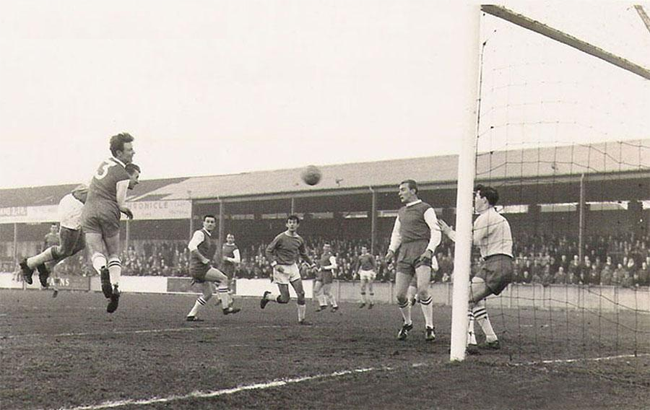
1964-65 : Wigan Athletic 3 Oswestry 0. Harry Lyon gets on to a Walter Stanley cross as Carl Davenport lurks menacingly. Allan Brown looks on from midfield (photo from Wigan World). 

In the late 1970s, my Dad and I would typically go out for a beer on Friday nights. We would rarely discuss things like politics or the weather, preferring to focus our conversations on Wigan Athletic’s progress in the Cheshire League. Among our discussions would be recollections of trips to watch Latics in exotic places like Stalybridge, Mossley and Oswestry. We lived in the south of Wigan, rugby league territory, so the pubs around us were steeped in that kind of nostalgia. One of those was ‘The Waterwheel’, run by ex-Great Britain rugby player, John Stopford. In his heyday in the early 1960s Stopford had been a lightning-fast winger for Swinton. Although he never played for Wigan RLFC, Stopford would draw rugby enthusiasts to his pub. We mostly avoided such places, preferring to walk further afield to pubs that were more salubrious for Wigan Athletic supporters.

One rainy night we succumbed, and tried ‘The Waterwheel’. Upon opening the door and the sight of the scrum surrounding the bar we started to think twice about it. There were some burly men there, faces like boxers, some with arms in slings. We were just about to walk out when my Dad said “Look it’s Harry Lyon over there.” It was indeed my hero from my teenage years. Chatting with Harry was easy. He just made you feel comfortable talking with him. Although he had left the club a decade before you could tell that Wigan Athletic was his first love. He said that it was a wonderful feeling running down the tunnel at the start of a game at Springfield Park, with some 3,000 people urging you on.

Harry Lyon was a great favourite with the fans, Wiganers not only appreciating his incredible goalscoring record, but also loving his commitment on the pitch. I asked him who was the best manager he had worked under – he had 5 during his time at the club from 1962-1968 — his reply was Allan Brown. Brown caused waves in the non-league world in 1964 when he took over at Wigan as player/manager, hiring a swath of full time professionals in a semi-professional league. After training, Brown would sometimes take his players to the town centre restaurant where my mother worked. I would be thrilled when she would bring home players’ autographs, usually written on the backs of serviettes.

Brown’s teams played an attacking 4-2-4 with the manager orchestrating from the centre of midfield. Carl Davenport was Lyon’s striking partner in Brown’s first year. Like Lyon he was an excellent header of the ball. I recall going to the Anchor Ground – aptly named at the time, a real quagmire of a pitch – to watch Latics play Darwen in a cup match. My Dad would recall for many years how Davenport had risen so high that his head was well over the height of the crossbar as he put the ball in the opponents net. Although Davenport was often referred to as an inside forward in those days, he was in reality a twin striker with Lyon. No teams found it easy to cope with the two of them. That season Harry Lyon scored 67 goals!

However, when I asked Harry who was the best striking partner he had played with he immediately retorted: Bert Llewellyn. Unlike Carl Davenport, Bert Llewellyn was only 5 feet 4 inches tall. A headed goal was a rarity, but after joining Latics in the summer of 1965, he scored 49 goals in 39 league appearances over the course of the season. Llewellyn was far from an elegant player, but was a natural goalscorer, sniffing around the penalty box for deflections, toe-poking and scrambling the ball into the back of the net. In his four years at Springfield Park, Llewellyn scored 140 goals in 185 appearances in all competitions. Remarkably, he outscored Lyon in his time at the club. Check out this wonderful article on This Northern Soul on Bert Llewellyn.

Since that era there have been lots of twin striking partnerships at Wigan Athletic. What a pity that wonderful pairing of Jason Roberts and Nathan Ellington was broken up when Latics reached the Premier League. How refreshing that Robert Martinez has adjusted his tactical system to play with two big strikers this season. The interplay between Arouna Kone and Franco Di Santo is a joy to watch. It is almost like turning back the clock.

We would love to hear from our readers – which has been your favourite striking partnership at Wigan Athletic?