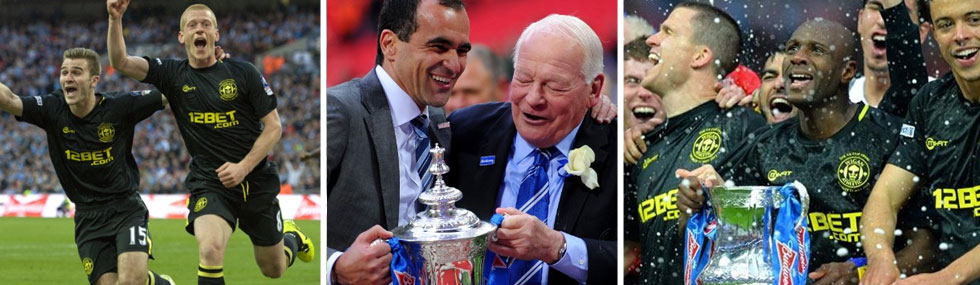

Is par for the course still good enough?

Last November, Wigan Athletic were bottom of the Premier League with just 5 points from 11 matches. At present, they lie in 14th place with 11 points, averaging a point per match? If they were to maintain that point rate  through the season, they would end on 38 points, usually enough to stay up. But is staying up sufficient for Wigan Athletic supporters and its management anymore?

Lets look back on the season so far. The team has won 3 league matches out of 11. With the exception of Ivan Ramis and Arouna Kone, this is the same nucleus that won 7 out of their last 9 games last season against stronger opposition. So why have they not done better?

It cannot be put down to Ramis and Kone. Apart from his difficult Premier League baptism against Chelsea, Ramis has been solid, getting better game by game. Despite speaking almost no English he has become the de facto captain in the absence of Caldwell. Given that he was previously captain of RCD Mallorca for several years, it is no surprise. Kone has made an excellent adaptation to English football. Strong, speedy, skilful and unselfish he has already 4 league goals – Moses only scored 6 in the whole of last season. Both are excellent signings. Moreover Martinez has moved on with his tactical formation without the maverick Moses (exciting,  but frustrating) to be able to play with two big strikers and a mobile playmaker.

Over these past years one has seen Wigan Athletic teams that have been either disorganised or short of a real game plan. That cannot be said of the current team, who play within a well-created tactical system that can pose problems for even the finest of Premier League teams. Moreover, the players know their roles and show a high degree of commitment. Roberto Martinez talks about this being the best squad he has had – and given the budget he has to work under, he has done a marvelous job at recruiting the players at his disposal.

So why are Wigan Athletic not at least in mid-table position at this stage? You could blame referees or say they have had some bad luck and there is validity in such arguments. However, so could many other clubs stuck in the lower reaches of the table. Losing at home to Chelsea with their wealth of talent is not going to be a surprise, but home losses to potentially mid-table teams like Fulham and West Bromwich is hard to take. Both matches were characterized by giving away soft goals and a lack of finishing. The old failings continue to haunt. Player-for-player, neither Fulham nor West Brom is superior to what Latics have, except maybe Berbatov for the Londoners. However, what both those teams have is a deep-rooted self confidence, which Wigan Athletic just don’t seem to have.

Roberto Martinez has put together a team that could beat any team in the division on their day – a remarkable achievement. His players are largely international journeymen or players who have come in from weaker leagues. Nevertheless they have the skills to compete with the best. Whether he can instill that kind of self-belief in his players, like those in the higher-placed teams continues to be his challenge. He has done everything else really well – a superb tactical system, motivated players – but is it within his powers to convince his players that they can be as good as those earning two or three times their salaries in the Premier League? Without that, Wigan Athletic are going to be involved in yet another relegation dog fight.
Twin strikers at Wigan Athletic — a trip down memory lane

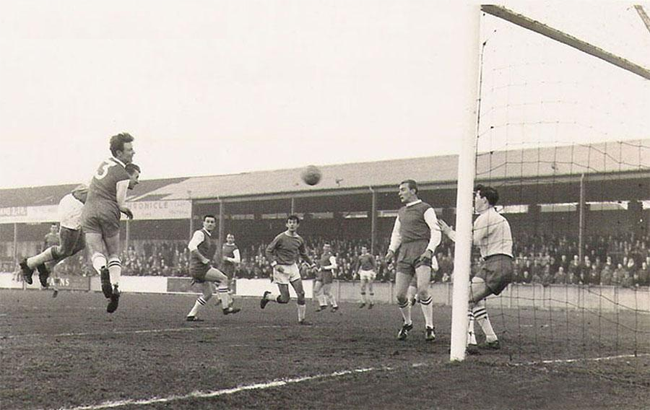
1964-65 : Wigan Athletic 3 Oswestry 0. Harry Lyon gets on to a Walter Stanley cross as Carl Davenport lurks menacingly. Allan Brown looks on from midfield (photo from Wigan World). 

In the late 1970s, my Dad and I would typically go out for a beer on Friday nights. We would rarely discuss things like politics or the weather, preferring to focus our conversations on Wigan Athletic’s progress in the Cheshire League. Among our discussions would be recollections of trips to watch Latics in exotic places like Stalybridge, Mossley and Oswestry. We lived in the south of Wigan, rugby league territory, so the pubs around us were steeped in that kind of nostalgia. One of those was ‘The Waterwheel’, run by ex-Great Britain rugby player, John Stopford. In his heyday in the early 1960s Stopford had been a lightning-fast winger for Swinton. Although he never played for Wigan RLFC, Stopford would draw rugby enthusiasts to his pub. We mostly avoided such places, preferring to walk further afield to pubs that were more salubrious for Wigan Athletic supporters.

One rainy night we succumbed, and tried ‘The Waterwheel’. Upon opening the door and the sight of the scrum surrounding the bar we started to think twice about it. There were some burly men there, faces like boxers, some with arms in slings. We were just about to walk out when my Dad said “Look it’s Harry Lyon over there.” It was indeed my hero from my teenage years. Chatting with Harry was easy. He just made you feel comfortable talking with him. Although he had left the club a decade before you could tell that Wigan Athletic was his first love. He said that it was a wonderful feeling running down the tunnel at the start of a game at Springfield Park, with some 3,000 people urging you on.

Harry Lyon was a great favourite with the fans, Wiganers not only appreciating his incredible goalscoring record, but also loving his commitment on the pitch. I asked him who was the best manager he had worked under – he had 5 during his time at the club from 1962-1968 — his reply was Allan Brown. Brown caused waves in the non-league world in 1964 when he took over at Wigan as player/manager, hiring a swath of full time professionals in a semi-professional league. After training, Brown would sometimes take his players to the town centre restaurant where my mother worked. I would be thrilled when she would bring home players’ autographs, usually written on the backs of serviettes.

Brown’s teams played an attacking 4-2-4 with the manager orchestrating from the centre of midfield. Carl Davenport was Lyon’s striking partner in Brown’s first year. Like Lyon he was an excellent header of the ball. I recall going to the Anchor Ground – aptly named at the time, a real quagmire of a pitch – to watch Latics play Darwen in a cup match. My Dad would recall for many years how Davenport had risen so high that his head was well over the height of the crossbar as he put the ball in the opponents net. Although Davenport was often referred to as an inside forward in those days, he was in reality a twin striker with Lyon. No teams found it easy to cope with the two of them. That season Harry Lyon scored 67 goals!

However, when I asked Harry who was the best striking partner he had played with he immediately retorted: Bert Llewellyn. Unlike Carl Davenport, Bert Llewellyn was only 5 feet 4 inches tall. A headed goal was a rarity, but after joining Latics in the summer of 1965, he scored 49 goals in 39 league appearances over the course of the season. Llewellyn was far from an elegant player, but was a natural goalscorer, sniffing around the penalty box for deflections, toe-poking and scrambling the ball into the back of the net. In his four years at Springfield Park, Llewellyn scored 140 goals in 185 appearances in all competitions. Remarkably, he outscored Lyon in his time at the club. Check out this wonderful article on This Northern Soul on Bert Llewellyn.

Since that era there have been lots of twin striking partnerships at Wigan Athletic. What a pity that wonderful pairing of Jason Roberts and Nathan Ellington was broken up when Latics reached the Premier League. How refreshing that Robert Martinez has adjusted his tactical system to play with two big strikers this season. The interplay between Arouna Kone and Franco Di Santo is a joy to watch. It is almost like turning back the clock.

We would love to hear from our readers – which has been your favourite striking partnership at Wigan Athletic?

A history of Scotsmen and the settling in period at Wigan Athletic

As a kid I often used to walk to school with my mother via her place of work in Wigan’s town centre. Typically, as we walked along we would chat and this would result in heads turning. My mother was a southerner and her accent stood out like a sore thumb. “Wur ya from luv?” was not an uncommon question for her to respond to. After being evacuated from the London blitz she had married a Wiganer who would not entertain living anywhere else but his hometown. It was a culture shock for her. She would recount stories of not understanding a word people said to her and how Wiganers could be so uncomfortably direct in conversation. Wigan was a pretty depressed town in those days, heavily polluted and with one of the lowest average household incomes in the country. Times have changed for the better. After the initial shock, my mother grew to love the town and its people, many of whom did not have easy lives. She understood that Wiganers were proud people with warm hearts.

My first experience of culture shock was arriving in Scotland, where I was to go to college. It was difficult enough to understand what people were saying to you, let alone walk around poorly-lit city streets where the English weren’t the most popular. I missed my trips to Springfield Park with my Dad, who would nevertheless do his best to keep me up to date on Latics progress at the time. I would call him up after he had been to watch a match for him to give me his commentary. It was usually fairly brief, laced with his habitual comment that the referee was the worst he had ever seen in his life. Did referees ever like Wigan Athletic one wonders?

Ian McNeill was not only one of my favourite Wigan Athletic managers, but also a Scot. He had been manager of Ross County and clearly retained good connections with his home country. When he first arrived – launching Wigan Athletic into the newly formed Northern Premier League in 1968 — he brought a posse of his countrymen. “Why do we need these Scotsmen? What’s wrong with our local lads” was a common refrain from some fans at the time. I enjoyed Scottish football, regularly watching the two Dundee teams in my time north of the border, and welcomed the acquisition of the Scots. There were the skilful wingers – Davy Breen and Jim Savage – plus the stylish Benny Cairney as a striker. There was also the lanky centre half, Doug Coutts, and that wonderful left back, Billy Sutherland: he of strong tackles and thunderous shots. But my favourite was Jim Fleming, a really skllful and intelligent forward who probably created as many goals as he scored. I often wondered why he would leave Hearts to take up a role as a part-time footballer at an English non-league club, together with a low key job at the Heinz factory. In those days the Scottish League produced more “ball players” than in England, with the ball less in the air and more at the feet. The” Nine in a row” Celtic team that produced the 5 foot 2 inch magician known as Jimmy Johnstone were the prime example.

Culture shock and Scotsmen remain very relevant to Wigan Athletic in modern day. The team that lined up at Swansea last week included four Scots (counting James McCarthy for the sake of argument), two South Americans, one Central American, one Spaniard, one African, one Omani (Oman is actually in Africa, but belongs to the Asian Confederation) and one English-raised player who represents Barbados. In McNeill’s early days the Scots were the minority in the team which was made up mainly of English players. Nowadays the Scots are the mainstay of the current multicultural mish-mash that represents Wigan Athletic. Like Ian McNeill, Roberto Martinez and Graeme Jones retain links with Scotland where they both played.

Not one of the current Wigan Athletic squad has played for any continuous period of time for a top Premier League club, before arriving at the club. Some might say the that Latics squad lack that genuine belief that players acquire after playing at such levels. The current bookmakers odds favour Queens Park Rangers to stay up despite their poor start, factoring in the presence of previously proven top level players in their ranks: Wright-Phillips, Zamora, Park to name but a few. Wigan do have Gary Caldwell and Shaun Maloney, winners of multiple championships in Scotland when with Celtic, but does that give them the kind of belief necessary for the Premier League?

Roberto Martinez’s task is always difficult. Because of the club’s salary cap he has to bring in players from outside England – Scotland, Latin America and Spain mainly. Even the Scots have a culture shock when arriving: probably not so much to the local culture, but more to that of the Premier League with its relentless physical and mental challenges. Gary Caldwell had spent some time at Newcastle before joining Celtic and he stepped right into the first team after his arrival. However, the other three – James McCarthy, James McArthur and Shaun Maloney were given a period of months before being thrust into regular first team action.

The double culture shock for players arriving from overseas can be daunting. Some like Di Santo and Beausejour had already been through that with their previous English clubs, Chelsea and Birmingham. Others came from Europe, where the culture is more similar than other far-flung parts of the world. But imagine Maynor Figueroa coming from Honduras, a developing nation in Central America. He was sensibly given time to settle in, having been signed in January 2008, but making an excellent debut as a starter– against Manchester United and Cristiano Ronaldo — in April of that year. Poor old Mauro Boselli, who had never played for a club outside Argentina, was thrust in immediately in August 2010. The end result was that he failed to make that cultural adjustment that was needed. Fortunately Boselli is back at Wigan, some two years later, biding his time to get into the starting lineup and scoring goals galore in cup and reserve fixtures in the mean time.

It looks like Scottish summer signing Fraser Fyvie is going to be given a significant settling in period before being considered for the first team. This despite the fact that he was a regular in the Aberdeen lineup from a tender age. Looking at other players who have been through the same process it appears the right thing to do. Sometimes the needs of the club force the manager into playing new recruits from the get go. It is not ideal, but some players rise to that challenge. Others unfortunately can’t make the adjustment so easily. The double culture shock is significant and should not be underrated.

Wigan Athletic & Honduras: A love story

It was a chilly evening in Bloemfontein. The 2010 World Cup was in full swing, and while the rest of the world adjusted their TV sets for the decisive Group H match — Spain vs. Chile — my party set off for Free State Stadium amid a sea of blue and white stripes.

My wife Kat and I, fresh from a 12 hour drive from Port Elizabeth where we’d taken in England’s 1-0 win over Slovenia a couple days prior — wore Wigan Athletic shirts. My brother-in-law John, also dressed in Wigan from head to toe, had followed Honduras’ progress through the qualifiers and ensured we had tickets for the group match against Switzerland. Everyone else wore Honduras colours, but by the time we arrived at the stadium, the distinction was blurred.

On paper, the match was a drab 0-0 that dumped Switzerland out of the tournament (Honduras had already been knocked out after defeats against Spain and Chile). But for Hondurans, this was an historic night. Second World Cup, their first since 1982. And it might have been a first win but for some good goalkeeping from the Swiss. The draw was seen as a dignified way to bow out of an extremely tricky group, in their second World Cup appearance. Switzerland had defeated Champions-to-be Spain only a week prior — they were no slouches.

On the pitch, former Latics favourite Wilson Palacios bossed the midfield alongside Hendry Thomas, still a Wigan player at the time. They never got to play together at the JJB or DW, a shame based on the tenacity displayed that evening. Maynor Figueroa, heroic in previous matches despite the defeats, continued his fine form in defense. Current Latics target Roger Espinoza was on the bench. As Figueroa walked toward the tunnel at the end of the match, I shouted in Spanish, “Maynor, por favor quedate en el Wigan!” [Maynor, please stay at Wigan] As the words registered, he retreated back out of the tunnel, stuck his back out head out, and gestured a thumbs up my way. True to his word, he remains a fixture at Wigan Athletic to this day.

I’ve since learned that we were not the only Latics supporters following Honduras at that World Cup. For years now, a curious bond has formed between the Central American nation and the northern town of Wigan.

Having spent a large part of my childhood in Colombia, I know what it means for a Latin American country to see their footballer exports succeed abroad. My dad would pull me out of bed on Sunday mornings to watch Faustino Asprilla play for Parma, and later Newcastle. This was long before the days of Ivan Cordoba’s success at Inter Milan, or the present day golden generation of Colombians succeeding in Europe led by Radamel Falcao. There were two or three players plying their trade abroad, and their every movement was watched with pride.

In many ways, Wigan Athletic has become dear to Hondurans as Parma did to Colombians back in those days. If Roger Espinoza completes his rumoured move from the MLS upon the expiration of his contract, he will become the fourth Honduran to play for the Latics. It is no coincidence that Honduras qualified to their first World Cup in 2010, as their players found first team football in top level leagues. Wigan continue to give their players a stage, an opportunity to grow — and they are reaping the benefits. Needing a win to progress in CONCACAF qualifying yesterday, they annihilated Canada 8-1 and in turn leapfrogged them and Panama to win their qualifying group in the final fixture. Their excellent showing at the Olympics proved there is more talent coming through, Espinoza included. A second consecutive World Cup is a possibility.

And so, there is a real bond between Honduras and Wigan Athletic. Jet-lag aside, Honduras’ success in the qualifiers can only be good for the Latics. Maynor Figueroa has grown immensely over the years. Honduras was the first to use him as a left centre-half, and it wouldn’t be surprising if watching Honduras had persuaded Roberto Martinez to use him in the same way in Wigan. The experience these players gain in major tournaments ultimately strengthens their performances for the club. If Rodallega had been able to break into the Colombian team, he too, might have further developed. As it was, he fell down the pecking order and stagnated for both club and country.

So keep an eye out for our Honduran brethren in the final six-team CONCACAF group stage. With Mexico, USA, Costa Rica, Panama, and Jamaica for company — three automatic berths, and a playoff against Oceania — you may have another reason to travel to Brazil in 2014.

iSaludos a nuestros lectores en Honduras! Siguenos en Twitter y Facebook.

Moving up a tier? Wigan and the Premier League financial league table

Over the years, Wigan Athletic have delivered performances ranging from the majestic to the downright nightmarish — none more so than the 2010 season opener against Blackpool. A 4-0 home defeat to anyone would have been bad enough, but to a team who the pundits had already condemned to relegation even before a ball was kicked? It was to prove a difficult season for Latics, only securing safety on the final game of the season. It also went down to the final game for Blackpool, who put up an amazing fight before eventually succumbing to Manchester United.

An old Bob Dylan song reminds us that “Money doesn’t talk, it swears.” The primary reason the pundits had tipped Blackpool for relegation that year was the perception that they did not have enough players of Premier League quality. Their Chairman, Karl Oyston, was not willing to splash money around like confetti and put the club at risk of insolvency. Blackpool’s salary bill that season amounted to just £14 million. Wigan’s was almost £40 million. During that 2010-11 season Blackpool were to do the home and away double over a team with a salary bill almost 10 times that of their own. That was Liverpool, at £135 million.

In the end Blackpool couldn’t quite avoid that relegation trap-door in the jungle of the Premier League, where clubs regularly make huge losses in an effort to keep up with the Joneses. You could say Blackpool got it right. Their salaries amounted to only around 25% of their income – compared with the league average of around 69% – and this helped them gain a positive cashflow for the season. They continue to be run on a sound financial basis in the Championship. Manchester City actually spent more on salaries than the revenues they had coming in, and even Aston Villa were leaking 92% of their revenue on salaries. No wonder Villa have since cut back, putting the emphasis on youth rather than established big-earners. It could be argued, however, that they have gone too far as the lack of quality and experience in this year’s squad makes them candidates for relegation.

Statistics show that the Premier League is financially tiered. In the 2010-2011 season club salary levels published by the Daily Telegraph ranged from £14 million to an absurd £190 million. The top three clubs in the table paid in the £150-£190m range. The teams finishing 4th and 6th paid in the £120-150m range, Tottenham bucking the trend by finishing 5th on a budget of “only” £91m. Fulham and Everton, with budgets around £58m managed to finish ahead of Aston Villa, who spent £84m on salaries. Then followed a clump of clubs paying between £40 and £60m, which included West Ham who were to be relegated despite a wage bill of £56m. Wigan Athletic, Wolves and West Bromwich had salary totals between £37 and £40 million, with only Blackpool below. It would be interesting to see salary levels for the current season, when these become available.

According to the Guardian “ The Premier League’s 20 clubs collectively made a loss of £361m last year, after spending all of their record £2.3bn income. Of the clubs which were in the Premier League in 2010-11, the year of most clubs’ latest published accounts, eight made a profit, of £97.4m in total.”  Dave Whelan wrote off Latics debts for £48m in August 2011. He advocated financial fair play to ensure that debt is maintained at “reasonable and sustainable levels”.

According to Alan Switzer,  of accounting group Deloitte, clubs with salary to revenue ratios of 70% and above are not likely to make a profit. He suggests that levels should go down to the low 60s. In 2010-11, Wigan Athletic were around the 80% level, according to the Daily Telegraph stats, which indicates a negative cashflow of £0.1 m.

The Daily Telegraph statistics show a clear correlation between salary levels and success on the field, although there are some exceptions. So how does a team stay afloat in a tiered Premier League? Do Wigan Athletic have to significantly increase salary levels in order to move up a tier in the league table? Would doing so make them financially less stable?

Last season both Mohamed Diame and Hugo Rodallega left at the ends of their contracts. A rough estimate might suggest that Wigan Athletic lost maybe £10 million in potential transfer money for the two. Whelan rightly insists that Wigan Athletic keep a lid on their salary payments so it is unlikely that either player was given an offer he could not refuse to stay on at the club. This season we have Franco Di Santo and Maynor Figueroa in their final year of contract. Both are key players. Figueroa has developed into an excellent left of centre defender in Martinez’ tactical system. He could prove costly to replace. Di Santo has now added goal poaching to his repertoire and could be worth in the region of £20 million on the open market if he continues to improve at this rate. When Roberto Martinez took over at the club various higher wage earners were sent packing to bring down the wage bill. He is now facing a dilemma in how to keep his top players from leaving at the ends of their contracts, given the total salary cap imposed by his chairman.

Given the factors above, is it possible for Wigan Athletic to consistently reach a mid-table position? Could they defy the stats on an annual basis, keeping a nucleus of good players, allowing a couple of stars to go for premium transfer fees each summer? In this way, the budget could be balanced. The first step would be to already have the replacements for the stars ready and in place. The second would be  to find a way to offer top players longer contracts at competitive rates, whilst maintaining a reasonable total salary cap. Food for thought for Bob and Dave.