Irritating “expert” commentators: a reflection on Garry Birtles commentary during Wigan-Arsenal

Do you ever get irritated by the “expert commentator” when you watch a televised football match? A particularly annoying tone of voice or an absurd level of incredulity and disbelief when a striker misses a chance. He will typically try to tell you that those things did not happen in his day. Some favour the top teams, others haven’t done their research or are just plain ignorant towards smaller sides like Wigan Athletic. Others still favour the clubs they used to play for. The theory is that they are good people to provide expert analyses, due to their experiences on the pitch during their playing careers. Their counterparts — the match narrators — are there because of their communication skills, their ability to reach out to mass audiences. They can grate on one too, particularly when glorifying the top teams and their players over all others — but I personally find them less irritating.

A few weeks ago I turned on my cable tv and found a Premier League match without any commentary. There was crowd noise, providing lots of atmosphere, but a technical glitch had done away with the official narration. What a refreshing 45 minutes of televised football. Unfortunately, after half time the commentary kicked back in and once again I found myself frustrated by the soundtrack. Ten minutes in, I turned the sound off and watched the rest of the match sans monotone monologue. While the first half with crowd noise was ideal, the second half on mute was not much fun. But the alternative of listening to the “expert” was definitely the worst of the options.

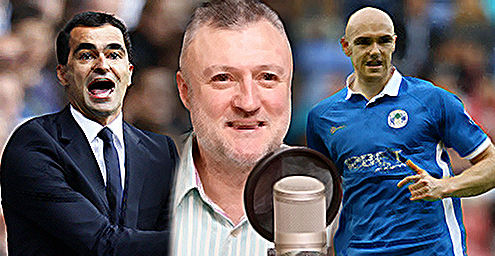
During last Saturday’s encounter with Arsenal, I found myself listening to Garry Birtles, the designated “expert” for the day. Now, Garry Birtles was a decent centre forward, who won the European cup twice with Nottingham Forest and won three caps for England. A good career to justify his “expert” status. Birtles was brutally frank about Wigan Athletic’s tactics against Arsenal. He criticized the lack of midfield tackling that led to Arsenal’s first goal, but reserved his most scathing comments for the lack of support lone forward Conor Sammon was receiving. At one stage in the first half he pointed out that Sammon was receiving the ball with not one of his own team within twenty yards of him. He continued to be flummoxed by this situation until he really blew in the 59th minute when Sammon was taken off and replaced by Franco Di Santo. “He (Sammon) was chasing his own flick-ons at times. When a system is just not working: change it!!” he remarked. He clearly had a lot of sympathy for Sammon. Later he was to state his disbelief that two substitutions had been made but the tactics remained the same. He advocated the need for a second central striker to be put in place.

I must admit that I almost muted the sound so I wouldn’t have to listen to him rant. You could picture the spit on the microphone. The fact I left him on was recognition, through my frustration, that he was absolutely right. The lone role of the Latics centre forward is something I commented on in my first article for this site. I have also advocated the need for more of steel in midfield. The reality of the Arsenal match is that we had little chance of getting back into the game after the errors that gifted them their first two goals. Martinez acknowledged as much after the match. Our players look desperately short of confidence. No matter what tactical system you adopt you cannot beat teams like Arsenal by giving away goals and lacking the self-belief to fight back. This was another capitulation to a big club — the statistics again making interesting reading. Wigan committed 8 fouls, while Arsenal gave away 12. In the matches against the big boys this year – Arsenal, Manchester City and Tottenham – Wigan have committed an average of 9 fouls per game. In the other 11 Premier League matches played so far Wigan have conceded 162 fouls, which makes for an average of 15 per game!

Let’s get back to the tactical situation. Our new system is a bit hard to fathom. I commend Roberto on playing with three centre halves. If Boyce and Alcaraz were to be two of those three on a regular basis it would surely help to shore up a leaky defence. Playing at wing back has given Ronnie Stam a new lease of life. It is his natural position. David Jones could have a bright future ahead of him as a left wing back. So far so good. But what about the midfield and the isolated centre forward? Prior to the change in the tactics we nominally had a centre forward and two wide players up front. However, one would expect that the addition of wing backs would change this arrangement. Two of the front three should theoretically be able to move narrower in support the centre forward, almost in the role of the old fashioned inside forward. However, last Saturday we continued to see Victor Moses operate primarily as a left winger with Jordi Gomez completely lost on the right. Diame and McCarthy were locked in primarily defensive midfield roles, rarely getting into the penalty box. The system needs to be fine-tuned so that when the ball does get into the opponents’ penalty box there are Wigan bodies there to latch on to it, not only that lone centre forward.

Listening to Garry Birtles on Saturday was painful. He was condescending and scathing in his commentary, occasionally ignorant. The problem is that he wasn’t wrong about most of his criticism. Let’s hope that the next time Birtles commentates on a Wigan match Roberto will have given him cause for praise.

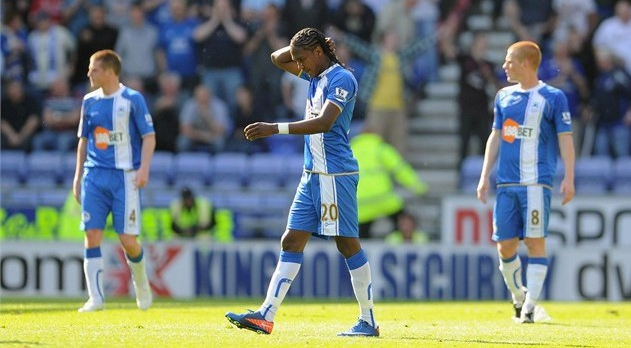
Wigan Athletic 0 Arsenal 4: Deflating afternoon as Latics get a drubbing

From the moment the lineup for Arsenal’s midweek Carling Cup match against league leaders Manchester City was announced, things looked grim for Wigan in this fixture. Wenger rested just about all of his key players against the billionaire sky blues only to unleash them fresh against second-from-bottom Wigan. It was a statement of intent from Wenger, whose focus is clearly on the Premier League this season. DW Stadium has after all, proven a tricky place for the Gunners. Latics twice came from behind in spectacular fashion to deny Arsenal in the previous two fixtures, drawing 2-2 last year and winning thrillingly 3-2 the year before. Further back, Latics fans will fondly remember Paul Scharner giving the team their first win over a “big four” team in the Carling Cup.

Despite all this, Latics started very, very well, moving the ball quickly, pressuring high, with a spring in their step after a couple of back-to-back non-defeats. It all could have been so different if Jordi Gomez had found the net when, after excellent buildup play, a David Jones cross was tipped into his path. But it wasn’t to be, and moments later a completely unmarked Mikel Arteta swerved a shot past Ali Al-Habsi, only for Thomas Vermaelen to make it two within a minute, heading from a corner. And that was basically it.

Gervinho and Van Persie would pad the score but, save for an excellent effort from outside the box by Mo Diame that might’ve changed things, the game was over when the second goal went in. Latics fell apart in all senses of the word, and despite a couple rare attacks and a decent penalty shout, it was always more likely Arsenal would score a fifth than Latics mounting any sort of comeback.

The Good:

The first 20-25 minutes. Passing the ball crisply and confidently, relatively organized at the back, they weren’t just playing well “for Wigan” they looked a better team than Arsenal.

Ronnie Stam. The new system has allowed Ronnie to play his natural position as a wing-back. It’s like having a new signing. He was again involved with most of Latics good attacking play, and showed energy and desire throughout the match.

The Bad:

This writer had high hopes that the new tactical system with three centre halves would get the best out of Gary Caldwell. He did well against Sunderland. But his lack of pace is cruelly exposed every time we play a team in the top half of the table. He was really poor. You expect him to be beaten for pace by players like Gervinho and Walcott, but he was outjumped by Vermaelen for the crucial second goal as well. If you are going to have a slow centre half you would at least hope for aerial dominance. Steve Gohouri, wobbly all season, was also poor and lucky to stay on the pitch after clearly hauling Gervinho down in the box. Alcaraz’s welcome could not come sooner, ditto Emmerson Boyce.

Less bad, but increasingly worrying is the form of Ali Al-Habsi. His mistake last week against Sunderland was forgiven after he kept Latics in the game with a string of sensational reflex saves. Conditions at the DW were extremely windy on Saturday, but he will have been disappointed with his positioning on Arteta’s opening goal. He only made one mistake that led to a goal last season (Man City, away). He’s already made three this term (QPR, Sunderland, Arsenal).

A Neutral Would Say

Wigan started brightly but were comprehensively beaten by an Arsenal team clicking on all levels.

Player Ratings

Al Al-Habsi: 6 —  Arteta’s goal was the result — in equal measures — of poor marking, windy conditions, and Ali’s positioning.

Steve Gohouri: 5 — Poor. Gave away a clear penalty (clear to all but the referee) and might have been sent off for it. Generally shaky.

Gary Caldwell: 4 — Struggles against the top players. No acceleration. Hasn’t been the same since the hip operation.

Maynor Figueroa: 6 — The best of the defenders.

Ronnie Stam: 7.5 — Involved in the best of the Latics attacking play, showed desire.

David Jones: 6 — Isn’t a natural wing-back but is doing alright there. His cross in the first half should have resulted in a goal. Either Sammon, or Jordi Gomez from the resulting rebound, could have scored.

Mo Diame: 7 — The only midfielder who is consistently comfortable against top quality opposition. He can tackle, dribble and pass the ball. Had a good strike in the second half that went just wide.

James McCarthy: 5.5 — Worked hard as always but didn’t contribute much from an attacking perspective. It was Mikel Arteta’s midfield on Saturday.

Jordi Gomez: 6 — Might have scored when the game was in the balance. Don’t remember much else of his contribution.

Victor Moses: 6 — Bright in Latics opening 20 minutes, but was kept fairly quiet.

Conor Sammon: 6 — Also useful in first 20 minutes, then chased shadows for the rest of the afternoon.

Subs:

Franco Di Santo: 6 — Did Ok.

Albert Crusat: 7 — Lively.

James McArthur: 6 — Game was over by the time he came on.

Latics against the big boys: damage limitation or capitulation?

My son’s mother in law is a psychologist. I could have used her help this weekend. Psychologists can help you sort out your head. They can enable you to meet reality and deal with it. For us Latics supporters this can be a real challenge. After the first half against Tottenham on Saturday I was suffering from a depression that was extreme. The immediate reality was intolerably hard to bear. However, a beer at half time, together with an improved second half performance from Latics, dissipated some of my immediate symptoms.

Cast your mind back to August 14th, 2005: Latics first match in the Premier League. What chance did we have for a result against the champions, Chelsea? Not much, according to the pundits at the time. Robbed in the end by a great strike from Hernan Crespo in the 93rd minute. That Latics team went on a great run after that and were second in the table briefly, reached the League Cup final and eventually finished in tenth position. A wonderfully uplifting season, giving us Latics fans hope for the future.

Optimism or pessimism? What is Latics’ reality? How did you feel watching that first half against Tottenham? And what about the recent capitulation against Manchester City? Did you expect anything different? Are you into market economics? What do you think: can the economically small compete with economic giants? Okay, Tottenham are giants compared with us, but not the biggest. We had beaten them only once in their six previous Premier League visits, so what did we expect? Can we ever narrow this huge gap?

How do you feel when Latics are about to play a team from the top four? Apprehensive? Statistics of Latics’ performance against the elite are stark. Even our most successful team in 2005-2006 could not win a single point against the top four teams that season. Since we joined the Premier League our number of points against the teams who were to finish in the top four each season has been (goal difference in brackets):

Year HOME AWAY TOTAL Positive results

2005/06: 0 (3-6) 0 (2-12) 0
2006/07: 0 (3-11) 0 (2-12) 0
2007/08: 1 (0-5) 2 (2-8) 3   — Arsenal H 1-1, Chelsea A 1-1, Liverpool A 1-1
2008/09: 1 (2-8) 0 (7-3) 1  — Liverpool H 1-1
2009-10: 6 (6-11) 0 (1-21) 6  — Chelsea H 3-1, Arsenal H 3-2
2010-11: 1 (2-14) 0 (0-7) 1  — Arsenal H 2-2

So, on average Latics have gained just less than 2 points per year of the 16 available against top four teams. A key statistic is that, if these points had not been obtained, Latics would still have had sufficient points to stay up, except in 2009/10 when they would have had the same number of points as the 18th placed team, Burnley.

In December 2009 Wolves put forward their reserve team to play at Manchester United in a Premier League game. This caused a considerable amount of anger among their visiting fans. However, Charles Ross, editor of a leading Wolves fanzine commented that: ‘… the fact of the matter is – and it doesn’t matter whether Mick McCarthy rested one, five or 10 players – the Premier League should take a long, hard look at themselves. Wolves are competing in a league where it is clear they are not operating among equals. The gap that the Premier League have created begs the question as to why managers like Mick McCarthy feel the need to do this. He knew he was going to be pilloried for his team selection at Old Trafford, but the mere fact he has been forced into this should spark a debate about the anti-competitive nature of the Premier League. There are the top four, a well-financed bunch below them and the rest of us feed off the crumbs.”

In April 2007 Liverpool fielded what was effectively their reserve team to lose at Fulham. Without those three points Fulham would have been relegated. Circumstances were radically different in the cases of Wolves and Liverpool , but both played weakened teams and flouted league rules such as: “In every league match, each participating club shall field a full-strength teams. “ and “In all matters and transactions relating to the league, each club shall behave towards each other club and the league with utmost good faith.”

Latics’ performances at Manchester City and in the first half against Tottenham set my mind rolling off in tangential directions. I began thinking of players like Cattermole and Palacios. Would Silva, Modric and Co have been able to drift past players like that with such ease? In both games it seemed like Latics had given up before they had even started. Did they need a sports psychologist to get inside their heads? Were they merely going through the motions, looking towards the next match, having given up on that one? In the end the scorelines were quite flattering: only 3-0 at City and 2-1 with Tottenham after a second half turnaround in attitude and approach. Was this through Martinez, a would-be psychologist, getting into the players’ heads during the half time interval? If so, one must ask why he couldn’t have done it before the game started?

There were statistical similarities between the City capitulation (we lost 3-0 on paper but it could have been a lot more) and the 9-1 loss a couple of years ago at Tottenham. Tottenham committed 9 fouls in that nightmare game, Latics gave away 10. Neither team received yellow cards. In the recent game at City we committed 9 fouls, City 6. Once again no yellow cards for either team. How can we be completely outplayed yet commit less fouls than teams usually do and not even get a yellow card? Don’t get me wrong – I am not advocating a return to the more pragmatic, physical approach of Steve Bruce’s Latics – but the stats give food for thought.

Have Latics been a “soft touch” under Martinez? Do we need a more Bruce-like approach to succeed? Once again the statistics tell another story. Over the past two Martinez seasons Latics have committed more fouls and had more yellow cards than the average in the Premier League. They would not have won any fair play league.

What should we do when we have games coming up against the big boys? Do what Mick McCarthy did and give our fringe players a chance? Flout the rules and the ethos of the Premier League as our more affluent and cynical adversaries frequently do? We stayed up last year largely because we had the best results of any of the lower placed teams when playing against each other. One could argue that these games should be our main focus and we should use the pairings with the big boys for developing our youngsters. I am not so sure that this should be the way to go, but capitulation is hard to bear. The second half against Tottenham last weekend was much more palatable, even if Gohouri did get sent off and we will be once again sorely stretched again in defence in his absence through suspension. At least there was effort, commitment and belief.

Do the Latics’ first team players need psychotherapy to exorcise those communal memories of being constantly flattened by the big teams? Or is it simply that they are taking a “damage limitation” approach, avoiding injuries and suspensions for more “winnable” upcoming matches? Is winning at least a point from Manchester United this season within the realms of possibility? It has not happened during the past six years, but maybe this will be the season? One continues to live in hope.