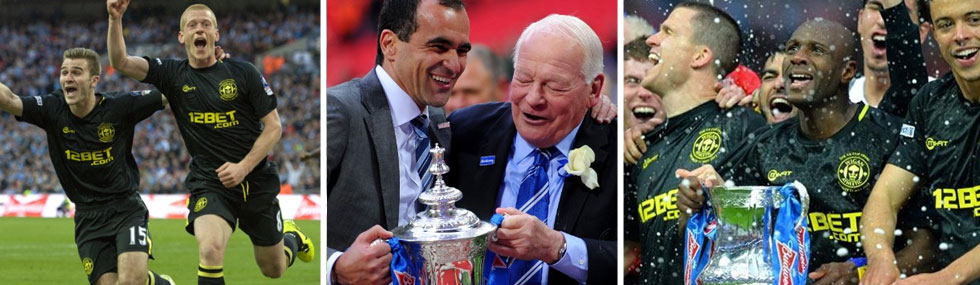
Huddersfield 1 Latics 2 – Joyce gets it right – video highlights and match reaction

“He’s not great running back as a wide player, but you look at what he’s good at and he’s hard to stop.You look at the GPS stuff – his top end pace is quicker than Nani and Ronaldo.That’s a fact. It’s a hell of an attribute to have.”

So said Warren Joyce after Yanic Wildschut’s pace destroyed Huddersfield.

Joyce had been pilloried by so many of the Latics faithful for leaving three centre forwards on the bench in the 0-0 draw at Barnsley, using the Dutch winger in the main striker position. He stuck his neck out even further last night by not even including Will Grigg on the bench, although the striker had travelled with the squad.

But Joyce was to have the last laugh as his game plan worked to a tee, his team defending en masse and counterattacking with gusto. Within the space of three weeks he has instigated a paradigm shift within his squad. The possession-based football of Gary Caldwell has been thrown out of the window for a more pragmatic style based on rugged defence and pace in attack.

Faced with the absence of the suspended Craig Morgan the manager moved Stephen Warnock across into the centre of defence, something that would have been risky against a team with more height up front. But Huddersfield play a smooth brand of football based on possession and pressing, rather than pumping long balls to a big target man. The captain once again had a major role to play, even though he was booked in the opening minutes for a crude foul on winger Sean Scannell who later had to be substituted. He also survived a strong second half penalty claim after pushing  Elias Kachunga to the ground. Earlier in the second half an unsighted referee had waved away home team penalty appeals after Luke Garbutt had tripped Nakhi Wells in the box.

During Caldwell’s brief reign as a manager in the Championship refereeing decisions tended to go against Latics, rather than for them. At times Latics had looked plain unlucky. But over the last couple of games under Joyce the tide has seemed to turn.

Latics had been poor in the first quarter of the game, the home side looking superior. But they gritted their teeth and were rewarded by a superb goal from Reece Burke. The young defender had won the ball in his own half, releasing it to Wildschut who sprinted past the Huddersfield defence to put in a superb cross for Burke who had run through the centre forward channel to score. It would be rash to suggest that this was part of Joyce’s game plan. Full backs don’t normally move into positions like that. But there were other occasions when players made long runs from their own half to support the attack. It did not happen so often, but when it did it was refreshing to see.

Wildschut had been a constant threat to the home team defence who found it hard to cope with his searing pace. Huddersfield had equalised in the 50th minute but ten minutes later the Dutchman raced past three defenders from the half way line before rounding the goalkeeper and slotting home. It proved to be the winner, thanks to a dogged rearguard action in the final half hour.

The statistics showed that Huddersfield had 70% of the possession with 19 shots, of which 5 were on target. Latics had 9 shots with 4 on target. Wigan’s style of play was the polar opposite of what we had come to expect under Caldwell, where so much emphasis was put on possession. Since the humbling experience of being beaten 3-0 at home by Reading in his first game at the helm, Joyce has tightened up defensively, with the midfield providing better cover and the back four playing no-nonsense football. However, there have been some hairy moments at both Barnsley and Huddersfield when the home teams have squandered goal scoring opportunities. Barnsley had enjoyed 62% of the possession, Huddersfield 70%. The pressure on the defence was inevitable given the amount of possession of the opposition.

Joyce’s next challenge will be to prepare his tactics for Saturday’s game against Derby County. Playing at home is a different scenario and he can be expected to introduce at least one more attacking player. However, it is unlikely to be Grigg.

These are still early days for Warren Joyce at Wigan. He now has four points from his three matches in charge, but will be looking for an even better rate of return in the coming weeks. The players who have been chosen in the past couple of matches have shown the kind of fighting spirit that can lift the club out of the relegation zone. It has not been pretty to watch, but with time we can expect a better style of football to come. Although we saw a glimpse of something at Huddersfield the manager still has not clearly enunciated his preferred playing style, preferring to talk about what his players should do on and off the ball.

Caldwell’s teams were stamped with his philosophy, sometimes to the irritation of fans who preferred a faster and more direct approach. It will be interesting to see how the playing style gradually unfurls under Joyce. The Derby match will provide us with further insight.

 

Like us on Facebook, or follow us on twitter here.

Echoes of Malky, but a point gained – Barnsley 0 Latics 0 – match reaction


They say that results are all important in football. So it could be said that Wigan Athletic supporters should be happy with the point at mid-table Barnsley. Latics played with the kind of passion and spirit that typified their rise up into the higher echelons of English football in latter years. After losing his first game 3-0, Warren Joyce had clearly instilled a backs-to-the wall mentality in his players. It was not pretty, but it got another valuable away point.

Joyce is no shrinking violet. He had the courage to leave his three front line centre forwards on the bench, with Dan Burn and Jordi Gomez totally absent. He brought back the experienced Craig Morgan, who had been marginalised by previous manager Gary Caldwell. Morgan went on to form a solid partnership with fellow veteran, Jake Buxton, as they held their own in repelling the Barnsley attacks. Morgan may not be fast, but his positioning remains as good as ever. He and Buxton were like peas from the same pod. Playing Nick Powell at centre forward and leaving out the likes of Davies, Grigg and Le Fondre certainly made a statement to us all.

But Powell went off after only 31 minutes, reportedly unwell. When Joyce replaced him with Luke Garbutt many of us wondered why would the manager replace a centre forward with a full back? Did he have any attacking intentions? Garbutt too had fallen out of favour with the previous manager. Was Joyce making a statement to say that the slate has been wiped clean and everyone starts from scratch with him? In fact, Garbutt was put into a left midfield position and was to go on to do no better or worse than most of his teammates. The reshuffle saw Yanic Wildschut move to the lone centre forward position. He was particularly lonely, although at times he could take on 3 or 4 defenders to try to salvage something.

I had surprisingly managed to get a live feed for the game, after preparing myself to listen to the audio commentary. Adam Bogdan went off injured after 58 minutes. When Jussi Jasskelainen came on the commentator told us he was a player/coach, which was a surprise to me. Has the big Finn replaced Mike Pollitt as goalkeeping coach?

When Caldwell was manager he would have close contact with Graham Barrow and the coaches during a game. But in this one Joyce seemed solitary, with the coaches in the background. The cynics might say he is waiting for them to leave. Or maybe it is just the manager’s preferred style? All will presumably be revealed in the coming weeks.

It could be said that in this case, the end justified the means. But that in itself would be a worry. The commentator had told us that Joyce had summonsed the players in for regular double training sessions. They certainly looked fit enough and did not cave in the closing minutes as has too often been the case this season. But what was worrying was the football, or lack of it.

Indeed the football was reminiscent of the days of Malky Mackay. It was more fightball than football. Moreover once again seeing a winger playing at centre forward was to further highlight those most painful of memories.

Barnsley manager Paul Heckinbottom summed up Latics’ approach by saying: “Their set-up and line-up, playing without a striker, a centre-midfielder at right midfield and the first sub is a left-back, so that shows that they came here paying us the utmost respect, trying to nullify us, which they did.

Warren Joyce has a reputation as a top coach whose teams have played skilful, entertaining football. But today it seemed like he had told his players to rip up the coaching book they had learned under Gary Caldwell and go back to basics. The possession football that the Scot had instilled in the players was barely evident today. Perhaps the manager had told his players to minimise potential errors at the back by playing the ball long when under pressure? But even that would not explain the lack of creativity and attacking intent from midfield.

Let’s hope that this is a one-off and that hoofball has not returned to Wigan.

Rekindling Grigg’s fire


Windsor Park erupted into song in the 62nd minute of a World Cup qualifying match on Friday. The chorus reverberated around the old Belfast stadium. The irony is that some Northern Ireland supporters may have been more familiar with the song than the player who came off the bench at that moment

Will Grigg went to the European Championships in France in summer, but never got the chance to play. He found himself the third choice centre forward behind  Kyle Lafferty of Norwich and Conor Washington of Queens Park Rangers. Lafferty has a fine goalscoring record for his country – one in every three games. He opened the scoring against Azerbaijan in the 24th minute, before going off with around half an hour to play. But Washington was not in the squad and Grigg was the replacement.

Will Grigg was born in Solihull and qualifies for Northern Ireland through an Irish grandparent. He made his debut for them in a 6-0 defeat to Italy in June 2012, going on to make five more appearances over the next 12 months, but over the past three years his appearances have become infrequent.

The experience in France will have been desperately disappointing for Grigg. He scored 27 goals last season, the third time in his career when he has exceeded the 20 mark. Given Lafferty’s goalscoring record at international level it was always going to be difficult to claim a place ahead of him. But Grigg’s fans will seriously question why he was not favoured over Washington, who had a good goalscoring ratio at Peterborough, but failed to score for QPR last season after his January transfer.

But despite the knockbacks of France and critics wondering if Grigg was up to the level of the Championship, the player started the season with a flourish. Despite his team’s poor start to the season Grigg not only managed to score 4 goals in the first 5 games, but also to look comfortable playing in the second tier. It looked like Grigg could be on fire in the Championship as he had been in League 1.

At the start of the season Grigg was Wigan’s most marketable player. Were he to make a success of himself in the Championship his potential transfer value would sky-rocket. The figure Latics paid Brentford – rumoured to be around £900,000 – looked like chicken feed compared with the possibilities of a valuation moving up towards the £10 million mark. In a cash-strapped situation the club could not afford to miss out on a big cash-in at a later date.

But since early September Grigg has not so much been on fire, but more like smouldering. With his first child due to be born he opted out of the Northern Ireland squad at the end of August, the arrival of Adam Le Fondre near the end of the transfer window also complicating Grigg’s position. At the end of September in the home game against Wolves Gary Caldwell chose Le Fondre to start ahead of Grigg. The manager could say his move paid off as Le Fondre scored after 5 minutes, with Grigg coming off the bench to score the winner in the 88th minute. In fact that has been Grigg’s only goal in his last 7 matches for Wigan.

Le Fondre was again preferred to Grigg in the goalless draw with Burton in mid-October, but Grigg was to regain his place for the next three matches. However, the arrival of new manager Warren Joyce was to see Le Fondre start in the ill-fated 3-0 defeat to Reading.

One wonders if Joyce will continue to favour Le Fondre over Grigg. The 29 year old Le Fondre arrived on loan from Cardiff with an impressive career strike record, having scored 164 goals in 287 league starts and 152 appearances off the bench. He has played in the lower divisions, but also in the Premier League with Reading. He joined Cardiff City in May 2014 but managed only 4 goals in 19 starts and 4 substitute appearances before being sent off on loan to Bolton then Wolves.

Joyce might well be looking into resting Grigg over the coming weeks. Last week he stated that: “It is a real frustration. Talking to Will, he’s had a long summer, where he maybe only had 10 days off between seasons, and he almost needs a little bit of a break. I know from my experience at Manchester United, the players always had at least a four-week break (over the summer) because the body needs that. It’s something we’ll be looking at with Will, to try to give him a chance to recharge his batteries and go again for the rest of the year.”

Up to this point Grigg has started in 13 league matches, with 3 appearances off the bench. He has scored 5 goals. Le Fondre has started in 3, with 4 substitute appearances, scoring 1 goal.

Both Grigg and Le Fondre have excellent goalscoring records. There are fans who would like to see them play together as twin strikers, but Joyce is likely to take a similar stance to Gary Caldwell and most other modern day managers by playing with one central striker. The 25 year old Grigg is physically bigger than Le Fondre and has shown his ability to play the lone centre forward role with skill and application. But Le Fondre has more experience of playing in higher levels of football.

Joyce also has a fit-again Craig Davies at his disposal. Davies can play the role of an old fashioned battering ram centre forward who can make life uncomfortable for central defenders. He was afforded little playing time last season, so often brought on near the ends of games, with little time to settle in. Davies needs more consistent playing time to be at his sharpest, but with Grigg and Le Fondre ahead of him in the pecking order he will find it tough. But the prospect of a Davies-Le Fondre double act in the final quarter of a tight game could be tempting for Joyce.

It is ironic that at the same time that Joyce is talking about resting Grigg he is at last getting playing time for Northern Ireland. It is a matter which is out of the manager’s hands, but he cannot be happy with the situation.

It remains to be seen not only how much rest Joyce will afford Grigg, but whether the player wants it. He started the season well, but events have conspired to disrupt his rhythm. Many fans advocate a return for Grigg as the undisputed first choice centre forward. Joyce will have to make some difficult decisions over the coming weeks.

An on-fire Grigg could be the key to Latics moving up the Championship table, free of the threat of relegation. He remains the club’s biggest asset and the manager will need to ensure that he is sharp and at his best.

Last season Grigg had only scored 6 league goals by Christmas, but went on to notch 25. He has already scored 5 goals in the Championship this season.

Can he do it again?

Can Joyce rekindle Grigg’s fire?

The finances facing Joyce

Photo courtesy of Wigan Athletic FC.

Photo courtesy of Wigan Athletic FC.

Just nine days ago Warren Joyce left a comfortable position at Manchester United to join a club struggling to avoid relegation whose budget ranks them at 19th in the Championship division.

Why would Joyce sever the link with Manchester United, a giant club where he had been held in high standing for more than eight years, to take over Wigan Athletic? How did David Sharpe sell the move to him?

A three and a half year contract probably helped, but what vision did Sharpe give him of where he expected the club to go in that time? What financial backing would the chairman be willing to provide to help Joyce compete for new players on an even keel against other clubs in the division?

Joyce has a fine reputation for developing young players, but it was at a club where funding was plentiful. If Wigan Athletic’s wage bill is already low compared with the majority of clubs in the division, what is it going to be a year from now when the inflow of parachute payments will have dried up?

It was Jonathan Jackson who mentioned the budget ranking at a recent Fans Advisory Board meeting, according to a reliable source. But how can this be the case when Latics are still receiving parachute payments?

Getting accurate financial data from football clubs is never easy and what you can get applies to years well gone by. But Jackson’s alleged statement certainly gives food for thought.

If a business were run like a typical Championship club it would soon find its way to bankruptcy. In 2014-15 Bournemouth spent lavishly on their ascent to the Premier League, making a loss of £39 million. From a financial point of view it could be said that the Cherries’ gamble came off and that the loss could be written off by the huge increase in revenue in the Premier League. But Fulham lost £27 million in finishing in 17th position, with Nottingham Forest losing £22 million and Blackburn Rovers £17 million only to hover around mid-table.

In fact 18 of the 24 clubs made losses that year. Of those in the black, Birmingham City and Wolves used their £10 million parachute payments to keep their heads above water, each making a profit of around £1 million. Three other clubs showed profits through transfers, revaluation of assets and owners writing off debt. Only Rotherham United, who made a tiny profit, did so without such inputs. They did well to narrowly escape relegation.

Wigan Athletic are one of 8 Championship clubs receiving parachute payments. The clubs that are newly relegated from the Premier League will receive around £28 million in their first season, whereas Latics are in their final parachute season and will receive around £10 million. Next season they will receive a solidarity payment of around £2.5million due to clubs in the division who are not in receipt of  parachute payments.

Last season in League 1 the parachute payments gave Latics a huge advantage over the other 23 clubs who did not have them. They were able to pay out major transfer fees and offer lucrative salaries to players who had completed their contracts at other clubs. The result was a squad too strong for the third tier.

However, the tables have now turned. Wigan Athletic find themselves in a division loaded not only with other clubs buoyed by parachute payments, but others whose owners are splashing out major money in a bid for promotion. In contrast Latics’  recruitment policy has had to be adapted according to the constraints of its finances.

Five players have been brought in on loan, another nine for either economical transfer fees or on free transfers. When Latics last started a Championship season under Owen Coyle the salary budget was around £30m.  The current budget could be as much as 40% less. The main factor is the reduction in the parachute payments from around £25m in the first year and £20m in the second to £10m in the third and fourth years. However, knowing that there will be a major drop in revenue next season, the club has had to be careful in offering long term contracts with lucrative salaries. One half of the players recruited this summer have contracts that expire before and or at the end of the season.

In a recent visit to Brentford to watch Latics fight I spoke at length with a group of their fans about their chances of reaching the Premier League. On paper it does not seem impossible. On coming up from League 1 the Bees finished 5th in 2014-15, reaching the playoffs. Last season saw them finish 9th. However, the Brentford fans were not optimistic about their club’s ability to reach the top division. They pointed out that they have a salary cap for individual players and have to sell off their top assets if realistic sums are offered. They surmised that owner Matthew Benham has put in over £90m into getting the club where it is today. Without his support they would surely flounder.

Brentford provides a model for comparison. Their average crowd last season was 10,700 which is close to what we can expect at Wigan this season. But in gaining promotion they made a loss of £7.7 million, which rose to £14.7 million that first season back in the Championship, with wages going from £10 million to £17.7 million.

The reality is that, without major input of funds from the owners on par with those of competitor clubs, Latics will not be able to compete on an even keel in the division.

Following a dire 3-0 home defeat to Reading, Wigan Athletic’s place in the Championship remains in jeopardy. There were always going to be questions over the ability of players from last season’s squad to replicate such form in a higher division. Moreover a more cash-strapped  recruitment process involved  a number of the players brought in have been short of first team exposure in the past year. This is not to suggest that those players do not have sufficient quality for the division, but it was always going to take them time for their match sharpness and overall fitness to reach a competitive level.

It is once more a period of transition for Wigan Athletic. For so many years Dave Whelan’s  financial backing, together with good management and terrific spirit, helped the club eclipse so many of the others currently in the Championship division. But times have changed and we will have to wait and see how the club will cut its cloth over the coming 12 months.

The first priority is for Joyce to get his new club out of the relegation zone and consolidate its place in the division. Should that happen we will then be looking at how the club is going to stay competitive in a division when the financial odds will have turned against their favour.

In his first full season David Sharpe brought back vitality and optimism to Wigan Athletic. His positivity shone through in his communications with the media and in his willingness to spend big in bringing players into the club who could help ensure promotion back to the Championship. When he appointed Gary Caldwell he talked about bringing back football played “The Wigan Way”, suggesting that the Scot would be there long-term. The chairman’s positivity was to be rewarded with a League 1 championship title.

But times and circumstances have changed.

In the summer of 2015 Sharpe had splashed out close to £1 million to bring a central striker, a hefty fee for a club about to begin anew in League 1. Moreover in the January transfer window he finalized the transfer of a player on loan for around £600,000. Without Will Grigg and Yanic Wildschut Latics would have been hard pressed to get promotion, let alone win the division.

This summer saw players brought in for modest fees, others being free agents or loanees. Granted Sharpe did stick his neck out to offer contracts which one assumes were close to the market rate for players like Jordi Gomez, Adam Le Fondre, Nick Powell and Stephen Warnock. Moreover a three year contract was offered to the 31 year old Jake Buxton who arrived on a free.

Sharpe’s recent comments about Joyce’s appointment and the club’s immediate future suggest that the Whelan family is unwilling to put in the kind of financial investment that is the norm in so many other clubs in the division. The chairman has made it clear that he is not going to throw money around in the style of clubs like Derby County, whilst emphasising the new manager’s skills at developing players. Put simply there is not the same vibe coming from the young chairman that we had a year ago.

The main aim for the current season must be consolidation in the Championship. It is to be hoped that Sharpe will avoid the kind of fire sale that we witnessed in January 2015 that led to relegation. It was an exercise based on cutting the wage budget by at least 30%. Significant money was saved in the short term, the club eventually losing £3.9 million for the season, substantially less than it would have been. But relegation was to mean that the club would only have one more year of a parachute buffer even if it were to regain Championship level status. With hindsight the scale of the clear out was a major mistake. But will history repeat itself this coming January?

In the meantime Joyce will try to get the best out of a squad that has enough quality to get out of the relegation zone. In the long-term, assuming he is given the longevity denied to Caldwell, he will most likely be working on a budget that will be dwarfed by those of the vast majority of clubs in the division. The strategy will involve selling off the pick of those young players the manager has developed in order to stay afloat.

Joyce’s immediate task of consolidation in the division is his most immediate challenge. Should he manage to do that he will face a more difficult task: that of achieving miracles on a shoestring budget.

Like us on Facebook, or follow us on twitter here.

Latics again in a state of flux

Warren Joyce’s first game in charge of Wigan Athletic coincided with the worst performance of the season. In fact some fans are even comparing the display with those we would too often see in the Malky Mackay era, when a demoralised and mediocre squad was not able to avoid relegation.

But comparisons with the Mackay era are groundless at this moment in time. A new manager has come in to take over a squad that had not been accumulating the points needed to keep the club away from the Championship relegation zone. When a new manager comes in results so often take an upturn, but with difficult away games following at Barnsley and Huddersfield it is going to be a hard task for Joyce.

Opening match performances for new managers can be deceptive. Indeed Mackay started with a promising 1-1 home draw with Middlesbrough when Latics performed with spirit and played good football in spells. It was not to continue with them losing their next four matches. By the end of January five of the players who had started against Boro had left the club. Latics were in turmoil with so many quality players leaving in that transfer window, being replaced largely by journeymen and young loanees.

The turmoil continues at the club. It has now had five managers in the past three years, a far cry from the longevity of six years with Paul Jewell and four with Roberto Martinez. Although Latics had returned to the Championship with the momentum of winning League 1 only three players in the starting line up on Saturday – Michael Jacobs, David Perkins and Max Power – were at the club precisely a year ago. Moreover chairman David Sharpe had spoken of Gary Caldwell being at the club long-term, but the young manager only lasted 18 months.

The stats suggest that successful teams are built upon stability rather than turnover. Last season when Leicester City won the Premier League there were 10 players who started in at least 30 of the 38 games in the season.  Kasper Schmeichel and Wes Morgan started in all 38, Riyad Mahrez and Jamie Vardy in 36. During the course of the season 20 different players started for Leicester, a figure which is relatively low but bears little comparison to the 14 starters used by  Aston Villa to win the first tier in 1980-81 and the 16 employed by Nottingham Forest three seasons earlier.

But Gary Caldwell used 34 players last season. Caldwell’s team was in a constant state of flux, but he still went on to win the League 1 title after a difficult start when the players took time to gel. He was to continue in the same vein, recruiting 14 new recruits over the summer.  But this time it was to be his undoing.

Instead of retaining the momentum of the team that had won the third tier he ripped out the core and started from scratch in key positions. The effective centre back partnership of Morgan and Pearce was superseded by Burn and Buxton, the excellent distribution and the authority of Jaaskelainen was replaced by a more agile, if less authoritative, Bogdan. In midfield the combative, but skilful, Morsy was replaced by the steady, conservative MacDonald. The right back position remains problematic, with nobody at this point impressing any more than Wabara did previously. The club’s most valuable asset, Will Grigg, has found himself too often on the bench, despite his good start to the season. One wonders if the centre forward will still be at Wigan by the end of the January transfer window.

Caldwell’s new players clearly needed more time to gel in such a competitive environment as the Championship. The manager made mistakes, but the decision to dismiss him once more puts the club in a state of flux. It could be one that the chairman will later regret.

When new managers take over at football clubs they invariably look at bringing in people they have worked with before. When Caldwell was dismissed the goalkeeping coach, Mike Pollitt, and chief scout Malcolm Crosby were also relieved of their positions. Further changes in the coaching and backroom staff look on the cards.

Indeed the rumours today suggest that Jimmy Ryan and Paul McGuinness, long term employees of the Manchester United coaching and backroom staff, could be joining Latics. But given that Ryan is now 71 years old and has been retired for the past four years one ponders on the veracity of the reports. On the playing front rumours suggest that Joyce is interested in winger Cameron Stewart, a free agent. Stewart started his career at Old Trafford, but his promising career has been punctuated by injury. Although still only 25 he has played at 11 clubs.

The state of flux at Wigan Athletic is therefore likely to continue as the new manager brings in his own coaching and backroom staff over the coming weeks. The January transfer window will then allow him the opportunity to bring in his own players, with the seemingly inevitable departure of some of the current squad.

Joyce’s preferred playing formation could well be the 4-2-3-1 which is becoming increasingly prevalent in English football. The line up on Saturday was conservative to say the least, with David Perkins playing wide on the right.  The manager hinted that he had had some help picking the team, but he picked a left footed midfield player on the right wing, who is not known for cutting inside and shooting. David Perkins remains an important figure at the club, but needs to be played in a position where he can be more effective. The preference of Adam Le Fondre over Will Grigg was another one open to debate.

The manager has got off to an underwhelming start at the club, but like Gary Caldwell, he will need time. His teams at Manchester United were known for their attractive football and it is to be hoped that he will continue in that style at Wigan, in contrast to his predecessors Owen Coyle and Malky Mackay. He has inherited a squad containing promising young players and others who are rebuilding their careers after difficult times of late.

It will be interesting to see if Joyce will restore Craig Morgan back to play a leading role as he did last season. It was sad to see the Welshman stripped of the captaincy and almost bundled off to Sheffield United as the deadline approached for the summer transfer window. That, plus the controversial departure of Jason Pearce and the banishment of Sam Morsy on loan to Barnsley must surely have caused some discord within the camp.

It is to be hoped that the chairman has learned from the lessons of the January transfer window of a couple of years ago, when the family silver was sold off for a pittance, resulting in relegation. It could be argued that the players who left the club then were of higher profile than those currently at the club, but Joyce and Sharpe must beware of ripping the heart out of the team as happened then.

The state of flux is going to continue for some time yet. In the meantime we will hope to see a pattern in what the new manager is trying to create, that the club does have genuine direction and that the constant toing and froing of players will abate.

There are going to be some tough months ahead. A more immediate target for the manager will be to lift the club clear of the relegation zone by the end of the calendar year. There are eight games coming up in that time.

Like us on Facebook, or follow us on twitter here.