Time to rebuild for beleaguered Wigan as icon Martinez bids farewell

roberto-martinez_2570061b

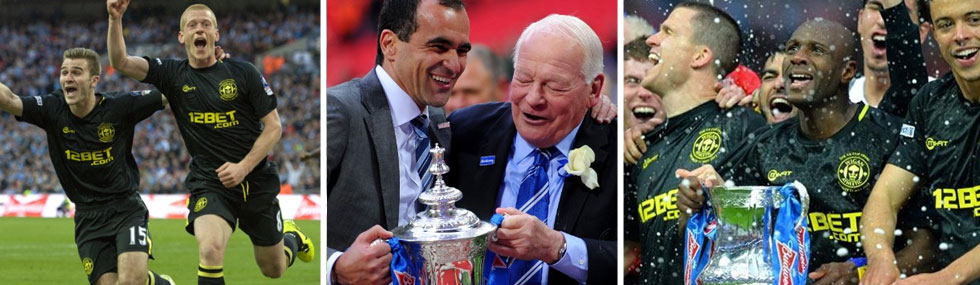
If a week is a long time in politics, this month has been an eternity in Wigan Athletic’s corner of football history. From that magical day at Wembley to the exhaustion and despair of relegation three days later, to the joy of the victory parade at which 30,000 Wiganers sang for Roberto Martinez to stay.

Ten or so days ago, it appeared the Wigan legend was making demands for further investment in the club’s training facilities and youth development — today, the club has announced that compensation has been officially agreed and he will leave to fill the managerial vacancy at Everton.

Well-deserved tributes to Martinez will follow in due course. He was far more than an employee during his managerial stint at Wigan Athletic — he represented the club as a true ambassador, with passion and pride, always portraying the club in the best possible light. He was a source of pride for most of the club’s supporters, a rarity in football who possesses a real love story with the club and town. He delivered footballing memories we shall never forget, including the club’s greatest achievement FA Cup victory but also the highest quality football the club has ever seen during last season’s great escape. He is and will remain an icon.

But he is gone, officially — and his departure leaves the club in a state of uncertainty. If the blow of relegation has been cushioned for many of us by the knowledge that his tireless work behind the scenes has left the club in strong shape for the long-term, his departure brings with it a wave of fresh concerns.

The immediate concern is a mass exodus. The loss of certain players was inevitable following relegation. But having already lost seven players to the expiration of the their contracts, either full-time or loan, the club now faces the challenge of keeping players who would have stayed loyal to Martinez but may now be tempted to follow his lead and jump ship. How many of the youngsters, especially the Spanish-speakers, will stick around for Championship football if a British manager takes over under a new playing philosophy? How many players — Alcaraz, Maloney and Kone spring to mind — will Martinez try to take with him? How many of the coaching staff will stay?

The longer-term concern is a potential loss of continuity. After four years of successfully revolutionizing the way the club played football from the youth teams upward, the club now faces the possibility of a new manager with a different footballing philosophy. The hope is that Dave Whelan will take a page out of Swansea’s book and prioritize continuity, bringing in a manager with a similar continental philosophy and an emphasis on youth development. Ideally, but impractically, Martinez would act in an advisory role to Whelan in the appointment of his successor to ensure his vision is continued.

The good news is that most of the candidates linked with the Wigan vacancy are promising from a footballing perspective. Gus Poyet is a personal favourite given his style of football, cultural and linguistic understanding, familiarity with the Championship, and relative youth. Rene Meulensteen represents a gamble, as Jakarta Jack recently wrote, but ticks many of the correct boxes with a continental approach, track record working with youth, and big-club pedigree. Karl Robinson is lesser known. Steve McLaren is experienced and did wonderful work at FC Twente and Middlesbrough, but has some blotches on his managerial record as well. Only Owen Coyle’s name sticks out as an unpopular candidacy. And finally, the Daily Mail couldn’t help but report that Whelan is after Steve Bruce for a third stint in the Premier League, this morning. Unlikely.

A swift appointment must be a priority. There will be much rebuilding over the summer. Poyet, Meulensteen and McLaren do inspire hope in the transfer market, something that should prove vital in the immediate future. But it remains to be seen what sort of budget Martinez’s successor is forced to operate within. There is a lingering sense of unfinished business for Martinez given the challenges posed by relegation. The biggest question is what led to the breakdown in talks between Whelan and Martinez, between that Friday when the Spaniard had asked for assurances about investments in the club, and the Monday when Whelan suggested he would be leaving. Did the manager ask the chairman for assurances about keeping certain players? About bringing new players in? Or strictly about investment in facilities and development?

The next few weeks promise to be unpleasant ones for the Wigan faithful. The ecstasy of the FA Cup win has been blunted by relegation and the slow and painful dismantling of the team that achieved it. The list of those to have left the club includes Antolin Alcaraz, Franco Di Santo, Maynor Figueroa, Ronnie Stam, Joel Robles, Angelo Henriquez, Paul Scharner, and now, most damningly, the captain of the ship, Roberto Martinez. Presumably his coaching staff will follow. Whelan’s swift action will be crucial. His managerial appointments in the past have largely been inspired, but this may be the greatest test yet.

Like us on Facebook, follow us on Twitter, or subscribe to the blog in the lower right column to receive an email every time we publish an article.
Season in review: One step back but a giant leap forward

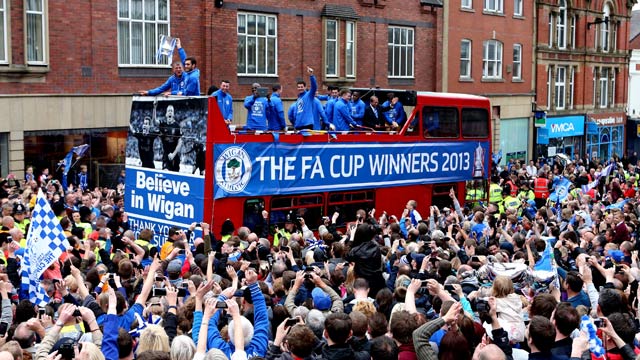
Wigan celebrate FA Cup win with parade shortly after Premier League relegation - video

No sooner had the dust settled on Wigan Athletic’s FA Cup semifinal success over Millwall a month ago than a notion started circulating that the Latics could become the first club to win the FA Cup and suffer relegation during the same season.

Deep in their hearts, most Wigan supporters suspected that the combination of defensive injuries and late season fixture congestion would probably make the dream double of survival and FA Cup a step too far. By the time a ball was kicked in the FA Cup final, just about every Latics supporter in the world had been asked what they would prefer: stay up or win the cup?

Though a complicated question, the answer was never really in doubt. Thirty thousand people — three eighths the town’s population — coloured the town of Wigan blue for yesterday’s FA Cup victory parade, emphatically putting ignorant and outdated “rugby town” stereotypes to bed. They sang and cheered, and even drowned out their manager, on-stage with a microphone, with chants “Roberto Martinez, we want you to stay.” There was not a boo or a negative word to be heard — not at the parade, nor at the Emirates last Tuesday when the team was consigned to relegation. The enduring sentiment was and is one of sheer pride.

This is not to say that relegation doesn’t hurt. Football, and the Premier League in particular, is a game of fine margins. Matches turn on a single incident, and there were a host of them this season, that if reversed, probably would have kept Wigan up. James McArthur’s missed opportunity to seal the game against Swansea, Tottenham’s incredibly fortunate last-gasp equaliser at the DW, Joe Hart’s unbelievable save to deny Franco Di Santo — all recent — stick in the memory.

But relegation from the league was always a possibility — no, a probability — and has been for years. Sunderland, who finished three points above Wigan, signed Steven Fletcher, Adam Johnson, Alfred N Diaye and Danny Graham within the past year alone for a total of 30 million pounds. Fellow relegation rivals Aston Villa, for context, signed Wigan’s best player two seasons ago for 9.5 million and kept him on the bench for most of the campaign — next to 18 million Darren Bent. They could afford to leave them out because they’d signed a gem of a player in Christian Benteke for 10 million pounds the previous summer. Newcastle spent more than 25 million this season. Southampton almost 33. Wigan’s total spending amounted to 9 million on four players, all of which were covered by the sale of Victor Moses to Chelsea. Conor Sammon’s 1.2 million deal to Sheffield Wednesday earned the club a net profit on transfers, something none of the aforementioned achieved. (Source: http://www.transferleague.co.uk/)

The good news when it comes to league status, as Martinez has said, is that it can be rectified. Not many teams bounce back up to the Premier League immediately following relegation. But not many teams that go down were living within their means during their Premier League stays like Wigan was. How many clubs have we seen promoted, overspend, get relegated and disband upon the realization that they cannot afford to keep paying the players they overspent on?

Sure, Latics will lose some of their stars — and those players deserve the chance to move to a top flight club. They were brought to Wigan on the promise that they would be allowed to move to a bigger club when the time was right for both parties. The stable financial footing Dave Whelan and Martinez have guided Wigan Athletic to means that they are not obligated to sell any of their players. They will, but only because it is beneficial to the club’s future. For every N’Zogbia or Moses — or this year probably McCarthy — that goes, four or five young talents are signed. Four such youngsters — Roman Golobart, Eduard Campabadal, Nouha Dicko, Fraser Fyvie — are likely to play big roles next season and cost Whelan very, very little.

A popular claim at the moment says that league status is temporary while trophies are forever. While certainly true, it does not quite sum up Wigan’s emotional season, or explain the absoluteness of their fans’ pride. If it had been QPR that had won the FA Cup but been relegated, it is highly doubtful that the overwhelming feeling at their parade would have been one of pride and progress. Their team has been messily run since being promoted two years ago, thrown money — a lots of it — at the problems and assembled an overpaid, overrated team of opportunists who will likely be sold off auction-style during the summer as they try to slash the astronomical wage bill they’ve created for themselves.

With apologies for harsh words to supporters of QPR, the point is that celebrations at yesterday’s parade were not solely focused on the amazing, unimaginable fairy-tale story of little Wigan spectacularly toppling the richest team in the land and defending league champions to lift the oldest football competition in the world. They were an acknowledgement of how far Wigan Athletic has come as an institution and the work of the last decade. The team will play in the Charity Shield and Europa League for the first time next season. A product of the youth and reserve squads was named man of the match in the FA Cup final. The New York Times has featured the Latics three times in the past month. Thirty thousand people came out to support the team. State of the art training facilities are on the horizon. Wigan Athletic won the FA Cup. Wigan won the FA Cup. The Latics won the bloody cup!

Relegation may be a step back, but the infrastructure is in place to keep this club in the Premier League or thereabouts for years to come. Of course, much hinges on the future of the iconic hero of this Wigan revolution, from player in the lower divisions to the manager who lifted the FA Cup, Roberto Martinez. But for now, it is safe to say that despite going down, Wigan Athletic is on the up.

Follow us on twitter. Like us on Facebook. 

Proud day for Wigan as the fairy tale rolls into Wembley

Latics' team for their debut match against Port Vale Reserves,  Thanks to Ron Hunt and WiganWorld for photo.

Latics’ team for their debut match against Port Vale Reserves,
With thanks to Ron Hunt and WiganWorld for photo.

* this post was co-written by the father and son writing team, from the perspective of the Jakarta Jack, the father. 

My father loved Wigan Athletic Football Club. Hardly a minute would go by after the final whistle before he would launch into talk about the next match. Conversations – and in some cases, monologues – about line-ups, tactics and referees were a feature of my life as long as I can remember.

His love affair with the Latics began the year the club was formed in 1932, and never wavered until his passing in 2005. His devotion to such a modest club was difficult for others to understand in a region saturated with prestigious football clubs such as Manchester United, Manchester City, Liverpool and Everton. It was especially difficult to understand for the rugby fans in the area.

But my dad wasn’t too perturbed by that. In his 73 years as a supporter, he witnessed the transition from non-league to Division 4, all the way up to the Championship, or second division as it was known for most of his time. Wigan were second in the Championship under the leadership of Paul Jewell, propelled by the dazzling strike partnership of Nathan Ellington and Jason Roberts, when he passed away. The Latics were promoted to the Premier League four months later. They have remained there ever since.

Were you to tell my father that his Wigan Athletic would go on to spend eight consecutive years in the Premier League and reach both the League Cup and FA Cup finals during that period – he almost certainly would not have believed you. He would have beamed with pride.

Thankfully, pride is something that is passed down. My son and co-writer, Ned, once told me that,  while the inspiration for the name of this fan site was a tip of the hat to the symbolic arrival of Wigan’s Three Amigos from Spain –  a pivotal moment in Wigan’s rise up the tables and Whelan’s revolution – it also on a more personal level represented the relationship between himself, his dad and grandad, who all shared that same passion for the club.

Neither Ned nor I were at that very first Wigan Athletic match back against Port Vale Reserves back in 1932, but we each remember our first Latics experience and know the previous history thanks to my dad. We know where the club came from, and we know we are living the Wigan Athletic dream.

No matter what the result is on Cup Final Saturday, or the outcome of the relegation fight in the Premier League, Wigan Athletic have confounded people with their achievements. The club has come farther than any of us imagined in our wildest dreams, and their achievements will leave an indelible memory.

What’s more – the work that Roberto Martinez has done in his return as manager of the club has been transformative. Rather than playing the role of the little fish up for a Premier League cameo, his plan has been one of consolidation.

While Steve Bruce did a job in keeping the club in the top flight, the money he spent on players and their wages was hardly sustainable if Latics were to suffer a bad season and go down. There was no investment in youth development or infrastructure.

Martinez’s work to cut operating budgets, sell the top players in order to fund long-term growth sets the club up to survive for years to come. Sure – relegation is a threat each year and is to many clubs with more money, more fans and so on — but the club and its support are rapidly growing behind the scenes with every year that passes.

It is somewhat fitting, then, that Wigan’s rival in the final is Manchester City – not only a club with massive support, but also the beneficiary of the largest cash injection in world football thanks to their billionaire owner. In comparison with Wigan Athletic and Manchester City even David and Goliath seem evenly matched!

Only a deluded romantic would expect a Wigan Athletic squad depleted by injury, mentally worn-down, in the middle of the most intense Premier League survival fight to date, to beat Manchester City on Saturday. But if the club’s history is anything to go by, the seemingly  impossible can happen. The supporters of this club believe anything is possible because they are continuing to live it.

The Wigan Athletic story is far from over. Three matches in less than 10 days will determine whether the 2012-2013 season goes down in history as the year Wigan conquered the FA Cup, or survived for a ninth consecutive Premier League season against all odds.

But even if neither materialises, we could not be more proud of our club which takes pride in doing things in a sensible way and never gives up. Just to be in the FA Cup final, with the guarantee of Europa League football next season boggles the mind. A win on Saturday would just be icing on the cake.

Like us on Facebook, or follow us on twitter here.

Dreaming of financial fair play — can Wigan ever win the league?

Ask a room of Premier League fans if Wigan Athletic could ever win the Premier League title, and your question will be met with derision and laughter. It is widely accepted that such an achievement is beyond a club of Wigan’s size and means. But what if the fundamental nature of financial competition were to radically change within English football? Is a future Premier League that Wigan Athletic could win, feasible?

It is not likely to happen this year. In fact, Ladbrokes are currently offering odds of 3500/1 against it. On the other hand they have Manchester City at 13/10, Manchester United 19/10 and Chelsea at 3/2. After that, the odds on the remaining clubs range from 14/1 to those of Latics. The bookmakers are clearly convinced that  the title will be gained by one of the two Manchester giants or Chelsea. However, if the financial ground rules under which the Premier League operates were to change radically, maybe a door would open for such dreams to come true?

In other sports, and in other countries, systems are put in place to stop elite clubs signing on dozens of highly paid players, preventing them from being available to other clubs. They also try to ensure that games are not so heavily weighted to one side that it almost seems like a foregone conclusion who is to win. Having the top players more evenly distributed between the clubs means that all clubs have some hopes for success. Their supporters are then more likely to stay with them, rather than being drawn to other sports, other entertainment, or other more wealthy clubs.

The Premier League was formed in 1992, after First Division clubs broke away from the Football League. The elite clubs had considered doing so for some time and the idea of a European League was mooted. At the time, English clubs lagged behind the top clubs in Italy and Spain in terms of revenues. Television money was burgeoning and the First Division clubs wanted a much larger slice of that cake, not wanting to share it with those in the lower divisions.

Since then the Premier League has become the most economically powerful league in the world, largely through selling itself to a global TV market. Its attendances are the second highest in Europe. Last year the average Premier League attendance was 34,601, beaten only by Germany 41,205.
It is no surprise in a league dominated by the elite that Premier League television revenue is far from evenly distributed among the 20 clubs. In the 2011-2012 season. Wigan Athletic received  £42.8 million in TV money. Manchester City received  £60.6 m and Manchester United  £60.3 m. Wolves received the lowest with  £39.1 million. It will be argued that the public are more likely to want to watch the elite teams, but the inequality clearly exacerbates the huge financial gap between rich and poor in the league.

In the 2013-2014 television rights are set to steeply rise, making it even more lucrative for Premier League clubs. At the same time, footballers’ salaries have escalated almost beyond control, the absurd spending of Manchester City and Chelsea exacerbating the problem. The League is looking at ways to provide more financial control. One realistic option is to follow UEFA’s initiative, which will require clubs to break even financially. According to BBC.co.uk, Dave Whelan supports the adoption of a financial fair play policy, saying that a proposal in this area has come from Manchester United. The strong inference is that United are envious of their near neighbour’s success last season.

Clearly a move towards Manchester United’s proposal would favour the interests of big clubs with huge fan support  like themselves and Arsenal, cutting out the excesses of clubs like Chelsea and Manchester City. This might help to redress the issue of spiralling player salaries and stop multi-millionaires financing huge debt in top clubs. However, the end result is still going to be a huge divide between rich and poor in the league.

This columnist advocates the implementation of not only financial fair play rules, but also of a salary cap per club. The latter would prevent the elite clubs hoarding so many top players, making them unavailable for other clubs. It sets a limit on the total salaries that a club can pay each season. This does not preclude a club paying the ridiculous wages to some players that have become the norm, but it does limit how many players they will be able to accommodate this way.

The salary cap concept is used widely in American sports as means of stopping wealthy clubs achieving dominance by signing up the majority of outstanding players available. The National Football League (NFL) of the USA had a salary cap of $120 million per club in 2011. It is to be noted that since the Premier League was formed in 1992 only 5 clubs have won championship titles. Manchester United have won it 12 times, Arsenal and Chelsea 3 times each, Blackburn and Manchester City once. In comparison the NFL has had 12 clubs winning its championship in that time.

The implementation of financial fair play rules and club salary caps would not be easy. There are so many potential loopholes involved. However, there has to be a way forward from the current situation which has such inequities that it makes it virtually impossible for any club without huge revenues or massively rich benefactors to reach the top. Let’s at least give the average club in the Premier League some chance – although it may be slim – to win the title.

It is highly unlikely that Wigan Athletic will ever win the Premier League. At present, their chance is almost zero. Lets at least lower the odds and give clubs outside the elite few at least a chance to dream.

BOB, DAVE AND YOUTH

The break-up of the Beatles, possibly the most successful and innovative group in pop history, probably received as much attention as the music they were creating. It was not so much a single event, but a long transition which had taken place over the years. It seemed inevitable – the question was not if it was going to happen, more when. It took a press release in April 1970 from Paul McCartney to provide final confirmation that it had happened. They had been formed in 1960.

So the Beatles spanned a decade, which will not be forgotten. Bob and Dave have been together running Wigan Athletic for 3 years. Whatever happens from now on Latics followers will retain unforgettable memories of the champagne football we have seen over these past  months. To see Wigan Athletic outplaying the rich and famous and beating them on merit is something we could not have dreamed of in the past. However, like the Beatles, it is inevitable that there is going to be a break up some time, even if we don’t know when.

Dave Whelan says Roberto Martinez is staying – for the foreseeable future at least. There has been nothing from Martinez at this point, but one hopes that the Chairman and he are in agreement. If Martinez is staying – then for how long? It would certainly calm our nerves if he were to make a statement indicating that he will be with us for at least a couple more years. He has done a wonderful job providing infrastructure and his long term vision for the club is to be admired. However, there is one area in which we really need to improve – youth.

According to the Daily Mail, Whelan told ESPN: ‘Roberto is staying with us and I’ve agreed to his request to up our spending on youth development and training facilities.” A full size indoor training ground makes good sense, but there is an acknowledgement that the club needs to spend more on youth development. So why does more money need to be spent on youth and where will it go?

The Wigan Athletic youth team lost 9-1 at Nottingham Forest in the FA Youth Cup. That our team lost is not a surprise, even if the scale of defeat was quite shocking. They played away to a team that plays in the Premier Academy League. There are 40 teams in that league, which consists of Premier League and Championship clubs. Latics’ youth team plays in the North West Division of the inferior Football League Youth Alliance. Among the champions of that league over the past five years appear clubs such as Rochdale and Wrexham. No other Premier League team has their youth team in Youth Alliance, only Wigan. I have been scanning the internet for tables and up to date information about the Youth Alliance, but to little or no avail. The Wigan Athletic official site gives the youth team results up to the end of March. There is a match report from the first game of the season – a 2-0 home loss to Port Vale on August 6th – but there is a gap until the next one, the Forest debacle on January 19th . Neither the Latics official site nor that of the Football League give end of season standings.

It was good to listen to interviews with Daniel Redmond and Jordan Mustoe on Latics Player. They have been offered further one year contracts. Redmond started at Everton and Mustoe at Liverpool, both Merseyside clubs having provided so many of our youth players over the years. The Liverpool area remains a breeding ground for footballers. Both players have benefitted from being sent out on-loan and getting regular first team football, albeit at levels well below that of the Premier League. The Premier Reserve League simply does not provide enough matches and there are periods without any game for weeks. Latics second string had just two matches in the whole of December and January. The move to send young players out to lower division clubs on loan is to be commended. In addition to Redmond and Mustoe add the names of Dicko, Golobart, Kiernan, and Nicholls who have also been out on loan. Callum McManaman had a successful period on loan at Blackpool until he recalled to Wigan in January, since then making only one brief appearance as a substitute. One wonders if he might have been better off staying at Blackpool?

Look at the profiles of youth players at the top Premier League clubs and you will see they come not so much from all over the country, but all over the world. Although Latics have some young professionals from abroad – Jeshua Angoy and Roman Golobart from Spain and Nouah Dicko from France – looking at the names in the youth team line-ups foreign names are few. Out of the 18 first and second year professionals we have Sheego from Somalia and Thompson from Florida. Waters comes from Neath, Bingham from Newham. The remainder come from the greater Liverpool, Manchester and Wigan areas.

Let’s hope that Bob and Dave will stay at Wigan Athletic for years to come. Expecting them to stay together as long as the Beatles might be asking too much, but every year we will see the club progressing under their leadership. They are a great double act. It is going to take money to attract higher quality youth players to the club. You simply cannot dump a 17 year old from overseas in a new cultural environment without providing the necessary support systems. Doing so costs money. Let’s get our youth team into the Premier Academy League, where they will be competing at a much better level, making a smoother transition to the Premier Reserve League. Roberto Martinez clearly recognises our shortcomings at youth level and the chairman is now giving his backing to increased spending on youth development. It looks like another step in the right direction!