Time to rebuild for beleaguered Wigan as icon Martinez bids farewell

roberto-martinez_2570061b

If a week is a long time in politics, this month has been an eternity in Wigan Athletic’s corner of football history. From that magical day at Wembley to the exhaustion and despair of relegation three days later, to the joy of the victory parade at which 30,000 Wiganers sang for Roberto Martinez to stay.

Ten or so days ago, it appeared the Wigan legend was making demands for further investment in the club’s training facilities and youth development — today, the club has announced that compensation has been officially agreed and he will leave to fill the managerial vacancy at Everton.

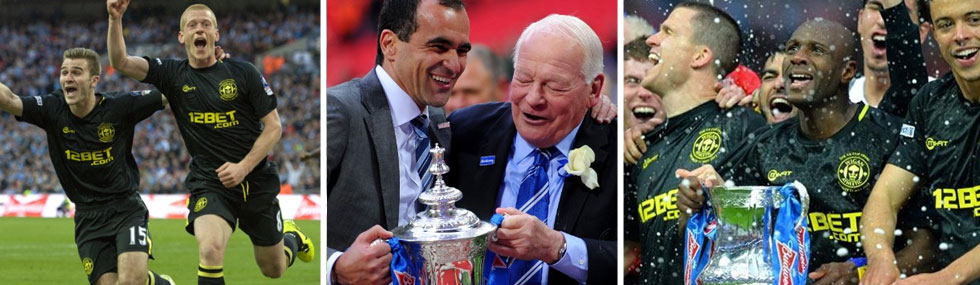
Well-deserved tributes to Martinez will follow in due course. He was far more than an employee during his managerial stint at Wigan Athletic — he represented the club as a true ambassador, with passion and pride, always portraying the club in the best possible light. He was a source of pride for most of the club’s supporters, a rarity in football who possesses a real love story with the club and town. He delivered footballing memories we shall never forget, including the club’s greatest achievement FA Cup victory but also the highest quality football the club has ever seen during last season’s great escape. He is and will remain an icon.

But he is gone, officially — and his departure leaves the club in a state of uncertainty. If the blow of relegation has been cushioned for many of us by the knowledge that his tireless work behind the scenes has left the club in strong shape for the long-term, his departure brings with it a wave of fresh concerns.

The immediate concern is a mass exodus. The loss of certain players was inevitable following relegation. But having already lost seven players to the expiration of the their contracts, either full-time or loan, the club now faces the challenge of keeping players who would have stayed loyal to Martinez but may now be tempted to follow his lead and jump ship. How many of the youngsters, especially the Spanish-speakers, will stick around for Championship football if a British manager takes over under a new playing philosophy? How many players — Alcaraz, Maloney and Kone spring to mind — will Martinez try to take with him? How many of the coaching staff will stay?

The longer-term concern is a potential loss of continuity. After four years of successfully revolutionizing the way the club played football from the youth teams upward, the club now faces the possibility of a new manager with a different footballing philosophy. The hope is that Dave Whelan will take a page out of Swansea’s book and prioritize continuity, bringing in a manager with a similar continental philosophy and an emphasis on youth development. Ideally, but impractically, Martinez would act in an advisory role to Whelan in the appointment of his successor to ensure his vision is continued.

The good news is that most of the candidates linked with the Wigan vacancy are promising from a footballing perspective. Gus Poyet is a personal favourite given his style of football, cultural and linguistic understanding, familiarity with the Championship, and relative youth. Rene Meulensteen represents a gamble, as Jakarta Jack recently wrote, but ticks many of the correct boxes with a continental approach, track record working with youth, and big-club pedigree. Karl Robinson is lesser known. Steve McLaren is experienced and did wonderful work at FC Twente and Middlesbrough, but has some blotches on his managerial record as well. Only Owen Coyle’s name sticks out as an unpopular candidacy. And finally, the Daily Mail couldn’t help but report that Whelan is after Steve Bruce for a third stint in the Premier League, this morning. Unlikely.

A swift appointment must be a priority. There will be much rebuilding over the summer. Poyet, Meulensteen and McLaren do inspire hope in the transfer market, something that should prove vital in the immediate future. But it remains to be seen what sort of budget Martinez’s successor is forced to operate within. There is a lingering sense of unfinished business for Martinez given the challenges posed by relegation. The biggest question is what led to the breakdown in talks between Whelan and Martinez, between that Friday when the Spaniard had asked for assurances about investments in the club, and the Monday when Whelan suggested he would be leaving. Did the manager ask the chairman for assurances about keeping certain players? About bringing new players in? Or strictly about investment in facilities and development?

The next few weeks promise to be unpleasant ones for the Wigan faithful. The ecstasy of the FA Cup win has been blunted by relegation and the slow and painful dismantling of the team that achieved it. The list of those to have left the club includes Antolin Alcaraz, Franco Di Santo, Maynor Figueroa, Ronnie Stam, Joel Robles, Angelo Henriquez, Paul Scharner, and now, most damningly, the captain of the ship, Roberto Martinez. Presumably his coaching staff will follow. Whelan’s swift action will be crucial. His managerial appointments in the past have largely been inspired, but this may be the greatest test yet.

Like us on Facebook, follow us on Twitter, or subscribe to the blog in the lower right column to receive an email every time we publish an article.
Season in review: One step back but a giant leap forward

Wigan celebrate FA Cup win with parade shortly after Premier League relegation - video

No sooner had the dust settled on Wigan Athletic’s FA Cup semifinal success over Millwall a month ago than a notion started circulating that the Latics could become the first club to win the FA Cup and suffer relegation during the same season.

Deep in their hearts, most Wigan supporters suspected that the combination of defensive injuries and late season fixture congestion would probably make the dream double of survival and FA Cup a step too far. By the time a ball was kicked in the FA Cup final, just about every Latics supporter in the world had been asked what they would prefer: stay up or win the cup?

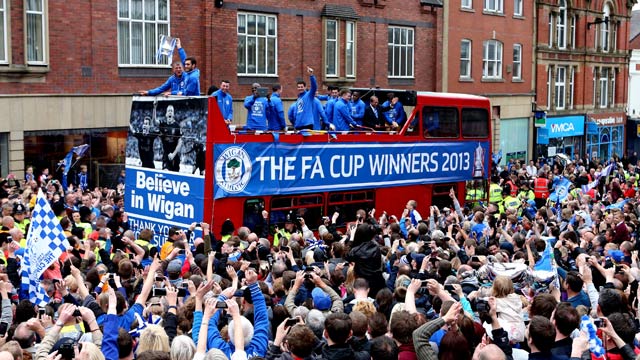
Though a complicated question, the answer was never really in doubt. Thirty thousand people — three eighths the town’s population — coloured the town of Wigan blue for yesterday’s FA Cup victory parade, emphatically putting ignorant and outdated “rugby town” stereotypes to bed. They sang and cheered, and even drowned out their manager, on-stage with a microphone, with chants “Roberto Martinez, we want you to stay.” There was not a boo or a negative word to be heard — not at the parade, nor at the Emirates last Tuesday when the team was consigned to relegation. The enduring sentiment was and is one of sheer pride.

This is not to say that relegation doesn’t hurt. Football, and the Premier League in particular, is a game of fine margins. Matches turn on a single incident, and there were a host of them this season, that if reversed, probably would have kept Wigan up. James McArthur’s missed opportunity to seal the game against Swansea, Tottenham’s incredibly fortunate last-gasp equaliser at the DW, Joe Hart’s unbelievable save to deny Franco Di Santo — all recent — stick in the memory.

But relegation from the league was always a possibility — no, a probability — and has been for years. Sunderland, who finished three points above Wigan, signed Steven Fletcher, Adam Johnson, Alfred N Diaye and Danny Graham within the past year alone for a total of 30 million pounds. Fellow relegation rivals Aston Villa, for context, signed Wigan’s best player two seasons ago for 9.5 million and kept him on the bench for most of the campaign — next to 18 million Darren Bent. They could afford to leave them out because they’d signed a gem of a player in Christian Benteke for 10 million pounds the previous summer. Newcastle spent more than 25 million this season. Southampton almost 33. Wigan’s total spending amounted to 9 million on four players, all of which were covered by the sale of Victor Moses to Chelsea. Conor Sammon’s 1.2 million deal to Sheffield Wednesday earned the club a net profit on transfers, something none of the aforementioned achieved. (Source: http://www.transferleague.co.uk/)

The good news when it comes to league status, as Martinez has said, is that it can be rectified. Not many teams bounce back up to the Premier League immediately following relegation. But not many teams that go down were living within their means during their Premier League stays like Wigan was. How many clubs have we seen promoted, overspend, get relegated and disband upon the realization that they cannot afford to keep paying the players they overspent on?

Sure, Latics will lose some of their stars — and those players deserve the chance to move to a top flight club. They were brought to Wigan on the promise that they would be allowed to move to a bigger club when the time was right for both parties. The stable financial footing Dave Whelan and Martinez have guided Wigan Athletic to means that they are not obligated to sell any of their players. They will, but only because it is beneficial to the club’s future. For every N’Zogbia or Moses — or this year probably McCarthy — that goes, four or five young talents are signed. Four such youngsters — Roman Golobart, Eduard Campabadal, Nouha Dicko, Fraser Fyvie — are likely to play big roles next season and cost Whelan very, very little.

A popular claim at the moment says that league status is temporary while trophies are forever. While certainly true, it does not quite sum up Wigan’s emotional season, or explain the absoluteness of their fans’ pride. If it had been QPR that had won the FA Cup but been relegated, it is highly doubtful that the overwhelming feeling at their parade would have been one of pride and progress. Their team has been messily run since being promoted two years ago, thrown money — a lots of it — at the problems and assembled an overpaid, overrated team of opportunists who will likely be sold off auction-style during the summer as they try to slash the astronomical wage bill they’ve created for themselves.

With apologies for harsh words to supporters of QPR, the point is that celebrations at yesterday’s parade were not solely focused on the amazing, unimaginable fairy-tale story of little Wigan spectacularly toppling the richest team in the land and defending league champions to lift the oldest football competition in the world. They were an acknowledgement of how far Wigan Athletic has come as an institution and the work of the last decade. The team will play in the Charity Shield and Europa League for the first time next season. A product of the youth and reserve squads was named man of the match in the FA Cup final. The New York Times has featured the Latics three times in the past month. Thirty thousand people came out to support the team. State of the art training facilities are on the horizon. Wigan Athletic won the FA Cup. Wigan won the FA Cup. The Latics won the bloody cup!

Relegation may be a step back, but the infrastructure is in place to keep this club in the Premier League or thereabouts for years to come. Of course, much hinges on the future of the iconic hero of this Wigan revolution, from player in the lower divisions to the manager who lifted the FA Cup, Roberto Martinez. But for now, it is safe to say that despite going down, Wigan Athletic is on the up.

Follow us on twitter. Like us on Facebook. 

Proud Wigan slip away

2013-relegation

The week that brought Wigan Athletic its greatest moment in football has ended in sadness as the club’s eight-year Premier League history has been placed in the to-be-continued pile along with so many others.

Few Wigan supporters will feel anything but overwhelming pride tonight despite being relegated, as an injury-plagued and thoroughly exhausted squad gave Arsenal a real scare amidst rainy scenes at the Emirates. With the scores equal in the second half, it was Wigan playing the better football, narrowly failing to take the lead on several occasions before an Arsenal counter-attack swung the match and ultimately put Latics down.

Ensuing weeks will address questions about who will stay and who will go. For the time being, it is safe to say that the work of Roberto Martinez’s staff has ensured that Wigan is in very strong shape to bounce back in short order. When the club was first promoted in 2005 there was little in the way of youth development or reserves. Times are different — so much Latics progressed through the FA Cup using squad and youth players and, despite a number of injuries to key players, won the bloody thing.

Many have been mystified by Martinez’s Wigan. Capable of beating absolutely anyone on their day — often in style — they have found themselves embroiled in relegation battles more times than not in the Premier League years. Why wait until the final stretch to get going? The yearly process of replacing first team players lost in the summer window plays a key role and certainly did this season. Not until the rise of Callum McManaman a couple months ago were Wigan able to replace the direct and skillful Victor Moses. But the funds raised from the Moses sale are exactly what have aided the rise of young players like McManaman and the purchases and development of talents such as Roman Golobart, Nouha Dicko and others that may become key players in the Championship next year. Those sales and that period of rebuilding were necessary for the model. Wigan have taken a gamble with said strategy for the past number of years and it has paid off, allowing the club to maintain Premier League status while building behind the scenes. This year, they lost the gamble with Premier League salvation, but Wigan won the FA Cup and qualified for European football for the first time in the club’s history, a stunning achievement. True to form, Wigan Athletic have been relegated in what is arguably the club’s most successful season ever.

On the pitch, the obvious deficiencies this season were defensive. Last year’s player of the season and club captain Gary Caldwell was dogged by a troublesome hip injury from beginning to end, the excellent Antolin Alcaraz missed more than two thirds of the campaign, new signing Ivan Ramis has been out since January, while Maynor Figueroa, Jean Beausejour and Ronnie Stam were all injured in the crucial final stretch. Ali Al-Habsi, so influential in previous seasons, made several high profile mistakes and was dropped. Fixture congestion — with the FA Cup final played only three days before today’s match — certainly didn’t help. When yet another influential player, McManaman, went off injured in today’s match, you got the sense it was the final straw for Martinez’s ailing squad.

So an end has come to Wigan’s memorable maiden Premier League voyage. Detailed analysis will follow but the lingering feeling remains that of pride in the achievements of a small town club that has graced the Premier League with unpredictable, exciting football over the past decade, climaxing at Wembley last Saturday. Today is a sad day, but keep an eye on those plucky Latics and their unique brand of underdog football — they’ll be back.

The day Wigan established themselves among football’s elite

2013-watson

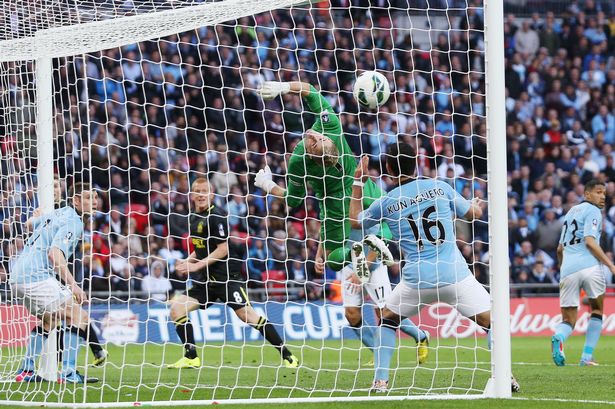
When you watch it again on television, it is hard to tell that Ben Watson’s FA Cup winning header actually happened in slow motion. But from my bright red Wembley seat about 15 yards away, I can assure you that the world stopped for a magical 10 seconds as the ball sat up, suspended in mid-air, spinning. Then the world moved forward again, in freeze-frame snapshots. Joe Hart’s acrobatic leap and disbelieving eyes. Arouna Koné’s realization. My wife and brother-in-law, wearing moustaches and sombreros, shaking me with unbridled joy. A child on his father’s shoulders taking in a moment he is unlikely to forget. The passion — the release — in Callum McManaman’s celebrations. A supporter wearing the 2005 shirt from the club’s promotion season, the same one my Grandad had received autographed by the first team and subsequently passed on to me. Sheer euphoria.

My love of Wigan Athletic goes beyond my considerable love of the game. It is a personal and emotional connection to my roots; a source of pride, of enjoyment; a sporting fairy tale that I love sharing with people. It is the source of friendships, a topic of conversation, a hobby. As I took in the moments after the final whistle, I found myself wishing I knew the stories of all these singing and dancing men, women and children around me. I thought of my mother and father waking up the neighbours at 2:00 a.m. in Indonesia, my brother-in-law John who had flown over for the semi-final from Germany, friends watching from all corners of the world, neutrals hatching an interest for a club they previously knew little about. I saw a section of Omani supporters singing an Ali Al-Habsi-themed song in chorus with a group of Wiganers. Roger Espinoza receiving an Honduran flag from the crowd. It was a magical moment at Wembley. Football may just be a game, but its power to unite people and form lasting friendships — and memories — is unquestionable.

From a sporting perspective, this result was the equivalent of Honduras winning the World Cup — something I would also enjoy. Plenty of newspapers have since mapped out the financial mismatch between the finalists, the consensus being that Wigan’s entire starting XI had been assembled for less money than the average cost of a single player in Manchester City’s starting XI. Bookmakers were offering 10-1 odds for a Wigan Athletic victory before kick-off. Manchester City supporters on the London Tube appeared to be in town for a victory celebration rather than a football match, and indeed sang about off-the-pitch matters rather than supporting their players for the task at hand. Meanwhile, Wigan had played three games in 10 days, were missing five defenders to injury, and had a crucial match at Arsenal in the league three days after to keep in mind.

And yet it was Wigan that looked fresher, hungrier, that looked the better team. Save for a couple first half scares — most notably a superb save by keeper Joel Robles from a Sergio Aguero effort — Latics created more and probably should have been awarded a couple penalties before Pablo Zabaleta’s sending off and Ben Watson’s winner. It was a performance on par with any I can recall against such strong opposition, and worthy of the title. Aside from the eye-catching performance of McManaman, it was a true team performance where individuals did not stand-out. It put the magic back into the FA Cup.

There is, of course, no time to celebrate as two disastrous results in the Premier League on Sunday meant Wigan must beat Arsenal away and Aston Villa at home in order to achieve their other aim of staying in the Premier League. The daunting Arsenal fixture is due to take place only three days after the superhuman effort the players put in at Wembley, which is plain unfair.

But Wigan supporters will be relatively at ease. The FA Cup victory is an achievement on so many levels, not least in that most of the victories on the road to Wembley were achieved using squad and youth players. Indeed, the player of the tournament, McManaman, wasn’t even in contention for a spot on the bench in the league at the beginning of the season. Even if some certain were to leave the club in a relegation scenario, the squad is deep. They made easy work of Huddersfield and Millwall — admittedly both strugglers in the Championship, but fired up for the Cup ties. Players such as Shaun Maloney and Koné have voiced their commitment to the club. It is doubtful that Martinez would leave if the club were to be relegated. Plus, there would be Europa League action to look forward to next season, something most of the club’s players will be eager to experience for the first time in their careers.

What’s more, the FA Cup victory proves a real winning mentality at the club. Martinez has not been successful just because of his results — it’s the manner in which they have been achieved. They’re no longer scared of anyone. Most of Manchester City’s opponents on a budget like Wigan’s would have parked the team bus and hoped for a lucky goal or penalties. Martinez attacked City, played them evenly ending the game with the same number of shots. The difference in budgets may have told over the course of the full season, where Wigan have struggled to replace departed or injured players and dropped points as a result — but in the FA Cup final, his cheaply assembled XI were better than City’s.

What’s more, the trophy establishes Wigan in football’s elite. It will help with recruiting talented players. It puts the club on the map. It will bring the club new fans. It puts the club in Europe next season, regardless of the outcome in the relegation battle. Whether Martinez manages the impossible with another great escape or not, Wigan is now in the big leagues to stay. It’s another step in the rapid progression the club has made, another rung on the ladder.

But it’s not over yet. Wigan has two more finals, and two more opportunities to defy the odds. Their best work seems to happen just when success appears impossible — this is certainly the most difficult league Premier League situation yet. They’ll certainly need that winning mentality on Tuesday, not to mention several pain-killing injections before the match. But anyone who witnessed the magic at Wembley on Saturday — and there were 30,000 of us there, three eighths of the town’s population — knows that regardless of the outcome, our proud little club just got bigger.

Proud day for Wigan as the fairy tale rolls into Wembley

Latics' team for their debut match against Port Vale Reserves,  Thanks to Ron Hunt and WiganWorld for photo.

Latics’ team for their debut match against Port Vale Reserves,
With thanks to Ron Hunt and WiganWorld for photo.

* this post was co-written by the father and son writing team, from the perspective of the Jakarta Jack, the father. 

My father loved Wigan Athletic Football Club. Hardly a minute would go by after the final whistle before he would launch into talk about the next match. Conversations – and in some cases, monologues – about line-ups, tactics and referees were a feature of my life as long as I can remember.

His love affair with the Latics began the year the club was formed in 1932, and never wavered until his passing in 2005. His devotion to such a modest club was difficult for others to understand in a region saturated with prestigious football clubs such as Manchester United, Manchester City, Liverpool and Everton. It was especially difficult to understand for the rugby fans in the area.

But my dad wasn’t too perturbed by that. In his 73 years as a supporter, he witnessed the transition from non-league to Division 4, all the way up to the Championship, or second division as it was known for most of his time. Wigan were second in the Championship under the leadership of Paul Jewell, propelled by the dazzling strike partnership of Nathan Ellington and Jason Roberts, when he passed away. The Latics were promoted to the Premier League four months later. They have remained there ever since.

Were you to tell my father that his Wigan Athletic would go on to spend eight consecutive years in the Premier League and reach both the League Cup and FA Cup finals during that period – he almost certainly would not have believed you. He would have beamed with pride.

Thankfully, pride is something that is passed down. My son and co-writer, Ned, once told me that,  while the inspiration for the name of this fan site was a tip of the hat to the symbolic arrival of Wigan’s Three Amigos from Spain –  a pivotal moment in Wigan’s rise up the tables and Whelan’s revolution – it also on a more personal level represented the relationship between himself, his dad and grandad, who all shared that same passion for the club.

Neither Ned nor I were at that very first Wigan Athletic match back against Port Vale Reserves back in 1932, but we each remember our first Latics experience and know the previous history thanks to my dad. We know where the club came from, and we know we are living the Wigan Athletic dream.

No matter what the result is on Cup Final Saturday, or the outcome of the relegation fight in the Premier League, Wigan Athletic have confounded people with their achievements. The club has come farther than any of us imagined in our wildest dreams, and their achievements will leave an indelible memory.

What’s more – the work that Roberto Martinez has done in his return as manager of the club has been transformative. Rather than playing the role of the little fish up for a Premier League cameo, his plan has been one of consolidation.

While Steve Bruce did a job in keeping the club in the top flight, the money he spent on players and their wages was hardly sustainable if Latics were to suffer a bad season and go down. There was no investment in youth development or infrastructure.

Martinez’s work to cut operating budgets, sell the top players in order to fund long-term growth sets the club up to survive for years to come. Sure – relegation is a threat each year and is to many clubs with more money, more fans and so on — but the club and its support are rapidly growing behind the scenes with every year that passes.

It is somewhat fitting, then, that Wigan’s rival in the final is Manchester City – not only a club with massive support, but also the beneficiary of the largest cash injection in world football thanks to their billionaire owner. In comparison with Wigan Athletic and Manchester City even David and Goliath seem evenly matched!

Only a deluded romantic would expect a Wigan Athletic squad depleted by injury, mentally worn-down, in the middle of the most intense Premier League survival fight to date, to beat Manchester City on Saturday. But if the club’s history is anything to go by, the seemingly  impossible can happen. The supporters of this club believe anything is possible because they are continuing to live it.

The Wigan Athletic story is far from over. Three matches in less than 10 days will determine whether the 2012-2013 season goes down in history as the year Wigan conquered the FA Cup, or survived for a ninth consecutive Premier League season against all odds.

But even if neither materialises, we could not be more proud of our club which takes pride in doing things in a sensible way and never gives up. Just to be in the FA Cup final, with the guarantee of Europa League football next season boggles the mind. A win on Saturday would just be icing on the cake.

Like us on Facebook, or follow us on twitter here.