Striking problems for Caldwell ahead of Shrewsbury match

Caldwell2

Will Gary Caldwell lose sleep over choosing his attacking players for the Shrewsbury game tomorrow?

Question – which club in cash-strapped League 1 can afford to leave a £1 million striker on the bench?

The response is that Wigan Athletic can. Moreover they did it last Saturday when Will Grigg was not only on the bench, but was not called on to the field of play as the game at Rochdale progressed.

Wigan Athletic’s affluence is clearly the envy of so many clubs in their division. According to Rochdale manager Keith Hill, Latics are the Manchester United of League 1. Indeed the squad that Gary Caldwell has put together is formidable compared those of their rivals. There is a minimum of two players fighting for each position, a healthy state of affairs as far as the manager is concerned.

Of course, Latics are in a lower division now, but it could be argued that Caldwell’s squad is superior to that of Malky Mackay in the Championship. The biggest weakness in Mackay’s squad was in the area of strikers. The hapless Scot not only persisted with a centre forward who went on to score one league goal in 34 appearances, but also played  winger James McClean as a central striker, where he looked like a fish out of water.

In contrast Caldwell has a wealth of striking options available to him. At Rochdale he employed a 4-2-3-1 system, meaning that he had four specialist attackers in his starting lineup. Typically this season he has lined up with three attackers in a 3-4-3 formation, but with wing backs pushed far forward. But even though he played with four attackers he was still able to leave Grigg on the bench, with Jordy Hiwula, Sanmi Odelusi and Haris Vuckic not even making the match day squad.

Caldwell has been talking to the media recently about his sleepless nights, as he mulls around in his head the different permutations and combinations available to him. One wonders if his sleep will be any better tonight given the Shrewsbury match coming up tomorrow. It is not only the personnel he chooses for the match to be considered, but also the “shape”. According to Caldwell he had decided on a new formation early in the week because of the way Rochdale attack. Then his headache was to choose the players to lineup in that different “shape”.

In previous eras there have been managers who have had a set way of playing, with the players having to fit into the system. There have been other managers who have adapted the style and shape of the team in order to get the best out of the players at their disposal. This was certainly the case for Wigan Athletic in the 2011-12 season. Latics were bottom of the Premier League in November 201l. Following yet another defeat, this time by Wolves, Roberto Martinez switched from a flat back four to having three central defenders and two wing backs. The change in shape was to catalyse a revival in performances, enabling Latics to finish in 15th place, 7 points clear of relegation. The 3-4-3 system had become the norm under Martinez as he used it to get the best out of the players at his disposal.

Having played in Martinez’s 3-4-3 and seeing its results Gary Caldwell is clearly a fan. Like Martinez, Caldwell too looks at the strengths and weaknesses of the upcoming opposition. Martinez would sometimes change his team’s shape during a game if things were not working out, although he would typically stand by his 3-4-3 set up. In contrast, already in his brief reign, Caldwell has adopted a variety of tactical formations and is not afraid to radically change his team’s shape within the ninety minutes.

What kind of tactical formation will Caldwell employ tomorrow against Shrewsbury? Will he persist with his four attackers in the 4-2-3-1 formation or will he revert to 3-4-3? Will Caldwell consider the strengths and weaknesses of the opposition before figuring out his formation?

Part of the reason for Grigg’s benching at Rochdale will surely be down to his late arrival, following his early release from the Northern Ireland squad. Another factor must be the presence of Craig Davies. The 29 year old is a superb centre forward at League 1 level. Were it not for a succession of injuries the big man would surely have played at higher levels throughout his career. Following a hamstring problem he was absent for more than five weeks. He came back on October 20th at Peterborough as a 76th minute substitute. He made a similar late entrance in the next two matches before starting in the FA Cup match at Bury. Davies started in the next two matches against Blackpool and Rochdale, being substituted around the two thirds mark in each. Caldwell is using Davies wisely in the hope that he can have a sustained run in the team without injury. Davies’ ability to turn a defender makes him a nightmare for opposition defences, but he also has pace and no mean levels of skill and tactical awareness.

Caldwell will be seeking the right blend among his attackers. Yanic Wildschut’s emergence has provided a whole new dynamic to the forward line and his is one of the first names to go on Caldwell’s team sheet. Michael Jacobs has been one of Caldwell’s leading players this season and will surely challenge for a place tomorrow. But what of the players who did not make the squad last week?

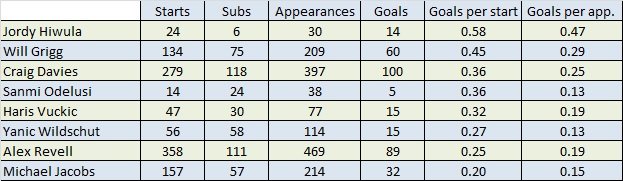
After scoring two goals against Blackpool, Hiwula could count himself unlucky not to have been included last week. In fact in terms of goals per start and goals per appearance in his career he is statistically Latics’ best goal threat:
striking2015

Hiwula is not a “target man” type of striker, but he clearly has an eye for goal and will remain in Caldwell’s thinking.

Caldwell might not sleep well tonight, as he decides on tomorrow’s lineup. Moreover he will surely also be thinking ahead of the visit of high flying Burton Albion on Tuesday. Will he stick with that same four-pronged attack that did so well at Rochdale or will he bring back Grigg to partner Davies up front?

However, many managers in League 1 will not feel even one ounce of sorrow for Caldwell, who currently has an abundance of options at his disposal. His team selection headaches are those which so many other managers in the division would love to have.
Much depends on Grigg

Grigg

I guarantee we will have a 20 goal a season striker this season

So said David Sharpe in June. Was the young chairman suggesting Latics would have a striker who would score 20 goals in the season ahead? Or was he saying that they would be signing a player who had already scored 20 goals in a season?

Less than two weeks after Sharpe had made his statement free agent Craig Davies was signed from Bolton on a two year contract. A week after that Latics paid Brentford around £1m for Will Grigg, who penned a three year deal.

Both had been 20 goal strikers. The 29 year old Davies scored 23 goals for Chesterfield in their promotion season from League 2 in 2010-11. Despite still only being 24 years old Grigg had done it twice. In the 2012-13 season he scored 20 for Walsall, then last season he scored 23 for the MK Dons in their promotion from League 1 to the Championship.

Davies remains a formidable force and has already impressed Latics fans with his all-action performances. Sadly the hamstring problems that haunted him at Bolton have returned, this time in his left leg. The big striker is now back in training, but even the most optimistic of fans will need to cross their fingers that he can stay away from further such problems. Given the likelihood of him receiving further injuries few would bet on Davies being a 20 goal striker this season. Up to this point he has made five starts, with one appearance as a substitute, scoring two goals.

In Davies and Grigg, Latics had signed players with proven goalscoring records in the lower divisions of the Football League. However, they already had another on their books. Grant Holt is now 34 years old and has recently recovered from a serious injury, but will nevertheless be feared by League 1 defences because of his superb goalscoring record in the lower divisions. Holt has reached the 20 goal mark on four occasions, once for Rochdale, once for Shrewsbury and twice for Norwich. Holt is being gradually eased back into playing a full 90 minutes and Latics will surely not rush him. The big man from Carlisle could have a big part to play in the remainder of the season, providing he can stay fit.

However, if Latics were to have a 20 goal striker this season, the odds would surely be on Grigg. On signing him Gary Caldwell said “Will is the one we were after. He’s a goalscorer, that’s what he does and why we’ve signed him. There were other clubs in the chase, including from the Championship, but he’s chosen to come to us and we are very happy about it.

But with the season at its first quarter Grigg has struggled to reach the goalscoring form that Caldwell would have hoped for. He has scored three goals up to this point, two of which were penalties. After starting in the first six games he missed the Chesterfield match through being on international duty for Northern Ireland. He came back as a 66th minute substitute at Port Vale, but was to pick up an elbow injury which kept him out of the next two games. He made his return as a 77th minute substitute, scoring the equalizer during added-on time against Millwall. Grigg returned to the starting lineup for the next game against Walsall, but was substituted after 70 minutes. However, international call up knocked on the door again and Grigg has missed the last two matches at Crewe and Bury.

Grigg’s season at Wigan has therefore been stop-start up to this point. Caldwell has experienced the frustration of the player being unavailable for three matches without getting on the field of play for Northern Ireland on top of his elbow injury.

At this point last season at MK Dons, Grigg was playing as a lone centre forward in Karl Robinson’s preferred 4-2-3-1 system, alternating with Benik Afobe in that position. He had made six starts, with four appearances as a substitute, scoring six goals including two in the Don’s League Cup victory over Manchester United.

Up to this point Grigg has played in the lone striker role and as a twin striker at Wigan. Caldwell has talked with enthusiasm about the Grigg-Davies partnership. They have started together three times, the most memorable being in the 3-0 destruction of Scunthorpe. The physical presence of Davies creates more space for Grigg and they are Caldwell’s optimal striking duo. The manager also has Holt at hand to play a similar kind of role to Davies and it will be interesting to see if he links the two together at some point in tomorrow’s game against Colchester.

Caldwell also has the option of linklng Grigg together with the physically less imposing, but pacy, Jordy Hiwula. The enigmatic Sanmi Odelusi remains another possibility in a partnership with Grigg.

Up to this point Latics have scored 17 goals in 13 games. Grigg ties with Hiwula and Michael Jacobs in being leading goalscorer with three goals. Recent loan signing Yanic Wildschut has really caught the fans’ attention with two exciting performances, including a blockbuster that will be a contender for goal of the season at Crewe. Hopes are high that the Dutch winger can terrify League 1 defences and score goals. However, the player’s career record reads 16 goals in 132 appearances, a goalscoring ratio similar to that of Jacobs who has also played a s winger during most of his career.

If any Wigan Athletic player is to reach the 20 goal mark this season, it will most likely to be Grigg. He has done it before on two occasions at League 1 level. But Grigg is much more than a goalscorer, his intelligent play and passing enabling him to create chances for others.

Caldwell will surely be counting on Will Grigg as being a cornerstone of his bid for promotion back to the Championship.


Like us on Facebook, or follow us on twitter here.


Latics’ legs go as Bury take advantage

Jordan Flores showed glimpses of genuine class on his debut in the starting lineup.

Jordan Flores showed glimpses of genuine class in his debut in the starting lineup.

“In the first half and at the start of the second half I think we played with the intensity that I know we can, we kept the ball well and gave it to our attacking players in the right areas. We got in their faces and made it very competitive throughout the first half, and came out with even more intensity in the second. “

Gary Caldwell was right about that. Some two thirds of the way through the match the Latics had started to flag. The early intensity and running off the ball had dissipated and it came as no real surprise when Leon Clarke headed his first goal from a left wing cross in the 63rd minute. Neither was Clarke’s second goal in the 89th minute as Bury had continued to threaten.

Caldwell fielded a 4-3-3 formation, akin to those of the Uwe Rosler era. Kevin McNaughton started at right back, with Leon Barnett partnering Craig Morgan in the centre of defence and Reece James on the left. Max Power, David Perkins and Jordan Flores made up the midfield, with Will Grigg at centre forward, Sanmi Odelusi on the right wing and Michael Jacobs on the left.

Wigan looked lively in the first half, with Jacobs marauding inside from the left, willing to take on defenders. However, the most clear cut chance came in the 33rd minute when Flores went on a long run from the half way line, rounding goalkeeper Walton in the six yard box before the keeper recovered to parry his shot. There was lots of running off the ball, with the players full of effort and commitment, but not surprisingly the players appeared to lack that telepathy which guides the final pass.

One wonders if Caldwell had told his players to make a point of running at the Bury defence as Jacobs did that straight from the kick off in the second half. He was upended in the box and Grigg hit home the penalty. It will do the centre forward a world of good, getting off the mark. He had been lively throughout and was soon to pull the ball back for Odelusi who spooned over the bar with the goal gaping.

Bury had by no means played badly by that stage. They were well organised and had played some good football. As the game moved on they looked so much more physically stronger than Wigan. Following Clarke’s first goal Latics had a throw in on the left hand side, at the half way line. There were four players close to the ball but not one made a run to receive it. The result was a short throw being made and Latics losing the ball. So many players had seemed to run out of steam with one third of the game still left.

Caldwell brought on Ryan Jennings after 70 minutes to replace the ineffective Odelusi. Grigg went off 8 minutes later for Craig Davies to enter. But neither substitution was to breathe further life into Wigan’s play. The substitution of Billy Mckay for Flores in the second minute of time added on seemed pointless, but somehow reminiscent of the treatment the Northern Ireland international received from Malky Mackay.

But there were positives for Wigan. Perkins shone, once again being the standout player. At 33 years of age he seemed to have the legs that his younger teammates lacked, covering acres of ground, solid in defence and with good distribution. Jacobs looks a good signing, with his willingness to take defenders on and to shoot. He has pace and determination. There were signs that Grigg and Jacobs will make a formidable pairing up front as their understanding of each other’s games improves. Both have skill has commitment and have enjoyed previous successes in League 1. McNaughton looked like an accomplished player throughout and will surely stake a claim for a regular starting berth. James performed well on the other flank.

Flores had a starting debut to remember, showing silky touches of genuine class, including that superb run on goal in the first half. Like any young player still learning the game, there were times when he switched off and made mistakes and by the end of the game he looked exhausted. Caldwell will have to decide how to develop the 19 year old further, whether to carefully nurture him within the club or to send him out on loan where he will get more game time. At any rate, Latics have got a player for the future in the Wigan lad who has a Spanish father and English mother.

It will be interesting to see if Caldwell sticks with 4-3-3 for the Doncaster match on Sunday. The centre of defence looked vulnerable to high balls in the second half and it led to two goals. Against teams with big, physically imposing forwards he might well opt for a line of three central defenders, including the powerful Donervon Daniels, who was on the bench last night. Moreover the return of Jason Pearce will surely strengthen the centre of defence. If Caldwell opts for three at the back it is to be hoped that he will play a 3-5-2 formation, rather than a 3-5-1-1 which leaves the centre forward isolated.

A home defeat to a team just promoted from League 2 can hardly be looked upon as a success. But few fans will bemoan an exit from a League Cup competition that adds extra games to a season that is already long and arduous.

Fans can accept last night’s result to some degree, knowing that Caldwell’s new team is a work in progress and the players need more game time together to develop that mutual understanding which enables good team play.

What is hard to accept or understand is why Bury looked so much fitter than Latics. The conspiracy theorists might say that Caldwell was not really interested in the League Cup and the players’ performances in the final third of the game reflected that. But the more likely explanation is that the visitors were simply physically fitter than Wigan.

Last year’s start of the season was marred by a disastrous pre-season programme that left the players largely unfit. Changes were clearly made this year, but the players still do not look fully fit. At the final pre-season match at Blackburn, Caldwell surprisingly made eight substitutions. Of the starting eleven at Coventry only three – Morgan, Perkins and Power – played the full 90 minutes at Blackburn.

The fitness issue at the beginning of the season goes back to Owen Coyle’s days. One can only hope that the people in charge of the physical preparation of the players at the club are getting it right this time around.

The Doncaster game will provide not only a glimpse into whether the players are starting to meld together as a team, but also whether they can match their opponents physically.


An enjoyable evening at Firhill – Partick Thistle 1 Wigan Athletic 1

Photo courtesy of Tim Attree.

Photo courtesy of Tim Attree.

What an enjoyable time it was last night at Firhill. The pleasant and friendly atmosphere at the stadium was lifted even further by a bright performance from a young Latics team.  They played not only with organisation and enterprise, but with no mean level of skill.

The last time I went to watch a football match in Glasgow was not long after England had won the World Cup. I had travelled down from Dundee with a couple of friends from university to watch a tense England-Scotland game at Hampden Park. The atmosphere was totally intimidating for an England fan. Being naïve at the time we had not realized that the tickets we had bought were at the Celtic end, where we stood among fans wearing colours of both club and country. We were perhaps wise to keep a low profile as the crowd was to constantly jeer the German referee, Rudolf Kreitlein, whom they thought was allowing England too much leeway. It ended in a 0-0 draw.

Hampden Park was certainly a scary venue to visit at the time for an Englishman living in Scotland. But that was a long time ago, so when one of those same two friends told me a week ago he would join me on a trip to our old haunts in Dundee I suggested we combine it with a trip to Firhill. I had watched Partick Thistle play at Dens Park and Tannadice so many times during my seven years in the port city. They were one of my favourite visiting teams, always seemingly intent on playing good football, easily identified by their distinctive red and yellow shirts.

Firhill is nothing like Hampden. It is a small stadium with a capacity of around 10,000. Thistle have not actually played in Partick since 1908, when they moved to the Firhill Stadium in nearby Maryhill. Being less than half an hour’s walk from Sauchiehull Street it is closer to the city centre than Ibrox or Celtic Park. They are a small club in a big city, living within their means, without inflated ambitions.

Gary Caldwell set up his team in a 3-5-2 formation. Lee Nicholls was in goal. There was a return to the starting lineup for both Leon Barnett and Chris McCann, who lined up in a back three marshaled by the dominating Craig Morgan in the centre. Loan singing Jonjo Kenny played at right wing back with Jordan Flores on the left. The second loanee, Francisco Junior, was to play in front of the back four, with Ryan Jennings and trialist John Lundstram pushed a little further forward in midfield. Billy Mckay and Louis Robles played up front.

With such a mixed lineup it seemed inevitable that Latics would lack some cohesion, but they were well organized and every player seemed to know his role. Both teams were there to try to play good football and it was an open contest. As the game progressed Latics were to gain more cohesion. A slow start had been inevitable.

Junior was a tireless worker in midfield, not only through tackles and interceptions, but also in making himself available to receive the ball from the defenders in tight situations. It is the type of midfield play that was lacking last season. Kenny attacked with gusto and looked a fine player, although at times he left Barnett exposed. Flores worked hard in an unfamiliar role.

Morgan was captain for the night and will clearly be the main pillar upon which the defence will be built this season. McCann played with more enthusiasm than we have seen from him for a long time. Uwe Rosler had used him at times in that role on the left of the backline of three, where his steel in the tackle and cultured distribution come to the fore. On the other side Barnett was strong in the air but looked vulnerable under pressure. Like so many other players at the club, Barnett lost his confidence last season and just did not look like the player he was in 2013-14. On the positive side at least he was given some game time to try to get himself back in shape.

Nicholls was dominant in goal, constantly calling for his defenders to get in position. He had no chance for Steven Lawless’ goal not long after half time, the shot passing through Barnett’s legs, with the keeper unsighted.

Lundstram looked useful in patches, but could not impose himself on the game, being taken off at half time for David Perkins. It was Jennings who was to catch the eye in an unfamiliar central midfield role where he had the licence to run at the opposition defence. He scored a fine goal in the 51st minutes following Thistle’s opener, receiving a layoff from Robles on the edge of the area, his low shot beating the keeper. The 20 year old will surely now be challenging for a regular place in the lineup.

Perkins’ signing was hardly greeted with universal approval by fans, looking like another journeyman was arriving as in the days of Malky Mackay. But what we saw last night was a hard working holding midfielder with a nice touch on the ball, fitting seamlessly into Caldwell’s style of play.

Billy Mckay looked lively, willing to run at the defence, but he let himself down by skewing his shot wide of an open goal from Robles’ cut back. Robles himself was industrious and gave a good account of himself.

The second half saw a slew of substitutions for both sides, but the good football continued with Latics getting on top. Will Grigg had come on for Mckay after 60 minutes and came close twice, one shot being smothered by keeper Cerny, another effort going narrowly wide. With a little more match fitness Grigg will surely convert such chances. It is refreshing to see a Latics striker who knows where to position himself to score goals.  Craig Davies came on in the final quarter and his physical presence complemented the bright and intelligent footwork of Grigg. If both can stay fit they will provide Latics with a real cutting edge.

Max Power had come on after 60 minutes and really looked the part. Power is well built, not easy to knock off the ball, and has the kinds of incisive passing skills that have been lacking at Wigan over the past twelve months. The player is only 21, but having played so many times at senior level for Tranmere, he is not afraid to display his considerable skills. He will surely be the main contender for a more creative, advanced midfield role.

In the end a 1-1 result was probably fair to both teams. It was an entertaining game and although Latics employed 16 players during the course of the proceedings their football was good to watch.

Pre-season friendly matches can so often give a skewed view of what is going to happen when the season proper gets underway. But the dominant performances of senior professionals like Morgan, McCann and Perkins together with the youthful promise of Flores, Jennings and Robles augur well for the future.

One wonders if McCann is now back in the fold, or whether he was put in the shop window in this game. Last season was a nightmare for him, but he showed yesterday that he can still represent Wigan Athletic with application and no mean level of skill.

It is likely to be a very different starting eleven at Dundee on Friday. Last night’s display has certainly whetted one’s whistle for what is to follow.

A Brentford fan’s view of Will Grigg

 Grigg

In addition to the MK Don fan’s view on Latics’ new signing, Will Grigg, we also reached out to a Brentford fan to give us an insight on the player’s time there.

Billy Grant (@billythebee99) writes and videoblogs for the Beesotted blog (www.beesotted.co.uk) and has previously written for us his view on ex-Brentford personnel Uwe Rosler and Adam Forshaw.

Here’s over to Billy:

Grigg came in with high expectations. He had scored 20 goals in the previous season for Walsall – all from open play and was scouted because, statistically, he fitted a profile. A striker who found himself himself in goalscoring positions and made chances. 

 His transfer was protracted and bad-blooded (quite similar in ways to the Wigan-Forshaw scenario) except unlike Forshaw, Grigg was out of contract. 

 Walsall manager Dean Smith didn’t want him to leave and had offered him a new deal. And even said something to the words when he left …  “If he were leaving to go to a better side I would have thought he would have done better than Brentford”. He toned down his comments later to say what he meant was he thought Grigg’s agent could have done better and got him a championship move.

 In the end, as the sides couldn’t agree a fee, it went to tribunal with Brentford having to pay Walsall compensation. A figure of £325k with add-ons was finally decided upon. Smith was still angry as he valued Grigg at closer to £1m even back then. 

 He had a good start to the season. Scored a brace on his home debut vs Sheffield Utd – missing a penalty for his hat trick. Brentford fans thought our time had come. Beating Sheffield Utd – the team who last season came so close to promotion to the Championship – was a real barometer of how we had stepped up. Or so we thought. Our next two months were fairly average to say the least .. whilst Sheffield United went from bad to worse. 

 As for Grigg, after that run he got immediately called into the Northern Ireland squad to start against Russia. And his bedding into the Brentford team was continually disrupted over the next few months by being taken off by he Northern Ireland national side to effectively sit on the bench. 

 He was missing out on game time. And training with his team mates. 

He also was unlucky with niggling injuries during that period which never saw him fully fit and he was often subbed off during matches. 

 All in all, this led to a massive dip in confidence for the lad who was starting to feel the pressure in a side gunning for promotion.

Eventually over the course of the season Marcello Trotta became the forward of choice with Brentford deciding to send Will off to Franchise FC aka MK Dons the following season to get ‘game time’ after scoring 4 goals in his 39 appearances for The Bees. 

 His time at MK Dons is unprecedented – scoring 22 goals in 50 games including a brace against Man United. Not many players can boast to their grandkids that they scored against Man United. 

 Apparently he was great for MK Dons. Worked hard. Made chances. And took over the mantle of top goalscorer after Afobe left for Wolves. 

 Brentford fans would often say ‘he couldn’t do that for the Bees though. He couldn’t play up front on his own’ .. but apparently, he played the lone striker role magnificently up in Milton Keynes. 

 Bees fans wee bracing themselves for giving Grigg a second chance. The thoughts – having a 20 goal striker as you 2nd or 3rd choice is never a bad thing. But for Will .. and for Brentford .. with 1 year left on his contract .. the opportunity to cash in (even make a profit) … and for Will to lead the line for a team intent in reclaiming they place back in the Championship proved too much of a pull. 

The Griggster (as we call him) …  lovely bloke. Really down to earth. I even managed to nab the first interview with him when he joined Brentford a couple of seasons ago.

 And I – and I’m sure all Bees fans – wish The Griggster the best of luck at Wigan … even easier to do so now that we are a division apart. And that wasn’t meant to be a dig by the way … just I don’t have to worry about him coming back to Griffin Park and scoring a hat trick … not for a season anyway.