“For us to have held our own against a good team is really pleasing. I am proud of the boys – they gave us everything. We threw everything at the game and made changes to try and get a result. I can’t fault the boys – I am really proud of them…… We’re not making excuses, but we had to field a team that we thought could compete, and have loads of energy. I felt like we did that – the goal we conceded is a scruffy one on our behalf. It’s not what we want, of course, but I can’t fault the lads. They stuck to the game plan. Luton were in the Premier League two years ago, and they’ve still got some Premiership and Championship players who shouldn’t be in this division.”
So commented Ryan Lowe after last night’s display at Luton.
It was certainly an improvement on the way Latics played at Leyton Orient. The players had rolled down their sleeves, showed energy and lots of commitment.
It was an odd game in many ways. Lowe had fielded a starting lineup that looked as defensively-minded as any that Wigan have put out since the days of Warren Joyce. However, despite playing with wing backs, Jensen Weir and Luke Robinson, who rarely pushed forward and a lone centre forward in Paul Mullin, they certainly matched the home team in the first half. After 9 minutes the home side had gone ahead when Liam Walsh too easily evaded the right side of Wigan’s defence to cross for George Saville to hit home. But it did not deter Latics and they played with energy and determination, launching balls down the channels to push Luton back and create chances that might have been converted.
Latics had started out with a 3-4-2-1 formation with Baba Adeeko and Tobias Brenan in defensive midfield, with central midfielders and Ryan Trevitt and Callum Wright pushed further forward. Three central strikers had been left on the bench.
Maleace Asamoah was brought on as a second striker for the second half, but it did not do the trick. The targeted long balls had turned into “hopeful” ones and the home team dominated. However, in the dying seconds Sam Tickle came up for a corner, but shot wide when he might have scored.
Lowe retains the backing of the majority of Latics fans. He has done well to build a squad that can compete with most teams in League 1 and there is a long way to go in the season. After suffering so many dull displays in home games last season prior to his arrival, the crowd at the Brick Community Stadium are now getting more entertainment. However, their away performances have been dour to watch.
I read an article the other day saying that in the 1960s the average tenure for a top flight manager was around four years, a far cry from the modern day when the figure is well below two. Since April 2015 Wigan Athletic have had 12 managers, although the figure does include those who were interim appointments.
Football clubs that are succeeding tend not to replace their managers frequently, but those who are not are doing well will usually ditch their manager in the hope of a new one coming in changing their fortunes. If the new manager does not succeed clubs rarely make thorough investigations into underlying factors that can cause the lack of success, so often repeating the process by making another change at the top. Over the past 25 years Wigan Athletic’s longest-serving managers have been Paul Jewell (6 years) and Roberto Martinez (4 years), both of whom brought honours to a club punching above its weight.
In early March I published an article “What kind of manager is needed to take Shaun Maloney’s legacy further? stating that:
“One can only hope that the Board are shrewd in their appointment. Whoever comes in will have players signed by Maloney on permanent contracts. They were signed to play the possession-based football that Maloney believes in. A shrewd appointment would be to bring in someone who can build on the good things that the Scot did, rather than one with a diametrically opposed philosophy of football.”
Whether Ryan Lowe can build on what Maloney did is open to question. From what we have seen so far, his style of football is hardly akin to that of the Scot. However, there was a faint chance of the club being relegated when Lowe took over and he adopted a “fightball” style of play, grinding out the results that would eventually get them to 15th position.
Most managers have a preferred tactical formation. The most common shape at Wigan in recent years has been 4-2-3-1, with a lone centre forward and an attacking midfielder playing behind him. Although Paul Cook and Leam Richardson were largely popular managers during their tenures there were always fans, particularly those who had witnessed the golden days of the Ellington-Roberts duo, who wanted to see twin strikers. Those fans will be delighted that Lowe likes to play with two central strikers. His preferred formation has been a version 3-1-4-2, with a central midfielder playing deep in front of the defence. He has lacked “natural” wing backs, having to use players more used to playing at full back or on the wing.
Given Lowe’s preferred tactical approach he will need to adjust the balance of the squad. The retained list shows a senior squad of 19 players under permanent contract, but with Steven Sessegnon made available for transfer. Options for another year are triggered for Joe Adams, Tom Watson and Luke Robinson. Matthew Corran, Callum McManaman and Harry McHugh may get extensions on depending on negotiations.
Lowe needs wing backs and more strikers so he will need to move on players his predecessor signed on permanent contracts. Some will leave for low fees or free transfers, others being sent out on loan. Much has been said about the quality of recruitment last summer, but the aim to bring in young players in their early to mid-twenties, with potential sell-on value, was refreshing. For too long the club had been saddled with older, experienced pros on relatively high salaries and long contracts, but with low sell-on values.
Lowe has made it clear that he needs more experience in his squad and that any under-21 players hoping to make the senior team will have to prove themselves worthy in training. He gave the exciting 19 -year-old K’Marni Miller his League 1 debut in the final game against Northampton, commenting “I said I wouldn’t be throwing in people for the sake of it, they’d have to have earned it with the way they handle themselves around the training ground and he’s been first one out and last one in ever since I’ve been here, so he was well worthy of coming on and I was pleased with what he did.” Miller was signed by Maloney last summer from on-league Guiseley.
Ryan Lowe’s appointment has gone down well with the majority of Latics fans. Although one could see the green shoots that suggested Maloney’s side would progress to a higher level with time it was nevertheless a frustrating season for us as fans, watching insipid stuff so often. Lowe’s arrival means yet another change in playing style and the kind of turnover in playing staff that has plagued the club over the past years. However, Lowe is an experienced manager who has a history of producing teams that punch above their weight despite being on modest budgets. One can only hope that he is given the full three years of his contract. Too many managers have been dismissed in an untimely manner over the years rather than being supported through difficult periods. The net result has been instability, with too much turnover not only of managers and coaches, but also of playing staff.
The hope is that over summer Lowe will make the adjustments in the balance of the squad that he feels he needs, but that turnover of playing staff is much reduced in the summer of 2026 and beyond. History has shown us that success is more likely if the manager is given a relatively long tenure.
I’m really happy with what people in the background have done, we’ve all worked extremely hard to get the squad to where it is now. I don’t see too many more coming in, maybe one or two.”
It has been a difficult summer recruitment exercise for Shaun Maloney and his staff. The previous recruitment team were shed in the upheavals over the previous months. Moreover, the Guardian newspaper reported that the EFL had decreed that the club would not be allowed to pay transfer fees until the summer of 2024.
Having rescued Latics from impending liquidation Mike Danson has kept faith in the manager, but has made it clear that he expects the club to be run in a more sustainable manner. That presents a considerable challenge to Maloney and will induce a major shift in expectations from the fan base.
Since Dave Whelan bought the club in 1995 it has never been run in a sustainable manner.
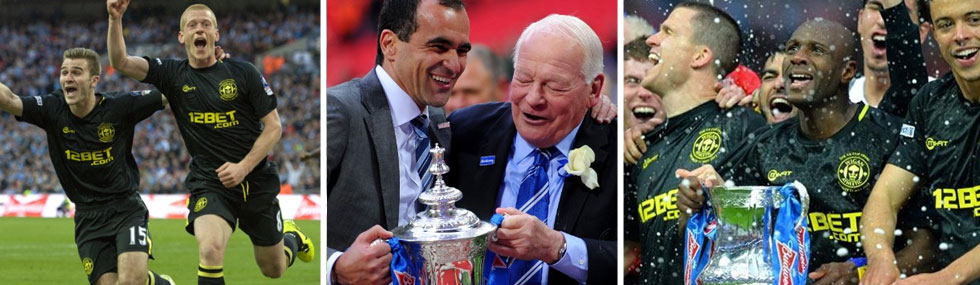
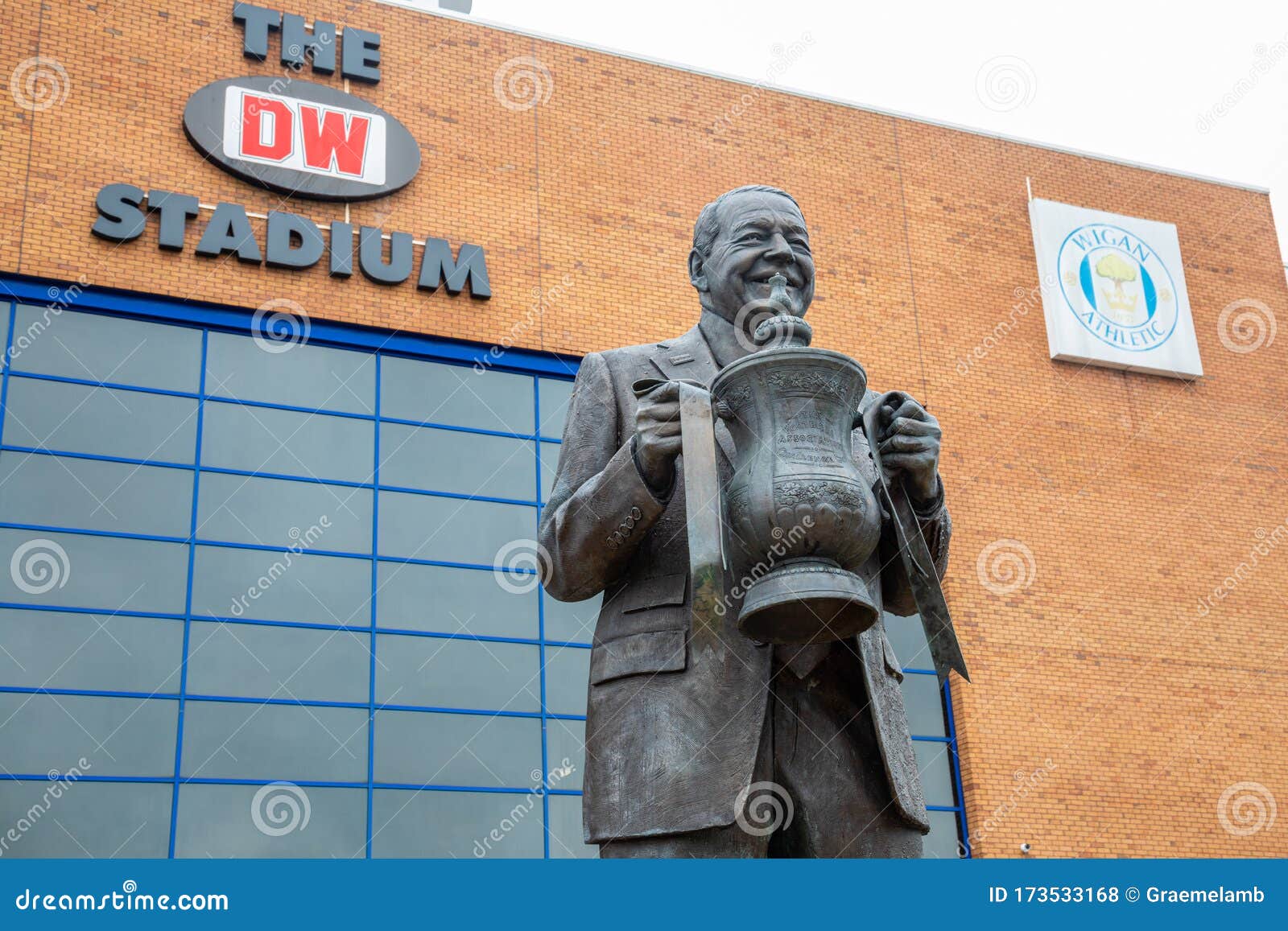
Whelan invested a large sum of money to help the club climb up to the Premier League in 2005. The first season was a great success, but Latics came so close to relegation in the second, an away win at Sheffield United on the last day of the season saving them. Steve Bruce took over from Paul Jewell in 2007 and stabilised things, albeit at a financial cost. Roberto Martinez was presented with a reduced budget when he took charge in 2009 and did incredibly well to keep the club in the division for four more years, winning the FA Cup in the relegation year of 2013.
Despite the huge increase in revenues Latics had continued to struggle financially in the top tier, with Whelan subsidising considerable losses. With large sums coming into the club from parachute payments and some £20m incoming transfer fees the return to the Championship could have been profitable. However, poor decisions were made in the hiring and firing of managers and recruitment of players. David Sharpe had replaced his grandfather as chairman in March 2015, but the net result was the frittering away of two years of parachute payments and relegation to League 1 The following season saw Latics winning League 1 but the heavy wage bill to do so largely wiped away the parachute payments coming in.
After more years of financial losses, the Whelan family sold the club to IEC in November 2018. The mysterious happenings under IEC saw the club go into administration in July 2020, before being bought by Phoenix 2021 in March 2021. Like IEC, the Bahraini ownership had poured funds into the club, but their overspending in the 2021-22 season was to become a millstone around their necks. Somewhere between £40-50m had been put into the club over those years by IEC and the Bahrainis.
Football clubs below the elite levels of the Premier League are rarely going to be good investments, as IEC and Phoenix 2021 discovered. Dave Whelan was a massive benefactor to Wigan Athletic, allowing the club to live beyond it means. He never required it to be run in a sustainable manner, constantly bankrolling it: some would say it was a series “gifts” from the local-born millionaire.
However, Mike Danson, another local-born owner, is not prepared to support the club in the Whelan way.
Most fans realise that without Danson the club could have ceased to exist. They are both relieved and appreciative, currently accepting his plans on running the club sustainably. However, with the billionaire due to take over full control of Wigan Warriors in November there are concerns of what will happen with the same person owning both the football club and the rugby league club. There are questions about whether the DW Stadium, currently under football club ownership, will be regarded as a separate entity, owned by neither club, but by Danson himself.
Given the number of players remaining at the club on bloated salaries given them by Phoenix 2021 it is unlikely that Latics will break-even financially this season. Reports suggested the budget will be set at around a third of that of least season, bringing to a figure around £6m, well over the average for the division.
Given the situation Maloney has been facing, with little wiggle room in the budget and a transfer embargo from the EFL, he has had to look for free agents add loan players. His main squad currently comprises:
Goalkeepers: Ben Amos (32), Sam Tickle (20).
Full backs/wing backs: Sean Clare (26), James McClean (34), Tom Pearce (25), Luke Robinson (21).
Central defenders: Charlie Hughes (19), Jason Kerr (26), Sean Morrison (20), Jack Whatmough (26).
Midfielders: Thelo Aasgaard (21), James Balagizi (19), Jamie McGrath (26), Liam Shaw (22), Matt Smith (22), Scott Smith (22),
Wide players: Jordan Jones (28), Callum Lang (24), Callum McManaman (32), Jonny Smith (25).
Strikers: Stephen Humphrys (25), Josh Magennis (32), Josh Stones (19), Charlie Wyke (30)
Several of those players can play in various positions in addition to the ascribed above. I have included Josh Stones in the senior squad because he appears there on the club website. The situation regarding Jamie McGrath remains uncertain, with him not having taken part in pre-season games. Reports suggest the return of central defender Kell Watts on loan, with rumours suggesting that Jack Whatmough will soon be leaving for a fee. With only one specialist right back/wing back in the squad, Sean Clare, Maloney will be looking for backup. Rumours link Latics with the experienced Josh Emmanuel (25) a free agent, ex-Grimsby Town.
Against Everton Latics played a fluid 4-4-2 system, with Callum Lang and Charlie Wyke up front and Stephen Humphrys and Callum McManaman playing wide. One expects that Maloney’s preferred formation will be 3-4-3 with Clare and McClean as wing backs and a mobile, interchanging front line of three. However, he will switch to the likes of 4-2-3-1 or 4-4-2 when a tactical change is needed.
Maloney’s squad is close to being complete. On paper it is not a strong as previous squads that have won the division. However, the manager will continue to work on a style of play that will help his players develop professionally. The latter is so important for the long-term survival of the club with Latics grooming young players to have significant sell-on value, unlike so many in last season’s squad.
Morale among the fan base is fairly high at the moment, but we need to expect some hiccups along the way. The Whelan years spoilt us to a large degree, but now we are getting closer to what the economics of the club will be like without him. Some fans, weaned on that era, have particularly high expectations, but will need to temper those with the reality of the present.
It has been a pretty solid start to the season, with 13 points from 9 games. The home record of W0D3L2 strongly contrasts with that of W3D1L0 away from home. Leam Richardson has kept faith in players who were part of last season’s squad, new signings being used sparingly up to this point.
On their return to the Championship in 2018-19 under the Cook/Richardson management team Latics took 16 points from their first 9 games. But their fine early form dissipated as they gathered only 10 points from the next 16 games until the end of December. Their record was W2D4L10.
The current team still has a winning mentality and togetherness from winning L1 but that can soon dissipate after a run of losses as happened four years previously. With fixture congestion in October before the World Cup, Leam Richardson will have to rotate more than he is comfortable doing, or their competitive edge of fitness and work rate will count for nothing as they tire.
My main concern is the style of play and the lack of invention. The long ball will always be part of this manager’s tactics, but it offers an easy way out for defenders under pressure, rather than short passing their way out of trouble. When the opposition play a high press Latics defenders look ill-equipped to cope with it. It so often leads to a loss of possession. There have been recent signs that Latics are trying to play the ball out of defence and midfield rather than simply launching it long. The presence of Graeme Shinnie in midfield is paramount to keeping the ball on the ground. Up to this point the play through midfield from the back has been slow and repetitive, but it is to be hoped that Richardson will persevere. Wigan must resist those hopeful long balls to an isolated centre forward which rarely achieve anything constructive.
The lack of invention is something that must be dealt with, especially in home games where the opposition sits back in defence. Richardson has players in his squad who are capable of unlocking defences, but he must get the balance right in his team selections. Nowhere is the lack of invention so apparent than from throw-ins. So often they result in either giving the ball back to the opposition or sending it backwards sometimes even ending up in the hands of the goalkeeper.
Of the new signings, Nathan Broadhead has the look of a player who can make a mark this season. Richardson might give him a chance on the wing in place of Thelo Aasgard, who is immensely talented and should get a start every few matches but is still making naive mistakes. Using him as an impact sub for another half a season seems prudent with a view to earning his place in the second half of the season. Having said that, Richardson should be rotating them more often in the coming weeks which creates the opportunity to rest Will Keane every 3-4 matches and play Aasgaard centrally.
Charlie Wyke has been used sparingly: appropriately after coming back from a life-threatening event. We are surely rooting for him, so to speak, but it would be good to see more of Ashley Fletcher and his mobility. Fletcher has a much higher ceiling than Wyke or Magennis if he can find form and fitness and click with Latics. That’s a big if, of course.
It is not surprising that Latics better away from home because they lack guile in the attacking third. Lang needs to sharpen his finishing which has been wasteful, but also promising, in the last few games. Magennis won’t score much. Keane was unlucky with header in his last outing but has struggled to make a major impact, although he remains Wigan’s most likely goalscorer. Aasgard will score some crackers but Broadhead may be a more reliable source over a season. What’s been missing is set piece goals! There is better defending on set-pieces in this division; but Latics are due one.
Ryan Nyambe has already shown his quality and will push Tendayi Darikwa for his place. Nyambe is physically strong, capable of rock-solid defence and surging runs forward, although he needs to work on his crossing. Darikwa is naturally attacking full back, well suited to a wing back role.
The situation on the other flank of defence appears uncertain. James McClean has lots of experience for Latics and Ireland in the left wing-back position, but there are question marks over his ability to play as a left full back. Both Joe Bennett and Tom Pearce have disappeared off the radar. Bennett has not played since being sent off at Birmingham, which is strange since his suspension was rescinded by the EFL. Pearce’s only league appearance was as s substitute in the first game against Preston.
There are rumours linking Latics to players available as free agents. Danny Rose has been touted as a possible signing. Should this happen McClean will compete with Anthony Scully and Gwion Edwards for the left wing position. McClean and Scully are very different types of player, Scully being an inverted winger who will cut in and shoot. He scored 25 goals in 61 starts and 25 substitute appearances for Lincoln. Edwards too will cut inside on his right foot, but his strike record is not as impressive as that of Scully.
Another free agent who might be interesting Richardson is Dale Stephens. The midfielder now 33, born in Bolton, was released by Burnley. With the fitness of Jordan Cousins remaining uncertain and the announcement of Scott Smith being released on loan to Torquay, a new arrival may be imminent.
On paper there is an easier run of fixtures coming up. We can only hope that Richardson rotates prudently enough to sustain that positive momentum and winning mentality!
When Paul Cook arrived at Wigan in summer 2017, we were told by Portsmouth fans that he was a successful manager but one who rigidly stuck with his preferred 4-2-3-1 formation, struggled against teams that “park the bus” on home turf, that he was a good motivator and it was rare for Pompey to lose consecutive games, that he did not have a Plan B.
So much of what we were told about Cook rang true during his time at Latics. However, we did witness a Plan B. It involved pumping long balls towards the centre forward’s head.
Following the arrival of the 6ft 5in tall Kieffer Moore in August 2019 that same Plan B became the main style of play. Moore looked a lonely and forlorn figure up front, spending his energy chasing hopeful punts from the defence. It took months for Latics to change that approach, but when they did it worked. Not only did results improve, but Moore was able to show the kinds of skills that big strikers of his ilk rarely possess. Put simply, Latics started to build up moves through the midfield to attack, keeping the ball on the ground, basically using their skills to play football rather than hoofball.
Paul Cook and Leam Richardson appeared to be joined at the hip. They had successful records as a managerial duo. Some would say they were a modern day, lower division, equivalent of Brian Clough and Peter Taylor. When Cook left Wigan and later joined Ipswich many expected Richardson to follow his old partner. Fortunately for Latics he did not, instead keeping the club afloat during the dire era of administration. He kept Wigan in League 1 in 2020-21 then won the title in 2021-22.
During Richardson’s time as Wigan Athletic’s manager we have seen a similar mix of football to what we saw when he worked with his previous partner. Indeed, many of the positive and negative profiles of the prior regime have continued to be evident.
But Richardson has shown himself to be more flexible in his tactics. Cook occasionally veered away from 4-2-3-1 towards playing a line of three central defenders, whilst Richardson has shown he can switch between the two. Another trait of the Cook/Richardson era was to be cautious in the use of substitutes, often leaving it late in the game to make changes. With the advent of being able to use five substitutes this season Richardson has already shown that he can be more proactive than before.
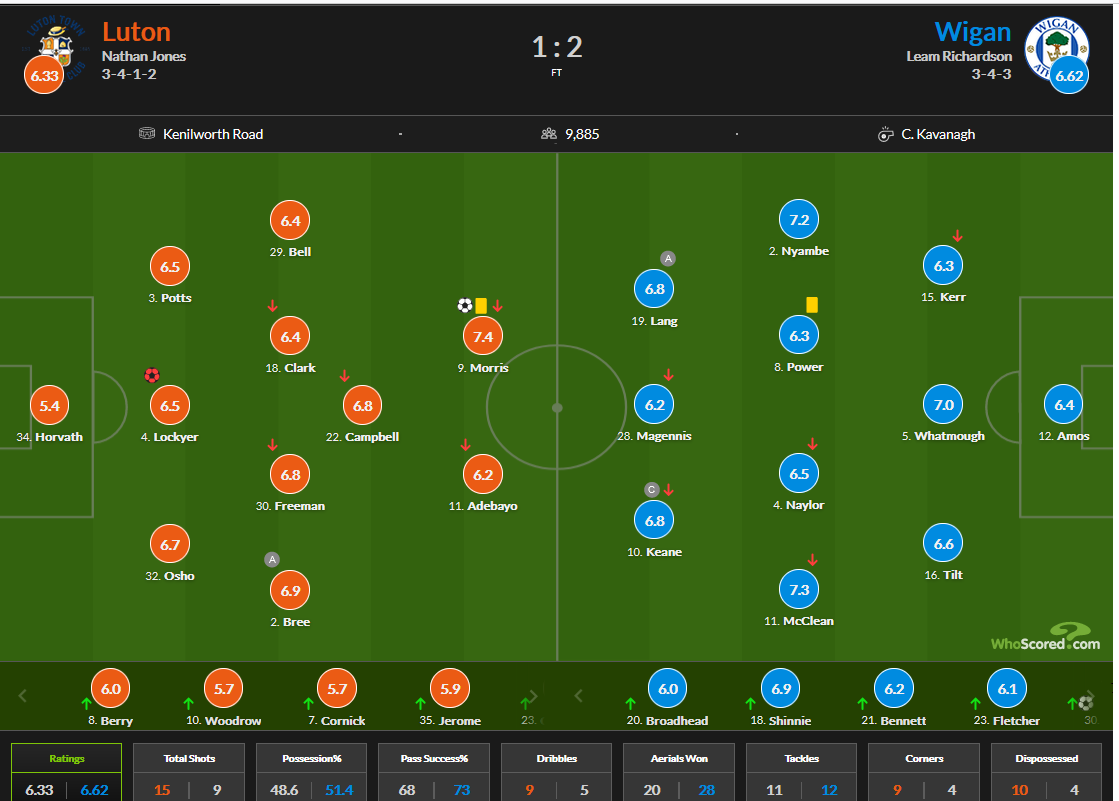
I found the first hour of play at Luton depressing. It was reminiscent of the early days of the Moore era. “Hopeful” long balls launched from the goalkeeper and his defence towards an isolated Josh Magennis. Luton are by no means an attractive footballing side, their main approach being to launch crosses from the flanks to two burly central strikers. However, it was still more constructive than Wigan’s approach and they would have added to their one goal lead if it had not been for the excellence of Ben Amos and resilience in defence.
Richardson’s three substitutions after 62 minutes changed the whole pattern of the game. Graeme Shinnie transformed the midfield by not only his tenacity, but by his ability to pass the ball on the ground to initiate attacks. Nathan Broadhead’s movement and Thelo Aasgaard’s sheer class and calm on the ball shone through. Callum Lang was having a torrid afternoon, but his stubbed shot was deflected into the net by a Luton defender in the 80th minute. Aasgaard’s stunning winner in the 88th minute came from an incisive pass along the ground by Lang, after Ashley Fletcher had drawn defenders away to provide the space.
The LaticsTV commentary remarked on the manager’s genius at making those bold substitutions, but the majority of fans on the social media asked why he had not put out a line-up like that from the start.
The pessimists are already suggesting that Richardson will revert to type for the upcoming Blackburn game, keeping faith in the senior professionals who helped win promotion last season, launching long balls to a big target man. It was Plan A in the Luton game, Plan B being playing constructive football with the ball on the ground.



 LOS THREE AMIGOS