Matt Smith was a key player in Shaun Maloney’s tenure as Wigan Athletic manager. If any player was almost irreplaceable in the Latics legend’s system, it was he. Maloney favoured a brand of possession football where moves are patiently built up from the back. Smith played the role of pivot in front of the central defenders, providing both extra defensive stability and creativity going forward. His serious hamstring injury near the end of December was a hammer blow to a manager who was struggling to impose his style of play on a young squad.
The Maloney era was one which helped stabilise a club that had come so close to going out of existence. The Scot had to operate on a much-reduced budget than his predecessors and aim towards making the club sustainable though the development of young players. Sadly, he is largely remembered for lacklustre home displays last season that provided scant entertainment for the fans. However, there were moments in his two-year spell where it looked like the manager’s vision might eventually come to fruition. Matt Smith was the catalyst who enabled those glimpses of skilful, flowing football.
Smith is still only 24 years old. An ex-Arsenal youth and under-21 team captain, he spent loan spells at Charlton, Swindon and Doncaster before Maloney signed him on a free transfer in July 2023. Although Maloney used him solely in the pivot role, he had shown himself to be an all-round midfielder in his Gunners days where he notched 7 goals and 22 assists in 94 appearances for the Gunners age group teams His attacking skills were also prominent in his stay at Doncaster.
In last night’s League Cup victory over Stockport County, he was employed in the #6 role in front of the defence, Baba Adeeko and Tobias Brenan playing further forward as #8s. However, Tyrese Francois has looked comfortable this season in the #6 role, which is also Adeeko’s best position. It leaves Ryan Lowe with options on how to utilise his midfielders. Both Smith and Francois have the skills necessary to play the #8 position. Adeeko’s strength lies in his ability to close down the opposition and protect the defence. Creativity is not his forte.
The return of Matt Smith was a welcome sight last night. Latics fans have not seen enough of him in his two years at the club. A groin injury in his first season and hamstring injury in his second meant that he has was available for selection for only half the time he has been at the club. Providing he can stay fit he can play a major role in Ryan Lowe’s plans.
“I thought Thelo’s performance in the second half against Charlton was as good as he’s produced since I’ve been here…I still think there’s a lot more he can do, but he’s doing okay.”
Shaun Maloney’s comment hit the nail on the head. His appraisal of Thelo Aasgaard was fair. Although the Norwegian did not have a great game against Charlton he was certainly one of the better performers that day. But one gets the feeling watching him that there he is playing below his capabilities.
Aasgaard made his league debut for Latics as an 18 -year-old in October 2020, coming on as an 88th minute substitute in a 0-1 home loss to Peterborough United. It was a bleak time to make a first appearance, with the club reeling from being under administration and the Covid pandemic causing football matches to be played behind closed doors. However, it provided opportunities for some of the club’s academy players with the club being cash-strapped, unable to bring in many experienced pros. Aasgaard went on to make 13 League 1 starts that season, with 20 appearances off the bench.
The following season he made just one league start, coming on as a substitute 4 times, in Leam Richardson’s League 1 title winning side. Last season saw the player making his largest number of appearances with 12 starts and 19 substitute experiences in the Championship.
Stats courtesy of Soccerway.com
In terms of playing time, it could be argued that Aasgaard has had more than enough to more consistently reveal his impressive range of talents. Click here to see his goalscoring prowess. He has been played in a variety of positions, although predominantly wide on the left. Although he has the attributes as a midfield playmaker he has rarely been employed in that position and when he has played there he has not over-impressed.
Together with Charlie Hughes, Aasgaard stands out as a player who has the capability to play at a much higher level. Although only 20 the former has already established himself as one of the first names on the team sheet, seeming destined to become a Premier League player. But some players mature earlier than others.
In the last three games Aasgaard has played the full 90 minutes-plus, scoring two goals. He has thrived in the role of playing in a mobile, interchanging front three. Maloney clearly has faith in the player and has given him the opportunity to play in a run of games that he has rarely been afforded in the past. Aasgaaard’s skills blend well with those of Martial Godo and Stephen Humphrys in a pacy and stylish front three.
Will this be Thelo Aasgaard’s breakout season?
Click here to see our previous article “Finding the right place for Thelo Aasgaard“
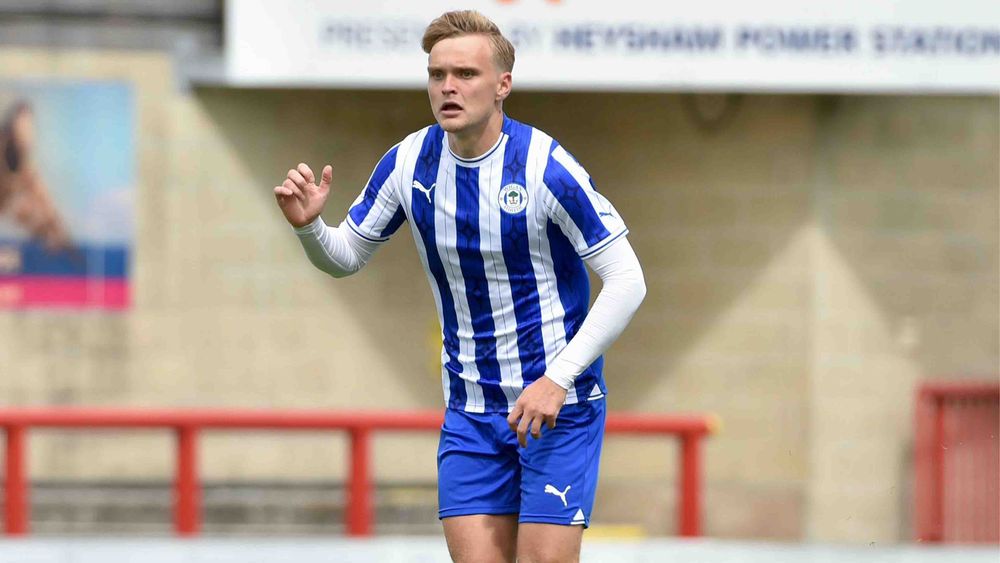
Matt Smith: a key player in “Maloneyball” (photo courtesy of Wigan Athtletic)
“We’ve pushed really hard to get him and he’s very important to how we are looking to play this year”
It was Shaun Maloney commenting on signing Matt Smith on a free transfer from Arsenal.
The 23-year-old Smith was hardly a “marquee signing”, having spent the past three seasons on loan at Swindon, Charlton and Doncaster. But he had been at Arsenal since he was seven and was steeped in the footballing style of the north London club. Why is Smith so important to the way Maloney wants his team to play this season?
Wigan Athletic’s early season form was a revelation. It was characterised by a possession-based style of football diametrically opposed to the long-ball approach that had been the norm over the past five years at the club. In true “Maloneyball” players get lots of touches of the ball, being required to create space for themselves in order to receive it. It is a purposeful style of football, based upon opening up the opposition, rather than merely retaining possession for possession’s sake.
Matt Smith played a pivotal role in excellent team performances in August. He constantly made himself available in tight situations, to receive the ball from defenders, rarely wasting a pass. Latics gained 10 points from their first four games in League 1, including wins at Bolton and Derby, both among the bookmakers’ favourites for promotion.
After a series of outstanding performances in August, Smith’s form dwindled. He was not able to stamp the same kind of authority on the play. In the first week of October Maloney revealed that Smith had been playing through pain caused by a hernia injury. He would receive surgery and would be out of action for up to six weeks.
The manager added:” I don’t know how these injuries happened; he was wrestling with his stomach. He was the ideal type of No. 6 or No. 8 I needed this summer, as seen by his performances against Derby, Carlisle, and Bolton.” Maloney also stated his expectation that other players would step up to cover Smith’s absence.
Sadly, Latics’ performances and results have taken a dive since August. They have lost their last four league games and the 8-point deduction means that they are in 23rd place with 5 points. Dire refereeing has played its part in the decline: controversial red cards and penalty decisions have hit Latics hard. The low point of the season was a 4-1 defeat at Bristol Rovers, followed by narrow defeats to Portsmouth, Burton Albion and Stevenage.
The praise that Maloney was receiving from fans in August has now veered towards heavy criticism as the results have nosedived. Among the many complaints are those that there seems little method in the way the team has been playing, a far cry from early in the season where the style of play was well-defined and the players clearly knew their roles. Team selection has also come under fire, some saying there has been too much squad rotation. The midfield, which was excellent in early season, has not provided sufficient protection for the defence, nor has it linked up well with the attack. It needs a hard man in the style of Sam Morsy in midfield. There have been too many changes in defence in particular. The inverted full back system has limited the attacking scope of the full backs. Maloney has been too loyal to some players over others. The cynics say that Maloney does not know his best starting X1.
At the start of the season Maloney named Josh Magennis as club captain and Callum Lang as vice-captain. Charlie Wyke has established himself as the first-choice centre forward, with Magennis as back up. Lang had an awful time last season in the Championship and his nightmare has continued in League 1, where the player had excelled a couple of seasons ago. Despite his woeful form Lang has featured in all 11 league games, in the majority of which he was a starter. The manager has continued to believe in the player, but with capable backups in the squad his preference for Lang has been questionable. Magennis has neither the goal scoring talent of Wyke, nor his ability to play as the target man role. With Wyke suspended, Maloney started the game at Burton with with a front three of Lang (one goal in his last 46 league games), Magennis (one goal in 44 league games) and Callum McManaman who scored a great goal against Northampton, but was never a prolific goal scorer.
With the international break Maloney has been afforded time to ponder over his options. Team selections and tactics have to be right. With Wyke suspended he has the option of playing Steven Humphrys at centre forward or to give the 19-year-old Josh Stones a league debut. Without Matt Smith we can expect less inter-passing between defence and midfield, unless Liam Shaw can play such a role. It is important to have a consistency in the centre of defence. Charlie Hughes will start, but who will play alongside him? Liam Morrison was excellent in early season, but has fallen out of favour. Omar Rekik and Kell Watts have been disappointing, although the former has had to play at full back at times. Lang has been mainly playing in the number 10 role, putting in lots of energy, but with close to zero end-product. Thelo Aasgaard is a natural number 10 but has been very disappointing so far. Humphrys might also be tried there.
Ideally Maloney would have Latics play that brand of football we saw in August, but Latics are in a relegation dog fight. Perhaps when Matt Smith returns to action, they will be in a healthier position to revert to that silky football we saw at the start of the season. Smith’s injury certainly had an effect on performances but it is not the sole reason that Latics have fallen down the table.
Maloney is still a relatively inexperienced football manager, but he is bright and talented and has shown real commitment towards the club. He has a young squad, operating on a quarter of the budget of last season. There is sufficient talent in the squad for Latics to avoid relegation and establish themselves in the division. Such is the youth of this squad that we can expect ups and downs along the road. It could be a bumpy ride until the season ends.
Matt Smith: a key player in “Maloneyball” (photo courtesy of Wigan Athtletic)
“We’ve pushed really hard to get him and he’s very important to how we are looking to play this year”
It was Shaun Maloney commenting on signing Matt Smith on a free transfer from Arsenal.
The 23-year-old Smith was hardly a “marquee signing”, having spent the past three seasons on loan at Swindon, Charlton and Doncaster. But he had been at Arsenal since he was seven and was steeped in the footballing style of the north London club. Why is Smith so important to the way Maloney wants his team to play this season?
Wigan Athletic’s early season form was a revelation. It was characterised by a possession-based style of football diametrically opposed to the long-ball approach that had been the norm over the past five years at the club. In true “Maloneyball” players get lots of touches of the ball, being required to create space for themselves in order to receive it. It is a purposeful style of football, based upon opening up the opposition, rather than merely retaining possession for possession’s sake.
Matt Smith played a pivotal role in excellent team performances in August. He constantly made himself available in tight situations, to receive the ball from defenders, rarely wasting a pass. Latics gained 10 points from their first four games in League 1, including wins at Bolton and Derby, both among the bookmakers’ favourites for promotion.
After a series of outstanding performances in August, Smith’s form dwindled. He was not able to stamp the same kind of authority on the play. In the first week of October Maloney revealed that Smith had been playing through pain caused by a hernia injury. He would receive surgery and would be out of action for up to six weeks.
The manager added:” I don’t know how these injuries happened; he was wrestling with his stomach. He was the ideal type of No. 6 or No. 8 I needed this summer, as seen by his performances against Derby, Carlisle, and Bolton.” Maloney also stated his expectation that other players would step up to cover Smith’s absence.
Sadly, Latics’ performances and results have taken a dive since August. They have lost their last four league games and the 8-point deduction means that they are in 23rd place with 5 points. Dire refereeing has played its part in the decline: controversial red cards and penalty decisions have hit Latics hard. The low point of the season was a 4-1 defeat at Bristol Rovers, followed by narrow defeats to Portsmouth, Burton Albion and Stevenage.
The praise that Maloney was receiving from fans in August has now veered towards heavy criticism as the results have nosedived. Among the many complaints are those that there seems little method in the way the team has been playing, a far cry from early in the season where the style of play was well-defined and the players clearly knew their roles. Team selection has also come under fire, some saying there has been too much squad rotation. The midfield, which was excellent in early season, has not provided sufficient protection for the defence, nor has it linked up well with the attack. It needs a hard man in the style of Sam Morsy in midfield. There have been too many changes in defence in particular. The inverted full back system has limited the attacking scope of the full backs. Maloney has been too loyal to some players over others. The cynics say that Maloney does not know his best starting X1.
At the start of the season Maloney named Josh Magennis as club captain and Callum Lang as vice-captain. Charlie Wyke has established himself as the first-choice centre forward, with Magennis as back up. Lang had an awful time last season in the Championship and his nightmare has continued in League 1, where the player had excelled a couple of seasons ago. Despite his woeful form Lang has featured in all 11 league games, in the majority of which he was a starter. The manager has continued to believe in the player, but with capable backups in the squad his preference for Lang has been questionable. Magennis has neither the goal scoring talent of Wyke, nor his ability to play as the target man role. With Wyke suspended, Maloney started the game at Burton with with a front three of Lang (one goal in his last 46 league games), Magennis (one goal in 44 league games) and Callum McManaman who scored a great goal against Northampton, but was never a prolific goal scorer.
With the international break Maloney has been afforded time to ponder over his options. Team selections and tactics have to be right. With Wyke suspended he has the option of playing Steven Humphrys at centre forward or to give the 19-year-old Josh Stones a league debut. Without Matt Smith we can expect less inter-passing between defence and midfield, unless Liam Shaw can play such a role. It is important to have a consistency in the centre of defence. Charlie Hughes will start, but who will play alongside him? Liam Morrison was excellent in early season, but has fallen out of favour. Omar Rekik and Kell Watts have been disappointing, although the former has had to play at full back at times. Lang has been mainly playing in the number 10 role, putting in lots of energy, but with close to zero end-product. Thelo Aasgaard is a natural number 10 but has been very disappointing so far. Humphrys might also be tried there.
Ideally Maloney would have Latics play that brand of football we saw in August, but Latics are in a relegation dog fight. Perhaps when Matt Smith returns to action, they will be in a healthier position to revert to that silky football we saw at the start of the season. Smith’s injury certainly had an effect on performances but it is not the sole reason that Latics have fallen down the table.
Maloney is still a relatively inexperienced football manager, but he is bright and talented and has shown real commitment towards the club. He has a young squad, operating on a quarter of the budget of last season. There is sufficient talent in the squad for Latics to avoid relegation and establish themselves in the division. Such is the youth of this squad that we can expect ups and downs along the road. It could be a bumpy ride until the season ends.
In late November 2013 a 20-year-old centre forward signed for Wigan Athletic on a month’s loan from Manchester United, joining another player already borrowed from that same club for a year. Both were to leave Wigan that season to return in later years. Will Keane and Nick Powell would go on to become major figures in Latics’ history.
Keane had played for England at U16, U17, U19 and U21 levels and had made his Premier League debut in December 2011 against Blackburn Rovers. He made his debut for Latics on December 1, 2013, only to be replaced at half time with Wigan 3-0 down to Derby County. He started the next game at Leeds United but was substituted after 55 minutes. After making two more appearances off the bench his stay at Wigan was cut short by a groin injury.
After such a promising start as a young player Will Keane’s career meandered. He went on to loan spells at Queens Park Rangers, Sheffield Wednesday and Preston before signing for Hull City for £1m in August 2016. In November 2016 he suffered a serious knee injury that saw him out of first team action for over a year. After making 22 appearances for the Tigers, scoring one goal, he joined Ipswich Town on loan in January 2019. After being given a free transfer by Hull he signed a one-year contract at Ipswich with the club having an option of a further 12 months. However, with football suspended due to the Covid-19 pandemic Ipswich chose not to take up their option and Keane left in May 2021 after scoring 6 goals in 34 league appearances for the Tractor Boys.
Keane ‘s return to Wigan in October 2020 was hardly greeted by a fanfare. He was joining a club that was on its knees under the yoke of administration with a threadbare squad. The club’s future was in the balance and even if new owners were to be found it was going to be an uphill battle to avoid relegation. He had signed a short-term contract until early January. He made his debut in a 3-0 defeat at Crewe, then appeared in losses to Charlton and Peterborough. However, on October 24 he scored the equaliser in a 1-1 draw with Plymouth. By the time his contract was up he had scored 4 goals in 9 League 1 appearances. On January 15 Keane signed another contract for the remainder of the season.
Will Keane proved to be a key player as the season continued, being more often played in a role behind the central striker. After spending his career as a number 9 he began to thrive in his new role, which better allowed him to showcase his broader range of skills. It was certainly a learning experience, but he looked a much better player. By the end of the season, he had scored 11 in 34 appearances, the best goalscoring ratio of his career. Moreover, he had overcome most of the career-long injuries and niggles that had dogged his career. It was the first season he had made more than 30 senior team appearances in a season.
Having witnessed Keane’s football renaissance Latics gave him a new 2-year-contract in June 2021. The player has gone from strength to strength, being one of the first names to be penciled into Leam Richardson’s team selections. Although he has occasionally been employed as a centre forward, he has usually operated in a number 10 or inside forward role.
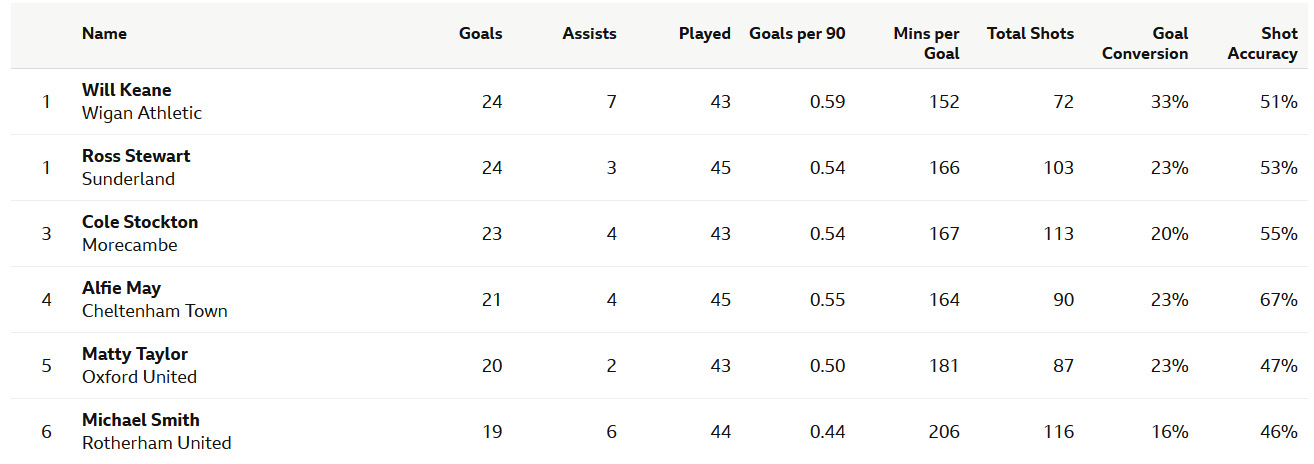
Courtesy of bbc.co.uk
The other players appearing in the above stats typically play as centre forwards. Keane’s ability to find space coming through from midfield has brought him so many goals.
Keane is at his best when linking up with midfield and initiating attacks. At 6ft 2in height he is a constant threat in the opponents’ penalty box, but he also plays a major shift in helping his own defence deal with set pieces. His ability to ghost his way into the box and get into the right place at the right time has caused problems for so many defences. Despite receiving lots of attention from the opposition trying to close down his threat he maintains his self-discipline, as evidenced by his receiving just two yellow cards this season.
Keane’s fine form brought him to the attention of Republic of Ireland manager, Stephen Kenny. Although he represented England at junior levels he decided to opt for Ireland, his father being Irish, at senior level. He made his debut for Ireland in a world Cup qualifier against Portugal in November.
Will Keane has resurrected his football career. He is an intelligent player with sound technical skills and good vision. Should Latics get promoted this weekend, as they almost certainly will, he will be able to showcase his skills once more in the Championship. This time around he will be at the peak of his career, with the self-confidence and fitness that may have been lacking in his previous spells in the second tier
Players reach their peak at different ages. Keane is now 29 years old and will be out to show the football world what a fine player he is. Will he reach his peak next season?



 LOS THREE AMIGOS