Wigan Athletic’s Crisis Goes Beyond Managers — Here’s What Must Be Done

Why the club’s crisis goes beyond managers — and what must be done to rebuild a football identity that lasts.

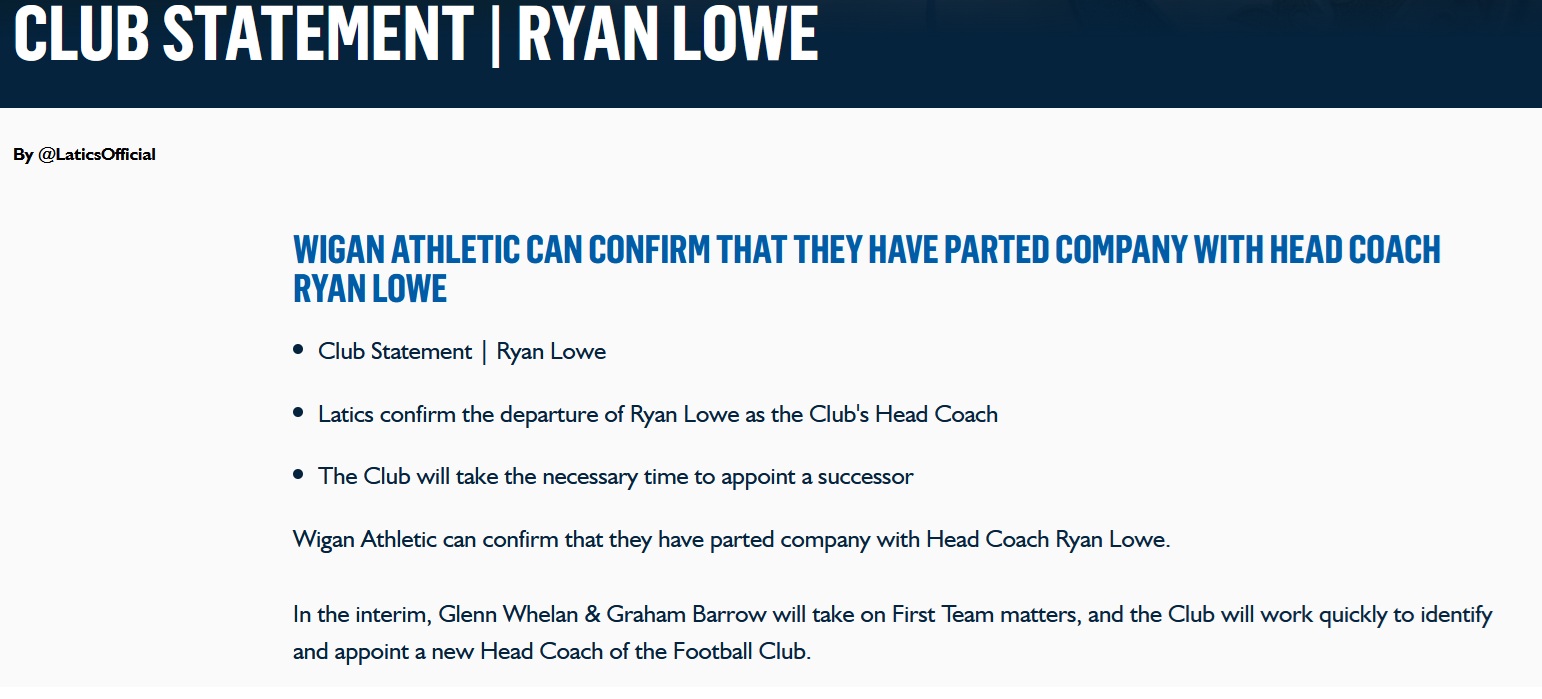
Wigan Athletic have officially parted ways with Ryan Lowe, ending an appointment that promised high-tempo, overachieving football but delivered little more than chaos. It was an inevitable decision: the team struggled to gel, results plummeted, and Latics now sit in the relegation zone. But while Lowe leaving makes the headlines, it really just highlights a bigger problem — Wigan Athletic don’t have a clear football identity, and until they sort that out, this cycle of instability is going to keep repeating.

Lowe came in with a reputation for overachieving, having impressed by pushing intensity and tempo above what this squads on paper could handle. That seemed to fit Wigan’s situation. In reality, that reputation was conditional. At Plymouth, his notable success was built on a solid tactical framework, where Steven Schumacher played a huge, if often overlooked, part. Without that kind of support and with a squad that wasn’t built for his style it quickly fell apart.

The fallout was messy: a squad built for multiple systems and suited to none now sits in the relegation zone. Following Lowe’s style was always going to need big changes and a long-term recruitment plan. He had a three-and-a-half-year contract, supposedly enough to lay the groundwork for a promotion push. But his preferred three-at-the-back system needed specialist wing-backs —key players the club never brought in, neither over the summer nor in January. As a result, his various formations, variations on 3-4-3, 3-1-4-2, 3-2-4-1, were rarely going to work.

Defensively, things were just as shaky. Wigan’s system relied on players getting back into position after losing the ball, but with constant turnovers, that rarely happened. Instead of controlling games with pace, the team stretched too far, left spaces open, and relied on second balls they couldn’t win. What was meant to be structured, intense football became disorganized and reactive. Tempo without structure ended up being chaos.

Looking back, it’s easy to see the contrast with what came before. Shaun Maloney’s Latics weren’t perfect, but at least they were understandable. His teams tried to control matches through possession, keeping units compact and roles clear. Results and entertainment weren’t always great, but there was a logic to the way they played — and it suited a club relying on loans, young players, and development rather than brute force. Replacing Maloney with Lowe wasn’t just swapping managers; it was a philosophical leap. Recruitment, squad balance, and tactics all pulled in different directions, and continuity went out the window.

The issues go way beyond managers, though. Gregor Rioch is also under pressure by the  fans. Rioch has been at the club for twelve years and, for better or worse, is now tied to almost everything Wigan do — or don’t do — on the pitch. The sporting director’s job is supposed to give some continuity above the head coach, but instead Wigan have gone through two contrastingly different managers, tried incompatible styles, and never really nailed down a recognizable way of playing. Whether Rioch stays or leaves, the role needs a serious rethink. Whoever fills it has to have the authority and responsibility to enforce a football identity, or the next manager is going to end up stuck in exactly the same mess.

That instability has left Wigan in the relegation zone with a squad built for multiple systems and suited perfectly to none. The danger now is repeating the same cycle — reacting to the failure of one style by chasing its opposite, instead of addressing the absence of a long-term plan.

Aligning the club to Lowe’s approach would require recruitment power Wigan do not possess and would accept volatility as the norm. Returning to Maloney’s principles, by contrast, offers a foundation: not aesthetic possession football, but a structured, compact, possession-leaning model with defined vertical triggers. A vertical trigger is simply a cue for a team to stop circulating the ball safely and go forward with intent. Instead of endlessly passing across the back line, players are coached to recognise specific moments when the opposition’s shape gives them an opportunity to attack.That trigger might be a forward peeling into space, a midfielder finding room between the lines, or an opponent stepping out of position and leaving a gap behind them. The key point is that progression isn’t random or rushed. The team waits for the right picture, then attacks decisively. It’s what separates possession with purpose from possession that just looks tidy but goes nowhere.

`Claims from a minority of fans that the club is “rotten from top to bottom” are emotionally powerful but analytically incomplete. The squad is not chronically uncompetitive. The academy continues to produce usable players. The fanbase remains engaged. What is broken is the connective tissue between ownership, sporting leadership, and the first team. Decisions have been isolated rather than aligned, producing constant resets instead of cumulative progress.

 Ownership always comes under the spotlight. Fans can complain about a lack of ambition, but the bigger problem has been inconsistency. Abrupt managerial changes, reactive appointments, and minimal clarity about long-term plans have left the club drifting rather than building. Ambition isn’t just about spending money — it’s about having a clear vision for style, recruitment, and success over multiple seasons. The fan perception that “everything is rotten from top to bottom” reflects frustration at that lack of alignment, not the quality of the squad itself.

So, what now? Wigan need to define a football identity first: structured, possession-oriented, and adaptable to League One realities. Recruitment, coaching appointments, and tactical planning all have to line up with that vision. The sporting director role has to be reshaped or replaced to enforce that philosophy consistently. Only then does hiring a head coach make sense. Only then can the club stop reacting to short-term failures and start building something sustainable.

Relegation would be a blow, but drift is worse. Clubs can recover from dropping a division. They rarely recover from never deciding who they are.

Wigan Athletic: time for a change?

Courtesy of bbc.co.uk

Wigan Athletic’s decision to part company with Shaun Maloney came after one win in eight matches had dragged the club down to 15th place, just six points above the relegation zone, and the mood among the fans had turned increasingly sour. When the club cited a failure to provide the “entertainment that supporters expect,” it was a telling choice of words — suggesting the issue ran deeper than the league table alone.

That same phrase now feels uncomfortably relevant again.

Under current head coach Ryan Lowe, Wigan find themselves 18th in League One, one point clear of trouble, with just one win in their last seven league outings. Performances have done little to ease growing fan frustration, and the sense of déjà vu is hard to ignore. Results have dipped, confidence has drained, and the football itself has struggled to inspire.

Supporters are once again asking familiar questions. Not just about results, but about identity. What is this team trying to be? Where is the attacking intent? And perhaps most importantly, where is the sense of progress?

The club’s ownership now faces a decision similar to the one they made with Maloney. Do they act decisively in response to mounting pressure, or do they hold their nerve and give Lowe the time to steady the ship? If patience is the chosen path, Lowe will need to address the same concerns that proved fatal for his predecessor — a lack of cutting edge, a shortage of excitement, and a feeling among supporters that the football simply isn’t delivering what they expect from their club.

Fan frustration with Ryan Lowe has been building around a few familiar themes. Supporters feel Wigan lack attacking threat and creativity, with performances often slow, cautious and short on ideas. There is a growing sense that the team plays not to lose rather than to win, particularly in games where greater ambition is expected.

A key criticism has been Lowe’s reluctance to change his system. Fans feel he has become too wedded to one formation, even when it clearly isn’t working, and that his in-game adjustments come too late or have little impact. This has fed into a broader belief that he hasn’t fully grasped what the club and its supporters expect in terms of style, intensity and front-foot football.

Over time, this has led to wider doubts about identity and direction. Results have struggled, but it’s the lack of entertainment and visible progress that has really tested patience — leaving many supporters questioning whether Lowe truly understands the club he’s managing or how to get the best out of it.

Yesterday’s game against Bolton was a big one for Lowe and his players, but their response was as poor as what happened last time the teams played each other.

The season had started positively until that inept performance in a 4-1 trouncing at Horwich in last September. Latics had just one shot on target and received just one yellow card in a derby game. Up to that point Lowe had adopted a 3-1-4-2 system, with Matt Smith playing the deep midfield role, the wing backs and more advanced midfielders providing a quartet behind the two strikers. As time moved on Lowe’s tactics, particularly away from home, became more a more defensive 3-2-4-1, a striker being omitted to pack the midfield. More recently it has morphed into a 3-4-3 system, with Callum Wright being pushed forward into an attacking role on the left of the front three.

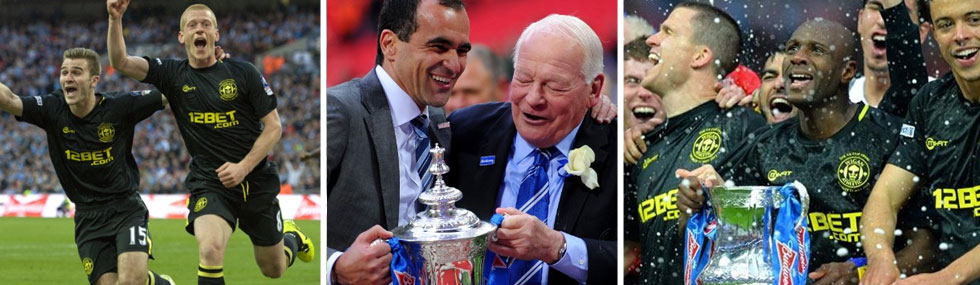
When Roberto Martínez switched Wigan to a 3-4-3 halfway through the 2011–12 season, the club was rock bottom of the Premier League and staring relegation in the face. It looked risky at the time, but it turned out to be inspired. Emmerson Boyce was pushed into a wing-back role, David Jones filled in on the left, until the January signing of Jean Beausejour — a natural wing-back for Chile — gave the system real balance.

What followed was remarkable. Wigan climbed to 15th, won seven of their final nine games, and picked up famous victories away at Arsenal and Liverpool, plus a home win over Manchester United. The FA Cup win over Manchester City the following season came using the same shape, even with players filling in out of position due to injuries.

Yet even then, not everyone was convinced. Some fans never warmed to the back three and longed for the old 4-4-2 they’d seen under Paul Jewell. That group of supporters never really went away — and many of them were pleased when Ryan Lowe arrived promising two strikers and a more attacking outlook. The dull, ugly football at the end of last season was tolerated because people believed something better was coming.

So far, that hasn’t really happened.

In truth, Lowe’s football has been no more entertaining than what came before it. If anything, it’s drifted into something even more functional — combative, cautious, and increasingly reliant on long balls. The idea of a more front-foot team hasn’t materialised.

There’s a common belief among football fans that playing three at the back automatically means defensive football. That isn’t really true. Plenty of teams use a back three to play expansive, attacking football. The problem at Wigan isn’t the system itself — it’s how it’s being used.

Under Lowe, the wing-backs now sit far too deep, as do the two holding midfielders. The result is a huge gap between defence and attack, leaving centre-backs with no real passing options. Too often the only solution is to go long, which just hands possession away. It’s not a design flaw as much as a lack of intent.

What’s frustrated supporters most is Lowe’s reluctance to change things when they’re clearly not working. Many have called for a switch to a back four, but he’s stuck stubbornly to his shape. That hasn’t helped by the fact that none of the regular wing-backs had much experience playing there before this season, making the system even harder to execute properly.

Despite all this, sacking Lowe now would feel like repeating the same old cycle. The club has churned through too many managers already, and constant upheaval hasn’t helped anyone. He should be given until the end of the season to try and fix things — but that comes with conditions.

There needs to be more attacking intent, less aimless long ball football, and more flexibility in how the team sets up. Lowe has to show he can adapt, trust his more technical players, and get more out of the squad than he has so far.

If he can’t do that, then a change in the summer would be justified. There’s enough quality in this group to stay up, even if it’s tight — but only if the football improves.

Wigan Athletic Under Ryan Lowe: From Grit to Something Greater?

Wigan Athletic’s time under Ryan Lowe has really been one built on grit. In football, “grinding out results” basically means doing whatever you need to get points, even if it’s a slog. It’s about being organised, disciplined, and prepared to battle for everything. In a league as tight and physical as League One, that kind of mentality often matters more than pretty football. Managers want players who stay switched on, stick to the plan, and don’t fall apart under pressure. It’s not always thrilling to watch, but it turns bad days into draws and half-chances into big wins.

When Lowe arrived in March 2025, Wigan were in a lower mid-table position and seriously struggling for goals — bottom of the league in that department. They weren’t heading straight for relegation, but the season had drifted. Lowe’s arrival felt like a reset — new ideas, fresh energy, and a chance to stabilise things.

Before long, the team leaned fully into that scrappy, hard-working identity. They finished the season in 15th, mostly because they became tougher mentally and harder to beat. They clawed back deficits, held onto narrow leads, and looked like a side willing to dig in. Not glamorous, but effective.

Over the summer, Lowe shaped the squad to fit his preferred 3-1-4-2. That system relies heavily on wing-backs, and the opening game of the new season showed exactly why. Joe Hungbo and Fraser Murray were excellent in the 3-1 win over Northampton — a scoreline that honestly could’ve been bigger. The first 20 minutes were messy and disjointed, but Murray’s goal around the half-hour settled everyone down and suddenly the team looked much more like a unit.

Of course, settling into a new shape and integrating new signings takes time. The early weeks were a mix of positives and frustrations: solid performances, some good results, but also draws where Wigan should’ve taken more. Opposition managers quickly figured out how dangerous the wing-backs were, so Hungbo and Murray started getting much more attention defensively. That’s League One — once you show a threat, everyone finds a way to make life difficult.

After eight league games, Wigan were sitting at W3 D3 L2 with 13 goals scored and 9 conceded — decent, but clearly still a work in progress. Then came Bolton. Wigan had enjoyed a strong record against them recently, and fans saw it as a genuine benchmark of their progress.

But Bolton, led by Steven Schumacher, were flying. They went with two natural wingers and caused Wigan’s wing-backs all sorts of problems. Latics were second best throughout, losing 4-1, and the fans were furious. They felt the team didn’t show enough fight and that Lowe hadn’t treated the derby with the importance it deserved. They even pointed out the lack of cards — Wigan picked up one yellow, Bolton none — which raised questions about the passion and intensity on display.

It did feel like Lowe misjudged the moment. Derbies aren’t just about points; they’re about pride and emotion. If that wasn’t fully communicated to the players, it could explain the flat performance. And once fans start questioning desire, the pressure ramps right up.

The Bolton defeat hit confidence hard. The football tightened up, became more cautious, and the spark in the final third faded. Lowe leaned further into defence-first thinking, which made sense in the moment but dulled the attacking edge even more. The injury to Ryan Trevitt made things worse — without their most creative midfielder, Wigan lacked imagination. The wing-backs also had to focus more on defending, meaning they weren’t getting forward as freely.

All of this made Wigan more solid, but not exactly entertaining. The challenge now is finding the right balance — keeping that grit without switching off the creativity.

As it stands, Latics sit 11th with a record of W6 D7 L5. They’re definitely harder to beat, and while fans still daydream about a run toward the Championship, Lowe has sensibly played that down, treating promotion as a long-term aim rather than something immediate. His popularity has dipped during the rough spells — some fans have even called for him to be sacked, others are simply bored by the football. But given how many managers Wigan have chewed through over the past decade, stability is badly needed. Lowe deserves the time to build something properly.

His spell at Preston is a useful comparison. In his first full Championship season there, they started with a 0-0 at the DW — one of FIVE goalless draws in their first six games. They had one of the smallest budgets in the league, yet still finished 12th. Not spectacular, but quietly impressive.

This season, Wigan reportedly have a top-ten League One budget. So can Lowe get them punching above their weight and pushing into the play-off conversation? A lot will hinge on the January transfer window.

With his commitment to 3-1-4-2, he needs proper wing-backs. He couldn’t sign any specialists in the summer and ended up using Hungbo and Murray — talented players, but natural wingers. Two real wing-backs surely top the shopping list, unless K’Marni Miller returns ready to step up. He also needs more creativity in midfield and better service for the strikers, who simply haven’t scored enough.

And that’s the big question hanging over everything: if the supply improves, will the forwards finally deliver the goals Latics need?

What a difference a win makes

It had been doom and gloom among so many Wigan Athletic fans for too long. The team was lying below mid-table in League 1 and the last time Latics had last won an away game under Ryan Lowe was on Good Friday.

The game at Wimbledon looked like it was following on from what we had seen before. The home side were a goal up, despite Wigan having the better chances in a first half when they could have gone ahead. They had not played badly but just did not look like they were going to show killer instinct in front of goal.

Enter the 18-year-old Harrison Bettoni in the 77th minute. With his first touch of the ball, he scored from a sublime free kick curling in to the top corner. Ten minutes later he latched on to a clever flick from Paul Mullin to race through and slot home. The away support went wild with excitement.

After talking about avoiding relegation and sacking Lowe the less tolerant and less patient core among the fan base have started to perk up. One fan even suggested promotion was even a possibility with Latics just 8 points behind the leaders, Cardiff City, after 16 games played.

Although Bettoni’s league debut was spectacular some fans had not heard of him. However, he has been at Wigan since his early teens and was a key player in the youth team. Lowe trusted him with the free kick because he had been taking them in the junior ranks for some time. Bettoni had showed his mettle in a much-improved U21 team and it was to Lowe’s credit that he was given that chance.

Wigan’s U21 team had a tough start to the season, losing their first four games. Their transformation was helped on its way by the arrival of 20-year-old Adam Moseley on trial from Runcorn Linnets. Moseley’s record of 17 goals in 11 games for the U21 team speaks for itself. Although he had been appearing under the name of “Trialist”, posts on social media a week ago told us his name and that he had agreed to a two-and-a-half-year contract at Latics. Although this has now been revealed in the local press, nothing yet has appeared on the club website.

The main news on the U21 side recently has been in sending players away on loan. Tom Watson has gone to South Shields, Leo Graham to Bury, Jack Rogers to Macclesfield, Christy Edwards to Witton Albion and K’Marni Miller to Radcliffe FC. Kai Payne went to Oldham Athletic at the start of the season, but injury has limited his appearances to 10 games so far. Some fans have been critical that the club has not secured them loan spells at clubs in higher tiers of English football. However, the majority are short term loans which expire before January.

The U21 team’s last three results have been spectacular. A 9-0 win at Coventry was followed by a 2-1 home win over top of the table Sheffield United, then by a 7-2 win at Barnsley. In the absence of U21 match reports on the club’s website one has had to rely on picking up information from opposing clubs’ sites. In previous years there were pockets of information on players in both the U21 and U18 squads to go with their photographs but there is scant coverage now.

Bettoni’s spectacular debut and Moseley’s acquisition have certainly helped to lift the spirits of supporters. At the beginning of the season, it had looked like Lowe had lots of options with four strikers in his senior squad. However, optimism has faded over the past months as none of the four have convinced. Lowe’s preference, particularly in home games, has been to play with twin strikers. Dara Costelloe and Christian Saydee were his choice for the opening game against Northampton, but both have had three game suspensions after receiving red cards, disrupting their settling into their roles. Paul Mullin and Maleace Asamoah have been largely used as substitutes in League 1 games. Between the four of them they have scored 7 goals.

Moseley will only be available for EFL games from the start of the January transfer window. It will be interesting to see how Lowe handles Bettoni. Will he start against Stevenage on Saturday or be used as an impact sub in the latter stages?

Although Lowe clearly likes the twin striker approach he has also resorted to packing the midfield with two number 6s, two number 10s and a single central striker. The latter system looked viable while Ryan Trevitt was available to provide some goal threat as a #10, but the other midfielders who have played there have rarely looked incisive.

Callum Wright scored a well taken goal against Barnsley and has got into good positions, but lacks the composure of a midfield goalscorer. Lowe might have to continue to persevere with Wright in the hope that the composure will come, even if his career goalscoring record does not suggest that.

In a similar way he has been relying on Christian Saydee to score goals as a central striker. Saydee has scored 2 goals so far at Wigan and his career record is 14 goals in 137 appearances. Although he is unlikely to score many goals as a striker, he is nevertheless a useful player to have on the pitch. He is a powerful and skilful forward able to hold the ball, with an eye for a killer pass through a defence. Some would say his style is reminiscent of Emile Heskey. Others might cite Marc-Antoine Fortune who scored 5 goals in 71 appearances at Wigan, but was nevertheless a regular starter in the Championship.

Following the opening game against Northampton I commented here that “Looking at the current squad there is certainly enough quality to finish in the top half of the table, barring major injuries.”

Since then, Lowe lost Isaac Mabaya early on and Ryan Trevitt since the end of September. However, my comment still holds. If they can be in a mid-table position by the New Year, they will have something to build on and it is by no means impossible that they will reach a playoff position.

If Lowe had money to spend, he would invest in specialist wing backs and creative midfielders. Good, proven strikers don’t come cheap and it is unlikely that Latics will ever splash out the kind of money needed.

In the meantime, he will look at getting the best of the strikers he has at his disposal. Finding the right blend will be key.

Is Ryan Lowe’s squad good enough to challenge for promotion?

Courtesy of TheMastermindsite.com

It is a long time since Wigan Athletic fans enjoyed the first game of the season so much. Latics beat Northampton 3-1, but the margin could easily have been greater. In a lacklustre first quarter, with Wigan lacking cohesion, it looked like it would take the players some time to gel, to effectively function as a unit. However, Fraser Murray’s brilliantly taken 29th minute goal was to rapidly accelerate the process. As the game proceeded the players seemed to thrive in their well-defined roles, providing a synergy that had been absent early on. They thoroughly deserved the warm applause they received from the home fans at the final whistle.

 Lowe has based his summer recruitment on adapting the squad he inherited into one that can operate effectively in his preferred 3-1-4-2 system. It is a system where wing backs play a key role and it was highlighted by the fine performances of Murray and Joe Hungbo. Lowe had made it clear that he needed wing backs, rather than full backs. It looked like Steven Sessegnon, a specialist full back, was on his way out, but he was impressive in a new position on the left of the back three. He will be staying after all. However, Lowe considers Josh Robinson a full back and therefore unwanted. The player signed by Shaun Maloney from Arsenal in January has been practically invisible to us fans. Isaac Mabaya (20), signed on loan from Liverpool, certainly looked confident in the wing back position when he came on in the second half, for his debut in senior football. However, he was beaten to the ball for Northampton’s goal and he will need time to adjust to the demands of first team football.

Having wing backs means that natural wingers will have few opportunities unless the manager changes the shape. Dion Rankin appears to be on his way to Leyton Orient. Jonny Smith remains, although he was less than impressive as a wing back following Lowe’s arrival. Smith’s previous role as an inverted winger has no place in the manager’s style of play. Callum McManaman’s re-signing was a surprise as he too is a winger. However, both players have the capability of changing the course of a match through moments of individual brilliance. K’Marni Miller (19) was unavailable through injury on Saturday. He is an exciting prospect as a left wing back and Lowe recently gave him a new two- year contract. He will challenge Hungbo for that position.

With twin strikers being part of Lowe’s system, it was crucial that he brought in reinforcements. The exciting, talented, but raw, Maleace Asamoah (22) remains. The manager has done well to provide a wide range of attacking options by bringing in Dara Costelloe (23), Paul Mullin (31) and Christian Saydee (23). Costello looked comfortable in the orthodox centre forward role on Saturday, with Saydee behind or to the side of him receiving long balls and feeding his teammates in a manner reminiscent of Emile Heskey. Given feedback from Portsmouth supporters it was no surprise to see the powerfully-built forward have such a good game in that role. The downside is that Saydee’s career goalscoring record is akin to of another excellent target man for Latics, Marc-Antoine Fortune. Paul Mullin has a superb goalscoring record, although has not been convincing at League 1 level. But Mullin could be a key signing if he can get into gear.  All four strikers have different attributes and Lowe can mix-and-match them as he pleases. It gives so many different options. Chris Sze (23) has had a career dogged by injury and a has yet to make his mark at senior level, but the player that Maloney said had as much technical ability as any in the squad remains at the club Lowe is certainly not short of midfield options. Tyrese Francois played in the defensive midfield role in front of the back three on Saturday and looked comfortable in the role. Baba Adeeko is excellent defensively in that position. Matt Smith played superbly there for Maloney, so capably helping the back three with the high press. At times, Smith’s incisive passing could have been more effectively employed further up field. Despite some injury problems over the past couple of seasons he does not have a career record of injuries. He played 45 games for Doncaster the season before joining Wigan. Lowe insists that Smith has a role to play.

On Saturday, Lowe played Jensen Weir (23) and Tobias Brenan (19) in the central midfield positions. Weir underperformed has last season, but Lowe has kept faith in him. He had his best game for the club on Saturday, scoring an opportunist goal with a bullet header. Brenan made a very positive debut, showing composure, despite nervousness. Lowe has sent Ronan Darcy on loan to Chesterfield after declaring that a #10 does not fit in his system. Harry McHugh (22) was surprisingly offered a new contract: Lowe surely sees him as a late developer. New loan signings Callum Wright (25) and Ryan Trevitt (22) will compete for places.

Last season’s defensive record last season was excellent. Sam Tickle showed himself as a shot-stopper of a quality way above League 1 and the back three were excellent in front of him. The trio of Carragher-Kerr-Aimson were formidable. However, Maloney’s style of football was based on a solid defence, but with forwards and midfielders also playing an important defensive role. Lowe has intimated that there will be an attacking approach in home matches, as it was on Saturday. However, away from home he will more cautious His record at Preston last season showed 35 goals scored at home and 21 away.

The signing of Morgan Fox (31) on a two-year contract is a positive statement from Lowe and the club. Fox has over 300 EFL appearances in his career, largely in the Championship. He is a left centre back. Will Aimson was mainly playing there since Lowe’s arrival, although he can play in any of the three centre back positions. With Steven Sessegnon, Jon Mellish and Luke Robinson also able to play in the left centre back position there will be stiff competition for the defensive positions, providing all those players stay at the club. Will there will be some departures (along with Josh Robinson) in order to balance the books?

There was speculation through recent weeks regarding the possible sale of Sam Tickle. However, Latics fans breathed a sigh of relief when Lowe stated categorically that the goalkeeper will not be leaving. Tickle is an outstanding young keeper in all areas except his distribution. Were it not for this weakness he would surely have been snapped up by a bigger club over the summer. Together with James Carragher he is the club’s most prized asset.

Up to this stage Lowe has done a fine job in rebalancing the squad to fit his preferred playing formation. His work is not yet finished and he will need to make more adjustments to ensure that staffing costs do not exceed the budget set by Mike Danson. Looking at the current squad there is certainly enough quality to finish in the top half of the table, barring major injuries. Injuries proved a major obstacle to Shaun Maloney in his tenure at Wigan. Lowe will be hoping he can keep them at a minimum as he seeks a top eight position, which would be by no means unlikely.