Attendances Looking Good

Wigan-Shrewsbury-27_11_93

Just twenty years ago Wigan Athletic were in dire straits.

1993 had been a bad year for Latics, losing their place in Division 2 – the third tier of English football – after an eleven season stay. Long serving manager Bryan Hamilton had left in March, to be replaced by Dave Philpotts, but to no avail.

Now Latics were in free-fall, struggling in the drop zone of Division 3. New manager Kenny Swain was to have the unenviable task in keeping Latics in the Football League with a rock-bottom budget. The prospect was looming of a return to the realm of non-league football, which had been their home for 46 years prior to election into the Football League in 1978.

Fans breathed a sigh of relief when they eventually  finished in  19th place.  The  average attendance in that 1993-94 season was 1,897.

Twenty years on and Latics have been relegated again – this time from the first tier to the second.

But 2013 has not been such a bad year for Wigan Athletic. They won the FA Cup, they have a good chance of qualifying for the knockout stage of the Europa League and they have a squad good enough to make a fair crack at getting back into the Premier League.

After 7 home matches the average attendance for Championship matches stands at 14,986.

Wigan Athletic’s fan base has grown way beyond expectations.

Where do these fans come from?

A fascinating study by real estate company Rightmove in August 2012 revealed that Latics had the highest level of local support of any club in the Premier League. Rightmove found that 65% of Wigan Athletic’s fans live in the same post code as the DW Stadium. Norwich came a close second with 61%, Southampton next on 51%.

The study showed each of  the big four northwest clubs – the two from Manchester and the two from Liverpool –  having  a score of less than 20%. Manchester United finished bottom on 9%.

The big four from Manchester and Merseyside clearly attract a lot of support from outside their city.

For so many years the media ridiculed Wigan Athletic’s level of support. The defence was that Wigan was a small town of 81,000 people that supported both football and rugby.  The big clubs from Manchester and Liverpool drew prospective fans away, let alone the neighbours up the road in Horwich.

However, the truth is that Wigan can support the two sports.  In fact the rugby club had its largest ever average attendances during the time Latics were in the Premier League.

Getting reliable attendance data for the Warriors is not an easy matter. Wigan Athletic  publish their historical attendance data on the club website and it makes fascinating reading. The Warriors do no such thing, neither does the Super League.

2013 has been a good year for the Warriors, winning both the championship and the Challenge Cup. Sky Sports quotes their average league attendance at 13,556. Their  clash with St Helens – as almost always – drew their best of the season at 23,861.  Their lowest was 6,327 against Widnes.

Latics averaged 19,375 in the 2012-13 season.

A couple of years ago I published an article “1932 and all that  – Is Wigan a Rugby Town“. I used data from Wikipedia to compare the attendances of Latics and Warriors. The updated figures are shown in the table below.

The figures for Latics have come directly from the club’s official site. Those for the Warriors from 2006-2010 come from Wikipedia. Those for 2011 and 2012 come from the Wiganwarriorsfans.com fan site.

AVERAGE ATTENDANCES

Football season

Rugby season

Wigan Athletic

Wigan Warriors

2005-2006

2006

20,160

14,464

2006-2007

2007

18,159

16,040

2007-2008

2008

19,045

13,995

2008-2009

2009

18,350

14,080

2009-2010

2010

17,848

15,181

2010-2011

2011

16,976

16,125

2011-2012

2012

18,634

16,043

2012-2013

2013

19,375

13,556

Average

18,568

14,936

Wigan Athletic’s average attendance went up by almost ten times from 1,897  in 1993-94 to 18,568 over the eight years in the Premier League. A remarkable transformation in a space of 20 years.

Moreover the current average of around 15,000 is a good sign for a club that has been relegated, with a team that has not yet hit its best form.

Gone are the days when the media can ridicule Latics’ attendances.

Like us on Facebook, or follow us on twitter here.

Coyle’s January Shopping List

shopping

Time is marching on and the January transfer window is creeping up on us.

Owen Coyle has worked wonders so far in the transfer market, his dealings having placed Latics balance sheet firmly in the black.

Coyle will go into the January market with ample funds available for transfers, but will be constrained by the club’s salary policy. That would rule out signings like Blackburn’s Jordan Rhodes. Once again Coyle will be looking out for bargain buys whose salary demands are realistic.

With the win at Yeovil, Latics have moved up to 10th place in the Championship, only two points short of the playoff zone with a game in hand. If they can continue in this vein they will be in a good position to mount a realistic promotion challenge. Moreover Coyle has the chance to bring in new blood to cover the squad’s weaker areas through the transfer window.

By January the futures of short-term loanees Marc Albrighton and Ryan Shotton will have been determined.

If Albrighton does not stay at Wigan then Coyle will need to look elsewhere for a wide player who can make a difference.  Ivan Ramis is approaching full fitness after a ten month absence through injury. If Shotton is recalled by Stoke, Coyle has a more than adequate replacement for him at centre back.

So what are the areas that need strengthening?

Latics have scored a paltry 17 goals in the 14 league matches they have played. Coyle’s two mainline central strikers are both 32 years old and past their best.

Both Marc-Antoine Fortune and Grant Holt have had injury problems. They have mustered only three league goals between them. This is not to suggest the two players cannot play a major role in a promotion push, but Coyle needs another option given their record up to this point.

At least one more central striker is a necessity for that promotion push.

Two new full backs would also make a difference.

The left back position has been problematic. Stephen Crainey has had a hard time adjusting following his move from Blackpool. He is also 32 years old and might not have the pace he used to have.

Jean Beausejour has stepped in at left back several times, but it is not his natural position and he is better employed further forward.  James Perch has provided defensive stability over recent matches in that position, but his attacking skills on his ‘wrong side’ are limited.

Specialist left back Juan Carlos Garcia remains untried. The Honduran has been given just one start – away at Manchester City in the League Cup, where he was played out of position in left midfield. Coyle seems reluctant to put him in at this stage.

The evergreen Emmerson Boyce is 34 years old now, but remains a fine right back. He might have lost a little bit of pace over the years, but what he might lack he makes up for it in experience. Boyce’s passing skills are sorely missed when he is not in the team. Ryan Shotton is a promising young central defender but his miserable 57% pass completion rate in the Rubin game in Russia shows how Latics need a specialist right back when Boyce is not available.

Wigan Athletic have the third best defensive record in the Championship, with only 12 goals conceded.  It provides a solid base on which to build a promotion challenge. It is scoring goals that is the problem.

Coyle’s main aim in the transfer window will therefore be to bring in at least one quality striker. A quality attacking left back would also help in the creation of goals. Moreover there is a need for a specialist right back in case of an injury to Boyce.

Perhaps Coyle will also look for a playmaker in the long-term absence of Shaun Maloney, although he already has Nick Powell and Jordi Gomez .

Providing Latics can maintain their defensive strength and  cover the weak areas of the squad through the transfer window they will surely be challenging for a Premier League place over the coming months.

Like us on Facebook, or follow us on twitter here.

Coyle brings back memories of Allan Brown

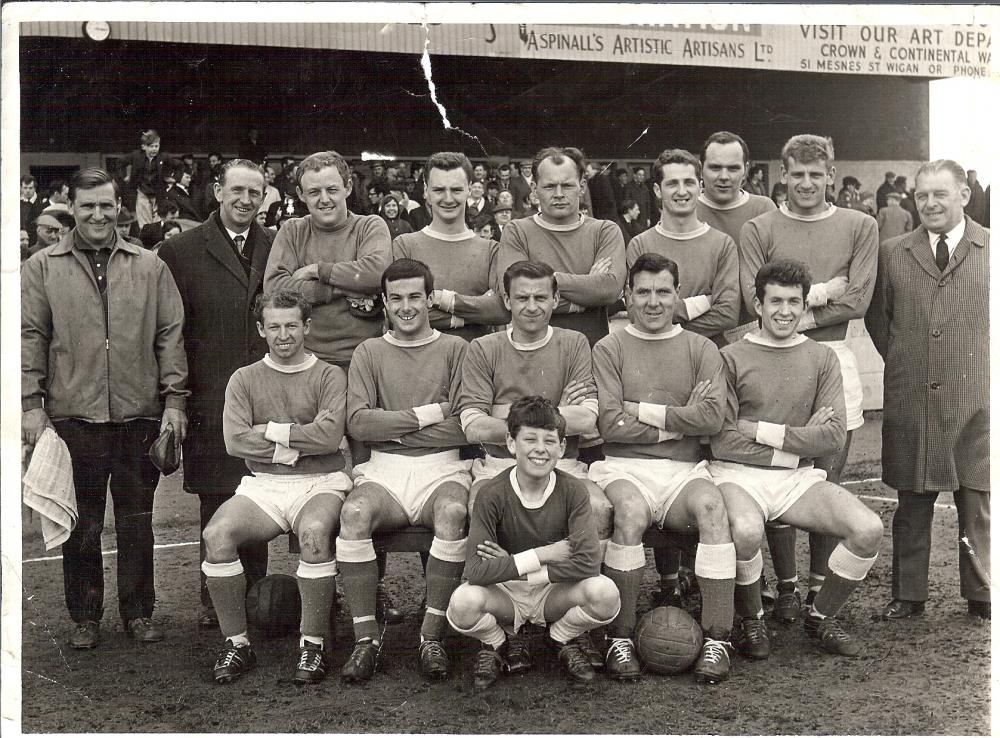
Wigan Athletic 1964-65. Back row, Wilf Birkett (Trainer),  Les Jackson (Chairman), Alan Halsall, Roy Wilkinson, Alf Craig, Ralph Gubbins, Derek Houghton, Derek Crompton, Frank Latham  Front Row: Les Campbell, Carl Davenport, Harry Lyon, Allan Brown (Player Manager), Walter Stanley

Wigan Athletic 1964-65.
Back row, Wilf Birkett (Trainer), Les Jackson (Chairman), Alan Halsall, Roy Wilkinson, Alf Craig, Ralph Gubbins, Derek Houghton, Denis Crompton, Frank Latham.
Front Row: Les Campbell, Carl Davenport, Harry Lyon, Allan Brown (Player Manager), Walter Stanley.
Thanks to WiganWorld for the photo.

A couple of weeks ago at Blackpool with Latics a goal behind, Owen Coyle made a bold move.  He already had two wingers on the field, Callum McManaman and James McClean, and decided to boost  Latics’ attack further by bringing on  two central strikers, Grant Holt and Marc-Antoine Fortune.  For a while Latics played in a formation akin to  4-2-4.

Seeing what was happening my mind drifted away to when I was a teenager watching Allan Brown’s team destroy rivals using that 4-2-4 system.

Brown took over at Wigan as player-manager in 1964 with a mandate to win the Cheshire League title. Latics had finished in mid table the previous year and it was obvious that a transformation was required. Brown and the Latics’ board at the time certainly meant business as they took the radical step of bringing in full-time professionals to give them a big advantage over the other clubs who use part-timers or amateurs. On top of that Brown brought in a 4-2-4 system, which was to reap high dividends.

As a teenager I was thrilled to get Brown’s autograph and those of his full time squad, who he would often take to the Roy Café in the centre of Wigan, where my mother worked. Sometimes I would even get a free ticket to the match.

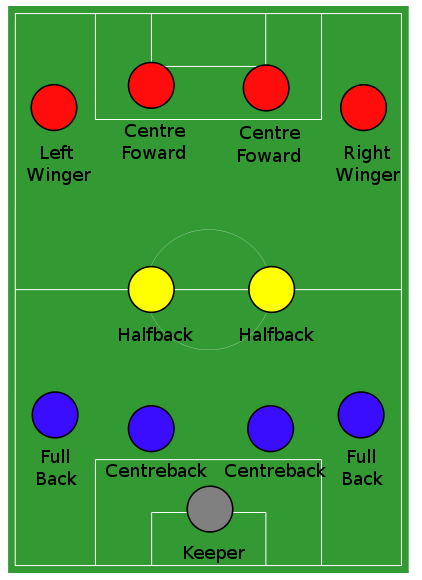
LaticLatics4-2-4_formation_svgs played an orthodox 4-2-4 system like the one Brazil had used to win the 1958 World Cup. They had a flat back four with two ‘halfbacks’ – usually Dennis Crompton and Brown himself –  in the centre of midfield. Crompton was the ball winner/water carrier and Brown the number 10 who would put the passes through to the forwards, scoring goals himself in the process.  Wingers Les Campbell and Walter Stanley were there to supply crosses to the central strikers, although they did do a share of defensive duties.

Latics were to take the league title from Macclesfield, who were to finish five points behind. Wigan scored 121 goals in 42 matches, most of them  down to central strikers Harry Lyon and Carl Davenport. With such an emphasis on attack they needed a defence which could hold its own when the half backs and strikers got stranded upfield and the opposition counterattacked. The superb Derek Houghton was at right back and Roy Wilkinson on the left. Ex-paratrooper Alf Craig was a rock in the centre of defence alongside the elegant Ralph Gubbins.

Association_football_4-4-2_formation_svgIn 1966,  during Brown ‘s tenure at Wigan,  Alf Ramsey’s “wingless wonders” won the World Cup with midfield players – Alan Ball and Martin Peters –  playing in the wide positions. The 4-4-2 system he used was eventually adopted by most English clubs for years to come.  It provided more defensive cover with the wide players being regarded as midfield players, helping the attack and shielding the defence.

In recent years both Paul Jewell and Steve Bruce successfully used 4-4-2 at Wigan.

Whether Owen Coyle would call the system he briefly played at Blackpool 4-2-4 or 4-4-2 is academic. One system reverts into the other depending on the degree to which  the wingers/wide midfielders roles are focused on attacking.

There were times at Blackpool when both McClean and McManaman were both thrust into largely attacking roles. 4-2-4 is a dangerous ploy these days when a single goal can so often determine the final result.  Although it gives powerful attacking options it leaves the defence light on cover.

What a breath of fresh air it was to see Coyle attacking with two wingers and two central strikers. However, the wingers are only going to be effective if they get the ball. Too often the ball is launched long to the central strikers, cutting them out.

It is interesting how Latics’ regular wide players are listed on the club website. Both Jean Beausejour and James  McClean are regarded as midfielders, whereas Callum McManaman is listed as  a forward. One wonders how they will categorise Marc Albrighton.

One of the strengths of Allan Brown’s team was their consistency of approach. All players coming in knew the 4-2-4 system they had to fit into. The same could be said about Jewell’s and Bruce’s 4-4-2. Roberto Martinez was a tactical innovator, but his teams had a clear purpose, if they found it difficult to implement against star-studded opposition.

If there is one main criticism of Owen Coyle’s reign so far it has to be that there is no tactical blueprint of that type.

Moreover his wide players have not consistently delivered the goods in the opponent’s penalty box. Part of this is down to a lack of good form on their part, but too often their defensive duties have limited their scope in attack.

We will have to wait and see if the Wigan Athletic defence is going to be strong enough to allow the wide players to adopt a more attacking role. When that happens strikers like Holt and Fortune are going to get goals.

Like us on Facebook, or follow us on twitter here.

Grant Holt – where do we go from here?

grant-holt_2635269b

He was lauded as the best of Owen Coyle’s new signings. But if you were ask a room of Latics supporters which of the twelve new players brought in by Coyle has been the most disappointing – the name of Grant Holt would be the one which comes up most.

What has happened to Holt? Is he past his best? Does his style of play suit Latics? Can he still make a major impact on the promotion push for Latics?

Up to this point Holt has made seven starts, with two appearances as a substitute. He has scored two goals, one being a penalty. He was injured in the Middlesbrough match in late August, coming back as a substitute against Blackburn in early October.

In the last two matches, against Rubin Kazan and Charlton, Holt has looked slow and cumbersome.

One cannot say that Holt is past his best. He has not played enough games to tell. But what is noticeable is that when he does play there are more long balls played by Latics. His mere presence causes the midfield to be by-passed.

Two years ago, in Norwich’s first season back in the Premier League, it was a surprise to their supporters to see their icon often being used as an impact player. Before that  Holt had been the first name to be written on the team sheet as his 45 league goals helped the Canaries ascend two divisions in consecutive seasons.

However, Paul Lambert used Holt to good effect as a super-sub. By the end of November Holt had scored four Premier League goals,  three of them being when he had come on as a substitute. At the end of the season Holt’s record in the Premier League was 15 goals from 24 starts and 12 appearances as a substitute.

Holt can clearly be very effective as an impact player, but the broader question remains – is he the right type of player for Wigan Athletic?

Despite it being the end of October  Latics still do not have a defined style of play. The manager continues to tinker on the tactical side and it does not help a squad with so many new players to gel together.

However, in general Latics try to play the ball through their highly capable midfield for the first 60 minutes. After that the defenders start to loft the ball over their heads, adopting a ‘more direct’ approach.

In the last two matches Holt has been substituted in the 63rd and 76th minute, leaving Marc-Antoine Fortune the task of beating big central defenders to high balls. That is not Fortune’s forte. He is big and powerful certainly, but is much more effective with the ball to his feet. If Latics are to continue to play ‘direct’ in the final third of the game it would make more sense for Holt to be the player coming on, not going off.

Grant Holt has a great reputation  as a top professional and a real team player. He will run himself into the ground for Wigan Athletic. He has a superb goalscoring record over the course of his career and is likely to get them out of  the Championship, given the right service.

The more cogent question is not so much whether Holt is the right type of player for Latics, but how to get the best out if him.

Holt is as good as anyone in the division in the role as a target man for long balls out of defence. He has the physical strength and technique to hold off two or three defenders, keeping the ball until teammates advance. In fact his enthusiasm is such that you see him actually courting the long pass.

However, Holt’s primary purpose is to score goals. He gets a lot of his goals through headers and deflections and needs the ball coming into the box from the flanks. Up to this point only Jean Beausejour of Latics’ wide players has been able to put quality crosses into the box. Callum McManaman and James McClean have not produced up to this point, but the season is still young.

Maybe we have expected too much from Holt. Given the physical exercion of holding off big opposition defenders he is expected to be sharp and lively in the box. All at 32 years of age.

Coyle needs to be realistic about how to get the best from the big Cumbrian. Give him the right service and don’t allow defenders to take the easy way out with long balls up to him when they are under pressure. Let him receive the ball facing the goal rather than with his back to it.

There will be matches where Fortune or Powell’s mobility will be required rather than Holt’s combativeness. Holt has proved how effective he can be as a super-sub.

Whether Grant Holt has a successful season and gets the goals to take Wigan back up depends on Coyle’s tactical approach.

In the match at Charlton there were signs that Latics were willing to play the ball through midfield when under pressure. Instead of taking the easy route of a long ball to an isolated central striker they sought the counterattack.

Give Holt good service from the flanks, minimize those speculative long balls and we will see the big Cumbrian get a lot of goals.

It is the tactics that have to be right for Holt to succeed.

Like us on Facebook, or follow us on twitter here.

Phasing out Martinez’s men?

Fraser Fyvie

Fraser Fyvie

“It’s not great. The manager’s just not given me any chance at all. Of course it’s demoralising. You go down there and a manager (Martinez) buys you and tries to mould you into the player that he wants you to be and then of course he went to Everton. The new manager (Owen Coyle) has come in and he’s got his own players, so there’s not much I can do apart from prove a point to him that I want to get in the Wigan side.”

The words of Fraser Fyvie quoted by the Scottish Herald, before he joined Yeovil Town on a three month loan deal today. The young  Scot had not even been made the bench, let alone started, in a league game this season.

Were Roger Espinoza  less tactful he too might say something similar.  A star in  an Honduras side that has secured qualification for Brazil, he has started in only two league matches for Latics this season.

Despite his international experience – 34 caps for his country at the age of 26 – Espinoza has not appeared in either of the Europa League games up to this point.  In the league matches where the Honduran made the starting line-up he was taken off after 65 minutes against Nottingham Forest and 55 minutes at Leicester.

The loan of Rob Kiernan to Southend was announced earlier this week. It is the central defender’s fourth loan  move since joining Latics in 2011.

Kiernan is 22 years old and does not yet have the right kind of experience to enable him to challenge for a first team place. He has made regular appearances for Latics’ under 21 team, but the lack of serious competition in the Central League would not have done much for his development. The under 21s  find themselves in a division of clubs from the third and fourth tier of English football. The gap between the level of football in the Central League and that of the Championship is huge.

Fyvie is only 20. Unlike Kiernan he has considerable  experience at a competitive level. He was signed as a 19 year old with more than 50 senior games prior experience under his belt for Aberdeen. Roberto Martinez used him sparingly last year, presumably giving him a year to adapt to English football. Fyvie has the potential to be a good player at Premier League level.

When Coyle signed Chris McCann, Fyvie probably saw the warning signs.  The squad was already overloaded with quality midfield players despite relegation from the Premier League. McCann himself has had few opportunities, despite his previous record of success in the division and might well prove to be a player of Premier League quality were the opportunity to arise.

Conspiracy theorists will say that Coyle is ridding himself of players he inherited.

Questions remain about the futures of long term injured players – Gary Caldwell, Ali Al Habsi and Ivan Ramis. Two of the three are ex-players of the year for Latics. The third – Ramis – might have received the same honour had his season not been curtailed by a cruciate knee ligament injury at Fulham in January.

One also wonders about Shaun Maloney.

A new manager typically brings in his own players. Coyle has done well in recruiting new players who can help Latics get back to the Premier League. That is quite distinct to preparing a squad that can get promotion and hold their own at that higher level.

Coyle runs the risk of losing players who have already proven themselves at Premier League level, let alone a potential talent like Fraser Fyvie.

One hopes that the conspiracy theorists are misguided.

Like us on Facebook, or follow us on twitter here.