Mackay sacking – a month too late.

Sharpe

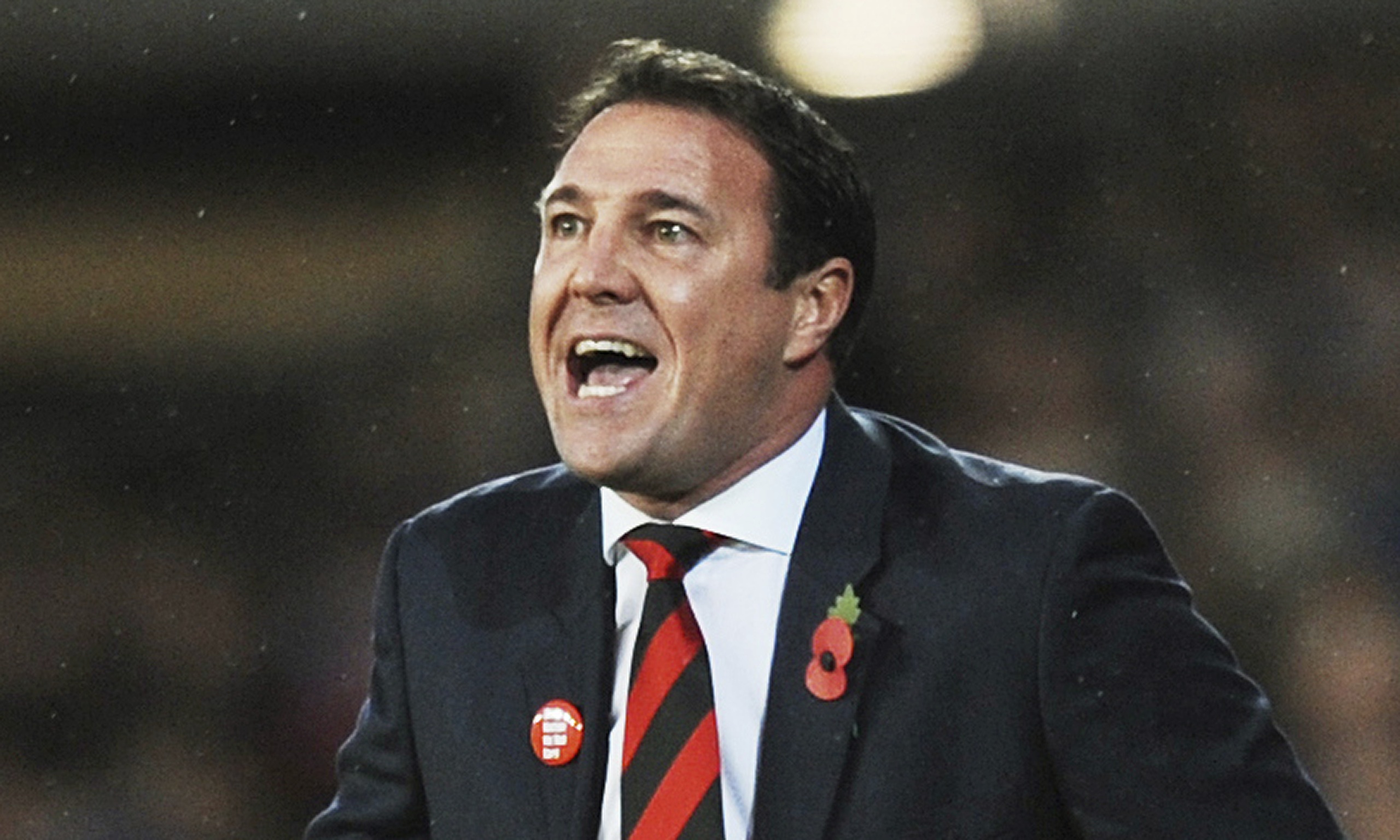
David Sharpe announced Malky Mackay’s departure tonight.


What a sad day.

The loss to Derby County puts Latics with practically no chance of avoiding the drop. The thought of relegation is hard to bear but what is even more depressing is that the two Davids – Sharpe and Whelan – did not remove Mackay at least a month ago. The lack of vision and decisiveness from above is worrying.

Less than 18 months ago Owen Coyle exited Wigan Athletic as a much derided figure. By coincidence his last game in charge had been a home loss to Derby. Coyle was sacked because it looked like he could not get Latics into the playoff zone. Moreover the stylish, if not always successful, football of the previous era had lapsed towards ‘hoofball’.

Uwe Rosler came in and enjoyed considerable success in his first season. His services were dispensed of when it looked like he was losing player support and failing in the quest to make Latics a serious candidate for promotion.

Little did we know what depths the team would plumage towards under his successor. Mackay’s appointment did great damage to the club’s image as portrayed by the national media. Moreover the team did not rise on the bounce effect of a new manager, as is so often the case. In fact they got worse. They did not win a single home game during his tenure and he might well go into Wigan Athletic history as their least successful manager.

When Mackay took over he stuck by an “old guard” who had clearly been underperforming under Rosler. Neither did they perform well under him. His revenge was sweet, with no less than thirteen players dispatched out of the club in the January window. Given the departure of so many players who had proved themselves in the Premier League it was no surprise that the standard of football was to plummet close to rock bottom. The hoofball that had become evident under Coyle, which Rosler could not eradicate, soon became the order of the day under Mackay.

Mackay’s tactics involved having two big strikers who could fight for those long balls. The most successful at retrieving those long balls was Marc-Antoine Fortune. Without him Latics seemed lost. With him they had a player adept at chasing seemingly lost causes and gaining possession. They also had a striker with an appalling goalscoring record. Forwards of lesser physical stature, such as Billy Mckay and Martyn Waghorn, were never going to be included in Mackay’s system, despite their proven career record as goalscorers.

The conspiracy theorists will say that Mackay was brought in as a short-term alternative, with his main task being to cull the dead wood within the playing staff. It could be said that he did that. Perhaps some of the players from the Martinez era had become complacent and were causing divisions within the camp. But the cull, together with a reluctance to provide Mackay with sufficient cash to find adequate replacements, left the club so short of quality players that relegation was always going to be a possibility.

Mackay was to replace the departed players with those on short term contracts or young loanees green behind the ears. It was a recipe for disaster.

So many fans will be relieved that Mackay will not be at the club next year, even if it is in League 1. But it should not hide the lack of foresight and decisiveness by Sharpe who has surely left it too late for hope of salvation in the Championship division.

It is to be hoped that Sharpe will also take a look at the coaching staff. Too many players have been written off this season despite arriving at the club with good credentials. There has been a disconnect between recruiting and coaching. The former has taken the brunt of criticism and Sharpe has enunciated his reorganisation of recruitment services. In the meantime it defies belief that the coaches could not have done more with so many of those new signings.

The challenge for Sharpe is to emulate his grandfather in appointing a manager capable of lifting the club out of this trough. Moreover lovers of good football will hope that he does not go for someone of the ilk of Coyle or Mackay. Between the two of them they caused so much damage.

It is to be hoped that the departure of Mackay will lead to a successful new era for the club.

Much of that will depend on Sharpe’s vision and leadership. It is a lot to expect from such a man so young.

The stats of goalscoring at Latics

“One of our forward-thinking players is going to have to stick the ball into the back of the net and that’s the key to it.”

So said Malky Mackay after the Leeds match where Latics had 60% of possession and 19 efforts on goal without scoring.

But in these days of increased use of data in football, did Mackay bear in mind the stats when picking his starting strikers? Has he looked at the performance records of the players he has at his disposal?

Goalscoring stats can be misleading. So often they are quoted as appearances per goal, which can be so unfair on a player largely used as an impact substitute. How can we compare the record of a player coming on in the 85th minute with one who has played the full 90? When we calculate a stat of appearances per goal we should also take into account at the ratio of starts to substitute appearances to get a true picture of player performance. Perhaps a more reliable indicator is starts per goal, but what about a player like Callum McManaman who would rarely complete the full 90 minutes?

However, these stats together can help us get a picture of the player’s goalscoring capabilities. Moreover looking at the player’s past performance stats can give us an overview on their current performance.

Compiling stats is dependent on a reliable source. The data that follows was compiled using player performance information from www.soccerbase.com . It is based on appearances in league and cup.

Looking at the main strikers currently available to Mackay:

Goals1

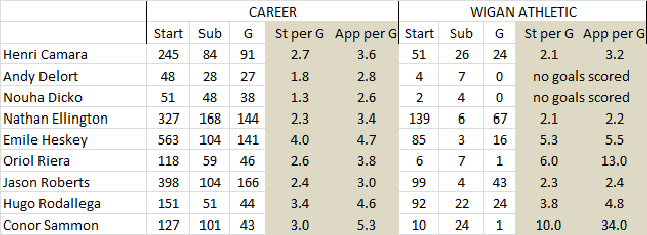
The raw stats suggest that Mackay chose the two players with the least probability of scoring against Leeds, Marc-Antoine Fortune and James McClean. However, until his recent conversion to central striker McClean has been on the left wing, where it is harder to score goals, so the stats should be interpreted carefully. The career stats suggest that the pairing with the most likelihood of scoring goals is that of Leon Clarke and Billy Mckay.

The more senior Latics supporters will remember the lethal goalscoring partnership of Harry Lyon and Bert Llewellyn. From 1965-68 Llewellyn scored 96 goals in 115 appearances for Wigan. Lyon remains the club’s leading all-time goalscorer with 273 to his name in his stay from 1962-70.

More recently the most memorable pairing is probably that of Nathan Ellington and Jason Roberts, whose stats show that each of them needed only just over two starts per goal.

In the Premier League days the partnership of Emile Heskey and Amr Zaki was one the best. Heskey was never a natural goalscorer but he created the space for Zaki. The result was the Egyptian scoring 11 goals in 24 starts.

In the Premier League era, Henri Camara was Wigan’s most consistent goalscorer. Taking a look at the stats of strikers who have now left Latics gives considerable insight:

GOALSOLD

The case of Nouha Dicko stands out. Deemed not wanted by the club, but his goalscoring record for Wolves has been outstanding. Dicko never started in a league game for Latics.

The sad stays of such as Conor Sammon and Jason Scotland are reflected in the difference between their Latics stats and those of their careers. The simple explanation would be that they were not good enough for the Premier League. But then again, is Dicko good enough for the Championship?

Andy Delort and Oriol Riera are back to scoring goals again in their home countries following frustrating stays at Wigan. Given the downsizing at the club, even if the miracle happens and relegation is avoided, it is unlikely they will return.

Mackay is now talking about solving his goalscoring problem through the loan market. This must feel like a kick in the teeth for such players as Billy Mckay and Martyn Waghorn who have shown in the past that they have the ability to be in the right place at the right time as far as goalscoring is concerned.

The coaching and management at the club continues to ostracise players. It has been far too apparent over the past couple of years that HR skills are sorely lacking.

Mark Twain once said “Facts are more stubborn things, but statistics are pliable”. As outsiders we are not privy to the real facts about what is happening at the club during the Mackay era. But pliable as statistics might be there is no getting away from the woeful record the Scot has had since he took over.

In a season where Latics have scored only 32 goals in 36 league games, one begins to wonder where the next goal will come from. It is a sad result of the mismanagement of the striking talent that the club has had and continues to squander.

Investing in Wigan Athletic –what comes next?

dave whelan espn

I read a quip the other day that amused me.

It is relatively easy to take out £1m by being the owner of a football club. All you have to do is first put in £2m.

Dave Whelan reportedly put £100 m into underpinning Wigan Athletic’s success over these past two decades. One wonders what he will get back.

Football clubs are probably the worst run businesses to invest in. So few make a profit because of mismanagement within and the pressure on clubs to spend to keep up with others. So many are kept afloat by their owners and benefactors.

According to Sir John Madejski, Reading chairman, the ideal football club owner is “someone with deep pockets, mercurial, and not faint-hearted.”

That could well describe Whelan over these years. His generosity to his home town club has been exceptional. Through converting debt to equity he has effectively given the club financial stability.

The case of Bolton Wanderers differs. They currently owe Eddie Davies over £165 m. Davies, now 67 years old, made his money out of thermostats for kettles and moved out of Bolton in his twenties. When he bought the club in 2004 fans expressed concern that they were now owned by an Isle of Man tax exile via a trust listed in Bermuda.

Davies has not actually given the money to the club, but has provided loans on which they have had to pay interest payments every year. The last time Wanderers made a profit was in 2006 and even that was close to breakeven. Put simply they have been living beyond their means for so long and if Davies were to pull the plug the very existence of the club would be at severe risk. Today’s Daily Telegraph reveals that Davies would be willing to sell the club, should he right buyer come along. But is any potential buyer going to be willing to takeover so much debt?

Dave Whelan’s silence over the past couple of months has caused unease among so many Wigan Athletic supporters. We had become so reliant on him to provide the financial backing needed for the club to make forward strides. However, over the past four years he has insisted on the club at least breaking even financially. The profits made over the past three seasons have made Latics a beacon among the dark and shady world of mismanagement typical at so many football clubs. Breaking even this season will be more of a challenge, but the selling off of assets and the reduction in liabilities that happened during the January transfer window will surely put things back on track.

The apathy by which fans have witnessed the selling off of many of the most accomplished players can be viewed as a sign that people are beginning to lower their expectations for Wigan Athletic Football Club. The notice boards and social media are awash with comments amounting to something like the club being bigger than just one man and that it can be run with dignity in the lower divisions. As always there are the cynics who suggest Whelan is pocketing profits, getting some money back after so many years of putting it in.

One thing we can expect over these coming weeks is for Whelan to step down as chairman. It remains to be seen if his grandson, David Sharpe, will take over the role.

The big question is whether the Whelan family will continue to pull the strings at the club in the long-term, or whether the house is being put in order for a sell off.

Should the Whelan dynasty continue we can expect the club to continue to be run on a breakeven basis.  After all could any of us reasonably expect the Whelans to pour in more funds in the hope of restoring past glories?

However, for a business to be run on even a breakeven basis there needs to be some kind of strategic plan. This would involve the fashioning of a new identity for the club that fits its current situation.

Gone is the romantic idea of “Little Wigan” holding its own in the world’s most wealthy football division. In its place needs to come a more grassroots identity, a club noted for its coaching and development of players who can be sold on in a systematic basis rather than the awful fire sale we have recently witnessed. The club as a finder of raw talent that it hones into a lustrous product that it cashes in on to keep itself moving forward.

The alternative is to stand still, which tends to inevitably lead to dropping back.

A key strategic issue that needs to be addressed is the development of an academy at Charnock Richard. Apart from the capital costs, which can be covered by incoming transfer dealings over the past year, will it be a moot point because of the operating costs it entails?

However, the probability is that Latics will be in League 1 next year. The FFP rules differ significantly there from those of the Championship division. Clubs are only allowed to spend up to 60% of their revenue on player salaries. Moreover standing costs for the club will need to be thinned down proportionate to the drop in revenue. Should that be done effectively it would surely leave some wiggle room for an academy which would cost around £2m to operate.

The starting lineup that faced Cardiff City on Tuesday night included only three players with contracts that go beyond this summer. The likelihood is that few of those short term signings or loanees have a future at the club. Moreover should relegation become reality Latics are going to have to shed not only those at the ends of their contracts, but a significant number of the players who were signed on contracts that could be considered lucrative by Championship standards.

When Wolves were in a similar situation in the summer of 2013 they released seven players, sold two and sent seven more out on loan. By the end of the season they had done seventeen loan deals of their players out to other clubs, They brought in three new players over the summer, with another five coming in January, including Leon Clarke and Nouha Dicko. They had only two incoming loans, both short-term in the first half of the season.

The key for Wolves turned out to be the appointment of manager Kenny Jackett, who remains in charge as they sit in eighth place in the Championship table. It remains to be seen whether Malky Mackay would be entrusted to try to follow Jackett’s lead should Latics get relegated.

Many fans are nervous about the possibility of the club being sold. Even if Latics are in League 1 next year the club will be a possible target for purchase. Through its successes, particularly in the past decade, the Wigan Athletic “brand” has gained considerable prestige. Moreover the club is close to being debt free. The fan base might pale in comparison with big city clubs, but has grown so much over these years. The club has a fine stadium and has bought a potentially excellent site for a youth academy.

Fears of the club being taken over by a foreign owner may be justified to some degree. However, with a new owner willing to invest in the club like Whelan did before, Latics would have a competitive edge compared with an austerity-laden approach that might operate under a Whelan dynasty regime.

Put simply, were Latics to be relegated they would have to compete with at least half a dozen ex-Premier League clubs in League 1. What would give them any kind of competitive advantage over those clubs and others in the division?

Without Whelan’s financial backing Latics would not have achieved what they did over the past twenty years. Without an owner willing to invest significant funds into the club it is going to considerably lower the odds of them getting remotely back to where they were three years ago.

Where Wigan Athletic will be ten years from now is impossible to predict – Premier League or Northern Premier League?

No matter who owns the club it will need to refine its vision and direction.

Without that it will meander into mediocrity.

Attendances and finances at Wigan Athletic

2012-moneyball

“There was nothing like it. Running down the tunnel and hearing the roar of a 3,000 crowd. Springfield Park was the best place in the world for me.”

Meeting Harry Lyon in the early 1980s was like a dream come true. It had been a chance encounter with the man for whom the title “legend” would be an understatement for me.

My father had continued to live in the south of Wigan, then rugby league territory, so the pubs around us were steeped in that kind of nostalgia. One of those was ‘The Waterwheel’, run by ex-Great Britain rugby player, John Stopford. Although he never played for Wigan RLFC, Stopford would draw rugby enthusiasts to his pub. We mostly avoided such places, preferring to walk further afield to pubs that were more salubrious for Wigan Athletic supporters.

But one rainy night we succumbed, and tried ‘The Waterwheel’. Upon opening the door and the sight of the scrum surrounding the bar we started to think twice about it. There were some burly men there, faces like boxers, some with arms in slings. We were just about to walk out when my father said “Look it’s Harry Lyon over there.” It was indeed my hero from my teenage years. Chatting with Harry was easy. He just made you feel comfortable talking with him. Although he had left the club a decade before it was obvious that Wigan Athletic was his first love. He remains the club’s leading scorer of all time, with 243 goals to his credit.

Harry’s quote was straight from the heart, but the reality was that a 3,000 crowd was not the norm at the time. True, Latics had the best home attendances in the Cheshire League and their traveling support would so often ensure that clubs like Oswestry and Stalybridge would get their best crowds of the season. But for clubs at that level of English football it was a hand to mouth existence, but somehow most clubs survived.

Gate receipts were the main source of revenue, which gave Latics an advantage, given their stronger support. But the reality was that most of the time the attendances were not a lot above the 2,000 mark. The club survived through the efforts of the Supporters Club and the Board of Directors dipping into their pockets.

Financial survival has never been easy for Latics. In their inaugural season in the Football League, 1978-79, they averaged a healthy 6,701. The club’s attendances the season before, their final one in the Northern Premier League, had dropped to an alarming 1,334. The move up clearly had a major impact upon the town.

Since then Latics’ highest average league attendance was 20,160 in their first season in the Premier League. Ironically their second highest was 19,345 in the relegation season of 2012-13. But the gloss was to wear off and Latics slumped to their lowest attendance levels of their Football League era with just 1,748 in 1994-95.

If it had not been for the arrival of Dave Whelan in 1995 where would Wigan Athletic have been now? Attendances had been woefully inadequate and the club was sinking into a seemingly inexorable financial quagmire.

But ten years later Latics were playing in the Premier League against Chelsea and a crowd of 23,575 was present despite the game being broadcast. It was a taste of things to come as the club’s attendances eclipsed those of the local rugby club that season and have done ever since, even last season despite relegation to the Championship.

Football season Rugby season Wigan Athletic Wigan Warriors
2005-2006 2006 20,160 14,464
2006-2007 2007 18,159 16,040
2007-2008 2008 19,045 13,995
2008-2009 2009 18,350 14,080
2009-2010 2010 17,848 15,181
2010-2011 2011 16,976 16,125
2011-2012 2012 18,634 16,043
2012-2013 2013 19,375 13,556
2013-2014 2014 15,176 14,102

Latics’ gate money in the Premier League days was always dwarfed by the TV revenues they were receiving and from a purely financial viewpoint attendances were not much of an issue. In their last season in the Premier League match day revenues covered no more than 10% of total revenue of £56.4m. Without the television revenues, the club could never have seriously competed for eight long seasons in the elite division.

In my article Finances, FFP and the long term future of Wigan Athletic, published in May 2014, I put forward figures needed to stay afloat in the Championship. To keep a team in mid-table would typically involve a wage bill in excess of £20 million. Whereas to get into the top six would cost around £30 million, which is precisely what it cost Latics last season.

With a significant drop in parachute payments to be received this season it looked likely that the club would start to trim its wage bill. The departures of ex-Premier League players Jean Beausejour, Jordi Gomez and James McArthur must have helped. However, manager Uwe Rosler was to bring in nine new players over the summer. Although some were younger players, probably not on relatively high earning contracts, the competition in the transfer market forced the club to offer more tempting salaries to the rest. The result was a squad that was larger than the club needed with a wage bill close to that £30 million of last year.

Dave Whelan clearly had promotion within his sights when he released some £8-9 million in transfer fees for Oriol Riera, Andy Delort, Emyr Huws and Adam Forshaw. Much of the outlay was covered by the fee received from Crystal Palace for James McArthur, but their arrivals put more pressure on the wage bill.

It was a gamble which was to fail, but Whelan is the shrewdest of businessmen and he knows if you don’t take risks you are likely to stand still. Huws was constantly bothered by an ankle injury and never reached top form, despite having moments of showing his true potential. He remains one for the future, despite being sidelined for the rest of the season with another ankle injury. Sadly Delort and Riera have been dispatched to their home countries on loan and Forshaw has been sold cut-price to Middlesbrough.

Whelan had made the gamble, backing a manager who had performed admirably in the previous season. After being criticised by fans for hoarding the cash from the James McCarthy transfer the season before he had stuck his neck out in allowing Rosler to bring in so many players and run the risk of expenses heavily outweighing revenue.

Following the departure of Rosler and the continuing downturn in results under Malky Mackay, the club made huge strides in getting its financial situation back on an even keel during the month of January. Just a few months before no one could have anticipated the fire sale that was to occur. Ten players were to leave, four of whom were members of the team that won the FA Cup Final.

That famous cup final man of the match, Callum McManaman, went to West Bromwich Albion for around £4.5 million. Putting back the clock, what might have happened if he had not injured his ankle in the Arsenal match that followed the Cup Final and put Latics down? Following his Wembley display he could well have gone to a big club for some £15 million, if he had been fit. Sadly it did not happen and the ankle injury had a major impact on his fitness the next season. The rest is history.

Such a fire sale would have brought huge protests from the fans under normal circumstances. But the “hatchet man” Mackay was able to do it with hardly a whimper from supporters who were thoroughly disillusioned with the lack of commitment shown by players whom many viewed as overpaid and overrated.

The fire sale has put Latics back on track financially. Apart from the transfer fees received they have cut the wage bill down significantly, to probably around £20 million on an annual basis. Mackay paid transfer fees for two players – Billy Mackay and Jason Pearce – but the outlay for the two was less than £1 million. The rest of his acquisitions are loanees or players on short term contracts.

For the coming season – no matter what division they are in – Latics will receive £8 million in parachute payments, plus around £2.5 million from TV money. The rest will need to come from gate receipts and commercial revenue.

The latter has not been a major factor over these years, so gate revenue becomes increasingly important.

Should they stay in the Championship, crowds of around 12,000 would most likely be the order of the day. That is providing a squad that will cost considerably less to maintain than those of the past two seasons can hold its own. Relegation would almost certainly mean a decrease in attendances, even if the team were to do well. Revenue from the visiting support would most likely nosedive.

Gate money will clearly play a more major role for Latics next year than it has for more than a decade. Put simply it is going to be a more proportionate part of revenue than it has been.

But then again, for Latics gate money does not correlate with attendance in the same way that it does for most clubs. The club had wisely kept admission prices relatively low during its most successful years and they remain so. It helped them compete for support within the town and build up a level of hard-core support that the club had never previously enjoyed. However, continuing the policy is not necessarily the right ploy for the club. At some time in the future it is going to have to start moving its prices more in line with that of its competitors, at the risk of losing some support.

For the coming season the revenue and spending numbers need to add up. A £20 million wage bill is out of the question. Austerity will be the order of the day, no matter which division the club is in.

However, the good news is that the club has become a model for others to follow in its financial management, which serves to safeguard its long term future. A profit of £2.6 million was announced for the 2013-14 season, following two previous campaigns in the black.

The big question regarding revenue streams is whether Latics will be able to afford to run the Charnock Richard facility, assuming it will be completed. If it dies a death it will be much harder for Latics to put in place an Academy that providesthe first team with players, the best of whom can be sold off to keep the club afloat. Should Latics suffer relegation it could be one of the cut backs.

Much will depend on the ability of Mackay’s current team to avoid relegation. If they can the outlook will be brighter.

Attendances and revenue remain inextricably linked, even if not as strongly as they were during the Harry Lyon era.
Playing for Malky

Will Mackay's appointment  prove to be worth the baggage that came with it?

Will Mackay’s appointment prove to be worth the baggage that came with it?

Despite the emotional and divisive effect Mackay’s candidacy and then appointment had amongst club’s supporters, there seemed to be a general feeling among backers and protesters, and even the media, that his arrival would probably still give the team the “new manager” boost on the pitch.

What is surprising to me is that although there has been plenty written about dressing room trouble, which we knew plenty about well before Mackay’s arrival, few have written or spoken about how much further damage his appointment might have inflicted it in a young, multicultural squad. (No matter what forced public statements of support the captains GC/EB gave at the time). If one of the biggest problems under Uwe was dressing room unity, he was surely the most ill-suited appointment possible, given how divisive his own public debacle was and continues to be.

Many of the stronger voices of dissent on #wafc forums and social media were those of younger supporters, some foreign. Your average footballer might not be the most involved with social or political issues, and yes, the language on the training ground and “in football” is far from “politically correct” and therefore it is unlikely many of the players were shocked at the content of Mackay’s texts. But their generation is far more likely than previous ones to want no part in what his texts, and his appointment, represent.

Many of the more experienced influential players – Al-Habsi, Maloney, Boyce, Watson, Espinoza, Ramis – were brought in at a time when the club had a very strong ethos of family values and doing things the right way. It was a source of pride, was my sense, for players and supporters alike.

I’ll always be grateful to Whelan for all that he has done, and personally hope he acts to put things right. But this mistake looks costly on just about every front other than the actual money spent, which was probably DW’s priority. Mackay is hardly Mourinho. Just not worth the risk. Someone else could have gotten us out of the bottom three. And even if still Mackay does, and there is plenty of time for him to do so, would it really be worth the baggage?