Paul Cook – the right man for the job

Football took a nose dive at Wigan Athletic last season. What we saw in its place was a kind of “fightball” with players allowed to hoof the ball upfield, the end result being players ultimately unable to pass the ball with any consistent degree of accuracy. The end result was another seemingly inevitable relegation.

It had happened before, in the 2014-15 season, when William Kvist’s long throw-ins into the penalty box had become Malky Mackay’s principal attacking ploy. Who could have guessed that Warren Joyce and Mackay would create such a blot on the landscape of football when they were first appointed?

Owen Coyle’s long ball tactics and lack of tactical expertise had been no surprise to those of us who had seen his teams play prior to his arrival at Wigan. The surprise was more that Dave Whelan had appointed a manager whose style of football was diametrically opposed to that of his predecessor.  The end result in Coyle’s case was a team that should have been challenging for promotion instead languishing in the bottom half of the table. In the cases of Mackay and Joyce the rot was to prove terminal.

Watching Paul Cook’s Chesterfield in the League 1 playoffs a couple of years ago immediately had me reflecting on his days at Wigan. Cook was the kind of player who probably would not have got a place in the teams of managers such as Mackay and Joyce. Harry McNally brought him in as an 18 year old from modest Marine, a club from Crosby who had been regular adversaries for Latics in their days in the Lancashire Combination. But despite his humble footballing origins Cook was a class act, an intelligent footballer with excellent control and a superb left foot. He was a member of Bryan Hamilton’s exciting Latics side of 1985-86, who were desperately unlucky not to be promoted to the second tier, a late run from Derby County pipping them by a single point. Cook continued to be an important player under Ray Mathias, who like Hamilton, encouraged his teams to play good football. But it was no surprise when he was snapped up by Norwich City in 1988, the next step in a career that was to see him go on to amass 642 Football League appearances, scoring 56 goals in the process.

Cook was a cultured player and he expects his teams to play in a similar fashion. He started his managerial career in the lower leagues, spending some six years at Southport, Sligo Rovers and Accrington Stanley before joining Chesterfield in October 2012. His first season saw the Spireites come within two points of the League 2 playoffs, but they were to win the division the following year. They went on to firmly establish themselves in League 1 in 2014-15, reaching 6th place, losing out to Preston North End in the playoffs.

In May 2015 Cook was appointed manager of Portsmouth. Pompey had fallen from the Premier League to 16th place in League 2 within a period of just five years. In 2015-16 Cook lifted them to sixth place and the playoffs, narrowly going down to Plymouth Argyle in the playoffs. They went on to win the division last season under his guidance.

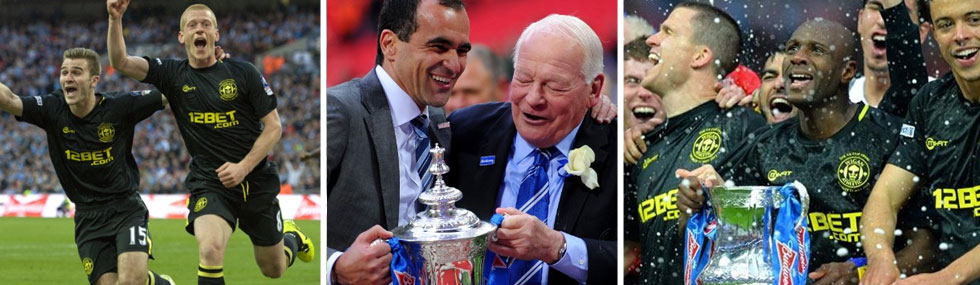
Paul Cook has an impressive 44% win ratio as a manager. Moreover he has done that by insisting that his teams play a version of football akin to that which led Wigan Athletic to the most successful results in their history. Roberto Martinez had led Latics to wins over giants – Arsenal, Chelsea, Liverpool, Manchester United – plus an FA Cup Final victory over Manchester City, by playing possession-based football.

As a young player at Wigan Cook was not universally appreciated by the home crowd. There were those who urged him to “get stuck in” and release the ball quicker. Fortunately in Hamilton and Mathias he had managers who appreciated his style of play and who wanted their teams to play good football.  If there was one thing that Cook lacked it was pace. It meant that he was not to play at the highest levels of English football, despite his technical expertise.

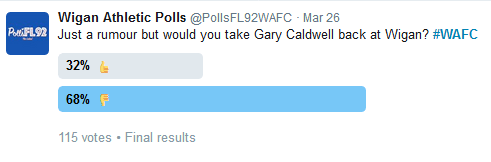
It looks like Paul Cook will be signed up as Wigan Athletic’s manager in the next 24 hours.  Once again he will not be popular with all of the fans. Those who prefer a more direct style of play will be left frustrated. It will signal a reversion to the kind of football most recently employed at Wigan by Gary Caldwell, prematurely dismissed in October. The cynics had said that Caldwell could not get promotion out of League 1 playing possession-based football. They were proven wrong as his team went on to win the division.

On Cook’s seemingly impending arrival at Wigan, his ex-boss Mathias remarked to Wigan Today that:

“He has proved he can do it. I know his upbringing and how he’s lived his life. He can be very strong for Wigan and he can be a strong talker when he has to be.”

 Paul Cook is an experienced manager with an excellent track record in the EPL’s lower divisions. He is the right qualities for the job at Wigan Athletic in this moment of time.

Like us on Facebook, or follow us on twitter here.

Garry Cook and the next chapter for Wigan Athletic

“I was both honoured and delighted to be asked to be part of the team developing the next chapter for Wigan Athletic. Returning to the UK and football was a careful decision and had to include supporting a chairman with a high level of ambition and enthusiasm to build the club for future success.”

Garry Cook’s arrival at Wigan was a bolt out of the blue. From 2008-2011 he was CEO of Manchester City, helping transform them into a major power in European football. He may have left City under controversial circumstances, but his prior accomplishments at the club were impressive.  On his departure the chairman Khaldoon Al Mubarak stated that:

On every level, the club is unrecognisable from the organisation which he inherited and our staff and supporter services, community outreach and commercial activity have seen unparalleled growth under his direction with yet more projects to be realised on the horizon.”

Cook had worked for Nike in the USA from 1996-2008, becoming head of the “Brand Jordan” project alongside basketball mega-star Michael Jordan. On joining Manchester City in May 2008 he was given an annual salary in the region of £1.5 m. In September 2012 Cook was appointed Executive Vice President and Managing Director of Europe, Middle East and Africa for the mixed martial arts organisation, UFC. He rose to the position of Chief Global Brand Officer. He left UFC in October 2016 following a series of staffing cuts.

Cook is a highly experienced executive, used to working on a large scale, with equally large budgets. Put simply, why would he get involved with Latics?

According to the club site Cook is to be a non-executive director, assisting part-time, “helping the Board of Directors with strategic planning and long term objectives”. But what does that really mean? When Cook refers to “developing the next chapter for Wigan Athletic”, what is he referring to?

Even to the impartial observer, Cook’s appointment would appear to be a win-win for Wigan Athletic. Given a seeming reluctance to pay top whack to people involved in the running of the club, it is unlikely that Cook will receive the level of remuneration to which he has been accustomed, even allowing for the fact that it is a part-time position. However, following a six year absence from English football Cook might well want to get his foot back in the door, foresaking his normal monetary expectations. But what can we expect from Cook?

If Cook is given a fair crack of the whip – “if” being the operative word – we can expect some changes in the strategic direction of a club that has had too many ups and downs since that eventful day in May 2013. The turnover of managers in the past four years has been disturbing. That of players even more so.

Last season Wigan Athletic had the biggest turnover of players of any club in English football’s four divisions, mirroring what has happened too often in  recent years. Over those years the choice of managers has been haphazard, the more successful ones being sacked so little time after doing so well. Others have been appointed that the discerning fan could see were ill-suited from Day 1. Player recruitment has been an area of great concern. Too much money has been spent on players who have not made the grade, sometimes not entirely their fault. Long term contracts have been offered to players past their best, seemingly up-and-coming signings have so often disappeared from view. In a business sense the dealings in the transfer market, including money paid to agents, have left much to be desired.

Given this backdrop, Cook’s input would surely be valuable. Cook was heavily involved in player recruitment at City, albeit on an elevated plane, but he also had a major input on infrastructure and the commercial side. Even when Latics were in the Premier League commercial revenues  were low compared with other clubs in the division. They remain so. In terms of infrastructure, the development of an academy, potentially capable of providing players for the senior squad, remains a work in progress. The club’s purchase of the Charnock Richard golf course was upstaged by the Whelan family’s  acquisition of the ex-Bolton Wanderers training facility at Euxton. The club owns neither its main training ground nor it stadium.

When Dave Whelan took over the club in 1995 his vision of Wigan Athletic being in the Premier League was to provide direction for the club in the years that followed. Following the FA Cup win and relegation there has been no overriding direction. Put simply, the club needs to come to terms as to what it is and what it could be. A clearly defined, well -articulated vision for the future could provide the driving force for improvement in the operations of the club.

Garry Cook clearly has a lot of nous to bring to the table of the Wigan Athletic Board of Directors. However, it should be noted that Cook was appointed  at City by Thaksin Shinawatra and was instrumental in bringing in Sheikh Mansour’s money to buy the club, in poor financial shape at the time, for a figure around £150 m.

Latics supporters continue to speculate on the influence that Cook will have on the club. Is he there to provide the kinds of ideas that can move the club forward, developing  a strategic plan? Or is he there to make the club more marketable, then find suitable future investors? Is it a signal that the Whelan dynasty is nearing its end?

In the meantime we can but ponder on what the next chapter for Wigan Athletic enabled by Cook might be.

Like us on Facebook, or follow us on twitter here.

A Director of Football for Wigan Athletic?

Mark Warburton was Brentford’s director of football when Uwe Rosler was manager.


“We want to be a modern football club, and we see that sometimes when managers leave a lot of the structure leaves with them. That is no use. You put a lot of time, a lot of investment and a lot of resource into developing that side of the business and you can’t have that changing every time a manager changes.The director of football gives you that continuity. They oversee the overall football department, all aspects of it, including the academy, performance and preparation, analysis and everything as well as the first team. It means that if a manager or a coach does leave, you are only replacing that one person and the club’s philosophy continues unbroken if you have that director of football in there.”

The words of a member of the Latics hierarchy? Jonathan Jackson or David Sharpe maybe?

The statement summed up what has been happening at Wigan over the past four years. The calamitous appointments of Owen Coyle, Malky Mackay and Warren Joyce destroyed what their predecessors had set up, leaving the club’s philosophy in tatters. Both Coyle and Joyce made not only wholesale changes in the playing staff, but their style of football was diametrically opposed to that of the previous managers. In both cases possession-based football was replaced by a physical approach embracing the long ball.

Ex-manager Uwe Rosler has been quoted recently as suggesting that Wigan Athletic need a period of stability. He was referring largely to Latics having had three managers this season and the instability it has caused. But it brought to mind another aspect of instability: that of player turnover. Alan Nixon’s “A mental amount of movement” tweet in January sticks in the mind. The Sun journalist had mentioned Latics’ interest in 5-6 new players. But by the end of the transfer window no less than 12 new faces had been brought in.

Few could disagree with Rosler’s comment. There is a clear need for continuity and stability at the club. Too many managers and players have come and gone. In the 2015-16 season there were 31 incomings and 44 outgoings of senior squad players at Wigan Athletic. The stats for the current season show 26 coming in and 29 leaving.

Strangely enough Rosler himself contributed to the lack of continuity and stability by bringing in a swathe of new players in the summer of 2014, despite the fact that his previous squad had reached the semi-finals of both the FA Cup and the Championship playoffs, due to his fine efforts. Sadly the majority of the new players could not make their mark and the manager was surely undermined by senior players from previous administrations. His departure in November 2014 was to lead to the appointment of Malky Mackay, a January fire sale and an avoidable relegation.

In his previous position at Brentford, Rosler had worked in tandem with Mark Warburton, who was Director of Football. Our Brentford sources tell us that it was Warburton who was largely responsible for the recruitment of players. One wonders what might have happened at Wigan if a Director of Football had been in charge to deal with recruitment with Rosler giving his input. It was sad to see a manager who had done so much to bring Wigan Athletic back into prominence the previous season being dismissed in a matter of months.

Although it might appear that the context was that of Wigan Athletic the preliminary comment came not from Wigan, but from Glasgow. The speaker was Rangers’ managing director Stewart Robertson talking to Sky Sports just a couple of months ago.

Although in continental Europe many clubs have sports directors, akin to the general manager role in American sport, the role of director of football in England has yet to be clearly defined. Essentially the director of football acts as an intermediary between that the board and the manager, but clubs have tailored job descriptions according to their own requirements. An experienced and competent director of football can advise both the manager and the board. The role seems to inevitably involve tensions between the director of football and the manager, especially in the area of player recruitment.

At this stage we are not advocating the appointment of a director of football at Wigan Athletic, but the concept merits due consideration. Stewart Robertson’s comments might have been made about Rangers, but they ring true to us supporters of Wigan Athletic.

Like us on Facebook, or follow us on twitter here.

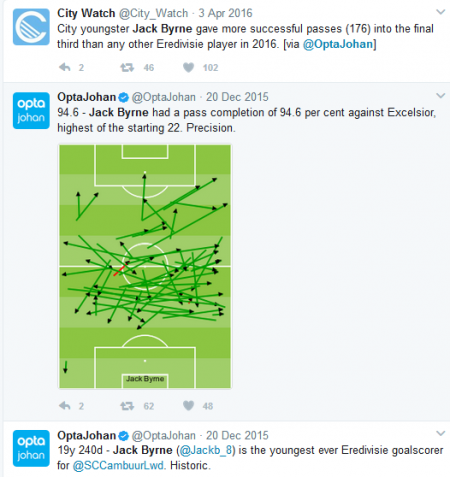
Jack Byrne –the best of the January 2017 signings?


Warren Joyce must have been looking forward to the January transfer window. It presented him with the opportunity to bring in his own men. Joyce had been appointed in early November to take over a squad used to playing possession football under their previous manager. Joyce was determined to change that approach to a more direct style of play.

But by the time the window had opened he had won just one of the nine games he had been in charge. Getting the right players in during the January window was never going to be easy. Clubs are not keen to lose key players in mid-season and the pickings in January tend to be thin.

Joyce went on to contract six new players, plus another seven on loan. He had a fair amount to say about the new arrivals, but his words about Jack Byrne were kept to a minimum:

“Jack is one for the long-term, a really hungry player who we feel can develop here over the next few seasons, a real talent.”

It was almost as if he was playing down Byrne’s signing, although the player had been given a three and a half year contract and had excellent reviews as a young player at Manchester City. The sale of Byrne did not go down well with quite a few City fans, frustrated that another talented young player coming through the ranks had been sold off. The transfer fee was of the “undisclosed” category, but City were unlikely to let the player go for peanuts. They had sold another talented young player to Latics a couple of years earlier. Wigan paid them around £2.5 m for Emyr Huws, who was 20 at the time. City would expect something substantial for Byrne, also 20.

One wonders if Joyce himself was responsible for Byrne’s signing or whether it was someone else within the club. Patrick Vieira, Manchester City youth team coach, had said a year ago that: “If you want to play direct, Jack will be useless but if you want to keep the ball on the floor, and you need someone really creative, Jack will be the player who can do that.” Joyce’s preferred playing style was certainly “direct”.

Byrne did not set foot on the pitch for the senior team during Joyce’s reign which was prematurely terminated in mid-March. But he does seem to feature in Graham Barrow’s thinking, having come on off the bench in the recent wins over Rotherham and Barnsley.

Born in Dublin, Jack Byrne joined Manchester City as a 14 year old. Byrne has played for the Republic of Ireland at U17,U18 and U21 levels. In 2014-15 he was a key player in a  Manchester City team that reached the quarter finals of the UEFA Youth League, scoring 6 goals in 8 appearances, including two against Bayern Munich.

Last season Byrne was sent to Cambuur to play in the Dutch Eredivisie. He made his debut in mid-September against FC Twente after a 6 week layoff due to an ankle injury.

The Irish site SportsJoe spoke to the Chairman of  De Kern van Cambuur (the Cambuur Supporters Club), Kees Elzinga. Referring to Byrne he commented:

Jack reminds me of the Welsh player Gareth Bale but he could probably learn a lot from Wesley Sneijder is mostly playing midfield and is able to give long distance passes to his left and right wing teammates. He also tries to get forward and threaten the goal of the opponent and he tries to score with long distance shots. Jack is well known in our Premier League; Dutch television (mostly FOX Sport) shows quite a lot of his actions and other teams do their best to keep him out of the play.”


Byrne went on to play 27 games for the Dutch team, scoring four goals.

Following a successful season in Holland, Byrne was sent on a season-long loan to Blackburn Rovers  last summer. It turned out to be a bad move for him as Owen Coyle so often left him out of the lineup. Byrne’s loan was cut short and he returned to Manchester City in early January.

Wigan Athletic have been desperately short of creativity this season. Jordi Gomez was too often sidelined before leaving in January. Both Nick Powell and Alex Gilbey had long spells out through injury. Byrne appeared late in the 85th minute against Rotherham, but was brought on after 54 minutes against Barnsley. His Wigan Athletic career has now been kick started.

Of all the January signings Byrne was perhaps the least heralded. But given his talent he will surely play a key creative role for Latics over the coming season, if properly nurtured. He has the ability to become a top player. Only time will tell if he proves to be the best of the January 2017 signings.


Like us on Facebook, or follow us on twitter here.

Latics fans react to the Ipswich defeat on social media

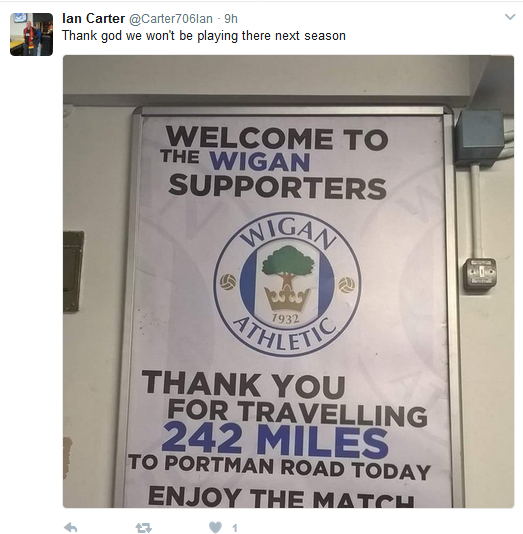
An hour before kick-off, anxiously waiting for the lineup that Graham Barrow was going to play at Portman Road. The caretaker-manager was severely hamstrung by the loss of both of his mainline strikers, Omar Bogle and Will Grigg. Was he going to put in the raw Mikael Mandron, plucked from non-league football, but nevertheless  a physical presence and goals to his name, albeit at Eastleigh Town? Or was he going to field the same forward line that finished the Newcastle game, short of physical presence?

Once the lineup was posted most of any pre-match hopes were doused. Could Latics really go into a crucial match like this without a recognised central striker? They did.

In the event it was defensive errors that handed the three points on a plate to Ipswich. On the other hand did the Wigan Athletic team really have the belief that they could pull off a good result in East Anglia?

After the match Graham Barrow was clearly fuming about the performance and critical of senior professionals for making errors that gifted a 3-0 win to a mediocre Ipswich side. But in our heart of hearts, did we really believe that Latics lineup was going to get a result? Confidence at rock bottom, following the devastation of the Joyce era, was there really any way Barrow could change the mind-set of a group of players who had unlearned the basics of good football?

It has been an awful season, paralleling that of 2014-15. Gary Caldwell certainly made mistakes this season, but was prematurely dismissed. Maybe we assumed the club would put in someone with more experience, who knew the division. But the disastrous outcome was the inept Warren Joyce.

Barrow is not everyone’s favourite to take the helm, but he had a mountain of a task to repair the damage done by Joyce when  he took over.  The players too, had a mountain ahead of them.  Under Caldwell they had played possession football.  But Joyce had them playing hoofball, often with ten men in defence. Joyce killed whatever fire Will Grigg had left by first leaving him out of the lineup, then playing him out of position. Then he brought in Omar Bogle, full of confidence, but destroyed that by isolating the player, devoid of support. Both are injured. Hopefully, with time, both will regain their confidence, but whether that might be at Wigan remains to be seen.

The sad situation is that, under Caldwell in the Championship, Latics were cautious, seemingly in awe of the opposition. As a result the goals were not going  to flow. But under Joyce it got much worse. Some said the defence tightened up under Joyce, although the stats do not reflect that. Many would say that the central defensive partnership of Burn and Buxton looked much more solid, although how much of that is due to the midfield having taking up primarily defensive roles alongside them is open to conjecture.

Although staying up might remain mathematically possible, Latics are practically relegated. According to who you speak to, the outlook of getting back to the Championship is either rosy or bleak. The half-full brigade will say Latics have enough good young players to come back up and become a backbone for the future. Their half-empty counterparts will say that most of the talent will be sold off in summer as Latics adjust to a massive cut in income. Instead of a £15-20 million wage bill in the Championship they will adjust towards the £2-3 million figure typical of so many clubs in League 1. Investment by the Sharpe/Whelan family is the unknown factor. Without it, Latics are unlikely to get out of League 1 for years to come, competing on an even keel with others in the division.

Once again we trawled the social media following another adverse result , with more speculation on the future. Our thanks go to the Cockney Latic Forum, the Vital Wigan – Latics Speyk Forum, the Boulevard of Broken Dreams on Facebook and Twitter for providing the media for the posts below to happen.  Thanks go to all whose contributions are identified below:

WhittleBlue on Latics Speyk commented:

Six games remain, sadly four of these are at home.

With the absence of any strikers (are Grigg and Bogle out for the season – I can’t recall any club communication actually confirming they are injured) the chances of us seeing the ball hit the back of the opposition net is somewhat slim.

The entertainment value is nil at the best of times and God only knows what affect another four goalless games and likely defeats will do to the prospects or retaining anyone other than the long term, hardcore fans next season. I’ve already heard kids on the way out of the DW saying they don’t want to go anymore. We don’t have a manager so it’s difficult to see the vision going forward and we don’t know what the season ticket prices will be next term. If we shift more than 3000 I will be very surprised. We all know it will be all change on the playing front again and only the dross will remain. The powers that be don’t understand the concept of a balanced squad nor do they feel communication with the fans is important. There is little for the casual fan to buy into. The damage being done is long term, not short term and incompetence at boardroom level that has led us here is quite remarkable and shows no sign of abating.

Our performances are pathetic and we have become relatively uncompetitive. We can longer field a centre forward as we only have two that are unfit and so it’s seems pointless taking to the field to see out the campaign. We are an embarrassment to this league. It’s a slow, torturous death and the end cannot come soon enough.

Stephen Warnock23 @StephenWarnock3 tweeted:

I can only apologise for my own performance last night. Simply not up to the standards I try and set myself.Embarrassed is an understatement

Jonny_SuffolkLatic on Latics Speyk commented:

Probably in a minority, but to me the entertainment value has come back a bit. I’ve gone into the past 2 games having accepted relegation, just wanted to see some attacking football and us not frightened to have a go as we were under Joyce, and we’ve done that pretty much. Yesterday was a shambolic display defensively, and unlike Villa and Newcastle we definitely deserved to lose, but at the other end, with no striker, we put in a good shift at least – and could’ve had a couple if it wern’t for Bialkowski being phenomenal. You’re probably right in that nothing but getting a win is going to win over casual fans, but for those who have followed us through the darkness of this season, I would hope there might at least be something to get out of seeing the team go at the opposition for 90 minutes each game until the end of the season.

Donnys page on the Cockney Latic Forum asked the questions:

What’s needed is a time machine to take us back to the end of last season to see what really happened and to why Mr Sharpe let this freefall happen.
Why have we played in such a negative manner all season?
Why Gary was not replaced with an experienced manager.
Why was Yootha allowed to sign players that were unfit?
Why has there been such an emphasis on midfielders all season?
Why have we been so dull to watch all season?
Why has there been no emphasis on attacking football?
Why do players not performing get picked?

Cupwinners on the Cockney Latic Forum said:

Whoever made the desision to let Fondre go in the Jan window should be taken down to market square and publicly flogged with a cat n nine tails made up of knotted Tic scarfs.
No club at any level should ever be left with anything less than 3 recognised strikers,but then again its Latics.

Andronicus on Latics Speyk added:

We actually did okay tonight attacking wise and their keeper made some cracking saves although it has to be said Gilks also made some great saves as well ! Defence though was abysmal and pretty much non existant with the central defenders looking like strangers!! Sadly Barrow is not the answer to our problem and we should be bringing someone in now to get his feet under the table for next year! So sad walk back to the hotel now and talking to the Ipswich fans they cannot get over the fact that their own mis firing team were given such an easy game tonight! Get someone in NOW!!

Jeff’s right on Latics Speyk opined:

I would have had Colclough on the right of midfield where he should be. Two youngsters from the development and youth up top. Jacobs (if the worst signing in our history Obertan isnt fit yet fit yet) out left, Gilbey and McDonald in centre midfield and four at the back. Simple. Every player in position.
Tomorrow though Sharpe needs to be down at Euxton and overseeing his shambles. Sack off all the loan players and Obertan and do what he should have done after the Bristol game start preparing for league one.

David Green on the Boulevard of Broken Dreams said:

So league 1 here we come. Lets look at the possitives no negatives because had more than enough of them.

1 cheaper tickets
2 not that many long trips ( exeption of possibly portsmouth ,plymouth and southend ) but wont be bad weekenders unless on a tuesday night .
3 a few more local games/derbies
4 good standard of football
these are only a few things i for one am looking forward to. Up the tics

Vincehill  on the Cockney Latic Forum gave his view:

From what I saw of Rotherham last Saturday in just the highlights footage I’m fully expecting them to drive the final relegation nail in on Saturday.
Let’s be honest the team is just not good Enough for this division which is so frustrating when you look at what Barnsley and Burton have done.
I keep reading deluded posts saying we can still do it but i gave up the ghost after the Bristol city game and with no strikers ( ??????) it’s all over end of .
The rot set in last summer with poor planning and investment and then the sale of wildschut and again no proper investment has left is in a real
Mess that quite frankly will continue next season if a major change in the club isn’t made .
To say it’s a disgrace isn’t doing it justice but they need to make these changes NOW especially with the season tickets sales about to start.
3 relegations in 5 years when only one in the previous 35 suggests the club has a major problem that lies beyond the players and manager and a huge change is needed throughout the club.

King_de_Zeeuw06  on Latics Speyk was far from happy with the performance:

The fact we played 5 at the back with 3 static defensive midfielders in a must win game shows me despite Barrows talk of ‘going for it’ – we simply aren’t. Negative tactics have been a common theme through all 3 managers this season and if it’s not changed by now i can’t see it changing at all until the new boss comes in.

I was really unhappy with last night after seeing that performance, but I’m absolutely seething now i’ve seen how other results went. They all went for us and if we could’ve got a win against a poor Ipswich side who had nothing to play for we’d have been back to 4 points adrift with Rotherham at home next and a ray of hope. But the set up lacked any ambition, there wasn’t enough fight and we might as well scored 3 own goals for them with the appauling mistakes we made trying to suicidally over play from the back under pressue. It was the type of game you expect the team to come out like men possessed and show some bravery and fire and we just completely bottled it. In other games we’ve been poor but at least the lads made the opposition work to earn their points, but last night was the easiest 3-0 win any team will ever get. We had everything to gain and nothing to lose by having a proper go and nearly all of them went missing – utter disgrace.

Martinh on the Cockney Latic Forum gave his summary of the season:

There’s no doubt that this has been one of the most depressing seasons in living memory, but can we put our fingers on what exactly went wrong? Below, I’ve listed my thoughts, but please chip in with your own in the hope that someone at the club might read and learn from some of this.

1) Caldwell’s clearout. He should never have let Pearce go, or send Morsy and Colclough out on loan. The team that won the league last year should have been given a chance in the Championship.

2) Going the whole season without a recognised right back. That’s apart from Luke Burke, of course, who impressed over three games or so, then was allowed to go out on loan.

3) Signing so many midfielders. How could the team possibly incorporate Nick Powell, Jordi Gomez, Michael Jacobs, Yanic Wildschutt and Alex Gilbey, or David Perkins, Shaun McDonald and Max Power? The squad was so imbalanced that just about all those players ended up filling in at right back.

4) Certain players not turning up. Alex Bogdan goes without saying, but Power, Grigg and Jacobs were all disappointing.

5) Did we panic and sack Caldwell too early?

6) Hiring Warren Joyce. I think we can all agree this was a mistake. Whatever reputation he had as a coach was undermined by some of the most boring football Wiganers have ever seen. To his credit, though, we did start defending better and he brought Morsy out from the cold.

7) Lack of professionalism.,We’re run by a 20-something chippy manager (or are we?), and Jonathan Jackson has been invisible all season. No manager since Martinez has been allowed to bring in their own backroom staff. Instead, we rely on a network of old boys who, this season, seemed to come and go intermittently (Pollitt, Cribley, Jackson, Atherton, Doolan, Barrow). It’s great to see them back st the club but are they the best people for the job? Joyce’s comments about fitness levels or the number of unexplained long-term injuries recently (Reece James, Donervon Daniels) would suggest not,

Getting rid of the local lads. Chow, Flores, Jennings and Burke may not have been worldbeaters but, in this situation, they may just have tried a little harder for their local team. Furthermore, we might have given them time rather than getting on their backs; local players are good for morale and no seen as mercenaries like Tinnicliffe and Hanson.

9) Too many loan signings, some of whom (Marcus Browne) were moaning as soon as they got here and half of whom were injured anyway.

10) Selling Wildschutt. The price may have been right but he was the only player who provided any surprise bits of magic all season.

So, which is the most important? Or can you add your own thoughts as to where it all went wrong?


Like us on Facebook, or follow us on twitter here.