It appears that Max Power is to sign for Wigan Athletic over the next few days. Power is a free agent, but Tranmere Rovers will be due to receive compensation from Latics because of his age. He appears to be a fine young prospect and could provide some genuine creative spark in Latics’ midfield.
The 5 ft 11 in tall Power has made 108 appearances, scoring 12 goals, for Tranmere despite still only being only 21 years old. Born in Birkenhead, Power joined his local team at the age of eight, captaining the team at all playing levels at the club, turning down an offer to play at Liverpool along the way. He was awarded a professional contract at the age of 17, making his first team debut as an 18 year old in August 2011.
Sadly Rovers were relegated in April, after a 94 year stay in the Football League. Power was unfortunate enough to have given away a penalty in the vital last match at Plymouth, which the home side converted. However, he was to make amends by firing home an effort from the edge of the box, although the home team were to eventually triumph by 3-2.
In order to find out more about Power’s time at Tranmere we got in touch with Deadly Submarine of the Total Tranmere site (total–tranmere.co.uk). Our thanks to him for his insight on this exciting young player.
A youth product at Tranmere and a lifelong supporter of the Club, Max Power, the guy with the most talked about name in football seems to have always suited a role alongside a playmaker type midfielder rather than being the guy to rely on to run a midfield game himself.
Capable of some great finishes and with a huge passion for the game (certainly when playing for his boyhood team), Power is a player still learning the game and learning from mistakes – a fact supported by two incidents last year where he tried to be clever and chip in a couple of penalties rather than just hit the target – something he will no doubt learn from. He also likes to look for a killer ball which is always good to see even if not always executed.
The nicest guy you could ever meet off the pitch (I have had many personal encounters with Max from his youth days right up to his time in the first team), if he carries on where he left off at Rovers, Latics fans will certainly be getting a passionate and committed player who in he right team and with the right players around him would do a job in League One although he may initially be a substitute for Wigan in my opinion.
Back-to-back relegations in the last two of his three or so senior seasons is no reflection on Max alone that’s for sure!
With less than a week to go to the first training session of the new season the summer sell off at Wigan Athletic is starting to gather momentum. Scott Carson has already gone to Derby and it looks like James McClean is off to West Bromwich and Rob Kiernan to Rangers. The latest rumour is that James Perch will be joining McClean and Callum McManaman at West Bromwich.
The demand for ex-Premier League players like Carson, McClean and Perch was always going to be there. They were to be the three most likely to attract transfer income for the club, as meanwhile it will ease its wage bill by some £20,000 per week or more for each of them. Keeping the three of them would have entailed using up around £3 m of an anticipated wage bill of £8- £10 m.
Behind them in the domestic transfer pecking order come Leon Barnett (29 years old), Don Cowie (32), Chris McCann (27) and Andrew Taylor (28) who have played in the Premier League, but are also experienced Championship division campaigners. Although their potential transfer values may not be high, the club will try to move on most of them, given their Championship-level salaries. Transfer fees will be waived as necessary.
The pairing of Andy Delort and Oriol Riera cost a total of around £5m in transfer fees last year. Sadly Delort was not able to regain his old goalscoring form after rejoining Tours on loan in January. He hit the back of the net only twice in fourteen starts. Reports from the French press suggest that there are Ligue 1 and Ligue 2 clubs interested in him, but it is doubtful whether they would be willing to pay the kind of transfer fee that Latics paid last September. Reports from Spain suggest that Deportivo La Coruna would like to keep Riera, but are unwilling to match the kind of transfer figure that Latics would like.
Latics face a dilemma with the two players. Sell them off for maybe a combined transfer input of £1m, signifying a £4m loss, or bring them back and have to use up 20% or more of the total wage bill for a squad of around 24 players, on their salaries alone. The option remains of a further loan period for each, relieving wage bill costs, but leaving the door open for the future.
However, media reports suggest that Latics are actively seeking strikers from other English clubs. It therefore looks like they will take the first option and sell the two players off at a significant loss.
All of the players mentioned so far are those for whom salaries are an issue for a club facing a change from a £30m wage bill to one of around a third of that within a year. However, there are also the cases of the younger players such as James Tavernier (23), Martyn Waghorn (25), Aaron Taylor-Sinclair (23), whose salaries will also have to be taken into account, together with the Malky Mackay signings Billy Mckay (26) and Jason Pearce (27), whom one assumes will be staying.
David Sharpe talked some time ago about needing up to fifteen new players. The implication is that the majority of the players signed prior to 2015 will be encouraged to move on.
However, if players are to move on they need a club not only interested in their services, but willing to get close to matching the salaries they have been receiving. In Grant Holt’s case the options seem slim. Ostracised by Uwe Rosler, Holt faded out of the Latics’ scene. He was sent off on loan to Aston Villa and Huddersfield, where he received an anterior cruciate knee injury that kept him out of action for the second half of last season. Holt is 34 years old and with that ACL injury he is unlikely to attract the interest of clubs who can afford to pay a salary probably well in excess of £20,000 per week.
Critics will say that Owen Coyle should not have been allowed to offer a three year contract with a lucrative salary to a 32 year old. At the time it appeared to be not such a bad bet, getting a player with proven goalscoring pedigree for a relatively low transfer fee. Little did we know that just two years later the club would be in League 1 and the player’s salary would be like a millstone around their necks.
Injuries certainly affect the marketability of a footballer. Holt’s injury while playing on loan at Huddersfield will most likely prove to be the factor that will mean him staying at the club. At 34 and past his best, recovering from injury, but playing in a lower division can he be a key player? Can he win back the fan support that he lost before he was dispatched to Villa Park? The likely scenario is that Gary Caldwell will have to find ways of motivating a player who has had a difficult time at the club, into being part of a successful set-up.
The injury to Holt did Latics no favours, but the ankle problem that prevented Emyr Huws playing in the second half of last season might well prove to be a blessing in disguise. The 21 year old Huws was initially signed on loan from Manchester City, but Rosler signed him for a fee in excess of £2m last September. Not long after Huws injured his ankle while playing for Wales and suffered a series of niggles with it that prevented him reaching top form.
However, it was an incident in training in early February that caused Malky Mackay to report that “Emyr’s rolled his ankle badly, we’ve had it looked at and he’s going to need operating on. He’s going to be out for three or four months, and that’s a real disappointment. He came back in for a couple of games, he grabbed his chance and did really well, and it’s a real blow for us and him.”
Mackay clearly rated Huws and the young Welshman was one who avoided the huge January sell-off. Midfield was to prove a problematic area under Mackay and one can only speculate what might have happened had Huws been fit.
Because of his injury Huws might well avoid the cull that will happen in the coming weeks. Big clubs will bide their time and see if he can overcome his injury and realise his full potential. Moreover Caldwell might consider him a key player, well worth paying a salary above the League 1 norm.
Huws showed what a quality player he can be when on loan at Birmingham in 2013-14. He has shown flashes of his quality at Wigan, but niggling injury has held him back. However, he has all the attributes needed to become a top midfield player. He is combative in the tackle, has a cultured left foot, good dribbling skills and the technique to score spectacular goals from distance.
In League 1 Huws is capable of being the kind of imposing midfield player that Latics have lacked since the departures of the Jimmy Macs, McCarthy and McArthur. Moreover in shedding players who have played at higher levels there is a danger of a lack of class in the team. Huws can provide that.
Who knows how many of the players from Coyle and Rosler’s days will be at Wigan come August? So many will be shed because of economic necessity.
But Emyr Huws could prove to be the asset most worth keeping from that 2014 squad.
Only time will tell if Gary Caldwell thinks the same.
“Last season is still a bit of a mystery for me. Having a poor season is one thing, it happens to a lot of teams. But for us to have got relegated was unthinkable. I’ve got my own opinion on what happened, but that’s all history now. We just need to let it go and be ready for the challenge of bouncing back next season.”
The words of Graham Barrow speaking to the Evening Post.
Many of us would be interested in hearing Barrow’s opinion of what happened last season, but he seems unwilling or unable to make it public. Barrow rightly wants to move on and focus on next season. However, despite saying that last season is all history now, he moves on to talking about his role in Latics’ Freight Rover Trophy win thirty years ago.
The Chorley-born Graham Barrow has had a long association with Wigan Athletic. He was the most rugged and determined of midfield players, sometimes used as a centre forward, signed from Altrincham for £10,000 in August 1981. He was to become a key component in Larry Lloyd’s team that won promotion from the fourth tier and made 179 appearances, scoring 35 goals, in his five seasons at Wigan. He was “Man of the Match” in that 3-1 win over Brentford in that Freight Rover Trophy final.
Barrow moved on to Chester at the age of 32 and suffered five bookings in his first seven games for them. However, he was to make 248 appearances for them, scoring 17 goals. In addition to being captain on the field of play he became assistant manager to Harry McNally, then player/manager from 1992-94. As Latics’ manager in 1994-95 he helped them avoid relegation to the Conference. He was to go on to manage Rochdale, before a short lived return to Chester, subsequently taking the reins at Bury.
Barrow was brought back to Wigan as first team coach by Roberto Martinez in July 2009. On Martinez’ departure in summer 2013 and the arrival of Owen Coyle his future seemed in the balance. New managers tend to bring in their own right hand men, but although Sandy Stewart came in as Coyle’s assistant, Barrow continued as coach. He was to become assistant manager under Uwe Rosler, keeping the position under Malky Mackay and Gary Caldwell who were to follow.
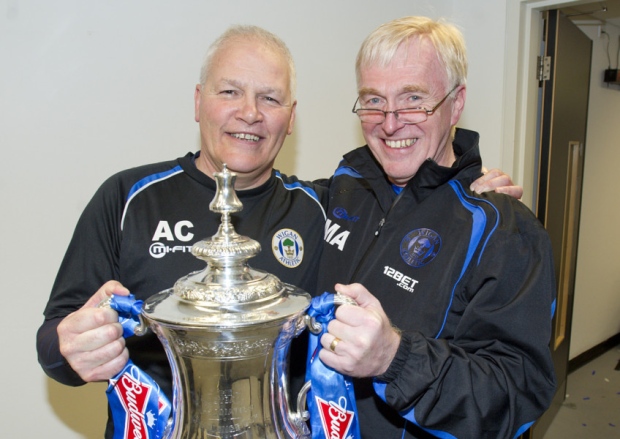
Alex Cribley played in the same Larry Lloyd team and that Wembley final against Brentford. In fact he made 328 appearances for Latics over eight years. Cribley had been signed on a free transfer from Liverpool by Ian McNeill in November 1980 and his versatility made him a key player. His best position was probably in the centre of defence, but he was a solid right back and could lend a hand in a midfield holding role. Cribley went on to become club physiotherapist, being connected with the club for 35 years.
Cribley is perhaps one of the more unsung of Latics icons. However, when Mike Ashworth retired as club doctor in April after 33 years of service he spoke of his colleague:
“One thing I will miss more than anything is Alex Cribley. He was there as a player when I started so he’s been there longer than me, then he became a physio. He’s been a fantastic friend, a fantastic support, a proper professional and Wigan Athletic has been very lucky to have him over the years. I’m going to miss that day to day contact with Alex but I’ll keep in touch, I’ll still go to the games and hopefully get a season ticket now and go back to where I started.”
A couple of weeks ago a rumour went around the social media and message boards that Cribley had left the club. Soon after the kit manager, Dave Mitten, tweeted that he had been made redundant. Ironically Mitten still appears on the Who’s Who on the official club site, but Cribley has disappeared.
Given a drop of two divisions in a space of years and an almost 80% potential dip in revenue compared with the life at the top, Wigan Athletic have to cut their coats according to their cloth. It entails not only a mind shift in terms of the kinds of players they will look to acquire, but also a fundamental restructuring of the auxiliary and administrative staff at the club.
Put simply Latics cannot continue with a Premier League infrastructure in League 1. It inevitably suggests a huge cut in the total costs of players’ wages, but also a general downsizing within the organisation.
There are fans who will question the outgoings over the next couple of months, not only players but support staff. The club will look at getting the best possible infrastructure in place, within its new financial situation, for the start of the 2015-16 season. It is going to be a painful time for so many within the club, as redundancies will be announced.
David Sharpe is in an unenviable position in having to oversee the culls. He currently has the support of the majority of fans, despite the poorly handled departure of Emmerson Boyce. There are fans who will question the exit of such as the kit manager, citing that what he was earning was a pittance in comparison with what a player would earn. Those questions will continue as the downsizing continues.
However, past commitments and service to the club should at least be acknowledged, if not celebrated. Boyce spent nine years at Latics in their heyday and deserved more thanks than he got from a club that has not been strong in the human resource management aspect. It is sadly the norm in football clubs across the country, Latics probably being no better or worse than most.
Football clubs need to look forward to the future, but at least recognise people who have put in so much in the past.
“The centre-forward is often a tall player, typically known as a target man, whose main function is to score the majority of goals on behalf of the team. The player may also be used to win long balls or receive passes and “hold up” the ball as team-mates advance, to help teammates score by providing a pass (‘through ball’ into the box); the latter variation usually requiring quicker pace. Most modern centre-forwards operate in front of the second strikers or central attacking midfielders, and do the majority of the ball handling outside the box.“
I had been looking for a description of the role of the centre forward and after a bit of searching I found the above on Wikipedia. It sums up more or less what I thought the role involved. But why didn’t I trust my own judgment in the first place? After decades of watching football surely I knew what a centre forward should do. But events over the past year or so had clouded my judgment.
My boyhood hero as a centre forward was Harry Lyon. Lyon was by no means a giant, but he had the jumping technique to out-do defenders on high crosses. He certainly scored the majority of the goals for Latics in his heyday. In fact he netted a remarkable 67 times in the 1964-65 season. But the following season saw his goalscoring tally drop, when he scored less than his strike partner Bert Llewellyn who got 49.
Lyon was a scapper, lacking elegance in his tussles against opposition defenders, but he would always chase the long ball and fight hammer and nail to hold possession. Memory fades, but I don’t recall Harry as the kind of player to provide through balls into the box, but his strike partner would be there sniffing for the rebound of one of his ferocious shots. Llewellyn and his predecessor at Wigan, Carl Davenport, were good at putting those loose balls in the net.
But football has changed since Lyon’s day. Defenders are much fitter and most teams have a couple of large guys in the centre of defence who are very good at clearing the ball, especially if it is in the air. For decades after Alf Ramsey brought in 4-4-2, teams used that system. The twin strikers would tussle with the twin central defenders of the opposition, but after a while the fashion changed.
Perhaps it had become too easy for those central defenders. Marking for them had been straightforward – you take one and I take the other being the order of the day. They were later to be faced with just one central striker, with support coming from the flanks and the midfield. Their roles became more complicated, sometimes confusing.
In the higher levels of English football not so many teams now play 4-4-2. The job of the centre forward has become an almost thankless task, extremely physically challenging in having to chase balls and hold up against often two big defenders. Then he has to have the energy and enthusiasm to mount attacks on goal. Not surprisingly good centre forwards are hard to come by in this day and age. Some are good at scoring goals, but not so efficient in chasing lost causes and holding up the ball. Others are the reverse. The average goal tally for a centre forward has not surprisingly dropped, given his onerous other duties.
However, this does not mean that modern day systems don’t work. The top teams have midfield players moving into the “hole” behind or to the side of the centre forward, notching opportunist goals. Those typically towering central defenders have a hard time coping with their runs.
Uwe Rosler was clearly a disciple of the “modern” approach. In his first season he often used MAF – Marc-Antoine Fortune – in that lone centre forward role, with two players wide of him. Fortune did a good job in holding up the ball and worked hard. MAF had been used sparingly by Owen Coyle, with Nick Powell being on the scene, but Rosler often used him as the target man following Powell’s loss of form and Grant Holt’s fall from grace. Over the course of the 2013-14 season, MAF was to make 17 league starts, with 20 appearances off the bench. He scored four goals.
Rosler had clearly decided that MAF would not be his first choice centre forward when he signed Oriol Riera before the beginning of last season. This was underlined when Andy Delort was signed just before the close of the summer transfer window. But neither of the two overseas players could settle in their roles. MAF was brought back in.
In Malky Mackay’s first game in charge in late November, Latics were home to Middlesbrough. MAF was given the lone centre forward role, with Callum McManaman and Shaun Maloney playing wide. MAF was to become a regular fixture in Mackay’s teams, even when he switched to 4-4-2. Fans had been hopeful that more goals would come with a switch to the system that had done Latics proud in their heyday. However, Mackay was to pair up MAF with James McClean, a winger playing as a central striker, or Leon Clarke, a journeyman who rarely delivered. Mackay had scorned the idea of linking him up with Billy Mckay or Martyn Waghorn. By the end of the season, MAF had made 27 league starts, with 8 appearances off the bench and scored one goal.
MAF had become a feature in the Mackay era through his ability to chase those lost causes and hold up the ball. Although he offered a minimal goal threat the team often suffered when he was not on the field. MAF had become an important cog in Mackay’s long ball tactics.
MAF was like Marmite to Wigan Athletic fans. You either loved him or you hated him. Despite his whole-hearted play and willingness to sacrifice for the team, few loved him. MAF had become synonymous with the most disappointing season in living memory for most fans.
At Wigan MAF had become the target man, not always his role at previous clubs. Indeed at West Bromwich he had often been played wide. Perhaps Latics would have got more out of the player if they had done that. MAF’s career record as a goalscorer was weak when he arrived at Wigan as a 32 year old, but playing as a lone centre forward helped make it even worse. Moreover his concentration could lapse and he could too often be caught offside.
We might well ponder what might have happened if Latics had persevered longer with the overseas strikers, Delort and Riera. Had they been written off by the coaches or was it an economy measure to send them off on loan in January? On top of that, the reluctance of Mackay to give Waghorn and Mckay a genuine chance was hard to fathom, given the impotent strike force he was regularly fielding. There are fans who even suggest that Latics have avoided relegation if Mackay had not so often fielded MAF.
MAF sadly became the scapegoat of an awful season. Unlike Harry Lyon he could not score goals. Neither could he make assists.
MAF is by no means a bad footballer, neither does he shirk in his duties. But he is not a goalscorer.
“Delighted to have agreed a deal to join @LaticsOfficial for next season. Can’t wait to start and help get them back where they should be….”
So said new Latics acquisition Richard O’Donnell on Twitter today.
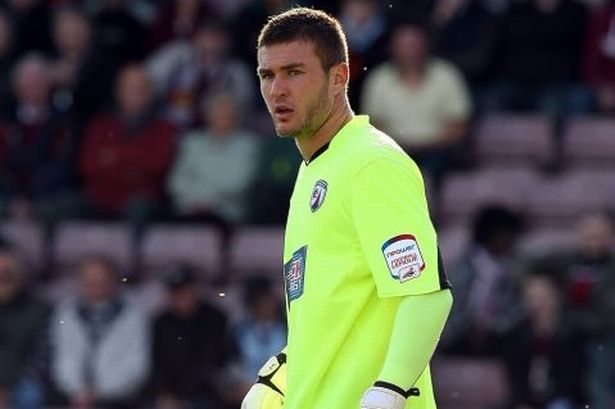
O’Donnell is a 6 ft 2 in goalkeeper, born in Sheffield, who will sign Wigan Athletic as a free agent from League 1 club Walsall. He is 26 years old, a product of the Sheffield Wednesday academy.
As a young player from O’Donnell was sent on loan to seven clubs in the lower divisions and non-league from 2007-11. He made his Football League debut as a 19 year old for Oldham Athletic against Luton Town in March 2008. It was three years later to the month that he made his debut for Wednesday in a match at Southampton. After making 19 appearances for the Owls he was released in May 2012.
O’Donnell then signed a one year contract for League 2 side Chesterfield. Covering for the absence of regular goalkeeper Tommy Lee he made 14 starts, but lost his place on Lee’s return from injury. In January he was loaned out to Stockport County in the Conference where he made 20 starts. He returned to Chesterfield for the last game of the season in a 4-0 win over Exeter.
In summer of 2013 he joined Walsall where he was to establish himself as the first choice goalkeeper, making 90 appearances in his two seasons there. He kept 21 clean sheets last season.
In order to learn more about O’Donnell’s time at Walsall we reached out to the BescotBanter.net fan site (@BescotBanter). Our thanks to them for the fan’s view that follows:
Following the Saddlers’ acquisition of goalkeeping coach Neil Cutler, Richard joined the club in the summer of 2013 and quickly went on to establish himself as first-choice, bringing his brand of committed stopping to the side.
A player who is willing to put his body on the line, Richard made over fifty first team appearances during his debut season with the club and penned a new eighteen-month contract in January 2014.
Following his debut season Richard continued as first-choice goalkeeper and went on to make his one hundredth consecutive first-team appearance for the club as the Saddlers played host to Notts County on 3rd April.
Richard established himself as a clear fan favourite during his time with the club and went on to be named both the Fans and Players’ Player of the Season at the 2014/15 End of Season Awards.
O’Donnell also came close to single-handedly breaking a club record for most clean sheets in a season, which was held by former Trinidad and Tobago international Clayton Ince, who was unbeaten on twenty-two occasions during the 2006/07 campaign.
The record was ultimately collected by Craig MacGillivray, as he kept a clean sheet during his debut against Oldham Athletic.
Following a lengthy spell of contract negotiations, which began in November 2014, Richard made the decision to leave the club and join Wigan Athletic on a three-year deal, the move seems to have come down to a length of contact issue, with the Saddlers either unable or unwilling to match the Latics’ three-year offering.
When the dust of his move settles Richard will go down as one of the best stoppers in the club’s recent history, and will always be welcome at Banks’s Stadium.