
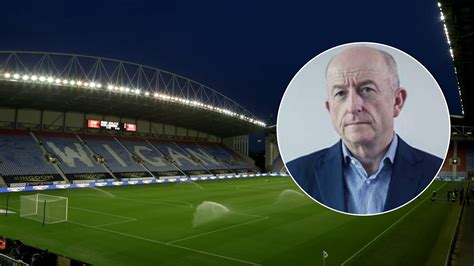
Whenever Mike Danson eventually sells Wigan Athletic, the debate over his legacy will begin almost immediately.
For some supporters, the judgement will be straightforward. Three years in League One, no sustained promotion challenge, managerial changes and football that has too often been cautious rather than exciting. Given the expectations created by Danson’s arrival and his personal wealth, many will argue that Wigan Athletic should have progressed much further.
That frustration is understandable.
Football supporters do not judge owners by balance sheets, financial reports or improved governance. They judge them by what happens on a Saturday afternoon. They want to see better players, better performances and a team that appears to be moving towards the Championship rather than simply trying to find stability.
By those standards, the Danson era has been disappointing.
However, there is another side to the story.
Those who view his ownership more positively will point back to the situation he inherited in 2023, when Wigan Athletic was facing serious financial uncertainty. They will argue that before talking about promotion, recruitment or ambition, the first responsibility was to ensure there was a club capable of having those conversations in the future.
Both views contain an element of truth. The difficulty is deciding which one will matter most when history looks back. Because the legacy of a football owner cannot always be judged by the league table alone.
The real question may not be whether Mike Danson took Wigan Athletic back to the Championship.
It may be whether he leaves the club in a stronger position than the one he found.
The Club Danson Inherited
When Danson took control of Wigan Athletic in 2023, he was not buying a club that was one or two quality signings away from promotion.
He was inheriting a club whose foundations had been badly damaged.
Years of financial problems had created uncertainty around almost every aspect of the club. Supporters had endured unpaid wages, ownership turmoil and the constant fear that another crisis was just around the corner. The reputation of Wigan Athletic had suffered, and confidence among supporters, creditors and the wider football community had been badly affected.
The priority was not promotion.
It was survival.
Danson’s first task was therefore not to assemble an expensive squad or make a statement signing. It was to restore stability, rebuild trust and make sure the club could operate normally again.
Those achievements rarely create excitement. Nobody celebrates a football club paying its bills. Nobody buys a shirt because suppliers have regained confidence.
But without those things, everything else becomes irrelevant. A club cannot plan for promotion when it is constantly fighting fires behind the scenes.
The irony is that supporters quickly moved from worrying about whether Wigan Athletic would survive to debating whether the football was good enough. In many ways, that was evidence that the immediate crisis had passed.
The problem was that once survival was no longer the main concern, expectations naturally returned.
And that is where the criticism began.
The Spending Debate and the New Reality of League One
The most common criticism of Mike Danson’s ownership has been a straightforward one. Why has a wealthy owner not invested more heavily in the playing squad?
It is a question supporters are entitled to ask. Football is ultimately judged by results, and after three seasons in League One without a sustained promotion challenge, many fans feel that Wigan Athletic has not progressed as quickly as expected.
The frustration is understandable. Supporters saw the arrival of a successful businessman, remembered the club’s Premier League years and hoped that financial stability would quickly be followed by investment on the pitch. They wanted better players, better performances and a realistic push towards the Championship.
Instead, progress has been slower.
Recruitment has not always delivered. Managers have come and gone. Performances have often lacked the creativity and consistency supporters want to see.
However, the financial landscape of lower-league football has changed significantly, and that needs to form part of the discussion when judging any modern owner.
For many years, the traditional route to success in the lower divisions was relatively simple. A wealthy owner could choose to cover losses, increase the wage bill and invest heavily in the playing squad. If they were prepared to put more money into the club, they could usually spend more money on players.
That model is becoming increasingly restricted.
League One and League Two clubs now operate under the EFL’s Salary Cost Management Protocol (SCMP), which is designed to prevent clubs from building unsustainable squads based on spending that cannot be supported by their own income.
One of the most significant changes is how additional football income can be used.
Previously, money generated from sources such as cup runs, prize money or transfer fees received could largely be reinvested into improving the playing squad. Under the revised rules, that flexibility has been reduced. League One clubs can now use 60% of this additional football income on player-related expenditure, while League Two clubs are limited to 50%.
The impact is important.
Even a wealthy owner investing significant sums into a club cannot simply convert all of that money into transfer fees and wages. A League One owner could invest £100 million into their club, but spending on the playing squad would still be restricted by the SCMP rules.
That does not prevent owners from investing. They can still commit unlimited funds to areas such as infrastructure improvements, training facilities, community projects and other non-player-related costs.
The purpose of the changes is to encourage clubs to become more sustainable and less dependent on owners continually increasing their financial support.
For clubs like Wigan Athletic, this changes the nature of the challenge.
A wealthy owner remains a major advantage, but money alone is no longer the complete answer. Increasingly, successful clubs will be those that can grow their own income and create greater room for investment within the rules.
Commercial partnerships, sponsorship, hospitality, ticket sales, academy development and better use of facilities all become more important because they directly influence what a club can spend on its squad.
That changes the question facing Wigan Athletic.
Instead of asking only:
“Why hasn’t Mike Danson spent more?”
perhaps the bigger question is:
“Has Mike Danson helped create a club that can generate and spend more sustainably in the future?”
This does not mean supporters should ignore the shortcomings of the last three years. They are right to demand better football, stronger recruitment and greater progress.
But the judgement of Danson’s ownership should also consider the environment in which the club now operates.
The successful clubs of the future are unlikely to be those with the richest owners alone. They will be those that build the strongest businesses.
And for Wigan Athletic, that may be the foundation on which the next chapter of the club’s history is built.
The Stadium Question
That brings us to the issue that could define the next stage of Wigan Athletic’s future: The Brick Community Stadium.
The stadium is owned separately from Wigan Athletic and remains under Mike Danson’s control alongside his ownership of Wigan Warriors. Naturally, this has become one of the biggest talking points surrounding any possible investment or sale of the football club.
There has been speculation that some potential buyers would prefer the stadium to be included in any deal, while Danson may want to retain control. Exactly how significant this issue has been in discussions is known only by those directly involved.
However, the reason the stadium matters is clear.
In modern football, a stadium is much more than four stands and a pitch. It is a commercial asset.
The difficulty is that stadium ownership is not always as straightforward as supporters might imagine. Outside the Premier League, stadiums are often expensive businesses rather than guaranteed sources of profit. Maintenance, utilities, staffing, insurance, safety requirements and ongoing repairs all create significant costs.
The Brick Community Stadium also has a unique challenge because it serves two professional clubs. Wigan Athletic and Wigan Warriors both rely on it. Both clubs help make the stadium more financially viable. That creates a difficult balancing act.
If Danson continues to own Wigan Warriors, it is understandable that he would want to protect the rugby club’s long-term future and ensure it has security over its home.
Equally, anyone buying Wigan Athletic would understandably want certainty over where the football club plays and how it can benefit from the commercial opportunities connected with the stadium.
Neither position is unreasonable.
The solution is likely to require compromise.
A long-term lease could provide Wigan Athletic with security without requiring a complete transfer of stadium ownership. A partnership arrangement could allow both clubs to benefit from future development.
The important thing is that the stadium becomes an asset supporting both clubs rather than an issue preventing progress.
Finding the Right Successor
Perhaps the biggest lesson from the Danson era is that the next owner cannot simply be judged by personal wealth.
Wigan Athletic does not need another short-term gamble.
The club needs someone who understands modern football. Someone with ambition, but also patience. Someone who recognises that success is not created by spending alone.
The ideal owner will need to grow revenues, maximise the potential of the stadium, strengthen recruitment structures and build a sustainable model capable of competing under the EFL’s financial rules.
The next owner will not be arriving to rescue Wigan Athletic. They will be arriving with the opportunity to build it.
How Will History Judge Mike Danson?
Ultimately, Mike Danson’s legacy may depend less on what happened while he was owner and more on what happens after he leaves.
If Latics remain stuck in League One, supporters will understandably question why greater progress was not achieved.
But if the next owner inherits a financially stable club, resolves the stadium issue, grows revenues and eventually takes Wigan Athletic back towards the Championship, history may view the Danson era very differently.
Perhaps the most important part of his legacy will be the foundations he has helped put in place, giving Wigan Athletic a stronger platform from which future success can be built.
Mike Danson may not be remembered as the owner who completed the journey back to the Championship.
But he may be remembered as the owner who ensured that Wigan Athletic was still capable of making that journey.
And perhaps that is the true measure of his legacy.
Not simply where the club was when he left.
But whether he left behind a club with a future.

