Ryan Lowe’s summer shopping list

I read an article the other day saying that in the 1960s the average tenure for a top flight manager was around four years, a far cry from the modern day when the figure is well below two. Since April 2015 Wigan Athletic have had 12 managers, although the figure does include those who were interim appointments.

Football clubs that are succeeding tend not to replace their managers frequently, but those who are not are doing well will usually ditch their manager in the hope of a new one coming in changing their fortunes. If the new manager does not succeed clubs rarely make thorough investigations into underlying factors that can cause the lack of success, so often repeating the process by making another change at the top. Over the past 25 years Wigan Athletic’s longest-serving managers have been Paul Jewell (6 years) and Roberto Martinez (4 years), both of whom brought honours to a club punching above its weight.

In early March I published an article “What kind of manager is needed to take Shaun Maloney’s legacy further? stating that:

“One can only hope that the Board are shrewd in their appointment. Whoever comes in will have players signed by Maloney on permanent contracts. They were signed to play the possession-based football that Maloney believes in. A shrewd appointment would be to bring in someone who can build on the good things that the Scot did, rather than one with a diametrically opposed philosophy of football.”

Whether Ryan Lowe can build on what Maloney did is open to question. From what we have seen so far, his style of football is hardly akin to that of the Scot. However, there was a faint chance of the club being relegated when Lowe took over and he adopted a “fightball” style of play, grinding out the results that would eventually get them to 15th position.

Most managers have a preferred tactical formation. The most common shape at Wigan in recent years has been 4-2-3-1, with a lone centre forward and an attacking midfielder playing behind him. Although Paul Cook and Leam Richardson were largely popular managers during their tenures there were always fans, particularly those who had witnessed the golden days of the Ellington-Roberts duo, who wanted to see twin strikers. Those fans will be delighted that Lowe likes to play with two central strikers. His preferred formation has been a version 3-1-4-2, with a central midfielder playing deep in front of the defence. He has lacked “natural” wing backs, having to use players more used to playing at full back or on the wing.  

Given Lowe’s preferred tactical approach he will need to adjust the balance of the squad. The retained list shows a senior squad of 19 players under permanent contract, but with Steven Sessegnon made available for transfer. Options for another year are triggered for Joe Adams, Tom Watson and Luke Robinson. Matthew Corran, Callum McManaman and Harry McHugh may get extensions on depending on negotiations.

Lowe needs wing backs and more strikers so he will need to move on players his predecessor signed on permanent contracts. Some will leave for low fees or free transfers, others being sent out on loan. Much has been said about the quality of recruitment last summer, but the aim to bring in young players in their early to mid-twenties, with potential sell-on value, was refreshing.  For too long the club had been saddled with older, experienced pros on relatively high salaries and long contracts, but with low sell-on values.

Lowe has made it clear that he needs more experience in his squad and that any under-21 players hoping to make the senior team will have to prove themselves worthy in training. He gave the exciting 19 -year-old K’Marni Miller his League 1 debut in the final game against Northampton, commenting “I said I wouldn’t be throwing in people for the sake of it, they’d have to have earned it with the way they handle themselves around the training ground and he’s been first one out and last one in ever since I’ve been here, so he was well worthy of coming on and I was pleased with what he did.” Miller was signed by Maloney last summer from on-league Guiseley.

Ryan Lowe’s appointment has gone down well with the majority of Latics fans. Although one could see the green shoots that suggested Maloney’s side would progress to a higher level with time it was nevertheless a frustrating season for us as fans, watching insipid stuff so often. Lowe’s arrival means yet another change in playing style and the kind of turnover in playing staff that has plagued the club over the past years. However, Lowe is an experienced manager who has a history of producing teams that punch above their weight despite being on modest budgets. One can only hope that he is given the full three years of his contract. Too many managers have been dismissed in an untimely manner over the years rather than being supported through difficult periods. The net result has been instability, with too much turnover not only of managers and coaches, but also of playing staff.

The hope is that over summer Lowe will make the adjustments in the balance of the squad that he feels he needs, but that turnover of playing staff is much reduced in the summer of 2026 and beyond. History has shown us that success is more likely if the manager is given a relatively long tenure.  

Wigan Athletic: what profile of manager is needed to take Shaun Maloney’s legacy forward?

I was gobsmacked when I read the communique on the Wigan Athletic website about Shaun Maloney’s dismissal. My gut reaction was: how can they treat a man so badly, given the huge amount he has done over the last couple of years to keep the club afloat? The stories we have heard about him going way beyond the bounds of his role to help the club he has loved have been so heart-warming. It was a hellish two-year tenure for the FA Cup final hero who came back to help get the football side at the club back on track. He was constantly buffeted and stretched, but maintained a dignity that rose above it all.

The communique did, at least, recognise some of Maloney’s achievements:

“Shaun was appointed Wigan Athletic Manager in January 2023 during what would be an extremely turbulent period in the Club’s history. Whilst he could not prevent the Club’s relegation from the EFL Championship, Shaun ensured that the Club returned to the third tier with fighting spirit.

Furthermore, through a change of ownership in the summer of 2023, Shaun stuck by the Club and helped us overcome an eight-point deduction and a squad overhaul to retain our 2023/24 League One status comfortably with matches to spare.

During his tenure, Shaun and his young team have provided the Club and its supporters with some proud moments, including an Emirates FA Cup Third Round tie with Manchester United, as well as three memorable victories over rivals Bolton Wanderers, just to name a few.

Shaun has also helped develop a number of our young players, some of whom have moved on to further their careers to the mutual benefit of the Football Club.”

The manager’s sudden departure from Wigan Athletic has come at a critical time of the season. Latics sit 6 points above the League 1 relegation zone with 13 matches left. Why did Mike Danson decide to dispense with the service of Maloney and his assistant, Max Rogers, with such odd timing?

It has been a particularly frustrating season for us Latics fans. As can be expected fans’ frustrations have been vented at the manager and the owner of the club. Some of the more vocal fans constantly attacked Maloney’s style of football as being sterile and over-defensive. Others suggested that Danson is a rugby man, unwilling to put the money in to enable the football club to regain its place in the Championship.  The distilled view from such fans was that Maloney was not the man to ultimately provide success on the pitch. However, the manager had to shed key players due to Danson’s sustainability focus, replacing them with inferior players on lower salaries, who are just not good enough. Did the unrest among this portion of the fan base contribute to Danson’s decision?

“However, it cannot be overlooked that the current League One campaign has clearly not progressed as anticipated. Home results and performances, in particular, have been disappointing and below the standard at which our supporters expect. For this reason, the Board felt that it was time for a change.” (communique)

Wigan’s home form this season puts them in 17th place in the division with a record of W5D4L8. However, it is the lack of goals this season at “The Brick” that has rankled the fans. In 17 home games they have scored just 16 goals, the lowest in the division. However, they have only conceded 20. So many games this season have been dull and uninspiring, offering minimal entertainment to paying customers.

But then again this was always going to be a transition season, as the budget constraints kicked in. Maloney was forced to bring in bargain basement signings and a host of loan players over the summer. The permanent signings were focused on players in their early 20s whose asset values could increase, given good coaching. The exception was the signing of Will Aimson, an experienced centre back, to replace the outgoing Charlie Hughes. However, there was a need to bring in loan players as has been the custom over previous years. They were all young players in a squad that already lacking experience. In January, Maloney was given the opportunity to jettison some underperforming loan players to bring in experienced loanees, Owen Dale (25) and Ollie Norburn (32). Fees were paid for the experienced Jon Mellish (27), Joe Hungbo (25), Ronan Darcy (24) plus Josh Robinson (20) from Arsenal U21s.

Over the course of the season so far Latics have used 28 players in League 1 matches.  Fans expected part of the fees received for the outgoing transfers of Charlie Hughes and Thelo Aasgaard (total around £6m-£7m), to bring in new players. Fees paid out in summer and January have not been disclosed, but can be estimated around £1m-£2m.

The departure of leading scorer Aasgaard was a blow for Maloney and the results from January have been disappointing. However, it has taken time for the new players from January to settle in, although recently the team has started to gel better, with Maloney making less changes in his starting lineups. It was ironic to see Maloney dismissed as he seemed to be making better progress with a hard-fought draw at 2nd placed Wycombe and a first half display against 4th placed Huddersfield that was the best of the season. It was no surprise that their performance was “flat” against the third promotion hopeful, Reading. What was a surprise was the timing of Maloney’s sacking, given the scenario. Was it because the Board already had another candidate lined up to take over at short notice to hopefully guide them to safety?

One can only hope that the Board are shrewd in their appointment. Whoever comes in will have players signed by Maloney on permanent contracts. They were signed to play the possession-based football that Maloney believes in. A shrewd appointment would be to bring in someone who can build on the good things that the Scot did, rather than one with a diametrically opposed philosophy of football.

One can only look back to Dave Whelan’s appointment of “long ball” Owen Coyle to replace Robert Martinez to know how disastrous some recruitment decisions can be.

Gomez and Maloney: wingers or playmakers?

How did Wigan Athletic stay up last season? Was that incredible late run due to a tactical transformation? Or was it due to new players coming in and changing things? The acquisition of a specialist left wing back – Jean Beausejour in January – certainly helped the system flow more effectively. However, if you were to ask a room full of Latics supporters which player made the biggest difference the answer would surely be Shaun Maloney.

Maloney’s season had not really started until he came on as a substitute against Norwich in March 2012. He put through a fantastic pass to Victor Moses to get the goal that earned an invaluable point at Carrow Road. Following that match, his ex-Celtic colleague , Gary Caldwell, dubbed Maloney as “Our Secret Weapon” quoting that “He picks up the ball in the final third and he can either beat his man and he can pick out that killer ball – like you saw with the goal.” Caldwell was proved to be right.

Maloney was later to score the Latics’ goal of the season to defeat Manchester United. His ice cool penalty in the victory over Liverpool at Anfield sticks in the memory, as does his cutting in from the left and putting a brilliant narrow angled finish in the 4-0 drubbing of Newcastle. But more than the goals he scored it was that role as a “playmaker”, linking between defence and attack that helped transform the quality of football Latics were able to play.

Maloney had come to Wigan following  a difficult final period at Celtic. His career had been blighted with injury. Moreover he had been struck by homesickness during his previous spell in the Premier League — at Aston Villa in 2007-2008. These factors made it unlikely that a Premier League team would come for him, until Roberto Martinez knocked on his door. During his two spells at Parkhead he had won five SPL Championships, Scottish Cups and three Scottish League Cups. His acquisition by Wigan Athletic is summer of 2011 was therefore a calculated gamble. For the first half of the season, he made four appearances as a substitute and played in two awful team performances in the FA and League Cups. Fitness remained the issue. It was through sheer hard work and dedication that Maloney got back to a level of fitness that would help him be able to showpiece his skills in the Premier League.

Wigan Athletic’s starting lineup last Saturday included both Jordi Gomez and Shaun Maloney. Normally, only one of them makes the starting lineup, with the other coming on as a substitute. Both are playmakers, who need to receive a lot of the ball to be effective. However, each has learned during his time at the club that defensive duties are also required. Neither is a natural tackler but they both do their share in trying to win the ball back. Both cover huge amounts of ground during a match. Both are cool penalty takers. Both score goals which are not from the penalty spot.

Jordi Gomez is a player who divides Latics fans. He is derided by those “Darksiders” who prefer more the more traditional English approach of “up and at ‘em” . The fans who appreciate him will say he is a skilful player who can bring order to a game through his cultured technique, keeping the ball while under pressure and drawing fouls. I have heard it said that we will never see how good Gomez can be until Latics are playing the level of skilful football that Roberto Martinez seeks. We have seen some really magic moments from Gomez during his time at Wigan. At Arsenal in April he put through the pass that sent Di Santo through to score then got an opportunist goal himself. He has been unlucky so many times with fine efforts that have hit the woodwork – last Saturday against Fulham was another example.

How do the playmakers – Gomez and Maloney – fit into the current tactical system? Are they wingers or central midfielders? Can they play together?

Maloney still finds it difficult to complete 90 minutes. Gomez is the natural replacement. Their styles differ greatly. Maloney will dribble with the ball more than Gomez who will seek the wall pass more frequently. Gomez does not have the pace or dribbling capacity to be a winger. When played wide on the right he inevitably turns towards the middle where he is going to be more comfortable and effective. However, he is not afraid to shoot – he has a good technique and can hit the target. Maloney was used mainly as a left winger by Aston Villa. Although right-footed he can cross the ball with his left foot. He can dribble past defenders and cause danger. However, it is when they move into the “hole” in midfield – behind the central striker- that both Gomez and Maloney are most effective.

Playing Gomez and Maloney together is unlikely to be effective because their basic function is too similar. They are players who make themselves available to receive the ball, providing the link between defence and attack. Both are good players. Let’s not forget that David Jones can also play in that position and is a capable and creative player. He added the incision in the Capital One victory at West Ham last night.

Let’s play the playmakers in their natural position in central midfield, ahead of the holding midfielders, but behind the forwards. Martinez has done well to adjust the tactical system following the loss of Victor Moses. The presence of two big central and pacy strikers is a real plus. There remains the possibility of playing without the central playmaker and having two wide players supporting the central striker. Well done, Roberto, in being open-minded towards further tactical innovation. But please – let’s not see Gomez and Maloney playing wide, flanking a single centre forward.

Wigan Athletic 0 Chelsea 2: Fatal five minutes mask a promising display

There was a time, not long ago, when conceding two goals in the first few minutes against a top six side almost guaranteed a hammering. Indeed, Chelsea have inflicted two such high-scoring morale wreckers in the last three years. Say what you will about the first five minutes in yesterday’s season opener, this team is lights years ahead of where it was, even a single year ago.

If you’d picked up the match seven minutes in (and ignored the scoreboard), you would have witnessed a pleasing first-half display of cultured possession football. Crosses were flying in from both sides of the pitch, Victor Moses was enjoying himself, the midfield looked comfortable, and but for a heavy first touch, Di Santo might have scored.

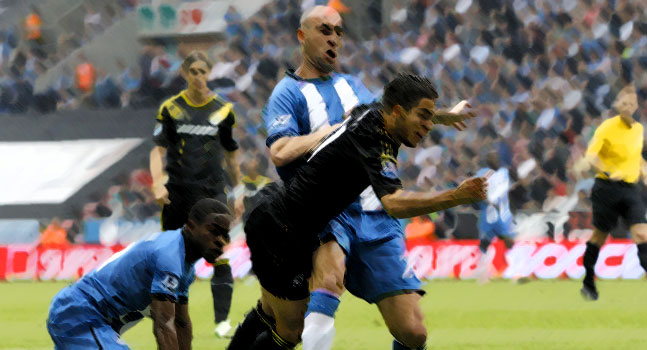
Unfortunately, as Roberto did in his post-match interviews, we must acknowledge those hapless opening exchanges. The match had barely gotten underway when Eden Hazard skilfully — but all too easily — turned Ivan Ramis near the midfield circle and found Branislav Ivanovic with a perfect through ball down the right wing. Chased by Figueroa, who was playing at left wing-back rather than his customary left centre-back position due to an injury to Jean Beausejour, the Chelsea fullback finished coolly past Al-Habsi to make it 1-0. Moments later, Chelsea’s marquee summer signing was causing panic once again, tempting Ramis into a lunge in the penalty box. Referee Mike Jones pointed to the spot and Frank Lampard rarely misses.

It was a tough start for the Spanish centre-back, who is not only adapting to a new country and culture, but a new tactical system with three centre-backs, and faster pace of play. All only a week or so after joining the club, and against the defending European Champions. Midfielders and strikers often get the benefit of being given 15-20 minutes at the end of the match to bed in, as new Ivorian striker Arouna Koné did later on. For Ramis, it was straight into the fire. But he improved as the game went on, and indeed cleared off the line brilliantly to deny Fernando Torres a second-half goal. Despite the mistakes — which were not characteristic of his game in Spain — he showed enough to suggest that once adapted, he will be a good addition.

Jean Beausejour missed his first match through injury since signing for the club in January. In his place, Maynor Figueroa performed well enough to suggest we now have cover, not only for the three centre-back positions, but for the wing-backs on both sides as well. Emmerson Boyce, down the right, was great and just seems to get better with age.

Much of Wigan’s momentum was lost when Shaun Maloney had to be withdrawn with a groin injury early in the second half. Roberto has since admitted both Maloney and MacArthur were taken off with little niggles as a precaution rather than due to serious injuries. Jordi Gomez, Maloney’s replacement, drew fouls and got himself in good positions, but ultimately failed with his finishing. Ben Watson, on for MacArthur, looked a little rusty but is a fine option from the bench. Neither of them filled the void left by Maloney, who along with Moses, has become our creative spark.

Things started to turn Chelsea’s way and a third goal looked likely. But some exciting end-to-end stuff produced Ramis’ aforementioned goal-line clearance and a surging Victor Moses run and cross down the other end. By then Arouna Koné had come on for his Wigan debut, and showed great promise with a trio of decent half-chances. He immediately appeared to have what Di Santo lacks — the movement and instincts necessary to know where to be when a cross comes into the box. Di Santo has just about everything else, but seldom gets on the end of crosses to head, poke, prod, or hammer home.

Wigan finished the match in the ascendancy and were quite unlucky not to emerge goalless. The usual questions will emerge about profligacy in front of goal, but Chelsea won the Champions League on the back of excellent defending (and a healthy slice of luck). They are not easy to break down.

All things considered, this was an encouraging performance. News outlets have of course focused on Hazard and Chelsea’s exciting new strikeforce, but Latics enjoyed more possession, created 15 goal attempts to Chelsea’s six, seven corners to the visitors’ one. The boys played in much the same way they ended last season — minus the defensive intensity in those first few minutes — and the news signings got a game under their belts.

Southampton promises to be a tricky fixture after their near-miss at the Etihad on Sunday. But if we play the way we did for 80 minutes, we’ll be in with a good chance to notch our first points of the season. Stay tuned for The Good, The Bad and Player Ratings, coming soon.

Momentum building: Wigan Athletic season preview

On first look, it’s hard to blame the people who doom Wigan Athletic to relegation each year. On paper, our late August squad looks weaker than the lads that kept us up in May. We’ve typically lost our top player (or three) to bigger clubs and replaced them with little known youngsters from the Scottish league or unfashionable, though generally astute, Spanish-speaking gambles in their late twenties.

But this season irks more than any of the previous. How short is the memory? To repeatedly read paid journalists make the point that Latics will suffer without Hugo Rodallega and Mo Diame is more than lazy. The finest run of form in Wigan Athletic history — ultimately resulting in survival and the scalps of Liverpool, Manchester United, Arsenal, in-form Newcastle and almost European Champions Chelsea but for two horrific mistakes by match officials — was achieved with the pair of them reduced to cameos from the substitutes bench. They scored three goals between them since Christmas and all were in matches that we had already lost.

This is not a slight on either player. Both immensely talented, they were a pleasure to watch and have at the JJB/DW. Hugo, a poacher, was frustrating on the left wing but certainly a success overall and crowd favourite, and suffered from injuries last season. Diame was outstanding in the first half of the term when no one else was, before losing his place to the thoroughly committed and deservedly appreciated James McArthur after the African Cup of Nations. But the point stands that they played no real role in Latics’ sensational final two months.

If anything, that unforgettable survival run emphasized the transition of Wigan Athletic as a Premier League club where individuals come to make their name, to a club of players proud to play for Wigan that operate as a team. Mauro Boselli, recently returned after a year and a half on loan in Italy and Argentina, made the interesting comment that contrary to two years ago when he arrived, there were no longer any divisions in the squad — it feels like a team of players that play for each other. We’ll be publishing an exclusive interview with him later this week.

What people are missing is that, behind the scenes, we’ve been making steady progress. Most people see Wigan as just surviving every year. But each of Roberto Martinez’s three years have brought progress. The squad is deeper and stronger, investment in youth has been made, and our crowds are growing as a new generation grows up supporting their local team in the Premier League.

Replacing people like Valencia, Palacios and N’Zogbia was a nightmare, though their sales may have been necessary to keep the books steady. Things are changing. We would all like to hold on to Moses, but he only really clicked last season when the rest of the team did. If he leaves, there will be an adaptation period as the team re-shapes itself without him, but this is no longer a “get it out wide to Rodallega, N’Zogbia or Moses and see what they can do” situation. Roberto’s highly successful wingback system is extremely flexible, and it is intriguing to think about how it might set up. New boy Aruna Kone is an astonishing buy at a reported 2.75 million pounds or good buy at 5 million depending which price you believe — a 28 striker at the peak of his career that just managed 15 goals in the Primera Liga last season for (another) unfashionable club like Levante. Mauro Boselli is back after a good season in Argentina, and hungry. Ryo Miyachi has been signed from Arsenal and didn’t look half bad at Bolton last season. Not to mention Shaun Maloney and Franco Di Santo, two of the undisputed stars of our survival success last year.

Wigan Athletic is quietly gaining momentum. I suspect it will be the midfield and defense that will have to spend more time adapting if Moses leaves — he is truly excellent at holding the ball up and drawing fouls to give the (even) harder-working core a breather.

The other gaping hole in the squad was defensive cover for the three centre-backs. Steve Gohouri has been released. He had a rough time last year, jittery and lacking sharpness. Adrian Lopez, to whom we wish the best of luck this season, has been dodgy at best. He seemed to struggle with the pace and physicality of the game. Roberto has faith in him, but has also brought in Ivan Ramis — another very good signing at the peak of his career. There is no questioning his ability as an uncompromising centre-back, the question is how he will take to his new surroundings after a career and life spent on a gorgeous island in the Mediterranean.

I’ll save the rest of the new signings talk for Jakarta Jack, whose article is coming soon.

Prediction for the season? Not quite the lofty heights of mid-table comfort that the brilliant and much-appreciated optimists out there are suggesting, but not relegation either. Somewhere in between. I would expect a wobbly start if Moses leaves. The new signings will take time to bed in like Maloney did last year and many before him. I personally have high hopes for Boselli, although the Kone signing radically decreases his chances of a regular run in the team. Perhaps Di Santo will drop deeper into the Moses role? Or is it Crusat’s year to shine in the free role? Talented young loan signing Ryo Miyaichi?

The fixture list is never kind. With Chelsea and Man United in two of the first four fixtures, plus a hungry Stoke without the Cup distractions of last season. If there is a time to play Chelsea it is now, with all their new signings and an uncertain new era under the lucky Roberto Di Matteo (lets face it, his approach to the CL was equivalent to Roy Hodgson’s for England in the Euros — he just had a better centre-forward.) The Southampton match is crucial.

We welcome all Latics supporters to the new season. Please join us on Facebook, follow us on Twitter, or subscribe (scroll down, lower right) to this blog. Please leave comments — we look forward to hearing from you, and c’mon Wigan — keep the faith!

* To read Jakarta Jack’s even more optimistic take on the new season, click here.