
Jacobs can be a cracker

Photo courtesy of Wigan Today.

Photo courtesy of Wigan Today.

What a cracker – Michael Jacobs joins Latics ” said one headline.

Had Wigan Athletic really signed a cracker, fans wondered?

The name of Michael Jacobs was largely unknown to Latics supporters until he signed from Wolves some four weeks ago. However, his performances up to this point have clearly stirred the interest of Latics fans.

Indeed the most clicked-on post on in the newsnow news aggregator site for Wigan Athletic yesterday was “Everything Is Happening by Michael Jacobs, review: ‘tantalising”. Unfortunately for Latics fans it was turned out to be a Daily Telegraph review of a book written by a writer of the same name who passed away last year.

One might think that Jacobs might be getting fed up of the cracker comments after almost a month at Wigan Athletic. But Jacobs is lively on Twitter, with 15,585 followers and yesterday’s tweet got lots of interest, including a quip from teammate Max Power and a response from @jacobsofficial.

Jacobscrackers

On signing Jacobs, Gary Caldwell had said “I’m really pleased we’ve got this one over the line. Michael knows this league well, and knows what it takes to be successful at this level having played at Wolves when they were promoted in 2014. He is a potential match winner on his day and will add terrific competition to the squad, which is now starting to take shape.”

Michael Jacobs made his debut for Wigan Athletic in the final pre-season game at Blackburn, being replaced by Craig Davies after 62 minutes. He was to make his first competitive appearance a week later in the 2-0 defeat to Coventry, playing behind the central striker, Will Grigg. Jacobs was one of the more impressive performers in a team that could not get its act together that day.

In the next match against Bury in the League Cup, Jacobs started on the left wing as Caldwell switched from 3-5-1-1 to 4-3-3. He had looked lively in the first half, linking up well with left back Reece James, marauding inside to threaten the visitors’ defence. It was Jacobs’ run from the second half kick off that caused Bury defender Peter Clarke to foul him and concede a penalty put away by Grigg. Once again Jacobs had caught the eye in what was a rather disappointing team performance.

Jacobs was again played on the left wing in the next game, a goalless draw with Doncaster. There were moments when he threatened the Yorkshire team’s defence and he had scraped the crossbar with a free kick early on. But it was hard for Jacobs to shine in a team that just did not seem to gel together.

However, we had already seen enough glimpses of skill from Jacobs to see that he would be a key player for Latics this season. But in what position? When he had joined the club he had been labeled as a winger who gets into the box and scores goals. Up to that point he had been played either behind a lone centre forward or on the wing. But against Scunthorpe we were to see him in a new position

.For the game against the Lincolnshire team, Caldwell was to send Latics out in a 3-5-2 formation, with Grigg and Davies up front. Jacobs was to play in attacking midfield role behind that front two. With the security of having Francisco Junior and David Perkins behind him, Jacobs was to have the freedom to link up with the twin strikers and wing backs in attacking positions. Moreover in the absence of Max Power he was to take most of the set pieces. However, Jacobs was not to forget his defensive duties, frequently dropping back to help out.

Caldwell played an attacking game against Scunthorpe and it paid off. With the wing backs pushed far up the field, with twin strikers and Jacobs behind them they had a lot of attacking options. If Caldwell continues to opt for such a formation more goals will surely come. The question is whether the back three are going to be exposed, even with the shield of Junior and Perkins in front of them.

Michael Jacobs, the footballer, is still a work in progress. He is still only 23 but has all the pre-requisites to become a top player. He has pace and technique, not being afraid to take on defenders and shoot. His skill on set pieces could well prove decisive in tight matches. Above all Jacobs has commitment, something that has been sadly lacking over the past year at Wigan.

Jacobs could well turn out to be that “cracker” that the headline was referring to.

Latics’ legs go as Bury take advantage

Jordan Flores showed glimpses of genuine class on his debut in the starting lineup.

Jordan Flores showed glimpses of genuine class in his debut in the starting lineup.

“In the first half and at the start of the second half I think we played with the intensity that I know we can, we kept the ball well and gave it to our attacking players in the right areas. We got in their faces and made it very competitive throughout the first half, and came out with even more intensity in the second. “

Gary Caldwell was right about that. Some two thirds of the way through the match the Latics had started to flag. The early intensity and running off the ball had dissipated and it came as no real surprise when Leon Clarke headed his first goal from a left wing cross in the 63rd minute. Neither was Clarke’s second goal in the 89th minute as Bury had continued to threaten.

Caldwell fielded a 4-3-3 formation, akin to those of the Uwe Rosler era. Kevin McNaughton started at right back, with Leon Barnett partnering Craig Morgan in the centre of defence and Reece James on the left. Max Power, David Perkins and Jordan Flores made up the midfield, with Will Grigg at centre forward, Sanmi Odelusi on the right wing and Michael Jacobs on the left.

Wigan looked lively in the first half, with Jacobs marauding inside from the left, willing to take on defenders. However, the most clear cut chance came in the 33rd minute when Flores went on a long run from the half way line, rounding goalkeeper Walton in the six yard box before the keeper recovered to parry his shot. There was lots of running off the ball, with the players full of effort and commitment, but not surprisingly the players appeared to lack that telepathy which guides the final pass.

One wonders if Caldwell had told his players to make a point of running at the Bury defence as Jacobs did that straight from the kick off in the second half. He was upended in the box and Grigg hit home the penalty. It will do the centre forward a world of good, getting off the mark. He had been lively throughout and was soon to pull the ball back for Odelusi who spooned over the bar with the goal gaping.

Bury had by no means played badly by that stage. They were well organised and had played some good football. As the game moved on they looked so much more physically stronger than Wigan. Following Clarke’s first goal Latics had a throw in on the left hand side, at the half way line. There were four players close to the ball but not one made a run to receive it. The result was a short throw being made and Latics losing the ball. So many players had seemed to run out of steam with one third of the game still left.

Caldwell brought on Ryan Jennings after 70 minutes to replace the ineffective Odelusi. Grigg went off 8 minutes later for Craig Davies to enter. But neither substitution was to breathe further life into Wigan’s play. The substitution of Billy Mckay for Flores in the second minute of time added on seemed pointless, but somehow reminiscent of the treatment the Northern Ireland international received from Malky Mackay.

But there were positives for Wigan. Perkins shone, once again being the standout player. At 33 years of age he seemed to have the legs that his younger teammates lacked, covering acres of ground, solid in defence and with good distribution. Jacobs looks a good signing, with his willingness to take defenders on and to shoot. He has pace and determination. There were signs that Grigg and Jacobs will make a formidable pairing up front as their understanding of each other’s games improves. Both have skill has commitment and have enjoyed previous successes in League 1. McNaughton looked like an accomplished player throughout and will surely stake a claim for a regular starting berth. James performed well on the other flank.

Flores had a starting debut to remember, showing silky touches of genuine class, including that superb run on goal in the first half. Like any young player still learning the game, there were times when he switched off and made mistakes and by the end of the game he looked exhausted. Caldwell will have to decide how to develop the 19 year old further, whether to carefully nurture him within the club or to send him out on loan where he will get more game time. At any rate, Latics have got a player for the future in the Wigan lad who has a Spanish father and English mother.

It will be interesting to see if Caldwell sticks with 4-3-3 for the Doncaster match on Sunday. The centre of defence looked vulnerable to high balls in the second half and it led to two goals. Against teams with big, physically imposing forwards he might well opt for a line of three central defenders, including the powerful Donervon Daniels, who was on the bench last night. Moreover the return of Jason Pearce will surely strengthen the centre of defence. If Caldwell opts for three at the back it is to be hoped that he will play a 3-5-2 formation, rather than a 3-5-1-1 which leaves the centre forward isolated.

A home defeat to a team just promoted from League 2 can hardly be looked upon as a success. But few fans will bemoan an exit from a League Cup competition that adds extra games to a season that is already long and arduous.

Fans can accept last night’s result to some degree, knowing that Caldwell’s new team is a work in progress and the players need more game time together to develop that mutual understanding which enables good team play.

What is hard to accept or understand is why Bury looked so much fitter than Latics. The conspiracy theorists might say that Caldwell was not really interested in the League Cup and the players’ performances in the final third of the game reflected that. But the more likely explanation is that the visitors were simply physically fitter than Wigan.

Last year’s start of the season was marred by a disastrous pre-season programme that left the players largely unfit. Changes were clearly made this year, but the players still do not look fully fit. At the final pre-season match at Blackburn, Caldwell surprisingly made eight substitutions. Of the starting eleven at Coventry only three – Morgan, Perkins and Power – played the full 90 minutes at Blackburn.

The fitness issue at the beginning of the season goes back to Owen Coyle’s days. One can only hope that the people in charge of the physical preparation of the players at the club are getting it right this time around.

The Doncaster game will provide not only a glimpse into whether the players are starting to meld together as a team, but also whether they can match their opponents physically.


A Sheffield Wednesday fan’s view of Chris Kirkland

kirkland

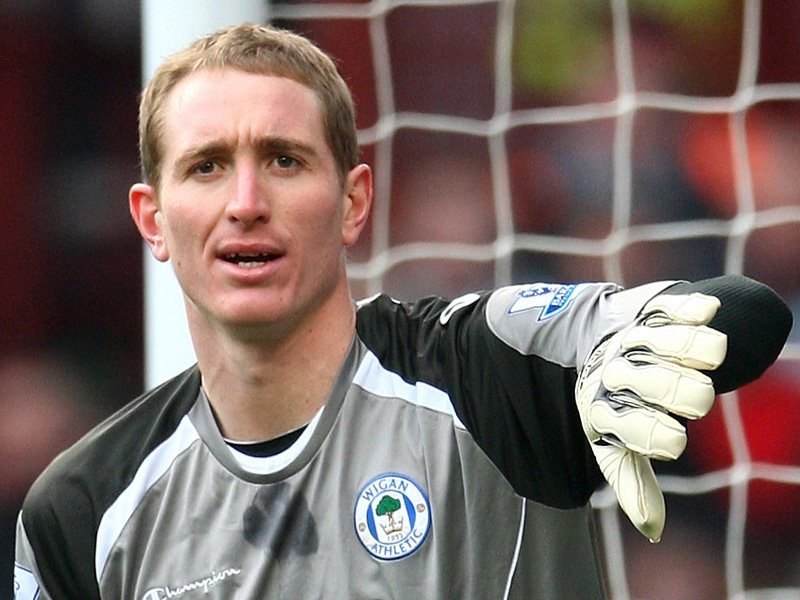
Reports suggest that Chris Kirkland is close to rejoining Wigan Athletic. The 34 year old goalkeeper joined Latics in 2006 and made 122 appearances before signing for Sheffield Wednesday in summer 2012.

Kirkland’s performances during his time at Wigan are well known to Latics fans, but how has he been doing since then?

In order to find out about Kirkland’s performances at Wednesday we reached out to Chris Morris, editor of the Owls-Mad fan site.

Here’s over to Chris:

Due to his injury problems there were a few doubts when Chris Kirkland signed for Wednesday in the summer of 2012 but any fears were found to be misplaced as the former England stopper was the standout performer in the Owls first season back in the Championship.

Last season saw Kirkland lose his place to Keiren Westwood – no disgrace in that given that Westwood was voted into the PFA team of the year last season.

Wednesday have been fortunate to have been blessed with top quality keepers over the past few years and although he may be past his best no-one would begrudge Kirkland the opportunity to be a number 1 again and he still has plenty to offer.

Getting the best out of the wing backs

3-5-2base_original

A bad start to the season is not uncommon for Wigan Athletic.

The beginning of the 2011-12 season was no exception. A  3-1 home loss to Wolves in early November was their eighth consecutive defeat and Roberto Martinez clearly had to look at changing something. The changes he made took some time to take effect, but in the end they were to underpin a remarkable turnaround in the team’s fortunes.

In the next match against Blackburn Rovers he brought in a back line of three central defenders, with Ronnie Stam and David Jones employed as wing backs. Stam had struggled as a conventional right back, but looked much more comfortable as a wing back where he had much more freedom to attack. Defending was not his forte. Jones was a central midfielder pushed into a new role, in which he never looked truly comfortable. Results improved a little, but by Christmas Latics were still locked in the bottom three.

By the time the January transfer window opened the fans were clamouring for new signings to reinvigorate a team that was heading for relegation. Martinez was to sign just one player, paying Birmingham City £2.5m for left winger, Jean Beausejour. It did not seem enough at the time.

However, Martinez knew that Beausejour had played as a wing back for Chile. He immediately replaced Jones in that position and made it his own. Stam’s defensive limitations, even as a right wing back, were to persuade Martinez to bring back Emmerson Boyce. If nothing else, Boyce could provide more stability to a defence that was hemorrhaging goals.

By mid-March and the introduction of Shaun Maloney the team was starting to play much better. The 3-4-3 system was working really well, not least because of the contributions of Boyce and Beausejour at wing back. When Latics were under pressure they would drop back to provide a back line of five, but still be available to link up with the central defenders to build up moves from the back. Their patient and skilful build up play was to prove a key feature in the amazing results the team was to achieve in avoiding relegation.

Boyce and Beausejour tucked in closely with the back three. If one advanced the other would stay put. Boyce was to show a range of skills that surprised so many of us – defensively solid and with a silky touch in attack. Beausejour rarely wasted a ball and his crossing could be reminiscent of David Beckham.

Sadly the era of Boyce and Beausejour is over, but the appointment of Gary Caldwell as manager has brought a return to a system involving wing backs.

On the tour of Scotland we saw the wing backs pushed well forward, much further than was typically the case under Martinez. The Scot has stated his preference for attacking football and deploying the wing backs in relatively advanced positions could be viewed as a consequence of that. But Martinez was facing high quality opposition and was rarely able to let his wing backs off a tight leash. Caldwell faces a different pressure – providing attacking football that delivers the goals that were so sadly lacking last season.

However, there were times in both matches where the wing backs were not dropping back sufficiently to receive the ball from the back three. The result was central defenders either looking for holding midfielders to receive the ball or playing it across their own back line, too often resulting into a back pass to the goalkeeper to punt forward. Moreover the central defenders were sometimes exposed to counterattacks as attacks had broken down with the wing backs stranded.

Yesterday Caldwell started with the youngsters Jonjoe Kenny and Reece James at wing back. Both have the ball skills, pace and energy to be effective wing backs, even if had not been their natural roles with Everton and Manchester United respectively. In the second half Kenny was replaced by the more conservative, but perhaps defensively stronger, Kevin McNaughton.

Thirteen out of the fourteen players who were involved in the action yesterday were new to the club. A certain degree of lack of cohesion was inevitable and so it proved with Coventry’s goals. Moreover Tony Mowbray had employed a Rosler-style high pressing game in the early stages that prevented the slow build up from the back.

Perhaps expectations of a good result at Coventry were unrealistically high. However, the sight of central defenders constantly passing the ball across the back line and to the goalkeeper suggests that they do not have sufficient passing options. In the days of Malky Mackay or Owen Coyle they would have often employed the hoof, so often resulting in the position gaining possession.

It is to Caldwell’s credit that he eschews that option. Despite the comments made on Latics Player/WISH FM, teams have achieved promotion out of League 1 playing the ball out of defence. Caldwell will resist the hoof and insist that good football is played. This is not to say that his defenders will not look to put forward a well measured long pass if a forward has moved into an appropriate receiving position.

Mowbray’s pressing tactics will surely be used by other teams to disrupt Latics’ game of building up from the back. It is to be hoped that Caldwell can develop a Plan B to deal with it.

History tells us that it takes time for players to adjust to playing in system that involves three central defenders and wing backs. Roberto Martinez learned that, but he persevered and it came good in the end. However, Martinez was not dealing with a practically brand new squad of players. His players knew each other’s games, even if the system they were playing under was tweaked.

It is going to take time for Caldwell’s new charges to effectively put his footballing ideas into practice. In the meantime it is to be hoped that he can look at providing more of a link between his central defenders and his wing backs. Perhaps a look at old videos from the “golden era” will show the wing backs what can be done against a calibre of opposition with which League 1 pales in comparison.

Yesterday’s team is the youngest Latics have fielded for some years, with six of the starting lineup being below 25 years of age. Young players make mistakes under the pressure of high expectations, as was learned last year under Uwe Rosler. It is to be hoped that the current crop are given time to settle, despite the expectations of the chairman and a significant number of fans.

With the fans clamouring for attacking football Caldwell is pushing his wing backs forward. The question to be posed is whether they are taking sufficient part in the build-up of moves from the back that will translate to goals up front.

A Cardiff fan’s view of Kevin McNaughton

Soccer - Pre Season Friendly - Cardiff CIty v Celtic - Cardiff City Stadium

It has been announced that  32 year old Kevin McNaughton has signed for Wigan Athletic on a one year contract, following a trial period at the club.

Given the youthful nature of his squad Gary Caldwell will be looking for some more experience and McNaughton can certainly provide it, having played more than 450 games in his career. McNaughton made his debut for Latics in the pre-season match at Southport and subsequently played against Dundee and Blackburn Rovers.

The 5 ft 10 in McNaughton was born in Dundee, but came up through the Aberdeen youth system. He made his debut for the Dons as an 18 year old and was to make 175 appearances over 5 seasons.

McNaughton signed for Cardiff City in summer 2006 and manager Dave Jones used him regularly as a left back in the 2006-07 season. The following season saw him switched to right back and he played in all six matches in Cardiff’s run to the 2008 FA Cup final. His following season was dogged by injury but he reclaimed his place in the 2010-11 season when he was voted Player of the Year.

In September 2013 McNaughton went on loan to Bolton Wanderers, making 13 appearances during a three month stay. He went back to Cardiff in January and played in a handful of Premier League games by the end of the season.  Last season saw McNaughton return to Bolton on loan, where he made 8 appearances. He had made 254 appearances for Cardiff before being released this summer.

In order to learn more about McNaughton’s time at Cardiff we reached out to Benjamin James of the View from the Ninian fan site.

Here’s over to Ben:

What to say about Kevin McNaughton?

A player who most, if not all Cardiff fans, would have gladly kept. A player who came in unheralded and went on to become one of the most revered players of recent times. The very definition of a club legend.

The image of him on the pitch after our promotion to the Premier League is iconic – he, out of all those players in the squad, deserved it more than most. Near misses and play-off disappointments were felt most by him.

It looked as if for all the years he had given us, he was going to miss out on some Premier League action; a loan to Bolton looked to signal the end of his career at Cardiff City. But he returned and I was so happy that he got to play in the Prem for us.

Wigan have signed a player who will build an incredible rapport with the fans. You’ve signed a player who will leave it all on the pitch. You’ve signed a player who will be invaluable to the dressing room – if you want someone to dress up as Dangermouse, he will be the first to do it.

I’ve seen him knock himself out in consecutive games, take out lino’s in his quest to get to the ball and outpace the quickest of players.

I can’t think of a bad word to say about him and I know I’m not alone in this. In an ideal world, Kev would have seen out his career with us. He became a true fan favourite in his nine years with the club and he will be missed.

He’s played all across the back four and even in midfield at points. He’s seen the best of times and some of the worst yet he’s stayed as consistent as ever. I really hope he succeeds at Wigan and Wigan succeed with him – he deserves nothing less.