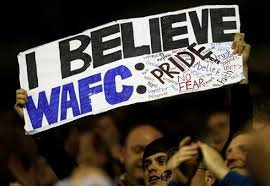
Latics can beat Bolton if…..

Defeat to Wigan Athletic is something that Bolton Wanderers supporters find hard to bear. After all their local rivals are nothing but young upstarts compared with the glorious history of their Trotters.

Wanderers were founder members of the first Football League in 1888, one of the 6 Lancashire clubs that formed that initial division of 12. Since then they have spent more time in the top tier (Premier League/First Division) than out of it, 73 seasons to be precise. Their highest placing in the top tier was 3rd in 1920-21 and 1924-25 seasons. By the time Latics entered the Football League in 1978, Bolton had won the FA Cup four times, being runners-up on three occasions.

Wigan Athletic and Bolton Wanderers had their first-ever encounter in the Football League on Boxing Day in 1983. That was in the old Third Division and Wanderers won 1-0, but Latics went on to win by the same score in the return match at Burnden Park. Things have remained fairly even ever since. Bolton have won 17 and Wigan 16, with 11 draws in league and cup matches between the two clubs.

No matter what situation of either club the result of the derby is always of paramount importance. But a win it is so much more important to Latics than Bolton this time around. The 2-0 home defeat to Watford in midweek was depressing in that it was a repeat of what has happened on too many occasions this season. Wigan seeming to match their opponents, but once a goal has gone against them they have not been able to get back into the game.

However, the 2-0 defeat of Rotherham at Nottingham Forest and a 3-0 home reverse for Fulham against Leeds United means that Latics remain at 6 points behind the two. Moreover the London team’s collapse continued with Leeds scoring with the only genuine chances they had.  Fulham strikers Ross McCormack and Matt Smith, who had a combined total of 42 goals for Leeds last season, just could not find the net. Like Wigan, Fulham were among the bookmakers’ favourites for promotion this season. They are caught in a downward spiral, having won only one of their last thirteen games.

Latics’ miserable home record – their last win was against Birmingham City on August 30 – will surely come to an end soon. The pundits have tried to explain how a team can win four consecutive games on the road, but lose their last six at the DW Stadium. Their approach to matches appears similar, be they home or away, but they have so often been caught by surprise at the DW.

The away victories have been characterized by them getting goals relatively early in the proceedings and hanging on to their lead with grim determination. Most of those goals have come from set pieces, which clearly have not worked at home where they have not scored a goal for four matches.

However, football is rarely as scientific as we sometimes think. The difference between winning and losing games in the Championship can so often depend on a slice of fortune – a deflection or a misplaced pass finding a teammate for whom it was not intended. Latics have enough height to be a danger at set pieces, but too often the delivery at home games has been found wanting.

However, the law of averages tells us that you are more likely to score goals if you have players in the penalty box. Even better if they are in the right place at the right time. Some players have a knack of being in such positions. Some do not. Given Mackay’s choice of strikers over recent months it is sadly no surprise that Latics have not been scoring goals.

Latics can certainly beat Bolton tomorrow if…………….

  1. Mackay plays strikers who have track records of goalscoring.
  2. They are organised, work hard and “win that second ball”, as ex-Latics captain Neil Rimmer says so often in his Wish FM commentaries.
  3. The rub of the green goes their way.

This is the least accomplished group of players the club has had for at least a decade. Most are loanees or on short term contracts. They lack the mutual understanding gained through playing as a collective unit over a long period of time. As a result the whole is less than the sum of its parts.

However, Mackay has largely succeeded in getting levels of commitment that were not apparent earlier in the season. He has stabilized the defence. The central defensive pairing of Harry Maguire and Jason Pearce is rugged and determined, well suited to the division. Mackay will look towards playing with a solid defence and scoring from set pieces.

However, Bolton do not have a particularly good team. They are out of the relegation zone due to the “new manager effect” after Neil Lennon was appointed, something that Latics crucially missed with Mackay. That effect has since faded and their squad is not overburdened with talent. They have lost their last six away games and have difficulty scoring goals. Their leading scorer is Zach Clough with just 6 goals, although Adam Le Fondre has scored 5 in his 10 matches so far.

Wigan Athletic fans have learned to keep their expectations low for results in home games over the past six months. Maybe the time has come for them to see the victory they have been waiting for so long. It would be particularly sweet against a local rival which considers itself a step above.

Believing again with Malky and Sharpy

Photo courtesy of fansonline.net

e Photo courtesy of fansonline.net

Situations can change quickly in the football world.

Three weeks ago I published an article “Can we believe under Mackay?” Latics had lost badly at Nottingham Forest and Malky Mackay’s record at Wigan was W1 D3 L10. Moreover the club seemed to be drifting with its talismanic leader, Dave Whelan, nowhere in sight. It was a club where leadership appeared noticeably absent. “Believing” was not easy.

The weekend later Latics did inspire some momentary confidence with a 1-0 win at Reading. There were two home games coming up, so the more optimistic of supporters raised their hopes that it could be the start of a revival, although the battle-hardened contingent warned us to beware of a false dawn. The darksiders proved to be right as Latics lost to both Charlton and Cardiff. A failure to get three points in the next match at Blackpool would nail the relegation coffin for Latics, psychologically of not mathematically.

The 3-1 win at Bloomfield Road was certainly a tonic, but unsettling rumours were starting to spread about the club being sold to Thai buyers. Still no word from Whelan. Moreover the next match was away at Norwich, who had won their last six games and were challenging for promotion.

Within the space of a few days the future suddenly seems much brighter. DW stepped down as chairman, but made it clear that the Whelan family and Chief Executive Jonathan Jackson would continue to run the club. There would be no sell-off. Fans were debating the idea of Whelan’s 23 year old grandson, David Sharpe, taking over as chairman although the more savvy pointed out that Jackson was the pillar upon which the near future of the club would largely rest.

The 1-0 win at Norwich, gained with just 32% possession, was precisely the kind of performance that many of us expected when Mackay was appointed. A gritty, backs to the wall display, based on strong defence and a moment’s inspiration from the excellent Kim Bo Kyung. Sharpe will surely have enjoyed overseeing a hard fought victory on receiving the reins from his grandfather.

The mood is much more positive among the fans now. The team has won two consecutive games for the first time this season and people are seriously thinking whether they can once more “Believe”. The manager remains unpopular and Sharpe has a hard act to follow as future chairman, but there is at least something to look forward to now.

The pundits tell us that Mackay’s current record of W4 D3 L12 – a winning percentage of 21% – lifts him above the level of being statistically the club’s least successful manager. He has certainly transformed things since his arrival. Not one of Uwe Rosler’s ten signings started the game at Norwich and only four of the eleven have contracts at Wigan beyond summer. At last he has succeeded into motivating the players to wear the Wigan Athletic jersey with pride, willing to give their all on the pitch.

But there is a hard road ahead for both Mackay and Sharpe.

After those consecutive wins the manager has regained some degree of credibility. However, he has incredibly still not won a match at the DW Stadium. He will be anxious to notch up his first against Leeds tomorrow. Can he lift his players to the same levels of energy and passion that they showed at Blackpool and Norwich? It will be a challenge to do so for the third time in a week.

David Sharpe has been active at the club for over a year now. He worked with Mackay on the January clear-out and is likely continue to support the manager at least until the end of the season. Questions remain whether relegation can be avoided and if Mackay is the right manager for Latics in the long term.

However, there suddenly seems much more purpose at the club, following Dave Whelan’s announcements and a couple of good results.

Let’s hope we can “Believe” in the Malky-Sharpy partnership.


Latics in a quagmire

Mud

Rugby League has never really appealed to me. In my pre-adolescent days Wigan RLFC used to have a good deal for kids. You could go and watch the famous Cherry and Whites for threepence in the ‘hen pen’ behind the goals. I did it twice, once when they beat Hull and finally when Ryan Giggs’ father, Danny Wilson, inspired Salford to victory there.

Central Park was just five minutes’ walk from where I lived, right next to the town centre. So when my dad asked me if I would like to make the longer crosstown walk over to Springfield Park on a rainy day I had to think twice about it. But from the moment I watched Latics that first time, as an eleven year old, there was no way I was going back to the hen pen.

I have maintained little interest in watching the local rugby team playing a sport that I have rarely found entertaining. But on Saturday I tuned into the second half of the World Club Challenge game between the Warriors and the Brisbane Broncos. The commentators were waxing lyrically about what a good game it was, but all I could see was the Warriors penned into their own half, unable to move forward on a quagmire of a pitch. It was dull stuff until they surprisingly broke away from their own half and equalized near the end of the game. By that time the pitch was totally ruined, so a little bit more punishment caused by the game going into extra time was not going to make that much difference.

It is the first rugby league game I have watched for ten years and a similar time period could elapse before I watch another. The pitch clearly made things difficult for both teams. It made me wonder if the Warriors would have been able to hold the Broncos to such a tight margin if the pitch had been better. Then my thoughts turned to the Cardiff match. Could it be that the quagmire pitch might actually help Latics?

The term ‘quagmire’ can be used to describe not only the DW Stadium pitch, but also the current plight of Wigan Athletic. They are stuck in a quagmire in their fight to avoid relegation. Most of the more skilful players in the squad have deserted a sinking ship and the manager has the most unenviable record in the Football League of W2 D3 L10. Moreover Malky Mackay’s plans have been hit by long term injuries to Emyr Huws, Chris Herd and Leon Clarke, plus a two week absence for William Kvist who has been the team’s most consistent performer over recent weeks. Having shipped the likes of Delort, Kiernan, Riera and Tavernier off on loan he is left with a squad that is starting to look threadbare.

Mackay and Latics are certainly in a quagmire and there appears no way out of it. The manager has dismantled the old squad, brought in new players, but performances continue to be well below par. Latics have got worse, not better, during Mackay’s tenure. Dave Whelan is back in town and clearly worried about results. If Latics do not beat Cardiff tonight will he be showing Mackay the door?

Cardiff City’s form has also slumped over the past couple of months, so Latics will face another side low on confidence like themselves. It would appear to be a real opportunity to pick up three precious points, but over recent weeks Latics have thrown away games against teams in similar situations. The home defeats to struggling Rotherham and Charlton sides were a bitter pill to swallow. But can they actually win tonight playing on that quagmire of a pitch?

The critics would say that good football has not been evident since Mackay’s arrival, with goals from set pieces the order of the day. The pitch could stifle any attacking moves from the opposition and a goal from a set piece could win it. Mackay will rue the absence of Kvist, with his long throw-ins.

It is likely to be a grim night for lovers of good football tonight at the DW Stadium. But it is the result that is paramount. A win for Latics would provide at least a ray of hope for the future. Less than that will surely bog them down even more in the quagmire that Mackay finds himself in.

Attendances and finances at Wigan Athletic

2012-moneyball

“There was nothing like it. Running down the tunnel and hearing the roar of a 3,000 crowd. Springfield Park was the best place in the world for me.”

Meeting Harry Lyon in the early 1980s was like a dream come true. It had been a chance encounter with the man for whom the title “legend” would be an understatement for me.

My father had continued to live in the south of Wigan, then rugby league territory, so the pubs around us were steeped in that kind of nostalgia. One of those was ‘The Waterwheel’, run by ex-Great Britain rugby player, John Stopford. Although he never played for Wigan RLFC, Stopford would draw rugby enthusiasts to his pub. We mostly avoided such places, preferring to walk further afield to pubs that were more salubrious for Wigan Athletic supporters.

But one rainy night we succumbed, and tried ‘The Waterwheel’. Upon opening the door and the sight of the scrum surrounding the bar we started to think twice about it. There were some burly men there, faces like boxers, some with arms in slings. We were just about to walk out when my father said “Look it’s Harry Lyon over there.” It was indeed my hero from my teenage years. Chatting with Harry was easy. He just made you feel comfortable talking with him. Although he had left the club a decade before it was obvious that Wigan Athletic was his first love. He remains the club’s leading scorer of all time, with 243 goals to his credit.

Harry’s quote was straight from the heart, but the reality was that a 3,000 crowd was not the norm at the time. True, Latics had the best home attendances in the Cheshire League and their traveling support would so often ensure that clubs like Oswestry and Stalybridge would get their best crowds of the season. But for clubs at that level of English football it was a hand to mouth existence, but somehow most clubs survived.

Gate receipts were the main source of revenue, which gave Latics an advantage, given their stronger support. But the reality was that most of the time the attendances were not a lot above the 2,000 mark. The club survived through the efforts of the Supporters Club and the Board of Directors dipping into their pockets.

Financial survival has never been easy for Latics. In their inaugural season in the Football League, 1978-79, they averaged a healthy 6,701. The club’s attendances the season before, their final one in the Northern Premier League, had dropped to an alarming 1,334. The move up clearly had a major impact upon the town.

Since then Latics’ highest average league attendance was 20,160 in their first season in the Premier League. Ironically their second highest was 19,345 in the relegation season of 2012-13. But the gloss was to wear off and Latics slumped to their lowest attendance levels of their Football League era with just 1,748 in 1994-95.

If it had not been for the arrival of Dave Whelan in 1995 where would Wigan Athletic have been now? Attendances had been woefully inadequate and the club was sinking into a seemingly inexorable financial quagmire.

But ten years later Latics were playing in the Premier League against Chelsea and a crowd of 23,575 was present despite the game being broadcast. It was a taste of things to come as the club’s attendances eclipsed those of the local rugby club that season and have done ever since, even last season despite relegation to the Championship.

Football season Rugby season Wigan Athletic Wigan Warriors
2005-2006 2006 20,160 14,464
2006-2007 2007 18,159 16,040
2007-2008 2008 19,045 13,995
2008-2009 2009 18,350 14,080
2009-2010 2010 17,848 15,181
2010-2011 2011 16,976 16,125
2011-2012 2012 18,634 16,043
2012-2013 2013 19,375 13,556
2013-2014 2014 15,176 14,102

Latics’ gate money in the Premier League days was always dwarfed by the TV revenues they were receiving and from a purely financial viewpoint attendances were not much of an issue. In their last season in the Premier League match day revenues covered no more than 10% of total revenue of £56.4m. Without the television revenues, the club could never have seriously competed for eight long seasons in the elite division.

In my article Finances, FFP and the long term future of Wigan Athletic, published in May 2014, I put forward figures needed to stay afloat in the Championship. To keep a team in mid-table would typically involve a wage bill in excess of £20 million. Whereas to get into the top six would cost around £30 million, which is precisely what it cost Latics last season.

With a significant drop in parachute payments to be received this season it looked likely that the club would start to trim its wage bill. The departures of ex-Premier League players Jean Beausejour, Jordi Gomez and James McArthur must have helped. However, manager Uwe Rosler was to bring in nine new players over the summer. Although some were younger players, probably not on relatively high earning contracts, the competition in the transfer market forced the club to offer more tempting salaries to the rest. The result was a squad that was larger than the club needed with a wage bill close to that £30 million of last year.

Dave Whelan clearly had promotion within his sights when he released some £8-9 million in transfer fees for Oriol Riera, Andy Delort, Emyr Huws and Adam Forshaw. Much of the outlay was covered by the fee received from Crystal Palace for James McArthur, but their arrivals put more pressure on the wage bill.

It was a gamble which was to fail, but Whelan is the shrewdest of businessmen and he knows if you don’t take risks you are likely to stand still. Huws was constantly bothered by an ankle injury and never reached top form, despite having moments of showing his true potential. He remains one for the future, despite being sidelined for the rest of the season with another ankle injury. Sadly Delort and Riera have been dispatched to their home countries on loan and Forshaw has been sold cut-price to Middlesbrough.

Whelan had made the gamble, backing a manager who had performed admirably in the previous season. After being criticised by fans for hoarding the cash from the James McCarthy transfer the season before he had stuck his neck out in allowing Rosler to bring in so many players and run the risk of expenses heavily outweighing revenue.

Following the departure of Rosler and the continuing downturn in results under Malky Mackay, the club made huge strides in getting its financial situation back on an even keel during the month of January. Just a few months before no one could have anticipated the fire sale that was to occur. Ten players were to leave, four of whom were members of the team that won the FA Cup Final.

That famous cup final man of the match, Callum McManaman, went to West Bromwich Albion for around £4.5 million. Putting back the clock, what might have happened if he had not injured his ankle in the Arsenal match that followed the Cup Final and put Latics down? Following his Wembley display he could well have gone to a big club for some £15 million, if he had been fit. Sadly it did not happen and the ankle injury had a major impact on his fitness the next season. The rest is history.

Such a fire sale would have brought huge protests from the fans under normal circumstances. But the “hatchet man” Mackay was able to do it with hardly a whimper from supporters who were thoroughly disillusioned with the lack of commitment shown by players whom many viewed as overpaid and overrated.

The fire sale has put Latics back on track financially. Apart from the transfer fees received they have cut the wage bill down significantly, to probably around £20 million on an annual basis. Mackay paid transfer fees for two players – Billy Mackay and Jason Pearce – but the outlay for the two was less than £1 million. The rest of his acquisitions are loanees or players on short term contracts.

For the coming season – no matter what division they are in – Latics will receive £8 million in parachute payments, plus around £2.5 million from TV money. The rest will need to come from gate receipts and commercial revenue.

The latter has not been a major factor over these years, so gate revenue becomes increasingly important.

Should they stay in the Championship, crowds of around 12,000 would most likely be the order of the day. That is providing a squad that will cost considerably less to maintain than those of the past two seasons can hold its own. Relegation would almost certainly mean a decrease in attendances, even if the team were to do well. Revenue from the visiting support would most likely nosedive.

Gate money will clearly play a more major role for Latics next year than it has for more than a decade. Put simply it is going to be a more proportionate part of revenue than it has been.

But then again, for Latics gate money does not correlate with attendance in the same way that it does for most clubs. The club had wisely kept admission prices relatively low during its most successful years and they remain so. It helped them compete for support within the town and build up a level of hard-core support that the club had never previously enjoyed. However, continuing the policy is not necessarily the right ploy for the club. At some time in the future it is going to have to start moving its prices more in line with that of its competitors, at the risk of losing some support.

For the coming season the revenue and spending numbers need to add up. A £20 million wage bill is out of the question. Austerity will be the order of the day, no matter which division the club is in.

However, the good news is that the club has become a model for others to follow in its financial management, which serves to safeguard its long term future. A profit of £2.6 million was announced for the 2013-14 season, following two previous campaigns in the black.

The big question regarding revenue streams is whether Latics will be able to afford to run the Charnock Richard facility, assuming it will be completed. If it dies a death it will be much harder for Latics to put in place an Academy that providesthe first team with players, the best of whom can be sold off to keep the club afloat. Should Latics suffer relegation it could be one of the cut backs.

Much will depend on the ability of Mackay’s current team to avoid relegation. If they can the outlook will be brighter.

Attendances and revenue remain inextricably linked, even if not as strongly as they were during the Harry Lyon era.
Can we “Believe” under Mackay?

Mackay's record makes sad reading: W1 D3 L10.   Photo courtesy of Sky Sports.

Mackay’s record makes sad reading: W1 D3 L10.
Photo courtesy of Sky Sports.

“Certainly off the back of tonight’s performance, there is going to be a couple of changes. It’s back to the training ground, we’ve got another few players into the club over the last couple of weeks so they’ll certainly be players getting their chances.”

So said Malky Mackay after arguably the worst performance of a depressing season, a 3-0 loss at Nottingham Forest.

Mackay had chosen a team with one change from that which lost against Bournemouth. Chris Herd came in for the injured Chris McCann. Billy McKay remained on the bench.

Mackay clearly had a plan to smother Forest’s fire by playing ugly. With Leon Clarke playing a lone centre forward role there was clearly going to be little goal threat from Latics unless the midfield trio of Cowie, Kvist and Herd got up to support him. With all three being defence-minded players that was unlikely to happen. Somehow Latics scrapped it out for 33 minutes until Britt Assombalomba opened the scoring, heralding a disintegration of order within the Wigan side. The only surprise is that Forest scored only two more.

One win in the last 16 league matches is the most dire of statistics. Moreover there is little likelihood of it changing soon as Mackay is likely to  bring in more players who have never played together before, some of whom will be lacking match fitness as has been the case with Herd and Kim Bo Kyung in the past couple of games.

The loss of Emyr Huws for the rest of the season is a hammer blow for Mackay. Moreover the absence of Chris McCann last night left him desperately short of midfield cover.

Looking at the Wigan lineup before the game gave one a sense of foreboding. There just was not the talent in the starting eleven that we have become accustomed to over these years. The family silver was sold off and the side is now desperately short on quality.

Mackay has signed in only two new players on permanent contracts, Billy McKay and Jason Pearce. Clarke – who has played for 14 clubs – and Herd are players whose contracts expire at the end of the season, coming to Wigan on loan, unlikely to be offered extensions by their parent clubs at the end of the season. Kim’s contract at Cardiff was cancelled, as was Gaetan Bong’s at Olympiakos. They are on short term deals until the end of the season. Harry Maguire and Sheyi Ojo are young players coming from Premier League clubs, the former having minimal experience of Championship football, tghe latter none.

Ironically the two players who have been signed on permanent terms have been low on the totem pole.

Pearce is yet to appear, despite the poor form showed by Leon Barnett, who now looks a mere shadow of the player he was a year ago. Mackay once again persisted in a back four of Perch, Barnett, Ridgewell and Taylor. One would have expected that that quartet would have built up some mutual understanding following several games as a unit, but the way Forest were able to slice them open suggests that was not the case.

Mackay will be forced to change his back four in the next game at Reading, with Liam Ridgewell returning to Portland. Andrew Taylor is another whose form has been below par and he might well be replaced by Gaetan Bong. The most likely formation at Reading will be Perch, Pearce, Maguire and Bong. Not an ideal situation at this time of the season to have a new team of back four players.

McKay sadly seems to be following in the footsteps of Andy Delort, having come on last night after 88 minutes, although he did play the full second half against Bournemouth. Despite scoring 10 goals in 23 Scottish Premier League games his manager does not deem him necessary in the starting lineup. Let’s hope he will be better treated at the club than the Frenchman, who is now back at Tours, the rumours being that Latics continue to pay his wages.

Both Kim and Herd arrived at the club short of match fitness. Kim played the first 45 minutes on Saturday and only 9 minutes more last night. Herd’s stats are 59 minutes and 63 minutes respectively. Putting in unfit players when the team is struggling is hardly ideal.

However, with an absence of technically skilled players in the squad Mackay probably felt Kim was worth the risk. Ojo showed his skills on Saturday, but is unproven at this level. Can he put those skills into effect over a whole game? Mackay was forced to play Herd at right back against Bournemouth in the absence of Perch. Last night he was pushed in to shore up the midfield.

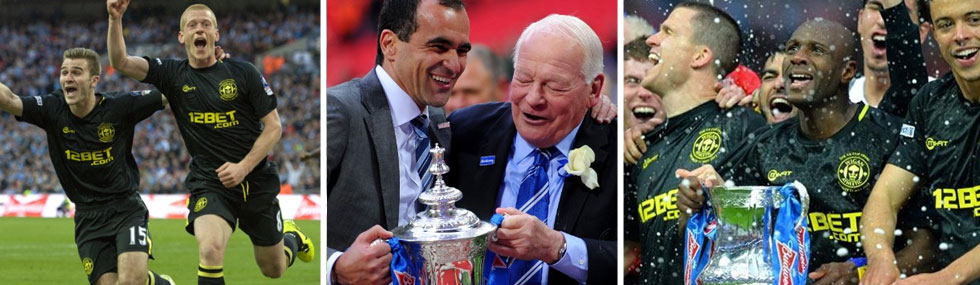
In the days of Roberto Martinez the “Believe” motto became the standard that raised the team into achieving against the odds. The manager himself had clear belief in his players and they responded on the pitch.

Under Mackay “believing” is much harder for us fans. His record up to this point as Latics manager is unbelievably bad. Will Dave Whelan pull the plug and bring in someone else to try to salvage the season, or is he already resigned to the club being in League 1 next year?

The likelihood is that Mackay will stay at least until the end of the season. He has come in as a hatchet man, chopping away at the squad, but he has not been allowed to bring in hordes of new players on long term contracts.

If Mackay stays next season, albeit in League 1, what can we expect?

The Scot is clearly a better manager than his results at Wigan suggest. His record at both Watford and Cardiff stands close scrutiny in terms of team performances. However, his teams have not been known for their entertainment value. Attendances will plummet, but the club will be cushioned by a continuing parachute payment of some £9 million. The pragmatists would continue to support him providing he got the results good enough to bring the club back upmto the Championship. If the results did not come then his situation woukd become untenable.

it is a bleak near future that lies ahead for Wigan Athletic. Will we ever get back to the point where we can “believe” again?